

How Long Does Prior Authorization Take? Timelines, Delays, and How to Speed Approvals
The Qualigenix Editorial Team consists of certified billing and coding experts with over 40 years of experience across 38+ medical specialties. Our content is rigorously researched against CMS, AMA, and payer-specific guidelines to ensure total compliance and accuracy. We apply the same elite standards to our resources as we do our client work, consistently delivering high claim accuracy and significant reductions in AR days.

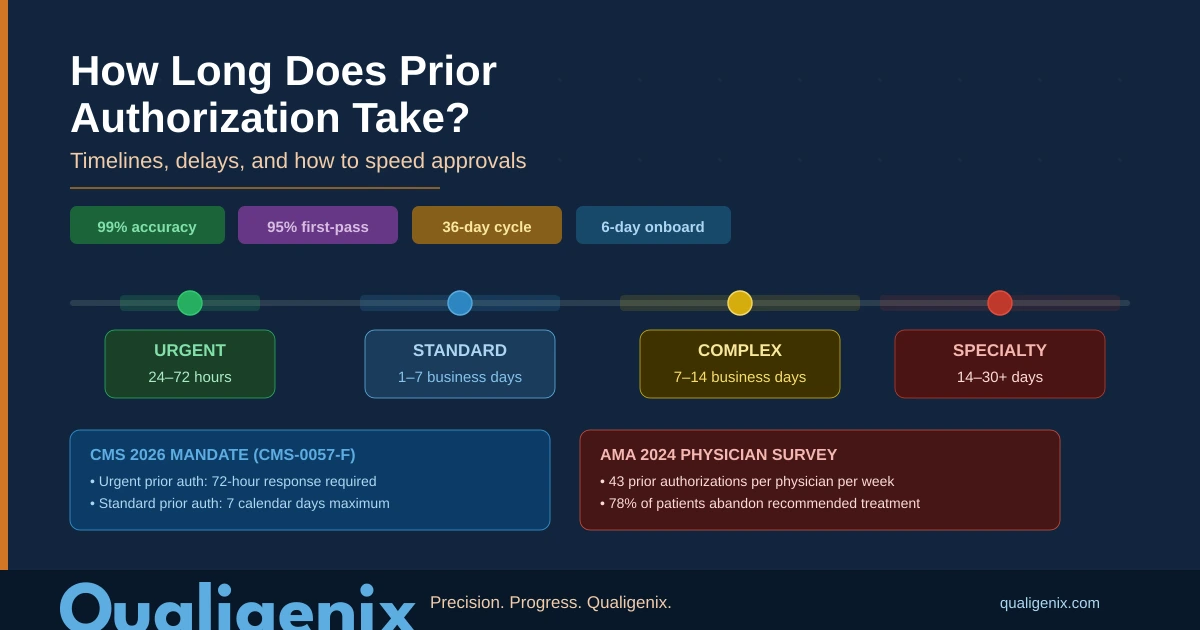
Standard prior authorization requests take 1–7 business days, urgent requests 24–72 hours, and complex specialty cases can stretch to 30+ days. Starting January 2026, CMS now requires Medicare Advantage, Medicaid, and ACA marketplace plans to respond within 72 hours for urgent requests and 7 calendar days for standard requests. The top causes of delays are incomplete clinical documentation, incorrect eligibility data, and fax-based submissions. Qualigenix’s prior authorization services manage the full PA lifecycle—from pre-submission eligibility checks to denial appeals—helping practices cut approval times, protect revenue, and keep patients on track.
Every physician and billing manager has asked the same question: how long does prior authorization take? The honest answer depends on the payer, the service type, and how clean your submission is. But across the industry, the pattern is consistent: prior authorization is eating time, burning staff hours, and delaying patient care at a scale that’s hard to overstate.
According to the AMA’s 2024 Prior Authorization Physician Survey, physicians complete an average of 43 prior authorizations per week, consuming roughly 12 hours of physician and staff time. Nearly 78% of physicians report that patients abandon recommended treatment because of prior auth delays. That’s not just an administrative headache—it’s a direct revenue and patient care quality problem that compounds every week it goes unaddressed.
This guide gives you the real numbers: prior authorization processing times by payer, by service type, and by urgency level. We cover the CMS 2026 rule changes that now enforce faster turnaround for federally regulated plans, the most common reasons prior auth requests get stuck, and exactly how to speed up the process. We also explain how Qualigenix’s prior authorization services help practices cut approval times, reduce denials, and keep patients on track.
How Long Does Prior Authorization Take?
Prior authorization typically takes 1–3 business days for standard medication requests, 3–7 business days for medical services, and 24–72 hours for urgent or expedited requests. Complex procedures and specialty drugs may take 7–30+ days. As of January 2026, CMS requires federally regulated payers to respond within 72 hours (urgent) or 7 calendar days (standard) under the Interoperability & Prior Authorization final rule (CMS-0057-F).
These timeframes assume a complete, accurately documented submission. In practice, missing clinical documentation, incorrect coding, or payer-specific form requirements can extend the timeline significantly. The difference between a 2-day approval and a 3-week delay often comes down to how well the request was prepared before it reached the payer.
Prior Authorization: Key Stats at a Glance
| Metric | Value / Source |
|---|---|
| Average prior auths completed per physician per week | 43 (AMA 2024 Survey) |
| Weekly staff hours consumed by prior auth per physician | 12 hours (AMA 2024 Survey) |
| Physicians reporting patients abandoned care due to PA | 78% (AMA 2024 Survey) |
| Physicians reporting PA caused serious adverse events | 29% (AMA 2024 Survey) |
| Physicians reporting PA increases burnout | 95% (AMA 2024 Survey) |
| CMS 2026 mandate: urgent PA response deadline | 72 hours (CMS-0057-F) |
| CMS 2026 mandate: standard PA response deadline | 7 calendar days (CMS-0057-F) |
| Projected 10-year savings from CMS PA rule | $15 billion (CMS estimate) |
| Commercial insurers pledging PA reform (June 2025) | 53+ (AHIP) |
| Electronic PA auto-determination rate within 2 hours | 62% (industry data) |
| Medicare Advantage PA appeal success rate | 83% (industry data) |
| Qualigenix claim accuracy rate | 99% |
| Qualigenix first-pass acceptance rate | 95% |
| Qualigenix average collection cycle | 36 days |
| Qualigenix average onboarding time | 6 days |
What Are the Prior Authorization Timelines by Request Type?
Prior authorization processing time varies significantly based on what’s being requested. Here’s how timelines break down across the major service and medication categories:
| Request Type | Standard Timeline | Urgent / Expedited | Complex / Specialty |
|---|---|---|---|
| Prescription medications | 24–72 hours | 24 hours or less | 7–14 business days |
| Medical services / procedures | 3–7 business days | 24–72 hours | 7–30+ days |
| Imaging (MRI, CT, PET) | 3–5 business days | 24–72 hours | 5–10 days |
| Surgical procedures | 5–14 business days | 48–72 hours | 14–30+ days |
| Specialty / biologic drugs | 7–14 business days | 48–72 hours | 14–30+ days |
| Durable Medical Equipment (DME) | 5–10 business days | 48–72 hours | 10–21 days |
| Behavioral health services | 3–7 business days | 24–72 hours | 7–14 days |
| Infusion therapy | 5–10 business days | 48–72 hours | 10–30 days |
Note: These are industry averages based on complete submissions. Missing documentation, step therapy requirements, or peer-to-peer review requests can add 5–15+ additional business days to any category.
How Long Does Prior Authorization Take by Payer?
Each major payer operates on its own internal workflow and turnaround commitments. While the CMS 2026 rule standardizes timelines for federally regulated plans, commercial payers still set their own processing windows. Here’s what practices are seeing in 2026:
| Payer | Standard Timeline | Urgent Timeline | 2025–2026 Reform Actions |
|---|---|---|---|
| UnitedHealthcare | 3–5 business days | 24–72 hours | Dropped PA for 231 procedures (Dec 2025) |
| Aetna (CVS Health) | 3–5 business days | 24–72 hours | Bundling PA requests; automating 25% of approvals |
| Cigna | 3–5 business days | 24–72 hours | Eliminated PA for ~100 services |
| Humana | 1–5 business days | 24–72 hours | 95% of e-requests decided within 1 day (2026 target) |
| BCBS (varies by plan) | 3–7 business days | 24–72 hours | Streamlining processes; reducing scope |
| Medicare Advantage (all) | 7 calendar days max | 72 hours max | CMS-0057-F mandate effective Jan 2026 |
| Medicaid managed care | 7 calendar days max | 72 hours max | CMS-0057-F mandate effective Jan 2026 |
| ACA marketplace plans | 7 calendar days max | 72 hours max | CMS-0057-F mandate effective Jan 2026 |
Even with these timelines, the AMA’s survey found that only 16% of physicians working with UnitedHealthcare and 16% working with Cigna reported that recent reform announcements actually reduced prior auth volume in practice (AMA 2024 Survey). The gap between payer promises and front-line reality remains wide.
Does the CMS 2026 Rule Apply to All Insurance Plans?
No. The CMS Interoperability & Prior Authorization final rule (CMS-0057-F) applies only to federally regulated plans: Medicare Advantage, Medicaid managed care, CHIP, Medicaid fee-for-service, and qualified health plans on the federal exchange. Commercial employer-sponsored plans are not covered by this rule.
That said, over 53 commercial payers voluntarily pledged in June 2025 to reduce prior authorization requirements and improve turnaround times. Compliance tracking by AHIP is expected to produce its first public report in spring 2026. For practices with a mixed payer portfolio, the key takeaway is that CMS-regulated plans now have enforceable deadlines, while commercial plans operate on voluntary commitments with no federal enforcement mechanism.
What Is the Difference Between Standard and Urgent Prior Authorization?
| Factor | Standard Prior Authorization | Urgent / Expedited Prior Authorization |
|---|---|---|
| Processing time (CMS 2026 rule) | 7 calendar days | 72 hours |
| Processing time (commercial avg.) | 3–7 business days | 24–72 hours |
| When it applies | Non-emergency, scheduled services | Patient’s health could worsen without immediate treatment |
| Who can request it | Provider or staff | Provider must indicate clinical urgency in documentation |
| Extension allowed | Up to 14 calendar days (CMS) | No extensions—decision required within 72 hours |
| Common examples | Elective imaging, non-urgent Rx, scheduled procedures | Cancer treatment, acute pain medication, post-surgical care |
| Appeal timeline if denied | 15–30 days (varies by payer) | 72 hours for expedited appeal |
The distinction matters because requesting an urgent review when it’s clinically warranted can cut your wait time from a week to under 72 hours. The request must include clear documentation that the patient’s condition meets the payer’s urgency criteria—otherwise it gets routed to the standard queue, costing days you can’t recover.
Why Do Prior Authorization Requests Get Delayed?
Understanding what causes prior authorization delays is the first step toward eliminating them. Based on industry data and the patterns our team at Qualigenix sees across 38+ specialties, here are the top causes:
1. Incomplete or Missing Clinical Documentation
Incomplete documentation is the #1 cause of prior auth delays. When clinical notes, lab results, imaging reports, or letters of medical necessity are missing from the submission, the payer sends the request back for additional information. Each round-trip adds 3–7 business days.
Experian Health’s 2025 data found that missing or inaccurate claim data now accounts for 50% of all denials. This is entirely preventable with a structured pre-submission documentation checklist and payer-specific submission templates.
2. Incorrect Insurance or Eligibility Information
Submitting a prior auth to the wrong payer or with outdated eligibility data causes immediate rejection. This often happens when patients change plans mid-year, have multiple coverages, or when front-desk staff skip real-time eligibility verification.
Qualigenix’s eligibility verification services catch these issues before the PA request is even submitted, preventing the rejection cycle from starting.
3. Step Therapy and Formulary Requirements
Payers frequently require patients to try lower-cost alternatives before approving the requested medication or procedure. If the prior auth request doesn’t document that step therapy has been attempted and failed, the payer will deny the request and require documentation of the failed trial—adding 7–14+ days.
4. Peer-to-Peer Review Requests
When a payer questions medical necessity, they may require a peer-to-peer review between the treating physician and the payer’s medical director. Scheduling this call can take 3–7 business days, and the review itself adds another 1–3 days. Nearly 65% of physicians report participating in peer-to-peer reviews at least sometimes (AMA 2024 Survey).
5. Manual and Fax-Based Submission Processes
Practices still using fax-based prior authorization face significantly longer processing times than those using electronic PA (ePA). Electronic submissions integrated with payer portals can receive determinations within 2 hours for routine requests, while fax-based submissions average 5–7+ business days for the same service.
Only 23% of physicians report that their EHR currently offers ePA for medications (AMA 2024 Survey). That adoption gap represents one of the largest speed opportunities available to practices right now.
6. Payer Backlog and Internal Processing Delays
High request volumes, staffing shortages, and internal review bottlenecks at payer organizations contribute to delays entirely outside the provider’s control. This is especially common during Q1 plan year resets and during payer system migrations.
Tracking request status through payer portals and escalating stalled requests through provider relations are the best mitigation strategies when the delay is on the payer’s side.
What Happens If a Payer Doesn’t Respond Within the Required Timeline?
Under the CMS 2026 rule, if a federally regulated payer fails to respond within the mandated timeframe (72 hours urgent / 7 days standard), the request is not auto-approved. Payers must report their response metrics publicly, and CMS can use compliance audits and enforcement actions to address systematic delays. For commercial plans, there is no federal enforcement mechanism—response timeliness depends on contractual terms and applicable state regulations.
Some states have enacted their own prior auth reform laws—Texas’s gold card law, for example—that impose stricter requirements on commercial payers. Practices should track turnaround times by payer and escalate pattern violations through provider relations channels.
How Can Providers Speed Up the Prior Authorization Process?
Reducing prior authorization processing time requires a combination of workflow optimization, technology adoption, and proactive payer engagement. Here are the six strategies that deliver the biggest impact:
Strategy 1: Verify Eligibility and PA Requirements Before Every Service
Real-time eligibility verification: Confirm the patient’s active coverage, check whether the requested service requires prior auth under that specific plan, and verify formulary or step therapy requirements before initiating the request. Qualigenix’s insurance eligibility verification services automate this process, catching coverage gaps and PA triggers before they become delays.
Strategy 2: Submit Complete Documentation on the First Attempt
First-pass completeness: Attach all required clinical documentation, letters of medical necessity, relevant lab and imaging results, and prior treatment history with the initial submission. Each resubmission adds 3–7 days. Qualigenix uses standardized PA submission templates by payer and service type to ensure nothing is missing from the first attempt.
Strategy 3: Use Electronic Prior Authorization (ePA) Wherever Available
Electronic submission speed: ePA systems integrated with EHR platforms can auto-populate clinical data and submit directly to payer portals. Industry data shows 62% of ePA requests receive a determination within 2 hours, compared to 5–7+ days for fax-based submissions. CMS will require FHIR-based PARDD APIs for all regulated plans by January 1, 2027—making ePA adoption a near-term operational priority for every practice.
Strategy 4: Track and Escalate Stalled Requests Proactively
Proactive follow-up: Don’t wait for the payer to respond. Track every open PA request in your billing system or RCM platform, set follow-up alerts at 48-hour intervals, and escalate requests that exceed expected timelines through payer provider relations. Qualigenix’s AR follow-up services include PA status tracking as part of standard claim lifecycle management.
Strategy 5: Prepare for Peer-to-Peer Reviews in Advance
Clinical preparation: When a peer-to-peer review is requested, have the treating physician prepare a concise clinical summary with the specific medical necessity rationale mapped to the payer’s coverage policy criteria. Time spent preparing translates directly into higher approval rates—83% of Medicare Advantage PA appeals are ultimately successful (industry data).
Strategy 6: Appeal Every Clinically Warranted Denial
Systematic appeals: Don’t accept denials passively. Qualigenix’s denial management services flag every PA denial for clinical review and initiate appeals within payer deadlines. Standard appeal timelines range from 15–30 days; urgent appeals must be resolved within 72 hours. Our how to appeal an insurance claim denial guide walks through the full step-by-step process.
What Changed Under the CMS 2026 Prior Authorization Rule?
The CMS Interoperability and Improving Prior Authorization Processes final rule (CMS-0057-F), finalized in January 2024, took effect on January 1, 2026. It represents the most significant federal prior authorization reform in years. Here’s what it mandates:
- Faster response times: Federally regulated payers must respond to urgent PA requests within 72 hours and standard requests within 7 calendar days. CMS noted this represents a 50% improvement for some payers (CMS final rule summary).
- Specific denial reasons required: Payers must now provide a specific reason for every PA denial. This helps providers submit targeted appeals and reduces unnecessary back-and-forth.
- Public reporting of PA metrics: Payers must publish prior authorization data on their websites, including which services require PA, approval and denial rates, and appeal overturn rates. This transparency creates accountability.
- Prior Authorization API by 2027: Payers must implement a FHIR-based PARDD API by January 1, 2027, enabling real-time electronic PA requests and responses across regulated plans.
- Payer-to-payer data exchange: When patients switch plans, payers must exchange PA and clinical data to support continuity of care—eliminating the need to restart the PA process from scratch.
For providers, the immediate impact is shorter wait times on Medicare Advantage, Medicaid, and exchange plan PAs. The longer-term impact—once FHIR APIs go live in 2027—is the potential for near-instant electronic PA processing across all regulated plans.
Are Commercial Insurance Plans Required to Follow the CMS 2026 PA Rule?
No. The CMS 2026 prior authorization rule applies only to Medicare Advantage, Medicaid, CHIP, and ACA exchange plans. Commercial employer-sponsored plans are not subject to these mandates. However, 53+ commercial insurers voluntarily pledged in June 2025 to reduce PA requirements and improve response times (AHIP commitment).
AHIP’s public compliance report, expected in spring 2026, will be the first meaningful data point on whether commercial payer pledges are translating into front-line improvements. For now, practices with significant commercial payer volume should continue managing to longer timelines and rely on proactive tracking to prevent delays from compounding.
How Does Qualigenix Reduce Prior Authorization Delays?
Prior authorization is one of the most time-consuming and error-prone steps in the revenue cycle. That’s why practices across 38+ specialties partner with Qualigenix to handle prior auth from start to finish—so clinical staff can focus on patient care instead of payer paperwork.
Here’s what our prior authorization solutions deliver:
- Pre-submission eligibility and PA requirement checks: Our team verifies coverage, confirms PA requirements by payer and CPT code, and identifies step therapy or formulary triggers before the request is submitted. This prevents the #1 cause of delays—incomplete or misdirected submissions.
- First-pass complete documentation: We use payer-specific PA submission templates to ensure every required document is attached on the first attempt. Our 99% claim accuracy rate reflects the same documentation rigor we apply to every PA request.
- Real-time tracking and escalation: Every PA request is tracked in our RCM system with automated follow-up alerts. Stalled requests are escalated within 48 hours. Our clients experience a 95% first-pass acceptance rate because issues are caught before they become denials.
- Denial appeals and peer-to-peer support: When a PA is denied, our team initiates appeals within payer deadlines, prepares clinical documentation for peer-to-peer reviews, and tracks every appeal through to resolution.
- 30% reduction in AR days: Faster PA approvals mean faster claim submissions, which means faster payments. Our average collection cycle of 36 days reflects the downstream impact of getting prior auth right the first time.
Prior Authorization Checklist for Providers
Use this checklist to audit and accelerate your current prior authorization workflow. Review it before every submission:
- ☐ Eligibility verified: Patient coverage confirmed with real-time eligibility check before PA initiation
- ☐ PA requirement confirmed: Service or medication verified against payer’s current prior authorization list and formulary
- ☐ Step therapy documented: Prior treatments attempted and documented if payer requires step therapy protocol
- ☐ Clinical documentation complete: Notes, labs, imaging, and letter of medical necessity attached with initial submission
- ☐ Correct payer portal used: Request submitted through the payer’s preferred channel (ePA, portal, or approved clearinghouse)
- ☐ Urgency correctly indicated: Urgent / expedited flag applied with clinical justification when patient condition warrants
- ☐ Tracking system active: PA request logged in billing system with automated follow-up alerts at 48-hour intervals
- ☐ Escalation protocol in place: Stalled requests escalated through payer provider relations within 5 business days
- ☐ Denial appeal filed promptly: Every clinically warranted denial appealed within payer’s appeal window
- ☐ Peer-to-peer prep completed: Physician briefed with clinical summary and payer policy criteria before scheduled review
Frequently Asked Questions About Prior Authorization Timelines
How long does prior authorization take for medication?
Standard medication prior authorization requests typically take 24–72 hours when submitted electronically with complete documentation. Complex or specialty medications may take 7–14 business days. Urgent medication requests can be processed within 24 hours if the provider documents that a delay could harm the patient’s health.
Formulary status and step therapy requirements affect timelines significantly. If the payer requires documentation of failed alternatives, expect an additional 5–10 days unless the clinical justification is pre-documented in the initial submission.
How long does prior authorization take for surgery?
Surgical prior authorization typically takes 5–14 business days for standard requests. Urgent surgical cases may be processed within 48–72 hours. Complex or high-cost procedures like joint replacements or bariatric surgery can extend to 14–30+ days, especially if peer-to-peer review is required.
How long does prior authorization take for an MRI?
MRI prior authorization generally takes 3–5 business days for standard requests. Urgent MRI requests may be approved within 24–72 hours. Delays typically occur when the clinical documentation doesn’t clearly demonstrate medical necessity or when the payer requires a lower-cost imaging alternative first.
What is the CMS 2026 prior authorization response deadline?
As of January 1, 2026, the CMS Interoperability & Prior Authorization final rule (CMS-0057-F) requires federally regulated payers to respond within 72 hours for urgent requests and 7 calendar days for standard requests. This applies to Medicare Advantage, Medicaid, CHIP, and ACA exchange plans. Commercial employer-sponsored plans are not covered by this mandate.
Can a prior authorization be expedited?
Yes. Providers can request an urgent or expedited review when the standard timeline could seriously harm the patient’s health. Urgent requests must include clinical documentation supporting the urgency. Most payers aim to respond within 24–72 hours for expedited requests, and the CMS 2026 rule mandates 72 hours for regulated plans.
What should I do if a prior authorization is denied?
File an appeal within the payer’s specified appeal window—typically 15–30 days for standard appeals and 72 hours for urgent appeals. Include additional clinical documentation, a letter of medical necessity, and request a peer-to-peer review if the denial was based on medical necessity. Industry data shows 83% of Medicare Advantage PA appeals are ultimately successful.
Qualigenix’s denial management services handle the entire appeals process—from documentation preparation to peer-to-peer coordination to resolution tracking.
How does electronic prior authorization (ePA) speed up approvals?
Electronic prior authorization integrates with EHR systems to auto-populate clinical data and submit requests directly to payer portals. Industry data shows 62% of ePA requests receive a determination within 2 hours, compared to 5–7+ business days for fax-based submissions. CMS will require FHIR-based PA APIs for regulated plans by January 2027.
Does prior authorization apply to emergency care?
No. Prior authorization is generally not required for emergency medical services. Payers are prohibited from requiring PA for emergency care under federal and most state regulations. However, follow-up services after the initial emergency may require prior authorization depending on the payer and service type.
Related Qualigenix Resources
Service Pages:
- Prior Authorization Services
- Insurance Eligibility Verification Services
- Denial Management Services
- AR Follow-Up Services
- Claim Submission Services
- Medical Credentialing Services
Blog Guides:
- Prior Authorization in Healthcare: How to Reduce Delays
- How to Appeal an Insurance Claim Denial Step by Step
- Patient Eligibility Verification: Workflow, Tools & ROI for 2026
- The Importance of Eligibility Checks and Benefit Verification in RCM
- How to Reduce Medical Claim Denials: Your 2025 Guide
- Healthcare Billing Process Explained: End-to-End Workflow
- What Is Revenue Cycle Management? A Beginner’s Guide
- Denial Management in Medical Billing: 7 Common Causes
Stop Losing Revenue to Prior Authorization Delays — Book a Free Consultation
Prior authorization delays drain staff time, frustrate patients, and stall your revenue cycle. Whether your team is spending 12+ hours a week on PA paperwork, losing patients to care abandonment, or watching denials pile up, Qualigenix has the expertise and infrastructure to fix it.
Our team delivers 99% claim accuracy, a 95% first-pass acceptance rate, and an average 36-day collection cycle. We onboard in as few as 6 days, starting with a comprehensive AR assessment that identifies where prior authorization bottlenecks are costing your practice.
Precision. Progress. Qualigenix.
What’s Next
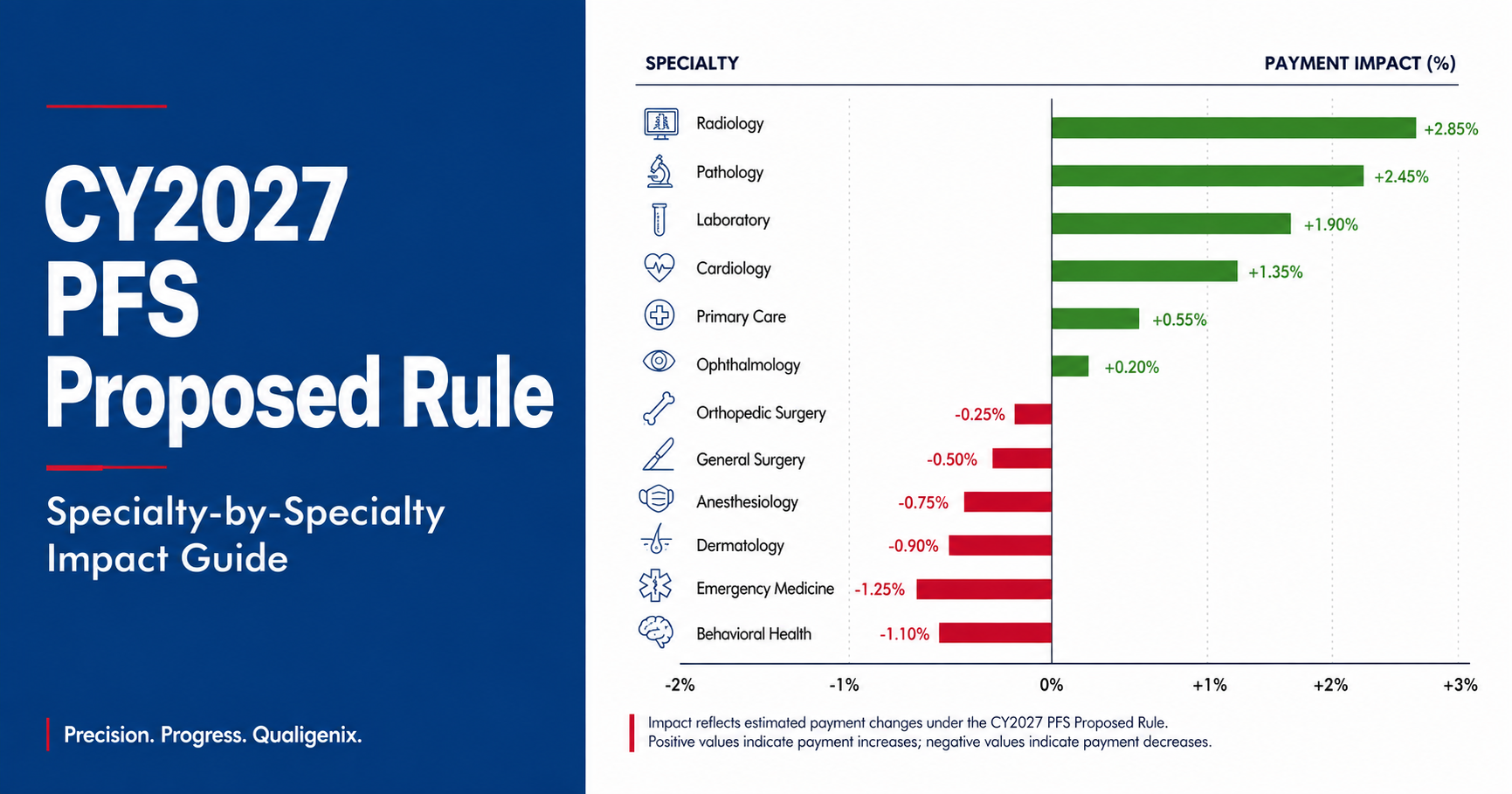
CY2027 Medicare PFS Proposed Rule: Specialty-by-Specialty Impact Guide
The CY2027 PFS proposed rule cuts the conversion factor to $32.84 for non-APM clinicians, but the real story...

Real-time eligibility returned active and the claim still denied: the five reasons why
An “active” eligibility result only proves the policy is in force. It never proves the service is covered, that...
Prior authorization turnaround requirements under the CMS interoperability rule: what changed for practices
The CMS interoperability rule (CMS-0057-F) forces impacted payers to decide standard prior authorizations in 7 calendar days and...