
Top 10 Clearinghouses in Medical Billing 2026
The Qualigenix Editorial Team consists of certified billing and coding experts with over 40 years of experience across 38+ medical specialties. Our content is rigorously researched against CMS, AMA, and payer-specific guidelines to ensure total compliance and accuracy. We apply the same elite standards to our resources as we do our client work, consistently delivering high claim accuracy and significant reductions in AR days.

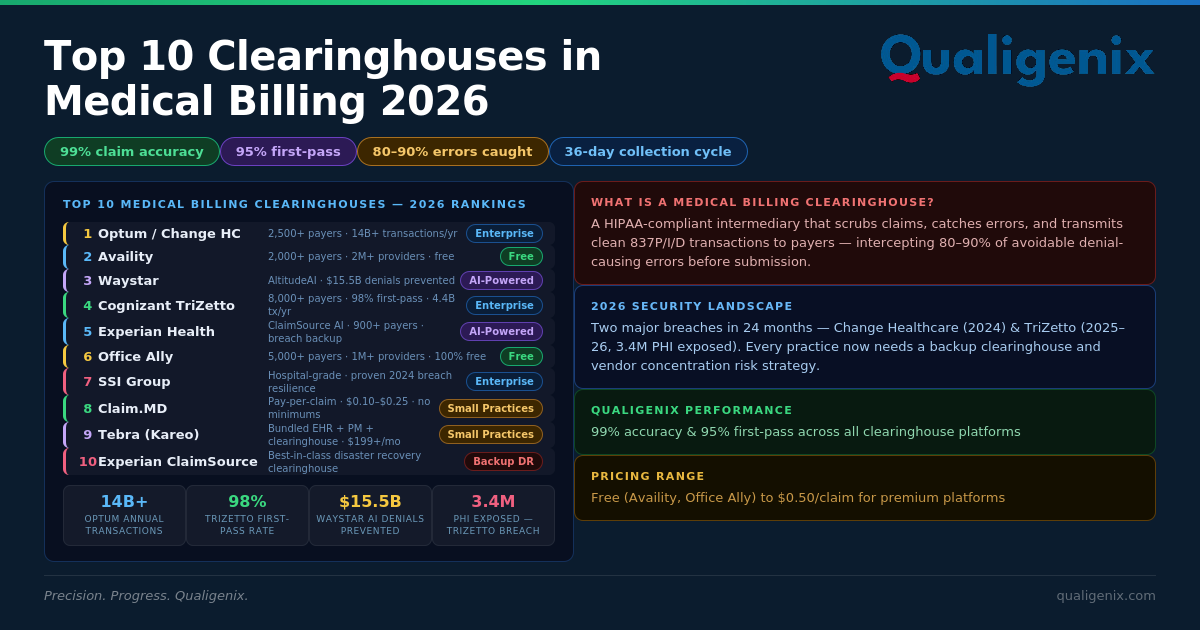
A medical billing clearinghouse is the HIPAA-compliant intermediary between your practice and insurance payers — scrubbing claims, catching errors, and transmitting clean claims for reimbursement. The right clearinghouse directly determines your clean claim rate. In 2026, Optum and Waystar lead for enterprise, Availity is the best free multi-payer network, and Office Ally remains the top free option for small practices. After two major security incidents in 24 months, every practice needs a backup clearinghouse. This guide compares all 10.
Your clearinghouse isn’t a commodity decision. It’s the gatekeeper between every claim your practice submits and the reimbursement your practice receives. Get it wrong — outdated payer connections, no AI scrubbing, a vendor that goes dark in a cyberattack — and your revenue cycle slows to a crawl.
In 2026, the market looks different than it did 18 months ago. Two major clearinghouse breaches in back-to-back years (Change Healthcare in 2024, TriZetto in 2025–2026) changed how every practice thinks about vendor concentration risk. AltitudeAI is now standard at Waystar, preventing over $15.5 billion in denials. CMS-0057-F is accelerating real-time API adoption across the industry. And claim scrubbing tools now catch 80–90% of avoidable errors before a claim ever reaches a payer.
This guide ranks the top 10 clearinghouses in medical billing for 2026 — with current pricing, payer connection counts, EHR compatibility, standout features, and an honest look at the 2026 security landscape. We also cover how Qualigenix’s claim submission services integrate clearinghouse management into a fully optimized revenue cycle that achieves a 99% claim accuracy rate and 95% first-pass acceptance rate.
What Is a Medical Billing Clearinghouse?
A medical billing clearinghouse is a HIPAA-compliant intermediary that receives electronic claims from a provider’s practice management system, validates them against payer-specific rules through claim scrubbing, reformats them to meet each payer’s specifications, and transmits clean claims for reimbursement. Clearinghouses catch coding errors, missing data, invalid modifiers, and formatting problems before submission — typically intercepting 80–90% of avoidable denial-causing errors.
Think of a clearinghouse as your claim’s quality control department. Before your claim reaches Aetna, BCBS, or Cigna, the clearinghouse runs it through hundreds of payer-specific edits. Wrong procedure code for patient age? Caught. Missing referring provider NPI? Caught. Modifier incompatible with the billed code? Caught. Each one of those errors, if it reached the payer, would generate a denial — adding weeks to your AR cycle and hours of rework for your billing team.
Every healthcare provider billing insurance electronically is required to submit HIPAA-compliant electronic transactions (EDI standards 837P for professional, 837I for institutional, 837D for dental). Clearinghouses serve as the conduit for these transactions, translating your system’s output into the exact format each payer requires. Without a clearinghouse, you’d need a separate direct connection to every payer — technically possible, operationally impractical for any practice with more than one or two payers.
Top Clearinghouse Benchmarks and Statistics 2026
| Metric | Value / Benchmark |
|---|---|
| Total annual US clearinghouse transactions | Billions — Optum alone processes 14B+ annually |
| TriZetto annual payer-provider transactions | 4.4 billion across 8,000+ payer connections |
| Waystar denials prevented by AltitudeAI | $15.5 billion |
| TriZetto first-pass acceptance rate | 98% (highest published in industry) |
| Providers on Availity network | 2+ million healthcare professionals |
| Providers on Office Ally network | 1+ million providers — free claim submission |
| Typical clearinghouse pricing range | Free (Availity, Office Ally) to $0.50/claim (premium) |
| Subscription pricing range | $200–$800/month (mid-market clearinghouses) |
| Claim scrubbing catch rate | 80–90% of avoidable errors caught pre-submission |
| TriZetto 2025–2026 breach impact | 3.4 million PHI records exposed; 24+ lawsuits pending (ClaimMax RCM, 2026) |
| Qualigenix first-pass acceptance rate | 95% — with integrated clearinghouse management |
| Qualigenix claim accuracy rate | 99% — across all clearinghouse platforms |
| Qualigenix AR days reduction | 30% average — faster clearinghouse = faster cash |
| Qualigenix average collection cycle | 36 days — from submission to payment posting |
Top 10 Clearinghouses in Medical Billing: Full Comparison
The following rankings account for payer network breadth, pricing transparency, EHR integration depth, AI capabilities, security posture post-2024–2026 breaches, and suitability by practice size.
| Clearinghouse | Best For | Pricing (2026) | Payer Connections | Standout Feature |
|---|---|---|---|---|
| 1. Optum (Change Healthcare) | Large health systems | $0.20–$0.50/claim | 2,500+ | Largest US network; AI denial prevention |
| 2. Availity | All sizes (free tier) | Free basic / custom | 2,000+ (all major) | Free multi-payer network; broadest coverage |
| 3. Waystar | Mid–large practices | $200–$800/mo | 1,000+ | AltitudeAI — $15.5B in denials prevented |
| 4. Cognizant TriZetto | Enterprises & billing cos. | $0.15–$0.40/claim | 8,000+ | 98% first-pass acceptance; 4.4B transactions/yr |
| 5. Experian Health | Mid–large practices | Custom (contact) | 900+ | ClaimSource AI Advantage; breach backup |
| 6. Office Ally | Solo & small practices | Free claims | 5,000+ | 100% free claim submission; 1M+ providers |
| 7. SSI Group | Hospital systems | Custom enterprise | 900+ | Emergency resilience proven in 2024 disruption |
| 8. Claim.MD | Small–mid practices | $0.10–$0.25/claim | 900+ | Pay-per-claim; no monthly minimums |
| 9. Tebra (Kareo) | Small independent practices | Bundled ($199+/mo) | 300+ | Integrated EHR + PM + clearinghouse in one |
| 10. Experian ClaimSource | Practices needing backup | Custom pricing | 900+ | Best-known disaster recovery clearinghouse |
Clearinghouse Profiles: Features, Pricing, and Best Fit
#1 — Optum (Change Healthcare): Best for Large Health Systems
Optum’s Change Healthcare network remains the largest clearinghouse infrastructure in the US, processing billions of transactions annually across 2,500+ payer connections. The 2024 cyberattack — one of the worst healthcare data breaches in US history — disrupted claims submissions for weeks across thousands of practices. Optum has since implemented multi-layered security upgrades and resumed full operations, but the incident forced every health system to reevaluate single-vendor dependency.
Pricing: $0.20–$0.50 per claim (volume tiers available). Enterprise contracts negotiated directly.
Best For: Large health systems, hospital groups, and high-volume billing companies. Not recommended as a sole clearinghouse — maintain Availity or SSI as a backup.
- 2,500+ payer connections: Widest network in the US
- AI-powered denial prevention: Predictive analytics at submission stage
- Deep EHR integrations: Epic, Cerner, and Meditech at API level
- ⚠ 2026 security note: Full post-breach security audit completed; enhanced MFA and encryption enforced
#2 — Availity: Best Free Multi-Payer Network
Availity is the most widely used free clearinghouse in medical billing. Over 2 million healthcare professionals use it, and its payer network covers virtually every major US insurance carrier. The basic claim submission and eligibility verification functions are free for providers. Its API-first architecture makes it the strongest free option for practices needing real-time eligibility checks alongside claim submission.
Pricing: Free for basic claims and eligibility. Enhanced analytics and workflow tools available at custom pricing.
Best For: Every practice should have an Availity account. Primary for budget-conscious practices; essential backup for everyone else.
- 2,000+ payer connections: Covers all major commercial carriers
- Free real-time eligibility verification: At scheduling or check-in
- Broad EHR compatibility: Epic, Cerner, athenahealth, NextGen, eClinicalWorks, Allscripts
- Availity Rapid Recovery: Cybersecurity standard issued in 2025 post-breach environment
#3 — Waystar: Best for AI-Powered Denial Prevention
Waystar was built in 2017 from the combined legacy of ZirMed and Navicure — two long-standing RCM leaders. Today it processes over $2.4 trillion in claims annually for more than 1 million providers, and earned KLAS Best-in-KLAS recognition in 2025. Its AltitudeAI platform has prevented an estimated $15.5 billion in denials — making AI denial prevention a core product differentiator rather than a feature add-on.
Pricing: $200–$800/month depending on features and volume. Custom enterprise pricing available.
Best For: Mid-to-large practices and health systems seeking automation, analytics, and scalable denial prevention.
- AltitudeAI: Predictive denial prevention at the submission stage
- Real-time claim status visibility: Centralized denial tracking dashboard
- KLAS Best-in-KLAS 2025: Strong user satisfaction and verified outcomes
- API-level EHR integrations: Not just file-based connectivity
#4 — Cognizant TriZetto: Best for Enterprise Volume and Payer Connectivity
TriZetto Provider Solutions, now under Cognizant, processes 4.4 billion annual payer-provider transactions across 8,000+ payer connections and 650+ EHR/PM interfaces. The 98% first-pass acceptance rate is the highest published figure among all clearinghouses reviewed. For complex multi-specialty billing and high-volume operations, TriZetto’s reach is unmatched.
⚠ Security Note: A 2025–2026 breach exposed 3.4 million individuals’ PHI. 24+ lawsuits are pending. Kroll is providing credit monitoring. Enhanced due diligence is required before committing TriZetto as your sole clearinghouse (ClaimMax RCM, 2026).
Pricing: $0.15–$0.40/claim. Volume discounts kick in at 5,000+ claims/month.
Best For: Enterprise practices, billing companies, and health systems handling complex multi-payer workflows.
- 8,000+ payer connections: Broadest enterprise payer network
- 98% first-pass acceptance rate: Highest published in the industry
- 650+ EHR/PM integrations: Extensive compatibility
- ⚠ Maintain a secondary clearinghouse: Per 2026 risk guidance
#5 — Experian Health: Best for AI Advantage and Breach Resilience
Experian Health’s clearinghouse combines decades of data expertise with modern AI claim editing. The AI Advantage modules apply predictive analytics to claim edits — identifying patterns that traditional scrubbing misses. ClaimSource is explicitly positioned as a backup clearinghouse for practices that need disaster recovery redundancy, making it a strategic secondary option for any practice currently dependent on Optum or TriZetto.
Pricing: Custom pricing — contact Experian Health for a quote based on volume and services.
Best For: Mid-to-large practices seeking AI-enhanced scrubbing and practices needing a proven backup clearinghouse.
- AI Advantage modules: Predictive error detection beyond standard rule-based edits
- ClaimSource as disaster recovery: Purpose-built backup clearinghouse positioning
- 900+ payer connections: Across commercial and government payers
- Real-time eligibility and 277CA claim status tracking
#6 — Office Ally: Best Free Option for Small Practices
Office Ally has served over 1 million providers with its free claim submission service, making it the default first clearinghouse for solo physicians and small practices. The free tier covers electronic claim submission to 5,000+ payers, patient statements, and basic practice management functions. It’s not the most sophisticated platform — integrations are file-based rather than API-level — but for practices under a certain volume threshold, the cost-to-value ratio is unbeatable.
Pricing: Free for claim submission. Nominal fees for patient statements and enhanced PM features.
Best For: Solo providers and small practices (under 1,000 claims/month) seeking zero-cost clearinghouse access.
- 100% free electronic claim submission: No monthly minimums
- 5,000+ payer connections: Including Medicare and Medicaid
- Simple interface: Minimal training required for new billing staff
- File-based integrations: Manual export/import required with most EHRs — not API-level
#7 — SSI Group: Best for Hospital System Resilience
SSI Group doesn’t have the consumer name recognition of Optum or Waystar, but approximately one-third of US health systems trust it with their institutional claims. It proved its value dramatically during the 2024 Change Healthcare disruption — SSI opened emergency access for displaced practices when other options went dark. With 900+ direct payer connections and deep hospital EHR expertise, SSI earns its place for any enterprise that needs proven uptime resilience.
Pricing: Custom enterprise pricing — negotiated based on system size and transaction volume.
Best For: Hospital systems, IDNs, and health systems with Epic or Cerner EHR environments and institutional claim complexity.
- 900+ direct payer connections: Strong institutional claims support
- Emergency access during 2024 Change Healthcare disruption: Proven resilience when it counted
- Trusted by approximately one-third of US health systems
- Deep Epic and Cerner integration: Weaker for smaller practice-level EHRs
#8 — Claim.MD: Best Pay-Per-Claim Value for Small-Mid Practices
Claim.MD fills the gap between Office Ally’s completely free (but limited) service and the higher monthly subscriptions of Waystar or Experian. At $0.10–$0.25 per claim with no monthly minimum, it gives small-to-mid practices access to real claim scrubbing, ERA auto-posting, and eligibility verification without committing to a subscription. For practices with variable monthly volume, the pay-per-claim model removes financial risk entirely.
Pricing: $0.10–$0.25/claim. No monthly minimum. No setup fees.
Best For: Small-to-mid practices (up to ~3,000 claims/month) seeking real scrubbing without subscription commitment.
- $0.10–$0.25/claim: Among the lowest per-claim pricing available
- ERA auto-posting and eligibility verification included
- 900+ payer connections: Covers major commercial and government payers
- No monthly minimums: Ideal for practices with variable claim volumes
#9 — Tebra (Kareo): Best Integrated Platform for Small Practices
Tebra, the company formed from the merger of Kareo and PatientPop, combines EHR, practice management, billing, and clearinghouse functions into a single platform. Over 50,000 providers use it. The integrated model eliminates the file transfer workflow between separate systems — claim data flows directly from the clinical encounter to the clearinghouse without manual export. The tradeoff: Tebra only works well if you use its EHR; connecting external EHRs adds complexity.
Pricing: Bundled subscription from approximately $199+/month. Full platform tiers vary by features.
Best For: Small independent practices (under 10 providers) seeking an all-in-one clinical and billing platform.
- Integrated EHR + PM + clearinghouse: No file transfers between systems
- 50,000+ providers: Across independent practices
- Strong for primary care, behavioral health, and solo specialties
- Limited with external EHRs: Best only when using Tebra’s native platform
#10 — Experian ClaimSource: Best Dedicated Backup Clearinghouse
Experian ClaimSource earns its standalone spot on this list for one specific reason: it is the most explicitly marketed backup clearinghouse in the industry. Post-2024 Change Healthcare attack and the 2025–2026 TriZetto breach, the concept of clearinghouse redundancy moved from nice-to-have to operational necessity. ClaimSource’s 900+ payer connections and AI-enhanced scrubbing make it a capable primary option, but its disaster recovery positioning and Experian’s data security infrastructure make it the strongest dedicated backup choice.
Pricing: Custom pricing — contact Experian Health for volume-based quote.
Best For: Any practice or health system seeking a tested, enterprise-grade backup clearinghouse for business continuity.
What Factors Matter Most When Selecting a Clearinghouse?
Practice size and claim volume determine the first cut. Solo practices under 500 claims per month should start with Office Ally (free) or Claim.MD (pay-per-claim). Mid-sized groups of 4–20 providers get the best balance of features and cost with Availity or Waystar. Large practices and health systems need the infrastructure of Optum or TriZetto — and should keep Availity or SSI as a mandatory backup.
Beyond size, the five factors that matter most are: (1) payer mix coverage — verify your top 10 payers are on the network before signing; (2) EHR integration type — API-level vs. file-based determines how much manual staff work is required; (3) claim scrubbing depth — how many edits does the clearinghouse run, and does it use predictive AI or rule-based scrubbing only; (4) ERA auto-posting — does payment data flow back to your PM automatically; (5) security posture — what redundancy and breach response protocols does the vendor maintain.
Why Does Every Practice Need a Backup Clearinghouse in 2026?
Two of the US’s largest clearinghouses suffered major security incidents within 24 months. The 2024 Change Healthcare cyberattack cut off claim submission for thousands of practices — some for weeks. The 2025–2026 TriZetto breach exposed 3.4 million individuals’ PHI and triggered 24+ lawsuits. Single-vendor dependency on any clearinghouse is now a documented financial and compliance risk. At minimum, every practice should have Availity set up as a secondary route, since its free tier costs nothing to maintain.
Direct Payer Submission vs. Using a Clearinghouse: What Is the Difference?
| Factor | Direct Payer Submission | Using a Clearinghouse |
|---|---|---|
| Claim scrubbing | None — errors reach payer as-is | Pre-submission scrubbing catches 80–90% of errors |
| Multi-payer submission | Separate portal per payer | Single submission point for all payers |
| Error notification speed | Days (payer rejection cycle) | Real-time — before submission |
| ERA / EOB auto-posting | Manual reconciliation required | Automated payment posting to PM system |
| Eligibility verification | Manual payer portal checks | Real-time eligibility queries via clearinghouse |
| Cost | $0 per transaction | $0.10–$0.50/claim or subscription |
| Staff time investment | High — separate logins per payer | Low — single platform workflow |
| Best for | 1–2 payer relationships max | Any practice with 3+ active payers |
What Is the Revenue Impact of a Poor Clearinghouse Choice?
The difference between a 78% first-pass rate and Qualigenix’s achieved 95% first-pass acceptance rate is the difference between a practice spending thousands of hours on denial rework versus one where claims clear on the first submission. Every percentage point of improvement in first-pass rate directly reduces AR days, cuts the cost per dollar collected, and compresses the time between service delivery and payment.
Choosing a clearinghouse is only the starting point. The real revenue gains come from how you configure scrubbing rules, manage payer-specific edits, and connect clearinghouse performance data to your denial management workflow. That’s the difference between a clearinghouse that transmits claims and one that optimizes your entire revenue cycle.
How Does Qualigenix Optimize Clearinghouse Performance for Your Practice?
Qualigenix’s claim submission services work across all major clearinghouse platforms — Waystar, Availity, Optum, TriZetto, and others — applying 99% claim accuracy standards before a single claim enters the clearinghouse queue. The combination of expert pre-submission review and real-time clearinghouse scrubbing intercepts errors at every layer.
The downstream benefit is direct: fewer denials mean less AR rework, shorter collection cycles, and a lower cost per dollar collected. Qualigenix achieves a 30% reduction in AR days and a 36-day average collection cycle — numbers that reflect what happens when clearinghouse management is integrated into a complete RCM workflow rather than treated as a standalone tool.
For practices managing denial recovery, Qualigenix’s denial management services track every clearinghouse rejection reason, build payer-specific edit rules over time, and close the feedback loop between submission errors and coding corrections. That continuous improvement loop is what makes the 95% first-pass rate sustainable rather than a one-time outcome.
Rather than recommending a single clearinghouse, Qualigenix configures the best clearinghouse routing for each practice’s payer mix, EHR environment, and specialty — including setting up a backup clearinghouse to protect against vendor disruptions. Six-day average onboarding means your clearinghouse infrastructure is optimized and active before your next billing cycle starts.
Clearinghouse Selection Checklist: 10 Questions Before You Commit
- ☐ Practice size match: Does this clearinghouse serve practices of your volume and specialty?
- ☐ Payer coverage verified: Are your top 10 payers on the network? Confirm Medicare, Medicaid, and major commercial carriers specifically.
- ☐ EHR integration type confirmed: Is it native API integration or file-based export/import? API = less manual work.
- ☐ Transaction types supported: Does it support 837P (professional), 837I (institutional), and/or 837D (dental) as your specialty requires?
- ☐ Claim scrubbing depth assessed: Does the clearinghouse use predictive AI or only static rule-based edits?
- ☐ ERA auto-posting available: Does payment data flow back automatically to your PM/EHR, or require manual reconciliation?
- ☐ Real-time eligibility included: Can you verify patient coverage at the time of scheduling or check-in?
- ☐ Backup clearinghouse identified: Have you set up at minimum a free Availity account for continuity if your primary vendor goes dark?
- ☐ Security posture reviewed: Has the vendor shared uptime history, their BAA, and breach response protocols?
- ☐ Pricing model fits your volume: Per-claim pricing favors variable volumes; subscriptions favor high-volume predictable billing.
Frequently Asked Questions About Medical Billing Clearinghouses
What is the best clearinghouse for medical billing in 2026?
The best clearinghouse depends on practice size. Office Ally and Claim.MD are the strongest free-to-low-cost options for solo and small practices. Availity provides the broadest payer network at no cost and works for all sizes. Waystar leads for mid-to-large practices needing AI-driven denial prevention. Optum and TriZetto serve enterprise health systems — though both require a secondary clearinghouse after recent security incidents.
There is no single best answer without knowing your volume, payer mix, EHR, and budget. The most important move any practice can make in 2026 is setting up a free Availity account as a backup — regardless of which primary clearinghouse you use.
How much does a medical billing clearinghouse cost?
Costs range from $0 (Availity basic, Office Ally claims) to $0.50 per claim for premium enterprise tiers. Per-claim pricing typically runs $0.10–$0.40 per claim depending on vendor and volume. Subscription models run $200–$800 per month for mid-market platforms like Waystar.
Some clearinghouses charge a percentage of collections (typically 4–7%) as part of bundled RCM services. High-volume practices (5,000+ claims/month) usually negotiate volume discounts that bring per-claim costs down significantly.
What is the difference between a clearinghouse and a billing company?
A clearinghouse is a technology platform that validates and transmits claims electronically between providers and payers. A medical billing company is a service provider that manages the entire revenue cycle — including clearinghouse selection and management, coding, claims submission, denial management, and AR follow-up.
Many practices work with both: an RCM partner like Qualigenix who manages the billing process, and a clearinghouse as the technical transmission layer. The RCM partner configures the clearinghouse to maximize clean claim rates, monitors rejection patterns, and builds payer-specific edit rules over time.
Can a practice use more than one clearinghouse?
Yes — and in 2026, it is strongly recommended. After two major clearinghouse breaches in 24 months, single-vendor dependency is a documented risk. Many practices use a primary clearinghouse alongside a free backup like Availity or Office Ally that stays configured and ready.
Some practices route specific payer types through different clearinghouses based on acceptance rates or specialty-specific connectivity. The cost of maintaining a backup is minimal — Availity’s free tier costs nothing — while the cost of a primary clearinghouse going dark for even two weeks can be catastrophic for cash flow.
Do all clearinghouses support all HIPAA EDI transaction types?
No. Most clearinghouses default to 837P (professional claims) and may not support 837I (institutional) or 837D (dental) without a separate setup or higher tier. Practices billing institutional or dental claims should explicitly confirm transaction type support before committing.
Similarly, 270/271 eligibility transactions and 835 ERA auto-posting are not universally included in free or entry-level tiers. Verify these specifically during your evaluation — especially if automated payment posting is a priority for your team.
What happened to Change Healthcare and TriZetto — should I still use them?
Both platforms remain operational after their respective security incidents. Optum (Change Healthcare) completed post-breach security upgrades and resumed full operations. TriZetto confirmed a 2025–2026 breach affecting 3.4 million individuals with 24+ lawsuits pending. Both remain viable — but neither should be used as a sole clearinghouse.
Maintaining Availity or SSI as a backup is the minimum risk mitigation step. Request each vendor’s current security documentation and BAA before re-committing or signing. Ask specifically about their multi-factor authentication requirements, encryption standards, and incident response timeline.
How does Qualigenix work with clearinghouses?
Qualigenix’s claim submission and RCM services integrate with all major clearinghouse platforms — Waystar, Availity, Optum, TriZetto, and others. Rather than recommending a single clearinghouse, Qualigenix configures the best clearinghouse routing for each practice’s payer mix, EHR environment, and specialty. The result: 99% claim accuracy and 95% first-pass acceptance, with a 30% reduction in AR days.
Related Qualigenix Resources
Service Pages:
- Claim Submission Services — Clean Electronic Claims for US Providers
- Denial Management Services — Fewer Claim Rejections
- Medical EDI Services — Claims & Rejection Management
- Payment Posting Services — Improve Cash Flow
- Insurance Eligibility Verification Services
- Revenue Cycle Management Services — End-to-End RCM
Blog Guides:
- What Is a Clean Claim Rate? Benchmarks & Best Practices
- Denial Management Process: 5 Essential Steps
- Healthcare Billing Process Explained: End-to-End Workflow
- How to Reduce Medical Claim Denials: Your 2026 Guide
- Importance of Eligibility Verification in Medical Billing
- Medical Billing and Medical Coding: What’s the Difference?
- What Is Revenue Cycle Management? A Beginner’s Guide
- Healthcare Billing Process Explained: End-to-End Workflow
Ready to Maximize Your Clearinghouse Performance?
Qualigenix integrates with all major clearinghouses to achieve 99% claim accuracy and 95% first-pass acceptance. Start billing faster with expert RCM management from Day 1.
Our team delivers 99% claim accuracy, a 95% first-pass acceptance rate, and an average 36-day collection cycle. We onboard in as few as 6 days, starting with a comprehensive AR assessment that identifies exactly where your clearinghouse configuration is costing you money.
Precision. Progress. Qualigenix.
What’s Next
Real-time eligibility returned active and the claim still denied: the five reasons why
An “active” eligibility result only proves the policy is in force. It never proves the service is covered, that...
Prior authorization turnaround requirements under the CMS interoperability rule: what changed for practices
The CMS interoperability rule (CMS-0057-F) forces impacted payers to decide standard prior authorizations in 7 calendar days and...

Appeal or Write Off? A Decision Framework for Denied Claims Over $500
Don’t let the dollar amount make the call by itself. Sort the denial by reason code, run the...