

Claim Adjustment in Medical Billing: CARC Codes, Group Codes, and How to Resolve Payment Discrepancies
The Qualigenix Editorial Team consists of certified billing and coding experts with over 40 years of experience across 38+ medical specialties. Our content is rigorously researched against CMS, AMA, and payer-specific guidelines to ensure total compliance and accuracy. We apply the same elite standards to our resources as we do our client work, consistently delivering high claim accuracy and significant reductions in AR days.

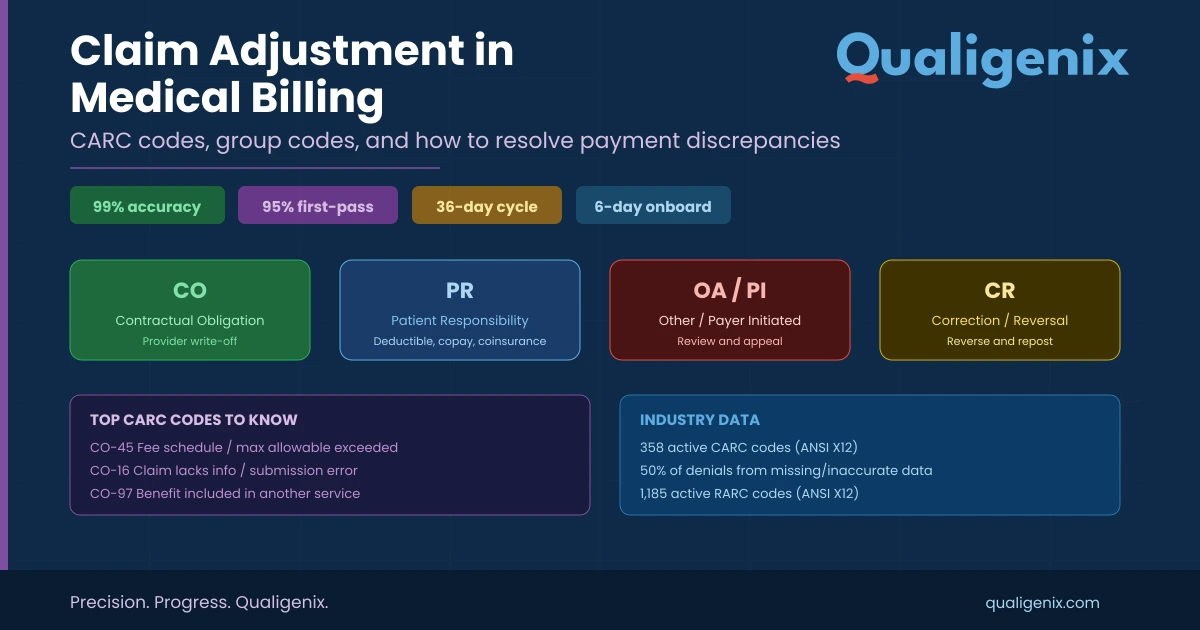
A claim adjustment occurs when a payer changes the reimbursement amount from what was originally billed. Every adjustment is communicated through standardized Claim Adjustment Reason Codes (CARCs) paired with group codes (CO, PR, OA, PI, CR) that assign financial responsibility. Understanding how to read, post, and resolve claim adjustments is fundamental to protecting your revenue. This guide covers every group code, the most common CARC codes, step-by-step resolution workflows, and how Qualigenix’s RCM services prevent revenue leakage from misposted or unresolved adjustments.
Every medical billing team encounters claim adjustments daily. They show up on your Electronic Remittance Advice (ERA 835), your Explanation of Benefits (EOB), and your aging reports. A claim adjustment is the payer’s way of telling you that a claim was paid differently than it was billed—and the standardized codes attached to that adjustment tell you exactly why.
The problem is that many practices treat claim adjustments as routine write-offs when they should be treating them as signals. A CO-45 adjustment for a fee schedule reduction is valid and should be posted as a contractual write-off. A CO-16 with a missing-information remark is recoverable revenue that your team should correct and resubmit. Knowing the difference between a valid adjustment and a recoverable denial is the skill that separates high-performing revenue cycles from ones bleeding money.
This guide walks you through everything your billing team needs to know about claim adjustments: how they work, what the group codes and CARC codes mean, the most common adjustment scenarios, and exactly how to resolve each one. We’ll also show how Qualigenix’s end-to-end denial management services and payment posting services turn claim adjustments from a revenue drain into a managed process.
What Is a Claim Adjustment in Medical Billing?
| A claim adjustment is a change made by a payer to the reimbursement amount of a submitted medical claim. Every adjustment is communicated using standardized Claim Adjustment Reason Codes (CARCs) maintained by ANSI X12, paired with group codes (CO, PR, OA, PI, CR) that identify who is financially responsible for the adjusted amount. Adjustments appear on the ERA 835 or EOB and must be posted accurately to maintain clean accounts receivable. |
Claim adjustments are a normal part of claims processing. Not every adjustment is a denial—many are contractual reductions that reflect the difference between your billed charge and the payer’s contracted allowed amount. The key is understanding which adjustments are valid write-offs, which represent patient responsibility, and which are actionable denials that your team should correct and resubmit for additional payment.
Claim Adjustment: Key Stats at a Glance
| Metric | Value / Source |
| Total active CARC codes | 358 codes (ANSI X12) |
| Total active RARC codes | 1,185 codes (ANSI X12) |
| Claim adjustment group codes | 5 (CO, PR, OA, PI, CR) |
| Missing/inaccurate data as top denial cause | 50% of all denials (Experian Health 2025) |
| Authorization issues causing denials | 35% (Experian Health 2025) |
| Incomplete registration data causing denials | 32% (Experian Health 2025) |
| CY 2026 Medicare nonqualifying APM conversion factor | $33.40 (CMS PFS Final Rule) |
| CY 2026 Medicare qualifying APM conversion factor | $33.57 (CMS PFS Final Rule) |
| CY 2026 efficiency adjustment to work RVUs | -2.5% (CMS PFS Final Rule) |
What Do Claim Adjustment Group Codes Mean?
Before you read any CARC code, look at the group code prefix. The group code tells you who is financially responsible for the adjusted amount—and that determines your next action. Billing a patient for a CO-adjusted amount, for example, directly violates your provider agreement and can trigger audits or contract termination.
| Group Code | Name | Who Pays? | Provider Action |
| CO | Contractual Obligation | Neither patient nor provider — write-off | Post as contractual adjustment. Never bill patient. |
| PR | Patient Responsibility | Patient (deductible, copay, coinsurance) | Post to patient balance. Bill patient directly. |
| OA | Other Adjustments | Varies — not CO or PR | Review CARC/RARC. May be payer-level adj, COB, or administrative. |
| PI | Payer Initiated Reduction | Payer (not patient responsibility) | Review for appealability. Payer believes adj is not patient’s responsibility but no contract supports it. |
| CR | Correction/Reversal | Reverses prior decision | Reverse original posting, then repost with corrected amounts. |
Pro tip: Always read the group code before the CARC number. The same CARC code paired with CO vs. PR has completely different financial implications for your practice and your patient.
Can You Bill a Patient for a CO Adjustment?
No. CO (Contractual Obligation) adjustments are write-offs that the provider must absorb under their payer contract. Billing a patient for a CO-adjusted amount violates the provider’s participation agreement and can result in audits, recoupment demands, or network termination. Only PR (Patient Responsibility) amounts can be billed to the patient.
What Are the Most Common Claim Adjustment Reason Codes?
With 358 active CARC codes, most billing teams encounter only 20–30 regularly. Here are the highest-frequency codes, organized by the type of issue they represent:
Contractual and Fee Schedule Adjustments
CO-45 — Charge exceeds fee schedule/maximum allowable: This is the most common CARC in medical billing. It means your billed charge was higher than the payer’s contracted allowed amount. Post the difference as a contractual write-off. If the allowed amount doesn’t match your contract, flag it for fee schedule review.
CO-97 — Benefit included in another service: The payer bundled this service with another procedure that was already paid. Review your coding—if the services were truly distinct, append the appropriate modifier (e.g., Modifier 59 or XE/XS/XP/XU) and resubmit.
CO-4 — Procedure code inconsistent with modifier or not valid for date of service: The CPT/HCPCS code and modifier combination doesn’t comply with NCCI edits or payer policy. Review the code pair, verify modifier appropriateness, and resubmit with corrections.
Patient Responsibility Adjustments
PR-1 — Deductible amount: The patient’s deductible has not been met. Post this amount to the patient’s balance and bill accordingly. Verify the deductible status through eligibility verification before the visit to set patient expectations upfront.
PR-2 — Coinsurance amount: The patient’s share of the allowed amount after the deductible. Post to patient balance. This is a valid patient responsibility under the benefit plan.
PR-3 — Copay amount: The patient’s fixed copay for the visit or service. Ideally collected at time of service. Post any uncollected copay to the patient’s balance.
Submission and Data Errors
CO-16 — Claim/service lacks information or has submission/billing error(s): This is the broadest and most common denial CARC. Always read the paired RARC—it tells you exactly what’s missing. Fix the specific error and resubmit. This code alone accounts for a significant share of recoverable revenue.
CO-29 — Time limit for filing has expired: The claim was submitted after the payer’s timely filing deadline. If you have proof of timely submission (clearinghouse report, portal timestamp), appeal. Otherwise, this is a write-off. Prevention through submission tracking is far more effective than appeal.
CO-18/OA-18 — Exact duplicate claim: The payer already received and processed this claim. Check your system for the original payment before resubmitting. If the original was denied, correct and resubmit as a corrected claim (not a new submission).
Coordination of Benefits
OA-23 — Impact of prior payer’s adjudication: The secondary payer adjusted its payment based on the primary payer’s allowed amount and payment. Submit the primary payer’s EOB with the secondary claim. This code is standard in Medicare secondary payer situations.
CO-22 — Coordination of benefits: Another payer is responsible. Verify the correct payer order through COB verification and resubmit to the appropriate primary payer.
What Is the Difference Between a CARC and a RARC?
CARCs (Claim Adjustment Reason Codes) explain the general reason a claim was adjusted—such as fee schedule reduction, missing information, or duplicate submission. RARCs (Remittance Advice Remark Codes) provide additional detail about what specifically triggered the adjustment. CARCs are mandatory on every adjusted claim under HIPAA. RARCs are supplemental but often contain the exact fix your team needs.
For broad codes like CO-16, the RARC is where the actionable information lives. For example, RARC N29 tells you the patient medical record is missing, while RARC MA04 specifies that the primary payer’s payment information is needed. Always read CARC and RARC as a pair.
How Do You Tell the Difference Between a Valid Adjustment and a Recoverable Denial?
| Factor | Valid Adjustment (Write-Off) | Recoverable Denial (Action Required) |
| Group code | CO (contractual) or valid PR | CO with actionable RARC, PI, or OA with error indicators |
| Typical CARCs | CO-45, CO-97, PR-1, PR-2, PR-3 | CO-16, CO-4, CO-29, CO-22, OA-18, PI codes |
| Revenue impact | Expected — reflects contract terms | Unexpected — represents lost revenue if not resolved |
| Provider action | Post as adjustment or patient balance | Correct, resubmit, or appeal within payer deadline |
| Prevention | Fee schedule monitoring | Clean claim submission, eligibility verification, coding accuracy |
| Qualigenix approach | Accurate contractual posting | Root-cause analysis, correction, and resubmission within timelines |
How Should Billing Teams Resolve Claim Adjustments Step by Step?
Here is the claim adjustment resolution workflow that Qualigenix trains every billing team to follow:
Step 1 — Pull the ERA 835 or EOB: Match the patient, payer control number, claim ID, and dates of service. Confirm you’re working the correct payer sequence (primary vs. secondary).
Step 2 — Read the group code first: CO = contractual write-off. PR = patient balance. OA = review further. PI = potential appeal. CR = reverse and repost.
Step 3 — Read the CARC and RARC together: The CARC tells you the category. The RARC tells you the specific fix. Map the code pair to a root-cause bucket: data error, coverage policy, documentation, bundling, COB, or timing.
Step 4 — Classify as valid or recoverable: If valid (e.g., CO-45 matching your contract), post the adjustment. If recoverable (e.g., CO-16 with a fixable error), correct and resubmit or appeal within the payer’s window.
Step 5 — Post accurately: CO to contractual adjustment bucket. PR to patient balance. Payer payment to insurance payment. Never post CO dollars to patient AR. Finalize secondary balances only after all payers have processed.
Step 6 — Track patterns and prevent recurrence: A spike in any specific CARC signals a systemic issue. CO-45 discrepancies suggest a fee schedule mismatch. CO-16 spikes suggest a registration or coding training gap. Use adjustment analytics to drive process improvement.
What Happens If You Post a Claim Adjustment Incorrectly?
Incorrect posting creates cascading AR errors. Posting a CO adjustment to the patient balance results in improper patient billing that violates your payer contract. Posting a PR amount as a contractual write-off means you’re giving away revenue your team should collect from the patient. Misposted adjustments also distort financial reports, making it impossible to accurately track contractual allowances, patient collections, or payer performance.
How Do 2026 CMS Reimbursement Changes Affect Claim Adjustments?
The CY 2026 Medicare Physician Fee Schedule introduced several structural changes that will directly impact the claim adjustment codes and amounts your team sees on Medicare remittances:
Dual conversion factors: For the first time, CMS split the conversion factor into two rates: $33.40 for nonqualifying APM providers and $33.57 for qualifying APM participants. Practices must verify which rate applies to their claims and flag any CO-45 adjustments that don’t match the correct conversion factor (per CMS PFS Final Rule CMS-1832-F).
-2.5% efficiency adjustment to work RVUs: CMS applied a blanket 2.5% reduction to work RVUs for procedural and imaging codes. This means allowed amounts on these services will be lower than 2025, generating new CO-45 adjustments that are valid under the updated fee schedule. Billing teams must update their internal fee schedules to avoid misclassifying these as underpayments.
Site-of-service payment shifts: CMS increased payments for office-based services and decreased payments for hospital-based settings. Practices billing from both settings will see different CO-45 adjustment amounts for the same CPT code depending on place of service. Verify that Place of Service codes on your claims match the actual service location.
Skin substitute bundling: CMS is bundling payment for skin substitute products into the application procedure code in non-facility settings. Practices that previously billed these separately will see new CO-97 bundling adjustments. Update coding workflows to reflect the new payment methodology.
How Does Qualigenix Help Practices Manage Claim Adjustments?
Claim adjustments touch every stage of the revenue cycle—from initial coding to final payment posting. That’s why practices across 38+ specialties partner with Qualigenix for end-to-end RCM management that catches adjustment issues before they become write-offs.
99% claim accuracy: Our coding team ensures CPT, HCPCS, and modifier accuracy before submission, reducing CO-4, CO-16, and CO-97 adjustments at the source. Learn more about our medical coding services.
Precise payment posting: Every ERA 835 is posted with group code accuracy—CO to contractual, PR to patient, OA/PI flagged for review. Our payment posting services prevent the misposting errors that distort AR and inflate patient balances.
Root-cause denial analytics: We track adjustment patterns by CARC code, payer, provider, and CPT code to identify systemic issues. A spike in CO-29 triggers submission workflow audits. A spike in CO-16 triggers coding training. Our denial management services turn reactive rework into proactive prevention.
Aggressive follow-up on recoverable adjustments: Our AR follow-up services flag every PI and OA adjustment for clinical review and initiate appeals within payer deadlines. We recover revenue other teams write off.
30% reduction in AR days: Clean posting, fast corrections, and proactive pattern analysis drive our clients’ average collection cycle down to 36 days with a 95% first-pass acceptance rate.
| “Game-changer… tailored solutions that streamlined our operations.” — Dr. Martha H., DPM |
| “Within months, our outstanding balances decreased, and we finally had visibility and control over our revenue.” — Jennifer H., CNP |
Claim Adjustment Resolution Checklist for Billing Teams
Use this checklist to audit your current claim adjustment workflow:
- ERA/EOB matched: Patient, claim ID, dates of service, and payer sequence confirmed before posting
- Group code read first: CO, PR, OA, PI, or CR identified before reading the CARC number
- CARC + RARC paired: Both codes read together to determine specific root cause and required action
- Valid vs. recoverable classified: Each adjustment categorized as contractual write-off, patient balance, or actionable denial
- CO posted correctly: All CO adjustments posted to contractual adjustment bucket — never to patient AR
- PR posted to patient balance: Deductible, copay, and coinsurance amounts posted to patient responsibility and billed
- Fee schedule verified: CO-45 allowed amounts matched against current payer contract and CMS fee schedule
- Recoverable denials corrected: CO-16, CO-4, and similar actionable CARCs corrected and resubmitted within filing deadlines
- Patterns tracked: CARC frequency reports generated monthly to identify systemic issues by payer, provider, and code
- Secondary claims finalized: Patient balance finalized only after all payer sequences (primary and secondary) have processed
Frequently Asked Questions About Claim Adjustments
What is a claim adjustment reason code?
A Claim Adjustment Reason Code (CARC) is a standardized three-character code used by payers to explain why a medical claim was paid differently than billed. Maintained by ANSI X12 and mandated by HIPAA for all electronic transactions, CARCs appear on the ERA 835 and EOB paired with group codes that assign financial responsibility.
What does group code CO mean on a remittance?
CO stands for Contractual Obligation. It indicates that the adjustment is the provider’s contractual write-off under their payer agreement. CO-adjusted amounts cannot be billed to the patient. Post these as contractual adjustments and verify the allowed amount matches your contract.
What does group code PR mean?
PR stands for Patient Responsibility. It indicates that the adjusted amount is the patient’s financial obligation—typically deductible (PR-1), coinsurance (PR-2), or copay (PR-3). Post PR amounts to the patient’s balance and bill accordingly.
What is the difference between CARC and RARC codes?
CARCs explain the general reason for a claim adjustment (e.g., fee schedule reduction, missing data, duplicate claim). RARCs provide supplemental detail about what specifically caused the adjustment. Both are mandated by HIPAA for electronic remittances. Read them as a pair for the most actionable information.
How do I know if a claim adjustment is appealable?
Review the group code and CARC together. CO adjustments matching your contract (CO-45, CO-97) are generally not appealable. PI adjustments, OA adjustments with error indicators, and CO adjustments paired with RARCs showing missing information (CO-16, CO-4) are often recoverable through correction and resubmission or formal appeal.
What is CO-45 in medical billing?
CO-45 means the billed charge exceeds the payer’s fee schedule, maximum allowable, or contracted rate. It is the most common CARC in medical billing. The difference between your billed charge and the allowed amount is posted as a contractual write-off. If the allowed amount doesn’t match your contract, flag it for fee schedule review.
How does Qualigenix handle claim adjustments?
Qualigenix posts every adjustment with group code precision—CO to contractual write-off, PR to patient balance, and actionable codes flagged for correction and resubmission. We track CARC patterns by payer and provider to identify systemic issues and prevent recurring denials. Our 99% claim accuracy rate and 95% first-pass acceptance rate reflect this approach.
Related Qualigenix Resources
Service Pages:
- Denial Management Services
- Payment Posting Services
- Medical Coding Services
- AR Follow-Up Services
- Claim Submission Services
- Insurance Eligibility Verification Services
Blog Guides:
- How to Appeal an Insurance Claim Denial Step by Step
- Denial Management in Medical Billing: 7 Common Causes
- How to Reduce Medical Claim Denials
- Healthcare Billing Process Explained
- What Is a Clean Claim Rate? Benchmarks & Best Practices
- Charge Capture in Healthcare: Common Errors & How to Fix Them
- What Is Revenue Cycle Management? A Beginner’s Guide
- RCM KPI Benchmarking Against Industry Standards
Stop Writing Off Recoverable Revenue — Book a Free Consultation
Every misposted claim adjustment, every unresolved CO-16, and every untracked pattern costs your practice money. Whether your team struggles with CARC interpretation, payment posting accuracy, or denial follow-up, Qualigenix has the expertise and infrastructure to fix it.
Our team delivers 99% claim accuracy, a 95% first-pass acceptance rate, and an average 36-day collection cycle. We onboard in as few as 6 days, starting with a comprehensive AR assessment that identifies where claim adjustments are costing your practice.
What’s Next

Outsourced vs. in-house behavioral health billing: which actually costs less?
For most behavioral health practices, outsourced billing costs less than in-house once you count the true price of a...
12 Questions to Ask a Medical Billing Company Before You Sign
The right billing company protects your revenue. The wrong one quietly drains it while sending you clean-looking reports....
Denial Management in 2026: The Top 10 Codes and the Appeal Playbook for Each
Denials cluster around a small set of codes, and each one has a different correct response. Some need a...