
Medical Transcription and Its Impact on Medical Billing
The Qualigenix Editorial Team consists of certified billing and coding experts with over 40 years of experience across 38+ medical specialties. Our content is rigorously researched against CMS, AMA, and payer-specific guidelines to ensure total compliance and accuracy. We apply the same elite standards to our resources as we do our client work, consistently delivering high claim accuracy and significant reductions in AR days.

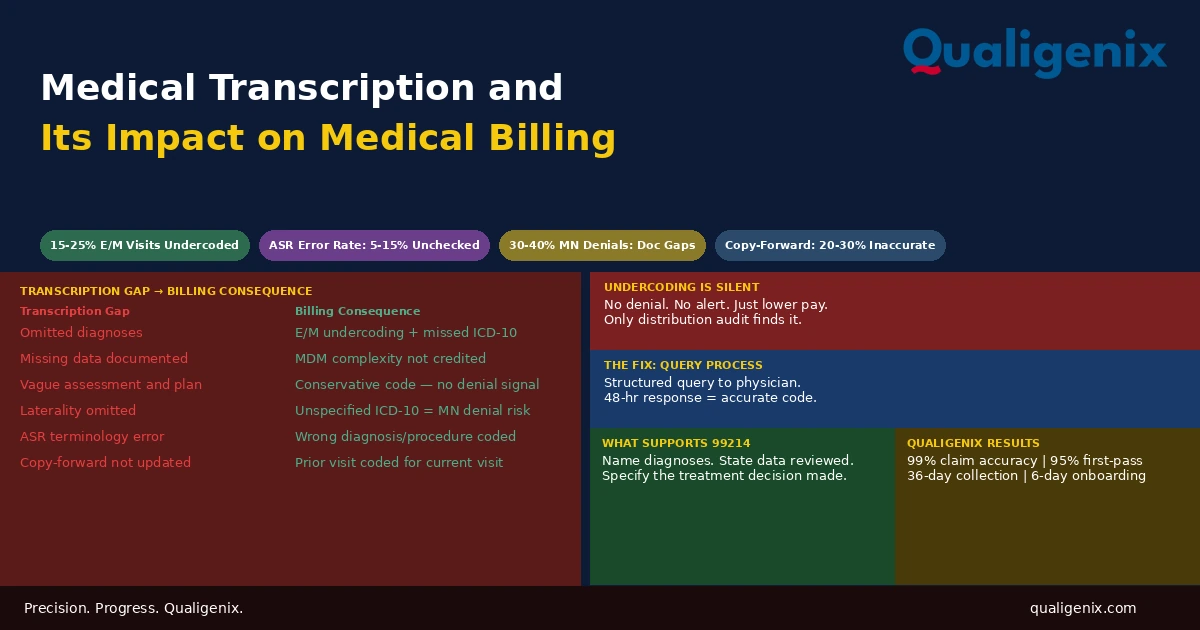
Medical transcription is the first step in a chain that ends with a paid or denied insurance claim. The physician dictates. The transcription system converts dictation to text. The coder reads the text and assigns codes. The biller submits the claim. The payer reimburses based on the codes submitted. Every step in that chain depends on the quality of the step before it. When the transcription is incomplete, inaccurate, or missing the clinical specificity that coding requires, the consequences flow downstream: conservative code assignment that collects less than the clinical work warranted, medical necessity denials for procedures where the documentation doesn’t establish the clinical rationale, and ICD-10 specificity failures that produce unspecified codes where specific ones were required. Transcription quality is not a clinical documentation issue that happens before billing begins. It is a revenue cycle input whose quality determines billing outcomes at every encounter.
When a practice’s E/M code distribution shows that 20% of established patient visits are billed at 99213 when the encounters should support 99214, the billing team is often the first to receive the diagnosis: there’s an under coding problem. The billing team looks at the claim. The claim was built correctly. The place-of-service code is right. The modifier is right. The diagnosis linkage is right. The problem isn’t in billing.
The problem is in the documentation the billing team received to work from. The transcribed note says the physician reviewed the patient’s conditions and adjusted a medication, but it doesn’t say which conditions, how many, what the medication adjustment involved, or what clinical decision the physician made. The coder read it and assigned 99213 because that’s what the note documents. The physician had a genuinely complex encounter that warranted 99214. But the coder can’t assign a code that the documentation doesn’t support, and the transcription didn’t capture the encounter’s complexity.
This is the most common and most invisible way that medical transcription affects medical billing: not through errors that produce denials, but through incompleteness that produces underpayments that look indistinguishable from correct payments in every billing report the practice generates.
Medical transcription directly affects billing by determining the quality of documentation available to the coder. Incomplete or vague transcription produces E/M undercoding through insufficient MDM documentation, medical necessity denials through missing clinical rationale for ordered services, ICD-10 specificity failures through absent diagnosis detail, and charge lag through extended turnaround times. The documentation standard that supports accurate billing explicitly captures the diagnoses managed, the data reviewed, the risk level of treatment decisions, and the procedures performed with their technique and extent.
Medical Transcription and Billing: Key Data
| Metric | Data Point | Source / Context |
|---|---|---|
| E/M visits billed below documented complexity | 15% to 25% | Coding audit benchmarks |
| Annual revenue lost to under coding per physician | $10,000 to $50,000+ | Physician revenue analysis |
| Medicare reimbursement difference: 99213 vs. 99214 | $35 to $50 per visit | CMS Physician Fee Schedule |
| Medical necessity denials from documentation gaps | Estimated 30% to 40% of MN denials | Denial root cause analysis |
| Speech recognition word error rate without physician review | 5% to 15% | Clinical NLP benchmarks |
| Copy-forward notes with outdated or inaccurate content | Estimated 20% to 30% | EHR documentation research |
| Transcription turnaround target for same-day coding | Same day or next business day | Revenue cycle best practices |
| Qualigenix claim accuracy rate | 99% | Qualigenix performance data |
| Qualigenix first-pass acceptance rate | 95% | Qualigenix performance data |
| Qualigenix average collection cycle | 36 days | Qualigenix performance data |
| Qualigenix client onboarding time | 6 days | Qualigenix operations data |
What Medical Transcription Is and Where It Fits in the Revenue Cycle
Medical transcription is the conversion of a physician’s verbal dictation into a written medical record. The physician dictates the encounter describing the patient’s presenting complaints, the clinical history, the examination findings, the diagnoses, the test results reviewed, and the treatment decisions made and a transcription process converts that verbal narrative into a structured clinical note that becomes the legal medical record for that encounter.
In the revenue cycle, the transcribed note occupies the position between the clinical encounter and the coding function. It is the source document from which the coder works. The coder cannot see the patient. The coder cannot call the physician mid-stream to ask what was discussed. The coder reads the transcribed note and assigns codes based on what is written. Every coding decision every CPT code, every ICD-10 code, every modifier, every E/M level. It is a direct function of what the transcription captured.
Medical transcription is not a billing function. It is a clinical documentation function that produces the input to the billing function. This distinction matters because it means the people responsible for transcription quality, the physician dictating and the transcription system or person converting are often not the same people responsible for billing performance. The revenue consequences of transcription gaps are visible in the billing department; the cause is upstream in the clinical workflow. Closing the feedback loop between billing outcomes and documentation quality requires explicitly connecting what the coding team receives with what the transcription process produced.
Transcription Method: How the Technology Affects Documentation Quality
Medical transcription is no longer exclusively a human function. Most practices today use some combination of human transcriptionists, speech recognition software, and AI-assisted documentation tools. Each method produces documentation with different accuracy profiles, different turnaround characteristics, and different failure patterns that affect downstream coding.
Human Transcription
Traditional human transcription involves a trained transcriptionist listening to a physician’s dictation recording and typing the note. Human transcriptionists familiar with medical terminology, specialty-specific language, and the physician’s dictation patterns produce high-accuracy transcriptions with low error rates on terminology. The limitations are turnaround time — typically 12 to 24 hours or longer — and cost, which is higher per note than automated methods.
For billing purposes, the turnaround limitation matters. A transcription that takes 24 hours means the coder cannot begin working the encounter until the next business day. At high volume, 24-hour transcription turnaround creates a systematic one-day charge lag that adds up across a month of encounters and can contribute to AR performance metrics that appear to be billing problems but originate in the documentation workflow.
Front-End Speech Recognition
Front-end speech recognition converts dictation to text in real time as the physician speaks. The text appears on screen as the physician dictates, allowing immediate review and correction before the note is finalized. The advantage is speed, the note is available as soon as the physician finishes dictating and makes any corrections. The limitation is that the quality depends heavily on the physician’s willingness and discipline to review and correct recognition errors before signing.
Speech recognition systems achieve word error rates of 5% to 15% on medical dictation without physician review. At a 10% word error rate in a 500-word clinical note, 50 words are incorrect. Some errors are minor transcription differences with no clinical or coding significance. Others are medically critical: “left” transcribed as “right,” a drug name slightly altered, a dosage number misread, or a diagnosis term rendered as a different diagnosis entirely. The physician who reviews the note carefully catches these. The physician who signs it quickly because the waiting room has 14 patients left catches some and misses others.
Back-End Speech Recognition
Back-end speech recognition records the dictation, converts it to text through automated processing, and routes the draft to a human medical editor who reviews and corrects the transcription before it becomes the final document. This adds a quality control layer that front-end speech recognition relies on the physician to provide. Back-end speech recognition with quality editors produces accuracy comparable to or exceeding human-only transcription, with faster turnaround than purely human transcription for practices with high dictation volumes.
AI-Assisted Documentation and Ambient Clinical Intelligence
The most recent generation of clinical documentation tools uses AI to generate clinical note drafts from ambient audio — the physician-patient conversation rather than structured dictation. These tools listen to the encounter, identify clinical content, and generate a structured note draft that the physician reviews and signs. Turnaround is essentially immediate. Accuracy on structured clinical content varies significantly by product and specialty. The billing implication of these tools is that the quality of the generated note its completeness, its specificity, its capture of MDM elements depends on how well the AI interpreted and structured the conversation it captured.
For billing purposes, the relevant question for any transcription method is not how it works but what it produces: does the resulting note contain the clinical specificity that coding requires to assign accurate, well-supported codes?
How Transcription Gaps Produce E/M Undercoding
E/M undercoding from documentation gaps is the most financially significant impact of transcription quality on billing, and the most invisible. When an E/M claim is undercoded, it pays at a lower rate, with no denial, with no alert, with no indication in any billing report that revenue was left behind.
Under the 2021 AMA E/M guidelines, outpatient office visit code levels are selected based on medical decision making complexity or total time. MDM complexity is assessed across three elements: the problems addressed, the data reviewed, and the risk level of the treatment decisions made. For a visit to support 99214 (moderate MDM), the documentation must establish at least two of the following: a chronic illness with exacerbation, prescription drug management, or a new problem requiring workup (problems element); independent review of external test results or assessment of independent historian (data element); prescription drug management or decision about minor surgery with identified risk factors (risk element).
When the transcribed note says “Patient here for follow-up. Conditions reviewed. Medications adjusted. RTC 3 months,” the coder has almost nothing to work with on the MDM elements. Which conditions? How many? Were they stable or exacerbated? Was medication adjusted or was a new medication initiated? What was the clinical rationale? The coder assigns 99213 because that’s what the documentation supports. The physician had a genuine 99214 encounter. The transcription didn’t capture it.
Warning: Template generated and copy-forward documentation creates specific E/M under coding risk because the MDM elements most important for code selection the specific diagnoses actively managed, the specific data reviewed with physician interpretation, the specific risk level of the clinical decision are exactly the elements that templates either omit or fill with generic language. A note that was templated to look thorough may contain less actual coding-relevant specificity than a brief but specific dictated note that names the conditions, identifies the data reviewed, and states the decision made.
Specific Transcription Failures and Their Coding Consequences
Different types of transcription failures produce different coding consequences. Understanding the mapping between transcription failure and coding outcome allows practices to prioritize the documentation improvements that have the highest billing impact.
Omitted Diagnoses
A physician who manages a patient’s hypertension, type 2 diabetes, and chronic kidney disease during a visit but whose transcribed note only explicitly mentions hypertension has given the coder one billable diagnosis instead of three. Under MDM coding, managing multiple chronic conditions contributes to the problems element that supports higher code levels. Under ICD-10 coding, each condition that was managed during the encounter should be coded they represent the clinical complexity of the visit and they establish medical necessity for the services billed. Omitted diagnoses from incomplete transcription understate both the E/M complexity and the diagnosis capture, reducing both the code level supported and the clinical data accuracy of the claim.
Missing Data Documentation
The data element of MDM what the physician reviewed and analyzed during the encounter is among the most commonly under documented elements in both dictated and template-generated notes. A physician who reviewed the patient’s recent CBC, interpreted an external cardiology note, and discussed the findings with the patient covered significant data complexity. If the transcribed note says “labs reviewed, patient counseled” without specifying which labs, what was found, and what the clinical interpretation was, the coder cannot credit the physician for the data review. The data element contributes zero to the MDM complexity assessment and the code is assigned at a lower level than the encounter warranted.
Vague Assessment and Plan
The assessment and plan section is where E/M code support is most concentrated and where transcription failures most directly produce under coding. A specific assessment and plan identifies each condition by name, states whether it is stable or changing, describes the treatment decision made (continue current therapy, adjust dosage, order additional testing, refer to specialist), and captures the clinical reasoning. A vague assessment and plan that says “patient stable, continue current management” for a patient with five active conditions provides minimal MDM documentation regardless of how complex the actual clinical encounter was.
Laterality and Anatomical Specificity Omissions
ICD-10 requires anatomical specificity for many conditions: right versus left, initial versus subsequent versus sequela, specific fracture type versus unspecified. When dictation omits laterality or specificity “knee pain” rather than “left knee pain” the transcription accurately reflects the dictation, but the resulting documentation doesn’t support the specific ICD-10 code. The coder assigns the unspecified code, which may not meet the payer’s covered diagnosis requirements for the procedure billed and may produce a medical necessity denial for specificity failure.
Incorrect Medical Terminology Transcription
Speech recognition systems generate errors on medical terminology at higher rates than on conversational language because medical terms are phonetically similar to other words, uncommon in general language models, and pronounced variably by different physicians. A diagnosis name rendered as a similar-sounding but different diagnosis, a drug name one letter different from the correct name, or a procedure term altered by a recognition error all produce documentation that doesn’t accurately reflect the clinical encounter. When these errors are not caught during physician review, the coder codes from incorrect source material potentially assigning an ICD-10 code for a different condition than the one the physician actually diagnosed.
How Transcription Gaps Produce Medical Necessity Denials
Medical necessity denials for procedures ordered during an encounter imaging studies, referrals, diagnostic tests are often attributed to coding or authorization failures. A significant proportion trace directly to documentation gaps in the clinical note that supported the order.
When a physician orders an MRI of the lumbar spine for a patient with lower back pain and radicular symptoms, the clinical rationale for the imaging is the specific symptom presentation and its severity, the duration of symptoms, the conservative treatments already tried, and the clinical judgment that imaging is necessary to guide further management. If the transcribed note records only “lower back pain — MRI ordered,” the payer reviews the claim and finds a nonspecific diagnosis code for low back pain paired with a high-cost imaging order. The payer’s coverage policy for lumbar MRI requires documentation of radicular symptoms persisting beyond a defined duration and failed conservative treatment. The note doesn’t contain it. The claim denies for medical necessity.
The physician’s clinical reasoning was entirely appropriate. The imaging was medically necessary. The transcription didn’t capture the justification that the payer’s coverage policy required. The denial is the documentation’s failure, not the clinical decision’s failure.
Related: Denial Management: The Most Common Denials and How to Fix Them
Transcription Turnaround and Charge Lag
Beyond accuracy and completeness, transcription turnaround time affects billing through its contribution to charge lag — the elapsed time between a clinical encounter and the submission of a claim for that encounter.
When transcription takes 24 to 48 hours, coding cannot begin until the note is available. If coding takes an additional 24 hours after the note arrives, the claim submits two to three days after the encounter. For commercial payers with 90-day filing windows, a two-to-three-day charge lag per encounter is not a timely filing risk in isolation. Over a high-volume month where some encounters are delayed by transcription backlogs or physician note completion delays, the average charge lag can extend to five to seven days, and outliers can extend to two to three weeks without triggering any specific alert.
The cumulative effect of even modest charge lag is visible in days-in-AR performance. A practice where the average time from encounter to claim submission is four days instead of one is carrying four additional days of AR on every claim in the pipeline. At 2,000 claims per month with an average allowed amount of $150, that’s $300,000 in claims that are four days further from payment than they would be with same-day submission. The cash flow difference is real; it compounds across every month the lag persists.
For practices using dictation-based transcription, setting a physician note completion standard same-day finalization of transcribed notes rather than end-of-week batch review — is the most direct way to reduce the transcription contribution to charge lag.
Copy-Forward Documentation: The Transcription Problem That Isn’t Transcription
Modern EHR systems allow physicians to copy a prior visit note forward into the current visit note and modify only the elements that changed. This practice eliminates the transcription step entirely for the carried-forward content but creates a documentation quality problem that affects billing in ways that are similar to transcription failures.
Copy-forward notes that aren’t carefully updated for the current visit can contain diagnoses from a prior visit that were resolved, medications that were discontinued, examination findings from three months ago presented as today’s findings, and assessment language that doesn’t reflect the current clinical status. When a coder reviews a copy-forward note for E/M coding, the challenge is determining which content reflects the current encounter and which is carried from a prior visit. Notes with extensive copy-forward content frequently produce E/M undercoding because the coder cannot confidently attribute the complexity of the note to the current visit.
Research estimates that 20% to 30% of EHR notes with copy-forward content contain outdated or inaccurate information in at least one clinical element. From a billing standpoint, this is equivalent to a transcription accuracy problem: the note doesn’t accurately reflect the encounter, and the codes assigned from the note therefore don’t accurately reflect the clinical work performed.
The Documentation Query Process: Recovering What Transcription Missed
When a coder receives a transcribed note that is insufficient to support the highest appropriate code too vague for the E/M level the encounter’s complexity should support, missing the diagnosis specificity for the ICD-10 codes required, or absent the clinical rationale for an ordered service the coder has two options. Code conservatively to what is documented and accept the lower reimbursement. Or send a documentation query to the physician asking for the missing specificity.
A well-designed documentation query process is the billing function’s mechanism for recovering coding accuracy from documentation gaps. A structured query identifies the specific encounter, the specific gap, and the specific information needed to support a higher code or more specific ICD-10 assignment. The physician reviews the query, confirms or adds the missing element as an addendum to the record, and the coder assigns the accurate code based on the completed documentation.
The query process has two requirements to be effective. First, the physician must respond within a defined window — 24 to 48 hours is the standard — or the encounter is coded from the existing documentation and the opportunity is lost. Second, the query must be specific enough that the physician understands exactly what is missing and what addendum would address it. A query that says “please clarify complexity” produces a response that says “patient was complex.” A query that says “the note documents hypertension and diabetes as conditions managed today, but does not document whether the diabetes was stable or whether there were complications reviewed — please addend to clarify” produces a specific clinical response that supports the appropriate ICD-10 code and MDM documentation.
Query response rates of 85% or higher within 48 hours are achievable with a well-designed process and physician awareness of why documentation specificity matters for coding accuracy and revenue cycle performance.
The Documentation Standard That Supports Accurate Billing
Understanding what documentation quality the billing function needs and communicating that standard to the physicians and transcription processes that produce it is the connection most practices fail to make explicitly. Physicians learn to document for clinical and legal purposes. They are not always taught what a coder needs to see in the note to assign the code that accurately reflects the clinical work.
The documentation standard that produces accurate billing is not more documentation. It is more specific documentation of the elements that determine code selection. A 500-word note with generic language produces lower coding accuracy than a 200-word note that specifically names the conditions managed, identifies the data reviewed and the physician’s interpretation, and states the clinical decision made and why.
| Documentation Element | What Supports Coding | What Doesn’t |
|---|---|---|
| Diagnoses managed | “Managing HTN, T2DM, CKD stage 3 today” | “Chronic conditions reviewed” |
| Data reviewed | “CBC reviewed — Hgb stable at 11.2, no change needed” | “Labs reviewed” |
| Risk / treatment decision | “Initiating metformin 500mg BID for T2DM management” | “Medications adjusted” |
| Anatomical specificity | “Left knee pain, medial compartment” | “Knee pain” |
| Imaging rationale | “MRI lumbar spine ordered — radicular sx >6 wks, conservative Rx failed” | “MRI ordered” |
| Procedure technique | “Arthrocentesis left knee, 5mL fluid aspirated, cortisone 40mg injected” | “Knee injection performed” |
| Time (when time-based) | “Total time today 38 minutes including documentation” | No time documented |
Physicians who understand what coders need from documentation produce notes that are both clinically accurate and billing-supportive without adding significant documentation burden. The content requirement is not volume, it is specificity on the specific elements that determine code selection.
How Qualigenix Bridges Transcription and Billing
At Qualigenix, we manage the coding function that sits between transcription and billing, and we actively manage the documentation quality feedback that makes the transcription-to-coding handoff produce accurate claims rather than conservative ones.
Our coders review transcribed notes against current AMA E/M MDM criteria for every encounter, identifying documentation gaps before coding rather than after. When a note doesn’t contain sufficient MDM specificity for the code level the encounter appears to warrant, we send a structured documentation query to the physician with the specific gap identified and the specific addendum that would address it. We track query response rates by physician and report monthly on which physicians generate the most queries and what documentation patterns those queries reflect.
We provide monthly physician feedback reports that show code distribution relative to specialty benchmarks and identify the documentation patterns associated with lower code assignments. Physicians who receive specific feedback, these three encounter notes were coded at 99213 because the assessment section didn’t identify the conditions managed by name adding this documentation would support 99214″ improve their documentation specificity more reliably than physicians who receive general feedback about documentation quality.
Our documentation feedback loop compounds over time. In the first month of an engagement, query volume is often highest as we identify the documentation gaps the prior coding process was working around silently. Over three to six months, as physician documentation responds to specific feedback, query volume declines and the code distribution shifts toward the levels the encounters actually support.
Related: What Is Healthcare Coding and How It Works | Medical Billing vs Coding: Key Differences | What Is RCM in Medical Billing
Documentation Quality and Transcription Accuracy Checklist
- Physician note completion standard defined — same-day or next-day finalization
- Speech recognition output reviewed by physician before signing — not rubber-stamped
- Assessment section names specific diagnoses managed — not generic “conditions reviewed”
- Data reviewed section identifies specific tests, records, or external data with physician interpretation
- Treatment decisions documented specifically — drug name, dose, change rationale
- Anatomical laterality captured in dictation — left/right, location, affected side
- Imaging or procedure orders include clinical rationale in the note
- Time documented when time-based E/M coding applies — total time on date of service
- Copy-forward documentation updated for current visit before signing
- Documentation query process in place — structured format, 48-hour physician response standard
- Monthly physician feedback provided on documentation patterns generating conservative codes
- Code distribution report reviewed monthly — distribution gaps flagged for documentation audit
Frequently Asked Questions: Medical Transcription and Billing
What is medical transcription?
Medical transcription is the conversion of a physician’s verbal dictation into a written clinical note that becomes the medical record for that encounter and the source document from which medical coders assign billing codes. It is the upstream input to the entire coding and billing process. The accuracy and completeness of the transcribed note directly determines what codes can be assigned, what reimbursement is received, and whether the clinical work the physician performed is fully represented in the claim submitted to the payer.
How does medical transcription affect medical billing?
Medical transcription affects billing by determining the quality of documentation available to the coder. Complete, specific transcription produces accurate high-level codes. Incomplete or vague transcription produces conservative codes, medical necessity denials, and ICD-10 specificity failures. The revenue consequences are largely invisible under coded claims pay at lower rates without denial, and the gap between what was collected and what was warranted appears nowhere in billing reports. Only a code distribution audit comparing physician patterns against specialty benchmarks makes the undercoding from documentation gaps visible.
What transcription errors cause coding problems?
The transcription failures with the highest billing impact are omitted diagnoses, missing data documentation, vague assessment and plan language, laterality omissions, and incorrectly transcribed medical terminology. Each maps to a specific coding failure: omitted diagnoses reduce E/M complexity and ICD-10 capture; missing data documentation reduces MDM complexity credit; vague assessment language prevents specific code assignment; laterality omissions force unspecified ICD-10 codes; terminology errors produce incorrect diagnosis or procedure codes. The most costly of these is the vague assessment and plan, because it affects E/M code level selection on the highest-volume billing category in most practices.
How does incomplete transcription cause medical necessity denials?
Incomplete transcription causes medical necessity denials when the clinical rationale for an ordered service — the symptoms, their severity, their duration, the conservative treatments already tried — isn’t captured in the note, leaving the payer with a diagnosis code that doesn’t satisfy their coverage criteria for the service billed. The clinical decision was appropriate. The documentation didn’t capture the justification. The denial follows from the documentation gap, not from the clinical inappropriateness of the service. Pre-service documentation review against payer coverage criteria prevents this category of denial before it generates.
What is a documentation query and how does it recover billing accuracy?
A documentation query is a structured request from the coder to the physician asking for clarification when the transcribed note is insufficient for accurate code assignment. It recovers billing accuracy by allowing the physician to addend the record with the missing specificity, enabling the coder to assign the appropriate code rather than defaulting to a conservative one. An effective query process achieves 85% or higher physician response rates within 48 hours and identifies specific documentation gaps rather than making vague requests for more detail. Over time, query patterns feed physician feedback that improves documentation quality and reduces future query volume.
Does copy-forward documentation affect billing?
Yes. Copy-forward documentation affects billing the same way incomplete transcription does: by producing notes that don’t accurately reflect the current encounter, leading to conservative code assignments and ICD-10 specificity failures. An estimated 20% to 30% of copy-forward notes contain outdated or inaccurate content in at least one clinical element. A note that carries forward a prior visit’s assessment without updating it for the current encounter’s clinical findings can produce an E/M code level appropriate for the prior visit’s complexity but not for the current one. Ensuring copy-forward notes are specifically updated for the current encounter’s MDM elements is the documentation standard that prevents this category of coding inaccuracy.
Related Resources from Qualigenix
Better Documentation In. Better Revenue Out.
Qualigenix manages coding and documentation quality feedback for practices across 38+ specialties — running structured query processes, delivering monthly physician documentation feedback, and ensuring that what was clinically done is accurately captured, coded, and collected.
Our team delivers 99% claim accuracy, a 95% first-pass acceptance rate, an average 36-day collection cycle, and a 30% reduction in AR days. We onboard in as few as 6 days.
Precision. Progress. Qualigenix.
What’s Next

Outsourced vs. in-house behavioral health billing: which actually costs less?
For most behavioral health practices, outsourced billing costs less than in-house once you count the true price of a...
12 Questions to Ask a Medical Billing Company Before You Sign
The right billing company protects your revenue. The wrong one quietly drains it while sending you clean-looking reports....
Denial Management in 2026: The Top 10 Codes and the Appeal Playbook for Each
Denials cluster around a small set of codes, and each one has a different correct response. Some need a...