

Denial Management: The Most Common Denials and How to Fix Them
The Qualigenix Editorial Team consists of certified billing and coding experts with over 40 years of experience across 38+ medical specialties. Our content is rigorously researched against CMS, AMA, and payer-specific guidelines to ensure total compliance and accuracy. We apply the same elite standards to our resources as we do our client work, consistently delivering high claim accuracy and significant reductions in AR days.

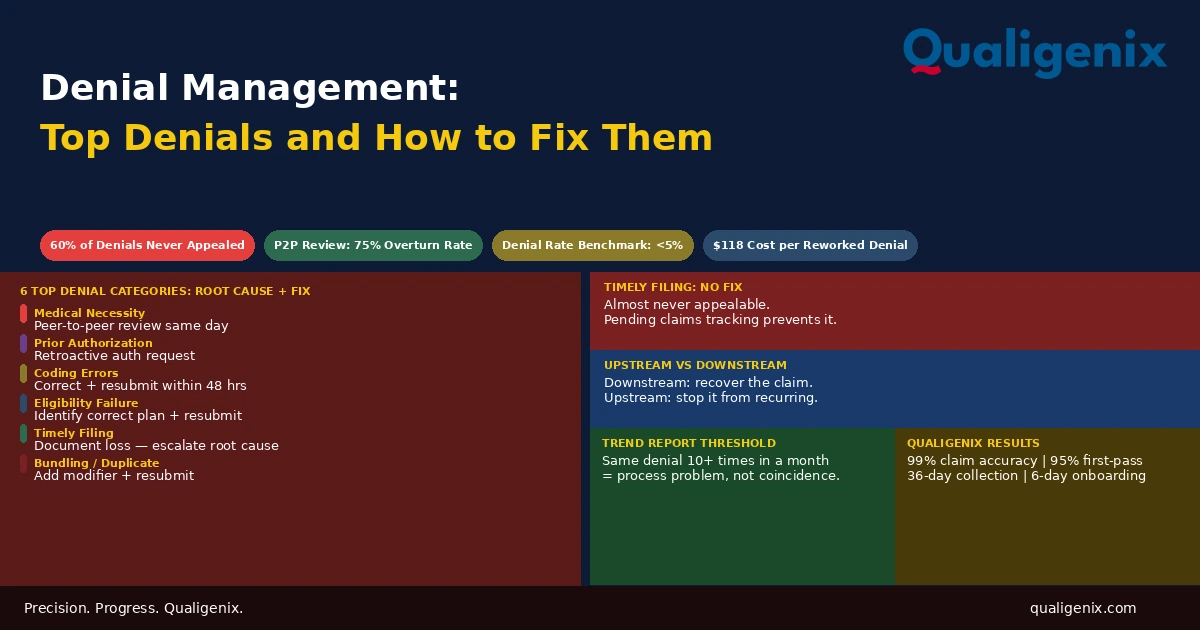
Claim denials are not random events. They are predictable outputs of specific process failures upstream of the claim. A medical necessity denial happened because the documentation didn’t address the payer’s coverage criteria before the service was delivered. A timely filing denial happened because a claim sat in a pending queue past the filing deadline. An eligibility denial happened because insurance data wasn’t verified before the encounter. Each denial category has a specific root cause and a specific upstream process fix. Working the individual denial recovers one claim’s revenue. Implementing the upstream fix prevents the same denial from generating again next month, and the month after, and the month after that. Practices that only do the first never get their denial rate below benchmark. Practices that do both do.
The average practice has a denial rate between 6% and 12% of submitted claims. The industry benchmark is under 5%. The gap between where most practices are and where the benchmark sits represents real revenue: denied claims that either require expensive rework, are appealed with variable success rates, or are written off when no one gets to them before the appeal window closes.
Approximately 60% of denied claims are never appealed. That statistic deserves to sit with you for a moment. For a practice generating $4 million in annual charges with a 10% denial rate, that’s roughly $400,000 in denied claims per year. Sixty percent of that $240,000 is written off without any attempt to recover it. Not because recovery was impossible, but because no one worked the denial.
The solution to the denial problem has two parts and most practices only address one. The part most practices address is working denials after they arrive. The part most practices underinvest in is tracing denial patterns to their root causes and implementing the upstream changes that prevent the same denial categories from recurring. This blog covers both parts: the most common denial categories, what generates each one, and what the upstream process fix looks like for each.
The six most common claim denial categories by volume and revenue impact are: medical necessity, prior authorization, coding errors, eligibility failures, timely filing violations, and bundling or duplicate edits. Each has a distinct root cause and a distinct upstream fix. The top five categories typically account for 70% to 80% of a practice’s total denial volume, meaning five upstream process improvements — correctly implemented — eliminate the majority of recurring denial activity.
Denial Management: Key Benchmarks
| Metric | Benchmark / Data Point | Source |
|---|---|---|
| Denial rate benchmark | Under 5% of submitted claims | MGMA / HFMA standards |
| Average practice denial rate | 6% to 12% | Industry billing benchmarks |
| Denied claims never appealed | Approximately 60% | Healthcare billing industry data |
| Medical necessity denials overturned after peer-to-peer | Up to 75% | AMA PA reversal data |
| Top 5 denial categories as share of total denials | 70% to 80% | Denial management analysis |
| Cost to rework one denied claim | $25 to $118 | HFMA denial cost analysis |
| Timely filing window — Medicare | 12 months from date of service | CMS Claims Processing Manual |
| Timely filing window — commercial payers | 90 to 180 days | Commercial payer contract standards |
| Peer-to-peer review window | 14 to 30 days from denial | Payer PA appeal policies |
| Qualigenix claim accuracy rate | 99% | Qualigenix performance data |
| Qualigenix first-pass acceptance rate | 95% | Qualigenix performance data |
| Qualigenix average collection cycle | 36 days | Qualigenix performance data |
Rejection vs. Denial: The Distinction That Matters for Routing
Before covering the denial categories, one distinction is worth establishing clearly because it determines how a billing team should respond when a claim comes back unpaid.
A rejection is returned by the clearinghouse or payer before the claim enters adjudication. The claim was not processed. It was returned because a technical or format error prevented processing: an invalid member ID, an NPI not recognized in the payer’s system, a missing required field, an invalid date format. Rejections are corrected at the technical level and resubmitted. They are not appeals. They are data corrections.
A denial is issued after the claim has been received, processed, and adjudicated. The payer reviewed the claim and declined to pay it based on a coverage, medical necessity, or administrative determination. Denials require a different response depending on the denial reason: correction and resubmission for administrative errors, peer-to-peer review or formal appeal for clinical denials, documentation submission for authorization denials.
Practices that route rejections and denials into the same queue are not only managing them inefficiently they are also distorting their denial rate calculations. A 12% “denial rate” that includes rejections is not the same performance picture as a 12% denial rate that counts only adjudicated denials. Separating the two in reporting gives an accurate picture of where the actual adjudication problems are and allows the billing team to address each type with the appropriate workflow.
Denial Category 1: Medical Necessity
Medical necessity denials are the highest-stakes denial category for most specialty practices. They represent a payer determination that the service delivered doesn’t meet their clinical coverage criteria for the patient’s documented condition. The revenue per denied encounter is typically higher than for administrative denials, the appeal process is more complex, and the upstream fix requires changes in clinical documentation behavior rather than billing workflow adjustment.
What Generates Medical Necessity Denials
Medical necessity denials are generated when the ICD-10 diagnosis codes on the claim don’t support the procedure billed under the payer’s coverage policies. This happens through several specific mechanisms. The diagnosis code is too general — an unspecified code was used when the payer’s coverage policy requires a specific code to confirm the condition meets their criteria. The diagnosis code is clinically accurate but doesn’t appear on the payer’s covered diagnosis list for that procedure. The clinical documentation doesn’t establish the severity or chronicity the payer requires to cover the service. Or the service was appropriate but the payer’s criteria require prior documentation of conservative treatment failure before the service is authorized.
The Downstream Fix: Peer-to-Peer Review
The fastest and most effective appeal tool for medical necessity denials is the peer-to-peer review. The treating physician requests a direct conversation with the payer’s medical reviewer, presents the clinical case, and addresses the specific coverage criterion the payer applied. Peer-to-peer reviews overturn medical necessity denials at rates up to 75% when the physician is prepared with the denial rationale, the clinical documentation, and any supporting clinical guidelines.
Most payers allow peer-to-peer review requests within 14 to 30 days of the denial date. This window must be tracked for every medical necessity denial. A peer-to-peer request submitted on day 31 for a payer with a 30-day window is denied without clinical review. The same clinical case that would have been overturned on day 15 is lost on day 31 not because the service was clinically inappropriate but because no one tracked the deadline.
The Upstream Fix: Pre-Service Criteria Review
The upstream fix for medical necessity denials is reviewing the payer’s coverage criteria before the service is delivered and ensuring the clinical documentation explicitly addresses those criteria. When a payer’s coverage policy for an advanced imaging study requires documentation of failed conservative treatment, the ordering physician’s note must include that documentation. When a payer requires a specific severity score for a biologic authorization, the clinical note must contain it. Pre-service documentation that addresses payer criteria produces claims that pass medical necessity review rather than generating denials that require peer-to-peer recovery.
Denial Category 2: Prior Authorization
Authorization denials are generated when a service requiring prior authorization was delivered without an approved authorization, with an expired authorization, or with an authorization that doesn’t match the service billed. For specialty practices managing high volumes of concurrent authorizations for biologics, surgical procedures, and advanced imaging, authorization-related denials can represent a disproportionate share of total denial volume and total denied revenue.
What Generates Authorization Denials
The most common authorization denial is delivering a service before authorization is confirmed. A pending authorization submission is not an approved authorization. A service delivered while the authorization request is still in the payer’s review queue generates an authorization denial regardless of whether the service was eventually going to be approved. The second most common is billing with an expired authorization number. Many payers issue authorizations for defined periods — six to twelve months — and claims submitted after the expiration date generate authorization denials even though the original authorization was legitimate. The third is a CPT code mismatch: the claim was submitted with a different code than what was authorized, and the payer’s system cannot match the claim to the authorization.
The Downstream Fix: Retroactive Authorization Request
For services delivered without authorization, the first step is determining whether the payer offers a retroactive authorization process. Some payers allow retroactive authorization requests within a defined window — typically 30 to 60 days — when the service was medically necessary and the omission was administrative rather than clinical. Retroactive authorization approval is not guaranteed and varies significantly by payer, but it is worth pursuing before treating the denial as a write-off.
The Upstream Fix: Authorization Tracking System
The upstream fix for authorization denials is a centralized authorization tracking system that shows every active authorization by patient with the effective date, expiration date, authorized CPT code, and authorized site of service. The system must generate renewal alerts 30 days before each authorization expires and flag pending authorizations so that no service is confirmed on the schedule without a confirmed authorization number in place. Related: Insurance Authorization for Specialty Practices
Denial Category 3: Coding Errors
Coding-related denials are the category most directly traceable to the coding function and the most clearly correctable through coding process improvement. They include wrong CPT code, wrong ICD-10 diagnosis code, missing modifier, invalid code combination, and diagnosis codes that don’t support the procedure billed under medical necessity review. Approximately 25% to 30% of all denials trace to coding errors.
What Generates Coding Denials
Coding denials are generated through several specific coding errors, each with its own resolution pathway. Wrong CPT code — either an incorrect code was assigned, or the code doesn’t match the clinical documentation produces a denial for the code billed rather than the service performed. Missing modifier 25 on a same-day E/M and procedure combination produces a bundling denial where the E/M is denied as a component of the procedure fee. An ICD-10 code that doesn’t support the procedure billed produces a medical necessity denial that looks like a clinical denial but actually originated in a coding decision. Invalid code combinations a procedure code that can’t be billed with a specific modifier produce edit denials from the payer’s claim processing system.
The Downstream Fix: Correct and Resubmit
For most coding denials, the resolution is correction and resubmission rather than formal appeal. The coder reviews the denied claim against the clinical documentation, identifies the specific error, corrects it, and the billing team resubmits the corrected claim within the payer’s corrected claim filing window. The cost of correcting and resubmitting a coding denial is $25 to $118 per claim depending on the complexity. At a practice generating 50 coding-related denials per month, the monthly rework cost alone is $1,250 to $5,900 before accounting for the payment delay on those claims.
The Upstream Fix: Claim Scrubber and Monthly Code Distribution Audit
The upstream fixes for coding denials operate at two levels. At the technical level, a claim scrubber configured with current payer-specific edit rules catches invalid code combinations, missing modifiers, and diagnosis-procedure mismatches before the claim is transmitted. Every coding error the scrubber catches internally costs a fraction of what the same error costs as a payer denial. At the practice level, monthly E/M code distribution reports identify physicians whose coding patterns suggest systematic under coding or miscoding relative to specialty benchmarks, enabling targeted chart review and physician documentation feedback that corrects the pattern rather than working the same denial type every month. Related: What Is Healthcare Coding and How It Works
Warning: Coding denials are the most visible category of coding problems. Coding underpayments services billed at lower code levels than the documentation supports are invisible in the denial queue because they produce payments, not denials. The absence of coding denials does not indicate that coding is performing at benchmark. A monthly code distribution audit comparing physician E/M patterns against specialty benchmarks is the only way to surface undercoding patterns that don’t appear as denials but produce the same revenue loss per affected encounter.
Denial Category 4: Eligibility Failures
Eligibility denials are generated when the patient’s insurance coverage was inactive, terminated, or different from what was billed at the time of service. The patient presented with an insurance card. The front desk registered them under that plan. The claim was submitted. The payer returned a denial because the patient’s coverage under that plan had ended, the patient switched to a different plan during the year, or the member ID on the card was no longer valid.
What Generates Eligibility Denials
The most common source of eligibility denials is failing to verify coverage before the encounter. Practices that rely on the insurance card the patient presents without running an electronic eligibility check are operating on information that may be months old. Patients change employers and lose group coverage. Medicare Advantage enrollments change annually. Medicaid coverage can terminate and reinstate based on eligibility redeterminations. A patient who had active coverage at their last visit three months ago may have lost it, changed plans, or enrolled in a new plan since then.
The second most common source is the Medicare to Medicare Advantage transition. A patient enrolled in traditional Medicare for years may have switched to a Medicare Advantage plan during the annual election period. The practice’s system still shows Medicare as the primary payer. The claim submits to Medicare and is denied because the patient is no longer enrolled in traditional Medicare. The patient is covered just under a different plan the practice doesn’t have on file.
The Downstream Fix: Secondary Insurance Investigation
For eligibility denials where the patient does have active coverage under a different plan, the downstream fix is identifying the correct plan, updating the patient’s record, and resubmitting the claim to the correct payer within the new payer’s timely filing window. The challenge is that the time between the original denial and the resubmission is consuming timely filing days at the new payer. If the eligibility denial takes three weeks to resolve and the correct payer has a 90-day filing window, the practice is resubmitting with 69 days remaining rather than 90.
The Upstream Fix: Real-Time Eligibility Verification Before Every Visit
The upstream fix for eligibility denials is automated real-time eligibility verification run against every patient on the appointment schedule — not just new patients, not just patients who report a change, but every patient before every visit. The 270/271 eligibility transaction queries the payer with the member ID and plan on file and returns current coverage status. When coverage has changed, the front desk sees it before the patient arrives, can collect updated insurance information, and can update the billing record before the claim is built.
Denial Category 5: Timely Filing Violations
Timely filing denials are the single most preventable and least recoverable denial category in medical billing. They are preventable because they have a single, simple cause: the claim was submitted after the payer’s deadline. They are unrecoverable because there is almost no successful appeal pathway for a timely filing denial the revenue is permanently lost regardless of whether the service was appropriate, correctly coded, and fully covered.
What Generates Timely Filing Denials
Timely filing denials are generated by charge entry lag, billing backlogs, and pending claims management failures. Charge entry lag occurs when encounters take three to five days or longer to reach the billing queue after the service is delivered. Billing backlogs accumulate when claim submission volume exceeds the billing team’s capacity. Pending claims management failures occur when claims are held in a pending status — awaiting authorization confirmation, awaiting documentation, awaiting coding resolution and no one tracks the timely filing deadline for each pending claim.
Medicare’s 12-month filing window is long enough that timely filing violations require significant process failures to occur. Commercial payer windows of 90 to 180 days are short enough that a two-to-three-month billing disruption, a biller resignation, a practice management system transition, a high-volume period without adequate staffing can push a cohort of claims past the deadline.
The Downstream Fix: Document and Escalate
There is no downstream fix for a timely filing denial. The revenue is gone. The appropriate downstream action is documenting the denial, removing the balance from collectible AR, and escalating the root cause for upstream process correction so the same failure doesn’t generate another cohort of timely filing denials next quarter.
The Upstream Fix: Pending Claims Calendar with Deadline Tracking
The upstream fix is a pending claims management process that tracks every open claim by payer, filing deadline, and days remaining to the deadline. Claims approaching 60 days from the date of service at a payer with a 90-day filing window are flagged for immediate review and submission. No claim should be in a pending status without an active follow-up assignment and a deadline in the tracking system. The cost of implementing this process is zero compared to the cost of a single cohort of timely filing denials on a busy practice’s monthly claims volume.
Denial Category 6: Bundling and Duplicate Claim Edits
Bundling denials occur when a payer’s edit rules determine that two services billed together should be paid as one global service rather than as two separate billable units. Duplicate claim denials occur when the same claim or service line is submitted more than once for the same date of service, same patient, same provider, and same code.
What Generates Bundling Denials
Bundling denials most commonly occur from missing modifiers that would have distinguished the services as separately payable. Modifier 25 missing on a same-day E/M and procedure combination causes the E/M to bundle into the procedure. Modifier 59 missing on two procedures that would otherwise be considered components of each other causes one to bundle into the other. The bundling denial is often a modifier error, the service combination was legitimate, but the modifier that would have signaled separate payability wasn’t applied.
Bundling also occurs from legitimate NCCI (National Correct Coding Initiative) edit pairs code combinations that CMS has determined should not be reported separately because one is a component of the other. Billing both codes in an NCCI pair without an appropriate modifier is a coding error, not just a billing workflow issue. The claim scrubber should catch these before submission.
The Downstream Fix: Modifier Addition and Resubmission
For bundling denials caused by missing modifiers, the downstream fix is adding the appropriate modifier and resubmitting. The clinical documentation must support that the services were separately identifiable for modifier 25, that the E/M was a significant, distinct service beyond the pre-service evaluation included in the procedure global. For modifier 59, that the procedures were performed at distinct anatomical sites or in distinct encounters. The modifier must accurately represent the clinical reality; modifiers applied to avoid bundling edits without the clinical documentation to support them are an unbundling compliance error.
The Upstream Fix: Scrubber Rules for Common Bundle Pairs
The upstream fix is configuring the claim scrubber with rules that flag any claim where a known bundle pair appears without the appropriate distinguishing modifier. The flagged claim is reviewed before submission to confirm the modifier is warranted and applied. Every claim that goes through this review costs a fraction of the rework cost for the same error identified as a payer denial after adjudication.
Denial Category 7: Credentialing and Provider Enrollment Denials
Credentialing denials occur when a claim is submitted under a provider not enrolled with the patient’s payer. The payer cannot verify the provider’s credentials or network status, and the claim is denied regardless of the clinical quality of the service. For practices with new providers, recently added payers, or lapsed credentialing on existing providers, this category can generate a concentrated burst of denials that requires both downstream recovery and urgent upstream credentialing action.
What Generates Credentialing Denials
The most common source is submitting claims for new providers before their payer enrollment is complete. Enrollment with commercial payers takes 90 to 120 days. A provider who begins seeing patients on day one of their employment generates claims from day one. If claims submit before enrollment is confirmed, every claim for that provider at that payer during the unenrolled period denies. The second source is lapsed credentialing — a provider whose credentials have expired at a payer without the practice initiating recredentialing receives a block on their NPI that produces denials until the recredentialing is resolved. Related: Provider Credentialing Services
The Downstream Fix: Urgent Credentialing Action and Retroactive Billing
When credentialing denials appear, the first action is confirming the credentialing status at the affected payer and initiating or accelerating the enrollment. The second is determining whether the payer offers a retroactive enrollment effective date that covers the denied claims — some payers backdate enrollment to the date the application was complete and accurate, which allows the practice to resubmit denied claims once enrollment is confirmed.
The Upstream Fix: Enrollment Tracking Before First Claim
The upstream fix is a provider enrollment tracking system that shows the enrollment status of every provider at every payer in the practice’s mix. Claims for a new provider at a specific payer are not submitted until enrollment at that payer is confirmed. This requires practice leadership to know that a provider who is clinically ready to see patients may not be administratively ready to have claims submitted on day one — and to plan the clinical start date around the expected enrollment completion date when possible.
The Denial Trend Report: The Management Tool That Separates Reactive from Proactive
Each denial category above has a downstream fix and an upstream fix. Implementing the upstream fixes requires knowing which categories are generating the most denials, which are trending upward, and which have already been addressed but are still recurring. The denial trend report is the management tool that makes this visible.
A monthly denial trend report shows denial volume by reason code over a rolling three to six month period, with month-over-month comparison. A coding-related denial that appeared 12 times in January, 18 times in February, and 23 times in March is trending upward. It is generating the same resolution costs every month while growing. It needs an upstream fix, not just ongoing downstream working.
The practices with the lowest sustained denial rates are not the ones with the best individual claims workers. They are the ones whose billing leadership reviews the trend report monthly, identifies the growing categories, traces each to its root cause, and implements the upstream process change before the category doubles in volume again next month.
How Qualigenix Manages Denial Management
At Qualigenix, denial management operates on both levels simultaneously. At the individual claim level, every denial is categorized by root cause at receipt and routed to the appropriate resolution workflow within 72 hours. Medical necessity denials trigger same-day peer-to-peer review requests. Coding errors route to the coding team for correction. Authorization denials route to the PA management team. Administrative corrections are made and resubmitted within 48 hours.
At the pattern level, we run monthly denial trend reports across every client practice, identifying denial categories generating more than 10 occurrences per month and tracing each to its root cause. We report the findings to practice leadership with specific upstream fix recommendations and track whether the fix is implemented and whether the denial category subsequently declines. Our goal is not a lower denial rate on paper — it is a lower denial rate through upstream process changes that prevent denial generation rather than just improving denial recovery speed.
Our results reflect both levels operating correctly: 99% claim accuracy rate, 95% first-pass acceptance rate, 36-day average collection cycle, and 30% reduction in AR days. We onboard new clients in as few as 6 days.
Denial Management Readiness Checklist
- Denial queue separates rejections from adjudicated denials before routing
- Every denial categorized by root cause at receipt — not placed in undifferentiated queue
- Medical necessity denials trigger same-day peer-to-peer review request
- Peer-to-peer review deadline tracked — 14 to 30 days from denial date per payer
- Authorization denials reviewed for retroactive authorization eligibility
- Coding errors corrected and resubmitted within 48 hours of denial receipt
- Eligibility denials trigger patient coverage investigation and record update
- Timely filing denials documented and root cause escalated immediately
- Pending claims tracked by payer deadline — 60-day flag for 90-day filing payers
- Bundling denials reviewed for modifier addition and resubmission
- Provider enrollment status tracked at every payer — no claims under unenrolled NPI
- Monthly denial trend report reviewed by leadership — categories above 10/month traced to root cause
- Upstream process fixes implemented and tracked for denial category reduction
Frequently Asked Questions: Denial Management
What is denial management in medical billing?
Denial management is the systematic process of identifying, categorizing, appealing, and resolving denied insurance claims while analyzing patterns to implement upstream process fixes that prevent recurring denial categories. It operates at two levels: working individual denials to recover revenue, and analyzing denial trends to prevent the same categories from generating next month. Practices that only do the first stay above benchmark denial rates indefinitely. Practices that do both drive their denial rates below benchmark through process improvement rather than staffing volume.
What is the difference between a rejected claim and a denied claim?
A rejection is returned before adjudication due to a technical error preventing processing. A denial is issued after adjudication when the payer declines to pay. Rejections are corrected at the data level and resubmitted — they are not appeals. Denials require the appropriate resolution pathway based on the denial reason: peer-to-peer review for medical necessity, correction and resubmission for administrative errors, appeal with documentation for coverage disputes. Routing both into the same queue conflates two different workflows and distorts denial rate reporting.
What are the most common reasons for claim denials?
The six most common denial categories by volume and revenue impact are: medical necessity, prior authorization, coding errors, eligibility failures, timely filing violations, and bundling edits. The top five categories account for 70% to 80% of most practices’ total denial volume. Each has a distinct root cause upstream of the claim and a distinct upstream process fix that prevents recurrence. Implementing five upstream fixes addresses the vast majority of recurring denial activity more effectively and more permanently than increasing the billing team’s capacity to work individual denials.
What is a medical necessity denial and how do you fix it?
A medical necessity denial means the payer determined the service doesn’t meet their clinical coverage criteria. The downstream fix is a peer-to-peer review requested the same day the denial arrives — overturning up to 75% of denials when the physician presents the clinical case directly. The upstream fix is reviewing payer coverage criteria before the service and ensuring clinical documentation explicitly addresses those criteria. Pre-service documentation that meets payer standards prevents the denial from generating in the first place.
What is a timely filing denial and can it be appealed?
A timely filing denial is issued when a claim was submitted after the payer’s deadline. It is almost entirely unappealable and represents permanent revenue loss. The only fix is the upstream one: a pending claims tracking system that monitors every open claim against its payer-specific filing deadline and triggers follow-up action when a claim approaches the 60-day mark at a 90-day filing payer. There is no downstream recovery path for a timely filing denial. Every dollar lost to timely filing was preventable at the billing workflow level.
What percentage of denied claims should be appealed?
Every denied claim should receive an appeal decision, the question is whether a particular denial warrants appeal based on its root cause and the likelihood of successful recovery, not whether appeal should be considered at all. Approximately 60% of denied claims are never appealed, which in most practices represents a significant amount of permanently lost revenue that was recoverable. Timely filing denials are generally not worth appealing. Administrative errors corrected and resubmitted are more efficient than formal appeals. Medical necessity denials with strong clinical documentation are strong candidates for peer-to-peer review. The appeal strategy should be driven by category and clinical strength, not by whether the billing team has capacity that week.
Related Resources from Qualigenix
Work the Denial. Fix the Root Cause. Don’t See It Again.
Qualigenix manages denial management for practices across 38+ specialties — routing every denial by root cause within 72 hours, initiating peer-to-peer reviews same day, and running monthly trend reports that drive the upstream fixes that prevent recurring denial categories from consuming billing team capacity indefinitely.
Our team delivers 99% claim accuracy, a 95% first-pass acceptance rate, an average 36-day collection cycle, and a 30% reduction in AR days. We onboard in as few as 6 days.
Precision. Progress. Qualigenix.
What’s Next

Outsourced vs. in-house behavioral health billing: which actually costs less?
For most behavioral health practices, outsourced billing costs less than in-house once you count the true price of a...
12 Questions to Ask a Medical Billing Company Before You Sign
The right billing company protects your revenue. The wrong one quietly drains it while sending you clean-looking reports....
Denial Management in 2026: The Top 10 Codes and the Appeal Playbook for Each
Denials cluster around a small set of codes, and each one has a different correct response. Some need a...