

Medical Billing Services for Small Practices: Complete Guide 2026
The Qualigenix Editorial Team consists of certified billing and coding experts with over 40 years of experience across 38+ medical specialties. Our content is rigorously researched against CMS, AMA, and payer-specific guidelines to ensure total compliance and accuracy. We apply the same elite standards to our resources as we do our client work, consistently delivering high claim accuracy and significant reductions in AR days.

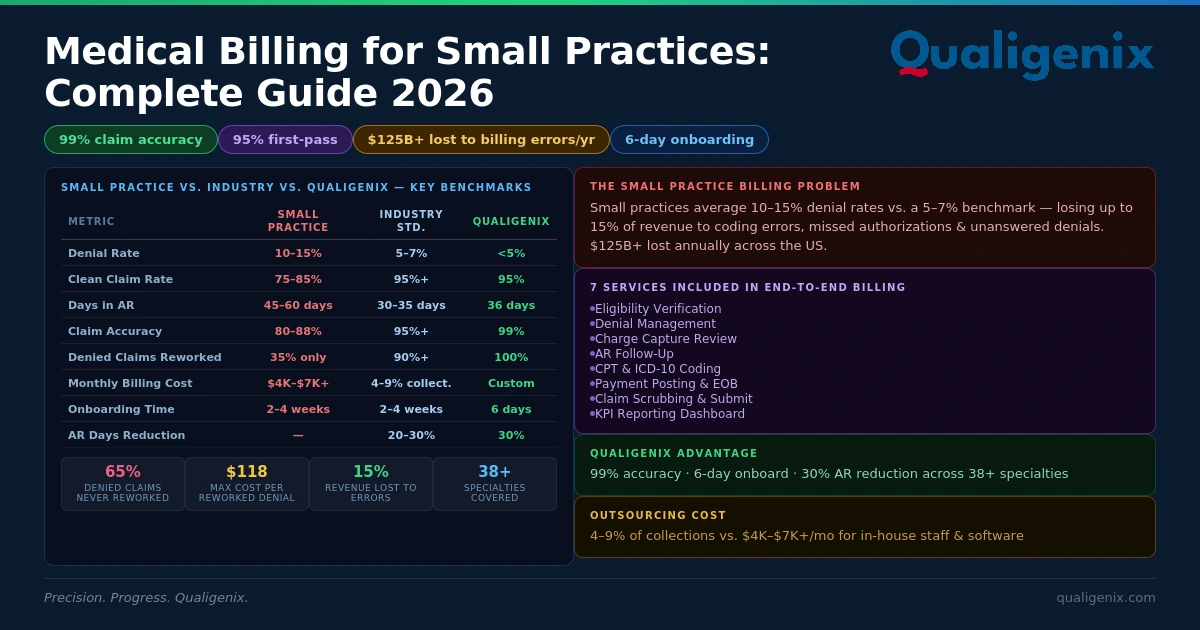
Small practices lose up to 15% of revenue to billing errors, denied claims, and slow follow-up. Professional medical billing services fix this by handling coding, claim submission, denial management, and AR follow-up. Qualigenix clients average a 99% claim accuracy rate, 95% first-pass acceptance, and a 30% reduction in AR days — with onboarding in as few as 6 days.
Running a small medical practice is rewarding. But billing often gets in the way. Your front desk is juggling check-ins. Your clinical staff is documenting visits. And somewhere in between, claims go out with errors, denials pile up unanswered, and revenue sits uncollected in aging AR.
This is not a management failure. It is a capacity problem. Small practices do not have the bandwidth to run a high-performing medical billing operation alongside everything else. Professional medical billing services exist to fill that gap.
This guide explains what medical billing services for small practices include, how much they cost, what to look for in a billing partner, and how to set up a process that works.
Medical billing services for small practices are outsourced solutions that manage claim submission, coding, denial management, and accounts receivable. They help practices collect revenue faster and stay compliant with payer rules — without the cost of a full in-house billing department.
The Real Cost of Billing Problems in Small Practices
Most small practice owners know billing is a problem. Few realize how large it is.
According to the Medical Group Management Association (MGMA), the average denial rate across all practices is 5 to 7%. Small practices routinely report denial rates of 10 to 15%. That gap represents money for services already delivered but never collected.
Denied claims cost $25 to $118 each to rework. And 65% of denied claims are never reworked at all — they are written off as bad debt. For a practice seeing 200 patients per month, a 10% denial rate means significant monthly revenue walking out the door.
The root causes are predictable: coding errors, missing authorizations, eligibility failures, and untimely filing. Each is preventable — but only if someone has time to run the process. That is the core value of outsourced medical billing.
Medical Billing Benchmarks: Small Practices vs. Industry Standards
| Metric | Small Practice Avg. | Industry Benchmark | Qualigenix |
|---|---|---|---|
| Denial Rate | 10–15% | 5–7% | <5% |
| Clean Claim Rate | 75–85% | 95%+ | 95% |
| Days in AR | 45–60 days | 30–35 days | 36 days avg. |
| Claim Accuracy Rate | 80–88% | 95%+ | 99% |
| Cost to Rework a Denied Claim | $25–$118 | Under $25 (target) | Minimized via prevention |
| Denied Claims Never Reworked | 65% | <10% | Systematic follow-up on all |
| Billing Service Cost | 4–9% of collections | 4–9% of collections | Custom per practice |
| Onboarding Time | 2–4 weeks (typical) | 2–4 weeks | As few as 6 days |
| AR Days Reduction Post-Outsourcing | Varies | 20–30% | 30% |
| Specialties Covered | Varies by vendor | — | 38+ specialties |
| U.S. Revenue Lost to Billing Errors | $125 billion+ / year | — | — |
| EHR-Related Billing Error Rate | Up to 30% | — | Caught in pre-submission scrub |
Sources: MGMA Cost Survey 2025; CMS National Health Expenditure Data 2025; Qualigenix internal performance data 2026.
What Medical Billing Services for Small Practices Include
A true end-to-end billing solution covers every step from patient registration to final payment — not just claim submission.
1. Insurance Eligibility Verification
Eligibility verification confirms a patient’s coverage, co-pay, deductible, and authorization requirements before the appointment. This single step prevents a large share of front-end denials — and a professional billing team does it in real time, so your front desk does not have to.
2. Charge Capture Review
Charge capture records all billable services from a patient encounter. Missed charges are silent revenue leaks — they do not generate denials, so they go undetected. A billing service reviews encounter data against documented services to catch unbilled charges before submission.
3. Medical Coding (CPT and ICD-10)
Accurate coding is the foundation of a high clean claim rate — the percentage of claims paid on the first submission. The benchmark is 95% or higher. Small practices relying on clinical staff to self-code often fall well below this due to specialty-specific nuances and payer rule variations.
4. Claim Submission and Scrubbing
Before a claim goes out, it should be scrubbed against payer-specific rules — checking for bundling conflicts, modifier requirements, and diagnosis linkage. Professional billing teams use clearinghouse tools to catch errors before submission, not after a denial arrives.
5. Denial Management
Denial management identifies, appeals, and resolves rejected claims, then fixes the root cause so it does not repeat. Most small practices lack the staff to do this systematically. A billing service makes denial resolution a defined workflow — not an afterthought.
6. Accounts Receivable Follow-Up
Days in AR — the average time between service date and payment — is a key financial metric. The benchmark is 30 to 35 days. Proactive AR follow-up, including outbound calls to payers on aging claims, keeps this number in range.
7. Payment Posting and Reconciliation
Payment posting records payments from Explanations of Benefits (EOBs) and Electronic Remittance Advice (ERAs). A thorough process also flags underpayments — where a payer paid less than the contracted rate — so you can pursue corrections.
Should a small practice outsource medical billing?
For most small practices, yes. Outsourcing eliminates the cost of hiring, training, and retaining billing staff. It replaces unpredictable in-house performance with defined benchmarks and systematic denial management. The fee — typically 4 to 9% of collections — is usually offset by higher collection rates and fewer write-offs.
In-House Billing vs. Outsourced Medical Billing
| Factor | In-House Billing | Outsourced Billing |
|---|---|---|
| Monthly Cost | $4,000–$7,000+ (salary + benefits + software) | 4–9% of collections |
| Coverage During Absence | None (vacation, sick, turnover) | Continuous — team-based model |
| Specialty Coding Expertise | Depends on individual hire | Built-in across 38+ specialties |
| Denial Follow-Up | Often inconsistent or delayed | Systematic, tracked per claim |
| Monthly Reporting | Manual or limited | Dashboard and KPI reports |
| Payer Rule Updates | Managed manually by staff | Maintained by billing team |
| Scalability | Requires new hires to grow | Scales with volume automatically |
How to Choose a Medical Billing Company for Your Small Practice
Your billing company becomes a core part of your revenue operation. Here is what to evaluate before signing a contract.
Specialty Experience
Payer rules and coding requirements vary by specialty. A company experienced in family medicine may not understand interventional pain or behavioral health. Ask how many providers in your specialty they currently serve — and ask for references.
Clean Claim Rate and Denial Benchmarks
Any reputable billing company should state their clean claim rate. The target is 95%+ on first submission. Ask for their average denial rate and how denied claims are tracked to resolution. If they cannot provide these numbers, move on.
What questions should I ask a medical billing company?
Ask: What is your clean claim rate? How do you handle denied claims? What is your onboarding timeline? Do you have experience with my specialty? What does monthly reporting include? What happens to my AR if I end the contract? Get every answer in writing before signing.
Transparent Reporting
Monthly performance reports are non-negotiable. You need data on claims submitted, paid, denied, and aging AR — broken down by payer. Without this visibility, you cannot manage your practice financially.
Onboarding Timeline
Onboarding requires EHR credentials, payer contracts, fee schedules, and NPI numbers. A well-run onboarding takes no more than two weeks. At Qualigenix, we complete it in as few as 6 days.
How to Set Up Medical Billing Services: Step by Step
- Audit your current billing performance. Pull 90 days of claims data. Calculate denial rate, clean claim rate, and days in AR. This baseline shows exactly where revenue is leaking.
- Select your billing partner. Evaluate specialty expertise, benchmarks, denial workflows, and contract terms. Ask for references.
- Complete onboarding. Provide EHR credentials, payer contracts, fee schedules, and NPI numbers. Your billing team maps charge codes and configures payer rules before going live.
- Establish communication workflows. Define how charge data flows from clinical to billing, how denials are resolved, and how often you receive reports.
- Monitor KPIs monthly. Track clean claim rate, denial rate, days in AR, and collection rate. Compare against your baseline every month.
How quickly can a small practice see results after outsourcing?
Most practices see measurable improvement within the first billing cycle. Clean claim rates improve within 30 days. AR reductions are visible within 60 to 90 days. Qualigenix clients regularly report a 30% reduction in AR days within the first quarter.
How Qualigenix Supports Small Medical Practices
At Qualigenix, we specialize in revenue cycle management for practices that cannot afford billing errors or slow collections. We bring specialty-specific expertise across 38+ specialties and manage every billing step — from eligibility verification through AR follow-up.
Our medical billing outsourcing services integrate with your existing EHR. No workflow changes on the clinical side. We handle billing so you can focus on patients.
We combine proactive denial management with aggressive AR follow-up — so revenue never sits idle. Every client gets monthly KPI reporting with full payer-level breakdowns.
Medical Billing Checklist for Small Practices
- ☐ Eligibility verified for every patient before the appointment
- ☐ Charge capture reviewed against clinical documentation per encounter
- ☐ Claims scrubbed against payer rules before submission
- ☐ Clean claim rate tracked monthly (target: 95%+)
- ☐ Denied claims worked within 5 business days of receipt
- ☐ Root cause analysis performed on all denial categories
- ☐ Aging AR over 90 days below 15% of total AR
- ☐ Payment postings reconciled against EOBs and ERAs within 48 hours
- ☐ Underpayments flagged and pursued against contracted rates
- ☐ Monthly reports include denial rate, days in AR, and collection rate
Frequently Asked Questions
What are medical billing services for small practices?
Outsourced solutions handling claim submission, coding, denial management, and AR on behalf of small medical offices. They help practices get paid faster and lower overhead without maintaining a full in-house billing team.
How much do medical billing services cost for a small practice?
Most companies charge 4 to 9% of monthly collections. This is typically offset by higher collection rates and fewer denied claims compared to in-house billing.
What is the denial rate for small medical practices?
Small practices often see 10 to 15%, vs. an industry benchmark of 5 to 7%. Poor coding, documentation gaps, and eligibility errors are the top causes. Professional billing typically brings this below 5%.
Should a small practice outsource medical billing?
Yes for most practices. Outsourcing removes salary, training, and software costs while improving clean claim rates and reducing AR days. The service fee is usually more than offset by better collection performance.
How long does it take to get paid after claim submission?
Commercial payers typically adjudicate electronic claims in 14 to 30 days. Medicare and Medicaid pay in 14 to 21 days for clean claims. Qualigenix clients average a 36-day collection cycle from service date to payment.
What is revenue cycle management for small practices?
Revenue Cycle Management (RCM) is the end-to-end process from scheduling and eligibility verification through coding, claim submission, payment posting, and AR follow-up. Outsourcing RCM improves cash flow and frees your team to focus on patient care.
What is a clean claim rate and why does it matter?
The percentage of claims paid on first submission without correction. The benchmark is 95%+. Low rates cause delayed cash flow, higher rework costs, and more write-offs. Qualigenix maintains a 95% first-pass acceptance rate.
How does Qualigenix help small medical practices with billing?
End-to-end billing across 38+ specialties — eligibility verification, specialty coding, claim submission, denial management, and AR follow-up. Clients get a 99% claim accuracy rate, 95% first-pass acceptance, 30% AR day reduction, and onboarding in as few as 6 days.
Related Resources
Qualigenix Service Pages:
- Medical Billing Outsourcing Services
- Revenue Cycle Management Services
- Denial Management Services
- AR Follow-Up Services
- Claim Submission Services
- Insurance Eligibility Verification
Blog Guides:
- Medical Billing Outsourcing vs. In-House: Full Comparison
- What Is Revenue Cycle Management? A Beginner’s Guide
- Denial Management Process: Essential Steps
- The Healthcare Billing Process Explained
- Accounts Receivable in Medical Billing
- Outsourcing Revenue Cycle Management: How It Works
Stop Leaving Revenue on the Table
Your small practice deserves billing performance that matches your clinical standards. Qualigenix handles every step — so you can focus on patients, not paperwork.
Our team delivers 99% claim accuracy, a 95% first-pass acceptance rate, an average 36-day collection cycle, and a 30% reduction in AR days. We onboard in as few as 6 days.
Precision. Progress. Qualigenix.
What’s Next

Denial Management in 2026: The Top 10 Codes and the Appeal Playbook for Each
Denials cluster around a small set of codes, and each one has a different correct response. Some need a...

ASC Billing: Where Facility Fees and Physician Fees Get Miscoded Together
ASC facility and physician claims both go out on a CMS-1500 form with the same CPT code and place...

Coordination of benefits errors: why secondary payer claims take 3x longer to resolve
Secondary payer claims stall because coordination of benefits errors, wrong payer order, outdated COB records, and missing primary...