

Payment Posting in Medical Billing: The Complete Guide for Healthcare Practices in 2026
The Qualigenix Editorial Team consists of certified billing and coding experts with over 40 years of experience across 38+ medical specialties. Our content is rigorously researched against CMS, AMA, and payer-specific guidelines to ensure total compliance and accuracy. We apply the same elite standards to our resources as we do our client work, consistently delivering high claim accuracy and significant reductions in AR days.


Key Takeaway: Payment posting in medical billing is the process of recording insurance payments, adjustments, and denials into the practice management system after a claim is adjudicated. Done accurately and within 24 to 48 hours, it keeps AR clean, surfaces underpayments, and ensures patients receive correct statements. Errors compound quickly and touch every downstream billing function. Qualigenix delivers 99% posting accuracy and a 36-day average collection cycle across 38+ specialties.
Payment posting in medical billing is one of the most overlooked steps in the revenue cycle and one of the most consequential. Every dollar your practice collects passes through payment posting. Every denial that needs follow-up is first identified here. Every patient statement that goes out is only as accurate as the payment posting that came before it.
Get it right, and your AR stays clean, your cash flow stays predictable, and your team knows exactly where every dollar stands. Get it wrong or let it fall behind and the errors compound fast. Incorrect postings distort financial reports, delay patient collections, mask underpayments, and create compliance exposure that is expensive to unwind.
Despite its importance, payment posting is frequently assigned to the least experienced billing staff, executed without quality checks, and deprioritized when the team gets busy. The result is an AR that looks fine on paper until someone digs in and finds months of unresolved balances, unapplied credits, and missed denials.
This guide covers exactly what payment posting in medical billing involves, how ERA and EOB processing works, the errors that cost practices the most revenue, and how Qualigenix manages it to keep your revenue cycle running cleanly.
What is payment posting in medical billing?
Payment posting in medical billing is the process of recording insurance payments, patient payments, contractual adjustments, and claim denials into a practice management system after a payer adjudicates a claim. It updates the patient account to reflect what was paid, what was written off, and what balance remains, connecting claim adjudication to AR management and patient billing.
Payment Posting in Medical Billing — Key Statistics 2026
| Metric | Data Point | Source / Notes |
|---|---|---|
| Ideal payment posting turnaround | 24–48 hours after receipt | Industry standard |
| ERA auto-posting accuracy | 97–99% | Industry benchmark |
| Manual EOB posting accuracy | 85–90% | Industry benchmark |
| Clean claim payment timeline | 14–30 days | Payer average |
| Revenue lost to underpayments | 1–3% of total collections | MGMA data |
| Denials never appealed | Up to 65% industry-wide | MGMA / AMA |
| Most common posting error | Posting to wrong patient / claim | Billing audit data |
| Impact of delayed posting on AR | AR ages 30–90+ days unnecessarily | Industry benchmark |
| Qualigenix claim accuracy rate | 99% | Qualigenix Internal |
| Qualigenix first-pass acceptance rate | 95% | Qualigenix Internal |
| Qualigenix average collection cycle | 36 days | Qualigenix Internal |
| Qualigenix reduction in AR days | 30% | Qualigenix Internal |
What Is Payment Posting in Medical Billing and Why Does It Matter?
Payment posting is the step in the revenue cycle that happens immediately after a payer processes a claim. The payer sends back a remittance either electronically via ERA or on paper via EOB explaining what was paid, what was denied, and what adjustments were applied. The billing team records all of this into the practice management system against the correct patient account and claim line.
It sounds simple. But precision matters at every step. A payment posted to the wrong account creates a false credit on one patient and an open balance on another. A contractual adjustment applied incorrectly makes a denied claim look paid. A denial that is not flagged for follow-up quietly ages out of the AR and gets written off revenue gone with no attempt at recovery.
The downstream impact of poor payment posting is significant. AR reports become unreliable. Patient statements carry wrong balances. Underpayments go undetected for months. Financial reports show inflated or deflated figures that make it impossible to manage the practice with confidence. Payment posting is not a clerical task, it is a revenue protection function. When it runs cleanly, everything downstream works better.
Where Payment Posting Fits in the Revenue Cycle
The revenue cycle moves from patient scheduling through charge capture, claim submission, adjudication, payment posting, denial management, and patient collections. Payment posting sits at the center of this flow, it receives the output of claim adjudication and feeds the input for both denial management and patient billing. Every dollar that enters the practice passes through payment posting. No other single process touches as much revenue as this one.
ERA vs. EOB: The Two Forms of Payment Posting in Medical Billing
Payment posting in medical billing happens through one of two remittance formats ERA or EOB. The format determines how fast posting can happen, how accurately it is completed, and how much staff time it consumes. Understanding both is essential for building an efficient posting operation.
What Is an ERA and How Does It Work?
An ERA (Electronic Remittance Advice) is a standardized X12 835 electronic file that payers transmit after claim adjudication. It contains line-item detail for every claim in the batch payment amounts, denial reason codes (CARC), remark codes (RARC), and patient responsibility figures. ERA files are received through a clearinghouse or direct payer connection and imported automatically into most practice management systems. This is called auto-posting. ERA auto-posting achieves 97 to 99% accuracy and processes entire payment batches in a fraction of the time manual EOB entry requires. Every practice should have ERA enrollment set up with all major payers. If yours does not, that is the first fix.
What Is an EOB and How Is It Posted?
An EOB (Explanation of Benefits) is the paper or PDF version of the same remittance information. It contains identical adjudication data but must be manually read and entered into the practice management system claim by claim. Manual EOB posting typically runs at 85 to 90% accuracy is meaningfully lower than ERA and is significantly more staff-intensive. For payers that still issue paper EOBs, a structured manual posting workflow with verification checkpoints is the only way to protect accuracy. Qualigenix applies the same four-point verification standard to manual EOB entries as it does to ERA exception handling, keeping both posting channels at the same accuracy level.
ERA vs. EOB Payment Posting: A Direct Comparison
| Factor | ERA (Electronic) | EOB (Paper / PDF) |
|---|---|---|
| Posting method | Auto-import into PMS | Manual data entry |
| Typical accuracy | 97–99% | 85–90% |
| Posting speed | Same day, often automated | 1–3 days per batch |
| Staff time required | Low — review and exceptions | High — full manual entry |
| Denial visibility | Immediate — coded CARC/RARC | Delayed — manual interpretation |
| Adjustment application | Automatic via crosswalk rules | Manual — higher error risk |
| Best for | All payers where ERA is available | Payers without ERA capability |
The Payment Posting Process in Medical Billing: Step by Step
Payment posting follows a defined sequence. Each step matters. Skipping or rushing any one of them introduces errors that are hard to find and expensive to correct later.
Step 1 — Receive the Remittance Advice
The process starts when the ERA or EOB arrives from the payer. ERAs come electronically through a clearinghouse and queue for auto-posting. EOBs arrive by mail or payer portal and must be batched for manual review. The date of receipt starts the clock, posting should be complete within 24 to 48 hours. Letting remittances sit for three to five days before posting allows AR to age unnecessarily and delays patient billing. This is one of the most common and most avoidable bottlenecks in the revenue cycle.
Step 2 — Match Payment to the Correct Claim
Every payment must match the correct patient account, claim number, date of service, and procedure code before entry. Mismatches are the single most common posting error and the most damaging. Posting a payment to the wrong account creates a false credit on one patient and an open balance on another. Both require manual audit trail documentation and correction that costs more time than getting it right the first time. ERA auto-posting uses electronic claim identifiers to eliminate most mismatch risk. Manual EOB posting requires a four-point verification step before any entry is made.
Step 3 — Post the Insurance Payment
Record the payment amount at both the claim level and the line-item level for each procedure code. Any difference between what was billed and what was paid must be classified in the next two steps as either a contractual adjustment or a denial. A payment that is posted as “paid in full” when the amount does not match the contracted rate is an underpayment and it will be invisible to your denial management team unless payment posting catches it first.
Step 4 — Apply Contractual Adjustments
The contractual adjustment is the write-off of the gap between the billed charge and the payer’s contracted fee schedule rate. This amount is not collected from the patient, and it is not a billing error. It is the negotiated discount. ERA auto-posting applies adjustment codes using a pre-configured crosswalk. Manual posting requires the specialist to calculate the correct adjustment from a current fee schedule. Using an outdated fee schedule or applying a flat adjustment is a frequent source of incorrect patient balances and distorted AR reports.
What Happens to Denied Claims During Payment Posting?
Denied claims are identified during payment posting when the payer returns a $0 payment with a denial reason code. The payment poster must flag every denial with the correct CARC and RARC, then route it immediately to the denial management team. A denial posted without being flagged becomes invisible, it ages out unworked and is written off without a recovery attempt. Up to 65% of denials industry-wide are never appealed, mostly because denial triage at the posting stage failed.
Every remittance contains a mix of paid claims and denied claims. The denied lines must be separated, coded with their reason codes, and routed to the follow-up queue at the time of posting not batched for later review. The longer a denial sits before it is worked, the harder recovery becomes. Payers have timely filing limits for appeals, and those windows close fast.
At Qualigenix, our posting team flags every denial in real time, applies the correct CARC and RARC codes, and passes it directly into our denial management workflow as part of the posting transaction itself. Nothing ages out unworked.
Underpayments: The Hidden Revenue Leak That Payment Posting Must Catch
An underpayment occurs when a payer reimburses less than the contracted rate not a denial, just less than owed. The claim shows as “paid.” The account looks resolved. But the practice collected less than it was contractually entitled to, and no one knows unless payment posting is designed to check.
Industry estimates put underpayments at 1 to 3% of total collections. For a practice billing $2 million annually, that is $20,000 to $60,000 in unrecovered revenue per year consistently, silently, compounding. Catching underpayments requires comparing each line-item payment against the contracted rate for that specific payer and CPT code combination. This is not possible without a current fee schedule crosswalk integrated into the posting workflow.
Warning: Accepting underpayments without disputing them effectively sets a precedent with the payer. Repeated underpayment of the same CPT code accepted without dispute, can make rate correction harder later, especially if your contracted fee schedule has not been reviewed and updated recently.
Qualigenix maintains current contracted rate tables for all major payers and runs payment-to-contract variance checks as part of every posting workflow. Underpayments are flagged, documented, and submitted for recovery systematically, not absorbed as a cost of doing business.
How Does Payment Posting Affect Patient Billing?
After insurance payment posting is complete, the remaining patient responsibility is copay, coinsurance, or deductible. It is calculated and posted to the patient account. This triggers the patient statement. Inaccurate payment posting means the patient receives a statement with the wrong balance, leading to billing disputes, delayed collections, and patient dissatisfaction that is entirely avoidable.
Every patient statement is built on top of the payment posting that preceded it. If the insurance payment was posted to the wrong account, or the contractual adjustment was applied incorrectly, the patient’s balance will be wrong. A patient billed more than they owe disputes the bill, delays payment, and may escalate the complaint. A patient billed less than they owe creates a revenue shortfall the practice absorbs. Both outcomes trace directly to a payment posting error.
Qualigenix runs a pre-statement balance verification step that confirms the math: insurance payment plus contractual adjustment equals billed amount. Any discrepancy is resolved before the statement is generated, eliminating the most common sources of patient billing complaints at the source.
How Qualigenix Manages Payment Posting for Healthcare Practices
At Qualigenix, payment posting is a revenue protection function not a data entry task. We treat every ERA and EOB as a financial document requiring verification, accurate entry, denial triage, underpayment review, and pre-statement balance confirmation before the account is considered resolved.
Our workflow is built on four core principles: post within 24 to 48 hours of receipt, verify every match before entry, flag every denial at the time of posting, and check every payment against the contracted rate. These four steps executed consistently drive our 99% claim accuracy rate and 36-day average collection cycle.
We handle ERA auto-posting and manual EOB posting with the same accuracy standard applied to both. ERA exceptions are reviewed by a specialist before manual intervention. EOB entries go through a four-point verification checklist. Denials are categorized and routed to follow-up as part of the posting transaction itself, not as a separate step scheduled for later.
Here is what our clients see:
- 99% claim accuracy — correct postings the first time, every time
- 95% first-pass acceptance rate — fewer denials reaching the posting stage
- 36-day average collection cycle — faster AR turnover, better cash flow
- 30% reduction in AR days — cleaner books, less aging, fewer write-offs
- Underpayment recovery — every payment checked against contracted rates
- Real-time denial routing — no denial ages out unworked
Our billing operations integrate directly with provider credentialing and payer enrollment, so credentialing gaps, taxonomy errors, and enrollment mismatches are caught before they generate denials that reach the posting stage.
Payment Posting Quality Control Checklist
Use this checklist to audit your payment posting process and identify gaps before they affect your AR:
- ☑ ERA enrollment active with all major payers for auto-posting
- ☑ All payments posted within 24–48 hours of remittance receipt
- ☑ Four-point account verification completed before every manual EOB entry
- ☑ Contractual adjustments applied using current, payer-specific fee schedule
- ☑ Every denied claim line flagged with CARC and RARC codes at time of posting
- ☑ Denied claims routed to follow-up queue at time of posting — not batched for later
- ☑ Every payment checked against contracted rate for underpayment variance
- ☑ ERA exceptions reviewed by billing specialist before manual intervention
- ☑ Patient balance verified mathematically before any statement is generated
- ☑ AR aging report reviewed weekly to catch unresolved postings before 60 days
Frequently Asked Questions About Payment Posting in Medical Billing
What is payment posting in medical billing?
Payment posting in medical billing is the process of recording insurance payments, patient payments, contractual adjustments, and claim denials into a practice management system after a payer adjudicates a claim. It connects claim adjudication to AR management and patient billing, every dollar the practice collects passes through this step.
What is the difference between ERA and EOB in payment posting?
An ERA is a digital X12 835 remittance file that auto-posts into the practice management system with 97 to 99% accuracy. An EOB is the paper or PDF version of the same data, requiring manual entry at 85 to 90% accuracy. All practices should set up ERA enrollment with every major payer to maximize posting speed and minimize errors.
Why is payment posting important in medical billing?
Payment posting is the foundation of clean AR management. Without accurate and timely posting, practices cannot identify denials, catch underpayments, generate correct patient statements, or produce reliable financial reports. Errors in payment posting affect every downstream billing function and compound over time into significant revenue loss.
What is a contractual adjustment in payment posting?
A contractual adjustment is the write-off of the difference between the provider’s billed charge and the payer’s contracted reimbursement rate. This amount is not billed to the patient. Applying the wrong adjustment amount distorts the patient balance and the AR report, a common but preventable error when current fee schedules are not used.
What causes payment posting errors in medical billing?
The most common causes are posting to the wrong patient or claim, applying incorrect contractual adjustments, failing to flag denials at the time of posting, missing underpayments by not checking against contracted rates, and manual entry errors on paper EOBs. Most errors are preventable with ERA auto-posting and structured verification workflows.
How long does payment posting take after a claim is processed?
Payment should be posted within 24 to 48 hours of receiving the remittance. Delays beyond 48 hours allow AR to age unnecessarily, delay patient billing, and make denial follow-up harder. ERA auto-posting can reduce turnaround to same-day for most electronic remittances, which is the standard Qualigenix applies across all client accounts.
What happens if payment posting is not done correctly?
Inaccurate payment posting leads to distorted AR balances, undetected underpayments, incorrect patient statements, denials that age out unworked, and financial reports that cannot be trusted. In serious cases, incorrect posting records can trigger payer audits. The downstream cost of poor payment posting far exceeds the cost of building a proper posting process.
What is balance billing in the context of payment posting?
After insurance payment posting is complete, the remaining patient responsibility is copay, coinsurance, or deductible. It is billed directly to the patient. Accurate payment posting is what determines the correct patient balance. If payment posting is wrong, the patient statement is wrong , leading to disputes, delayed collections, and preventable patient dissatisfaction.
Related Resources
- Revenue Cycle Management Services
- Denial Management Services
- Provider Credentialing
- Payer Enrollment Services
- Podiatry Billing Guide
- Medicare Billing Guidelines
Is Your Payment Posting Costing You Revenue?
Qualigenix manages payment posting, denial identification, underpayment recovery, and patient balance billing all with a 99% accuracy rate and a 36-day average collection cycle. We clean up your AR and keep it that way.
Our team delivers 99% claim accuracy, a 95% first-pass acceptance rate, an average 36-day collection cycle, and a 30% reduction in AR days. We onboard in as few as 6 days.
Precision. Progress. Qualigenix.
What’s Next
Denial Management in 2026: The Top 10 Codes and the Appeal Playbook for Each
Denials cluster around a small set of codes, and each one has a different correct response. Some need a...

ASC Billing: Where Facility Fees and Physician Fees Get Miscoded Together
ASC facility and physician claims both go out on a CMS-1500 form with the same CPT code and place...
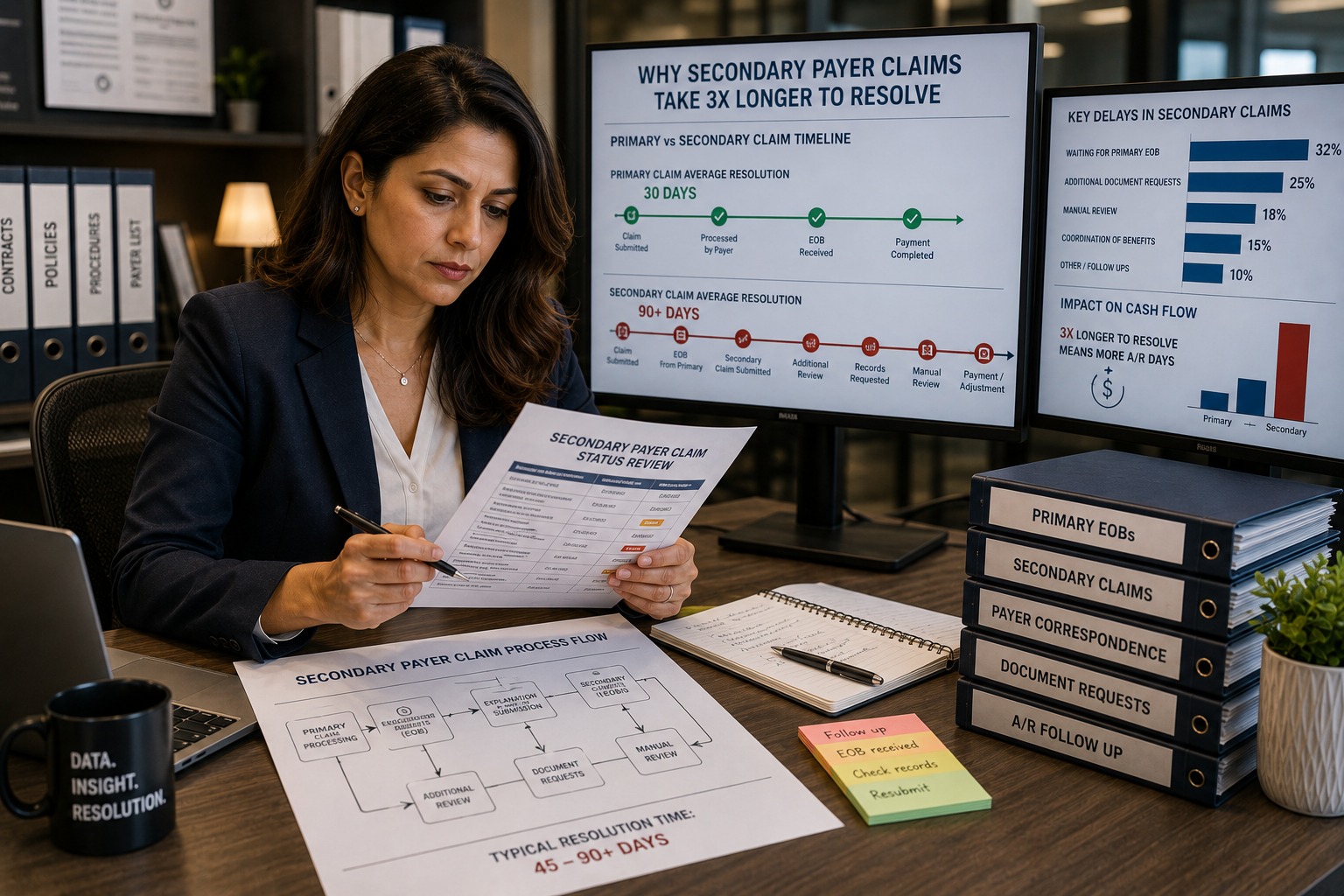
Coordination of benefits errors: why secondary payer claims take 3x longer to resolve
Secondary payer claims stall because coordination of benefits errors, wrong payer order, outdated COB records, and missing primary...