

Inpatient Coding for Physicians: What Changes in Hospital Settings
The Qualigenix Editorial Team consists of certified billing and coding experts with over 40 years of experience across 38+ medical specialties. Our content is rigorously researched against CMS, AMA, and payer-specific guidelines to ensure total compliance and accuracy. We apply the same elite standards to our resources as we do our client work, consistently delivering high claim accuracy and significant reductions in AR days.

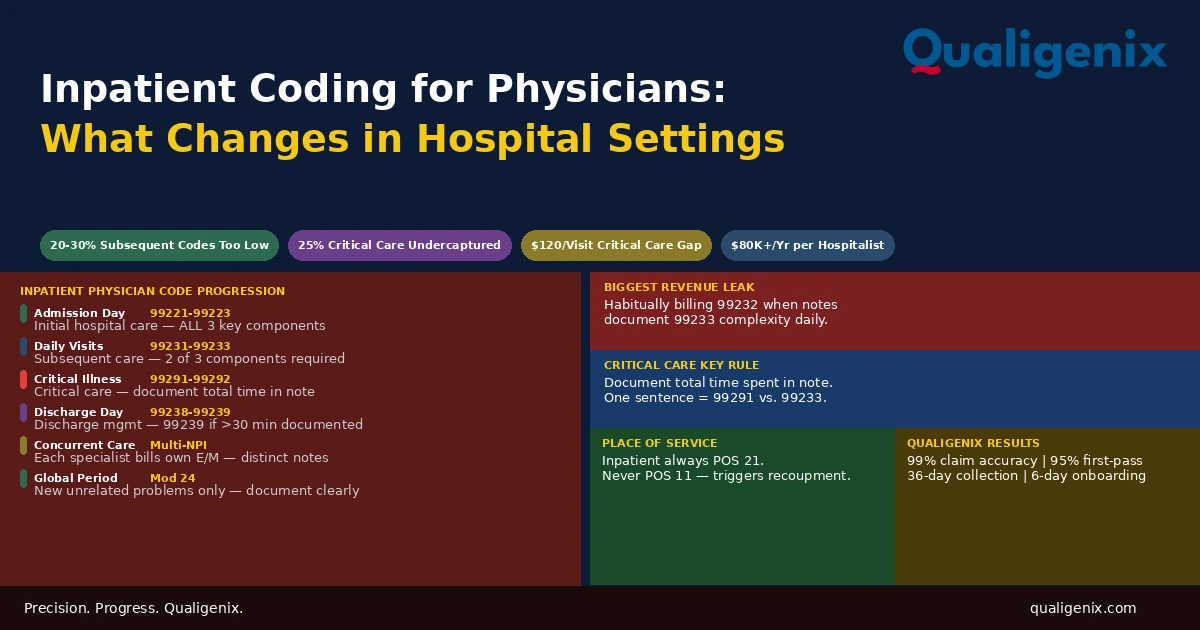
Physician inpatient coding uses a completely different CPT code set than outpatient coding, with different documentation requirements, different code selection logic, and different revenue risks. A hospitalist, surgeon, or specialist billing professional services from a hospital setting is not applying outpatient E/M rules to a different patient population. They are operating under a separate billing framework with its own admission codes, daily visit codes, discharge codes, critical care rules, concurrent care documentation standards, and global period considerations. Practices that treat inpatient coding as outpatient coding in a hospital produce systematic revenue gaps that compound across every day of every patient stay.
The physician working in a hospital and the physician working in an office are both billing Medicare Part B for professional services on the CMS-1500 form. From a billing structure perspective, that’s where the similarity ends. The codes are different. The documentation requirements are different. The per-encounter billing logic is different. The modifiers are different. The relationship between today’s visit and yesterday’s visit is different. And the revenue risks — the specific ways money gets lost through coding errors — are different.
Most physicians who work in both settings learn outpatient coding first and extend it imperfectly to inpatient situations. Hospitalists who came up through residency and fellowship learned to document hospital encounters for clinical purposes, not billing purposes. The gap between what was documented and what was needed to support the highest defensible code level is often significant, and it shows up in every subsequent visit code billed at 99231 when the clinical complexity documented supports 99233.
This blog covers the physician inpatient coding framework: what codes apply at each stage of an admission, what documentation they require, where revenue is consistently lost, and what the specialty-specific considerations are for hospitalists, surgeons, and consulting specialists.
Inpatient coding for physicians covers professional services billed under Medicare Part B using CPT codes on the CMS-1500. Admission day services use initial hospital care codes 99221-99223. Daily visits use subsequent hospital care codes 99231-99233. Discharge services use codes 99238-99239. Critical care uses 99291-99292 based on documented time. Each code has distinct documentation requirements. All inpatient claims use place of service code 21. The most common revenue losses are habitual subsequent care code selection, under-captured critical care time, and missed discharge service documentation.
Inpatient Physician Coding: Key Numbers
| Metric | Data Point | Source |
|---|---|---|
| Subsequent care visits billed below supported level | Estimated 20% to 30% | Inpatient coding audit benchmarks |
| Critical care under-capture rate | Estimated 15% to 25% of qualifying encounters | Hospital billing analysis |
| Medicare difference: 99231 vs. 99232 | $25 to $40 per daily visit | CMS Physician Fee Schedule |
| Medicare difference: 99232 vs. 99233 | $40 to $60 per daily visit | CMS Physician Fee Schedule |
| Critical care (99291) vs. subsequent (99233) gap | $80 to $120 per encounter (Medicare) | CMS Physician Fee Schedule |
| Annual revenue impact of missed daily visit per hospitalist | $30,000 to $80,000+ depending on census | Hospitalist revenue analysis |
| Inpatient place of service code | 21 | CMS place of service standards |
| Discharge code 99239 threshold | More than 30 minutes documented | CMS Medicare Claims Processing Manual |
| Critical care 99291 time threshold | 30 to 74 minutes per day | AMA CPT guidelines |
| Global period surgical post-op care (major surgery) | 90 days | CMS global period standards |
| Qualigenix first-pass acceptance rate | 95% | Qualigenix performance data |
| Qualigenix claim accuracy rate | 99% | Qualigenix performance data |
| Qualigenix average collection cycle | 36 days | Qualigenix performance data |
| Qualigenix client onboarding time | 6 days | Qualigenix operations data |
The Core Distinction: Professional Billing vs. Facility Billing
When a patient is admitted to a hospital, two completely separate billing entities are generating claims from the same stay. The hospital bills under Part A using the UB-04 form for facility costs: the room, the nursing care, the equipment, the supplies. The physician bills under Part B using the CMS-1500 form for professional services: the clinical evaluation, the decision making, the procedures performed.
These two billing streams run completely independently. The hospital’s ICD-10-PCS facility coding has no bearing on the physician’s CPT professional coding. The hospital’s DRG payment to the facility has no bearing on the physician’s fee schedule payment. A physician practicing in a hospital setting needs to understand only the professional billing framework, not the facility coding system.
The place of service code on the physician’s CMS-1500 claim does affect their reimbursement rate. Medicare pays the facility rate (lower) when POS 21 is used because the hospital is receiving a separate Part A payment for overhead. This is not a penalty. It is how the payment system is designed. Physicians practicing in hospitals understand they will be paid at the facility rate for inpatient professional services. What they must avoid is accidentally billing at the non-facility rate (POS 11) for inpatient services, which triggers overpayment followed by recoupment.
The Inpatient E/M Code Set: Admission Through Discharge
Physician inpatient professional services follow a structured code progression through the patient’s stay. Each phase of the admission has its own CPT code set with its own documentation requirements and its own code selection logic.
Initial Hospital Care: 99221, 99222, 99223
The first time a physician sees a patient after hospital admission, they bill one of the initial hospital care codes. These are billed once per admission per physician. If a hospitalist admits a patient and then another hospitalist covers the weekend, the second hospitalist bills subsequent care codes, not initial care codes, because the initial visit has already been billed for this admission under the same group practice.
Initial hospital care code selection requires all three key components to be documented at the highest level that supports the code: comprehensive history, comprehensive physical examination, and medical decision making. The level of each component determines which of the three codes is appropriate.
| Code | History | Exam | MDM | Typical Scenario |
|---|---|---|---|---|
| 99221 | Detailed | Detailed | Straightforward or Low | Uncomplicated admission for a single problem |
| 99222 | Comprehensive | Comprehensive | Moderate | Admission requiring workup with multiple considerations |
| 99223 | Comprehensive | Comprehensive | High | Complex admission with high severity, multiple conditions |
Most hospital admissions document at the 99222 or 99223 level. A patient admitted with chest pain, dyspnea, and multiple comorbidities receiving a full workup is a 99223. Billing them at 99221 because it feels “safer” is systematic undercoding that compounds across every admission the practice handles.
Subsequent Hospital Care: 99231, 99232, 99233
Every calendar day after the initial visit when the physician sees the patient, a subsequent hospital care code is billed. These are the highest-volume codes in hospitalist billing and the ones where habitual code selection causes the most revenue loss.
Subsequent hospital care code selection requires at least two of three key components to be documented. The problem is that most daily hospital notes have a standard format that supports the same code level regardless of how complex the patient’s clinical situation actually was that day. A physician managing a patient with multiple decompensating organ systems documents their note in the same SOAP format they use for a patient being observed after a minor procedure. The code selected is often the same because the note looks the same, not because the clinical complexity was the same.
| Code | Documentation (2 of 3) | MDM Level | Typical Scenario |
|---|---|---|---|
| 99231 | Problem-focused, Expanded PF, Straightforward/Low | Straightforward or Low | Patient stable, recovering uneventfully |
| 99232 | Expanded PF, Detailed, Moderate | Moderate | Patient responding but with ongoing management decisions |
| 99233 | Detailed, Comprehensive, High | High | Patient unstable, new or worsening conditions, complex management |
Warning: The single most common inpatient coding revenue loss is hospitalists defaulting to 99232 for all subsequent visits regardless of daily clinical complexity. A patient with new acute kidney injury layered on heart failure and COPD being actively managed with multiple medication adjustments, cardiology and nephrology consults, and daily lab review documents high complexity MDM. That is a 99233. A patient two days post-uncomplicated pneumonia treatment who is stable and nearing discharge documents low complexity. That is a 99231. Billing both at 99232 undervalues the complex day and overvalues the simple one. The complex day’s undercoding is where the revenue loss lives.
Hospital Discharge Day Management: 99238, 99239
The day a patient is discharged, the physician bills discharge day management rather than a subsequent care code. Discharge services include the final examination, a discussion of the hospital course with the patient and family, instructions for continuing care after discharge, preparation of referral forms and prescriptions, and coordination of post-discharge care.
CPT 99238 applies when discharge services take 30 minutes or less. CPT 99239 applies when they take more than 30 minutes. The time must be documented in the note to support 99239. Many hospitalists document thorough discharge plans but don’t record the time spent on discharge activities, defaulting to 99238 even when the work clearly exceeded 30 minutes.
Discharge coding is the code most frequently missed entirely in hospitalist billing. When a hospitalist signs a discharge order but doesn’t enter a charge because the administrative workload at shift end absorbs the coding step, the encounter generates no revenue. For a hospitalist group discharging 10 patients per day across the group, missing one discharge code per day represents $5,000 to $10,000 in annual lost revenue from a single overlooked charge entry step.
Critical Care Coding: The Highest Revenue Opportunity Most Physicians Miss
Critical care coding is the most underutilized billing opportunity in hospital-based physician practice. When a physician spends significant time directly managing a critically ill patient — a patient with acute respiratory failure, septic shock, hemodynamic instability, or any condition that poses an immediate threat to life and requires constant physician attention — that time qualifies for critical care billing rather than standard inpatient E/M codes.
CPT 99291 covers the first 30 to 74 minutes of critical care time on a given calendar day. CPT 99292 covers each additional 30 minutes beyond that. Critical care reimburses substantially more than even the highest subsequent care code: $80 to $120 more per encounter under Medicare, and proportionally more with commercial payers.
What Critical Care Requires
Critical care billing requires three things to be properly documented. First, the patient must have a critical illness or injury, defined as one that acutely impairs one or more vital organ systems and creates a high probability of imminent life-threatening deterioration without physician intervention. Second, the physician must be providing high-complexity decision making to assess and manage the critical condition. Third, the physician must document the total time spent in direct critical care, even if not continuous.
The time documentation is where many physicians fall short. A physician who spent 45 minutes at the bedside managing a patient in septic shock, reviewing cultures, adjusting vasopressors, and speaking with the family about goals of care has provided critical care services. If the note says “complex patient, multiple adjustments made” but doesn’t document the time spent, the coder cannot bill critical care. They must fall back to a subsequent care code because the time element is missing.
Research consistently shows that 15% to 25% of inpatient encounters that qualify for critical care coding are billed at subsequent care code levels instead. The primary reason is not that the physician didn’t provide critical care. It is that the note doesn’t include the phrase “critical care” or the time spent in direct critical care management. A single sentence — “I provided 45 minutes of direct critical care management” — is the difference between a 99233 and a 99291 on that encounter.
Critical care cannot be billed simultaneously with certain other services on the same day. Procedures that are bundled into critical care include interpretation of cardiac output measurements, chest X-ray interpretation, pulse oximetry, and certain ventilator management services. Unbundling these from critical care claims is a compliance error. The billing team must know what is and is not separately billable during a critical care episode.
Concurrent Care: When Multiple Specialists Bill the Same Day
A hospitalized patient with heart failure, diabetes, and acute kidney injury may be seen by the hospitalist, a cardiologist, and a nephrologist on the same day. Each of these physicians can bill their own inpatient E/M service independently because each is providing a distinct, medically necessary service from their specialty perspective.
This is concurrent care, and it is legitimate billing when documented correctly. The documentation requirement for concurrent care is that each physician’s note must establish that their service was medically necessary and distinct from the other physicians’ services. A hospitalist note and a cardiologist note that are substantially identical in their assessment and plan create a documentation question about whether two separate E/M services were genuinely provided or whether one physician’s note was replicated.
Payers reviewing concurrent care claims look for specialty-specific content. The cardiologist’s note should address cardiac management decisions. The nephrologist’s note should address renal considerations. The hospitalist’s note should reflect overall coordination and management decisions beyond the scope of the consulting specialists. Notes that don’t differentiate by specialty content are vulnerable to audit.
Inpatient Coding for Surgeons: The Global Period Complexity
For surgeons, inpatient coding intersects with the global surgical period in ways that create both compliance risk and revenue gaps if not managed correctly.
What’s Included in the Global Period
The surgical global period includes preoperative care beginning one day before major procedures, the procedure itself, and post-operative care for either 10 days (minor surgery) or 90 days (major surgery). During the global period, routine inpatient visits related to the surgical procedure are bundled into the surgical fee. A surgeon making daily rounds on a patient they operated on is performing global period care for which no additional billing is allowed for post-op management.
This means a surgeon who performs a major abdominal procedure cannot bill inpatient E/M codes for the patient’s routine post-operative management during the 90-day global period. Those visits are included in the surgical fee. Billing them separately is a global period violation that payers will recoup during audit.
When Separate Billing Is Allowed During the Global Period
Not every inpatient encounter during the global period is non-billable. Three categories of services are separately billable during the surgical global period.
The first is E/M services for a new problem unrelated to the surgery. If a patient develops a new condition during their post-operative stay that has no relationship to the procedure performed, the surgeon can bill an E/M for that visit using modifier 24. The modifier signals that the E/M was unrelated to the surgery. The documentation must clearly establish the new problem and why it is unrelated to the surgical episode.
The second is E/M services for complications of the surgery that require a decision for return to the operating room. A significant, unplanned complication requiring surgical intervention is separately billable.
The third is evaluation and management by a different physician in a different specialty who was not involved in the original surgery. A cardiologist consulting on a post-operative patient can bill their inpatient E/M regardless of the surgical global period because the global period applies to the surgeon’s services, not the consulting specialist’s.
Observation vs. Inpatient: Coding Implications for Physicians
Hospital admission status determines whether a patient is classified as inpatient or observation. This classification affects the hospital’s billing under Part A, but for physician professional billing under Part B, the CPT codes are largely the same regardless of admission status.
Initial observation care uses codes 99221-99223. Subsequent observation care uses 99224-99226. Observation discharge uses 99217. If a patient is converted from observation to inpatient status during the same calendar day, the initial hospital care code (99221-99223) is billed for that day rather than separate observation codes.
The practical billing challenge with observation status is that patients and practices are sometimes unclear about the patient’s status. A patient who believes they are admitted as an inpatient may actually be on observation status for Medicare purposes. This affects the patient’s cost-sharing under Medicare but doesn’t change the physician’s professional billing significantly. What it does affect is whether the practice bills initial hospital care or initial observation care codes for the first day, which requires knowing the patient’s actual status.
Documentation Standards for Inpatient Physician Coding
The documentation requirements for inpatient physician coding differ from outpatient in a critical respect: the history and physical examination components still matter for inpatient E/M code selection. The 2021 AMA guideline changes that shifted outpatient E/M selection to MDM or time did not apply in the same way to inpatient coding at its initial implementation. The key components framework — history, examination, and medical decision making still drives initial and subsequent hospital care code selection.
This means physicians who have updated their outpatient documentation to reflect MDM-based coding may still need to document specific history and exam components for their inpatient encounters to support the highest appropriate code level. A daily hospital note that focuses entirely on the patient’s current status and plan without capturing the interval history taken and the examination performed that day may not support the highest level of subsequent care code even when the clinical management was complex.
The practical documentation standard for inpatient physician notes that support appropriate coding is: interval history noting any changes in the patient’s condition since the last visit, a focused or comprehensive physical examination depending on the complexity of management, and an assessment and plan that explicitly identifies the problems being managed, the data reviewed, and the risk level of the clinical decisions made.
How Qualigenix Manages Inpatient Physician Coding
At Qualigenix, we manage inpatient physician billing for hospitalist groups, surgical practices, and specialist consultants across 38+ specialties. Our coding team applies the correct inpatient code set for each encounter type, reviews documentation for key component support, and identifies critical care opportunities where time documentation exists but the code hasn’t been applied.
We run monthly code distribution reports on subsequent care code selection per physician, flagging providers who bill predominantly at 99231 or 99232 when their patient census complexity suggests a higher distribution is expected. We coordinate directly with physicians when documentation doesn’t support a higher code level, giving specific feedback on what to add rather than defaulting to a lower code and writing off the revenue opportunity.
We also manage the credentialing and enrollment infrastructure that makes inpatient billing valid in the first place. A hospitalist, surgeon, or consultant seeing patients in a hospital must be credentialed with the hospital for clinical privileges and enrolled with the patient’s payer for billing. Both must be current. We track both.
Related: Outpatient Coding Accuracy at Scale | What Is Physician Billing | Charge Capture for High-Volume Specialties
Inpatient Physician Coding Checklist
- Initial hospital care (99221-99223) billed once per admission per physician on first visit day
- Subsequent hospital care code level selected based on documented clinical complexity, not habit
- Daily notes document interval history, examination, and assessment/plan with MDM elements
- Critical care time documented in notes when patient status meets critical care definition
- Discharge code (99238 or 99239) entered on discharge day with time documented for 99239
- Place of service code 21 applied to all inpatient claims
- Concurrent care notes differentiate each specialty’s service from others on same day
- Surgical global period tracked — routine post-op visits not separately billed during global period
- Modifier 24 applied for E/M services during global period for new unrelated problems
- Observation vs. inpatient status confirmed before coding first-day encounter
- Same-day admission and discharge billed with initial hospital care code only
- Charges entered within 24 hours to prevent memory-based coding and timely filing risk
Frequently Asked Questions: Inpatient Coding
What is inpatient coding for physicians?
Inpatient coding for physicians is the CPT code assignment for professional services delivered to admitted hospital patients, billed under Medicare Part B on the CMS-1500. It uses a distinct code set from outpatient coding: 99221-99223 for admission, 99231-99233 for daily visits, 99238-99239 for discharge, and 99291-99292 for critical care. All inpatient physician claims use place of service code 21. The physician’s professional fee is billed separately from the hospital’s facility fee, which runs under Part A on the UB-04.
How does inpatient E/M coding differ from outpatient E/M coding?
Outpatient E/M codes 99202-99215 are selected based on MDM complexity or total time under 2021 AMA guidelines. Inpatient E/M codes use a different set — 99221-99223 for admission and 99231-99233 for daily visits — selected using key component documentation of history, exam, and medical decision making. The 2021 outpatient E/M changes did not apply identically to inpatient codes. Physicians who updated their outpatient documentation approach may still need to document specific history and exam components for inpatient encounters to support appropriate code levels.
What is critical care coding in the inpatient setting?
Critical care is billed using CPT 99291 for the first 30-74 minutes of direct management of a critically ill patient and 99292 for each additional 30 minutes. It replaces the standard subsequent care code when the patient’s condition meets the critical care definition. Time must be explicitly documented in the note. An estimated 15% to 25% of encounters qualifying for critical care billing are coded at subsequent care levels instead because the physician didn’t document the time spent in direct critical care management.
What is hospital discharge day management coding?
Hospital discharge day management uses CPT 99238 for discharge services of 30 minutes or less and 99239 for more than 30 minutes, billed on the actual discharge date. It covers the final examination, discharge instructions, coordination of post-discharge care, and preparation of discharge documentation. Discharge coding is the encounter most commonly missed in hospitalist billing when charge entry is skipped at shift end. Each missed discharge code represents a separately billable encounter that was delivered but never billed.
What is concurrent care in inpatient coding?
Concurrent care is when two or more physicians from different specialties each provide distinct, medically necessary services to the same inpatient on the same day. Each bills their own E/M code under their own NPI. Documentation must demonstrate that each physician’s service was specialty-specific and distinct. Notes that appear substantially identical across specialties create audit risk. Each specialist’s note should reflect their specific clinical domain and the decisions made within it.
How does the surgical global period affect inpatient coding?
Routine post-operative inpatient visits during the surgical global period are bundled into the surgical fee and cannot be separately billed. E/M services for new problems unrelated to the surgery are billable with modifier 24. Major surgery carries a 90-day global period. Billing inpatient E/M codes for routine post-op management during this window is a global period violation that generates recoupment. Missing modifier 24 on separately billable visits for new problems during the global period is a revenue gap on legitimate services.
What are the most common inpatient physician coding errors?
The most common inpatient physician coding errors are billing subsequent care codes at habitual levels regardless of daily clinical complexity, missing critical care time documentation when patient status qualifies, failing to enter discharge codes at all, billing both initial and discharge codes on same-day admission and discharge, and using incorrect place-of-service codes. All are systematic revenue losses or compliance risks that require a code distribution review and documentation audit to identify and correct prospectively.
Related Resources from Qualigenix
- Outpatient Coding Accuracy at Scale
- What Is Physician Billing
- Charge Capture for High-Volume Specialties
- Provider Credentialing Services
- What Is RCM in Medical Billing
- Accounts Receivable Medical Billing
- CMS Medicare Claims Processing Manual (CMS.gov)
Inpatient Coding Gaps Cost More Per Day Than Outpatient Ones.
Qualigenix manages inpatient physician billing for hospitalists, surgeons, and specialists across 38+ specialties. We apply the right codes at every stage of the admission, capture critical care when it qualifies, and close the documentation gaps that leave inpatient revenue behind every day.
Our team delivers 99% claim accuracy, a 95% first-pass acceptance rate, an average 36-day collection cycle, and a 30% reduction in AR days. We onboard in as few as 6 days.
Precision. Progress. Qualigenix.
What’s Next

Outsourced vs. in-house behavioral health billing: which actually costs less?
For most behavioral health practices, outsourced billing costs less than in-house once you count the true price of a...
12 Questions to Ask a Medical Billing Company Before You Sign
The right billing company protects your revenue. The wrong one quietly drains it while sending you clean-looking reports....
Denial Management in 2026: The Top 10 Codes and the Appeal Playbook for Each
Denials cluster around a small set of codes, and each one has a different correct response. Some need a...