

Charge Capture in Medical Billing for High-Volume Specialties: What’s Different
The Qualigenix Editorial Team consists of certified billing and coding experts with over 40 years of experience across 38+ medical specialties. Our content is rigorously researched against CMS, AMA, and payer-specific guidelines to ensure total compliance and accuracy. We apply the same elite standards to our resources as we do our client work, consistently delivering high claim accuracy and significant reductions in AR days.

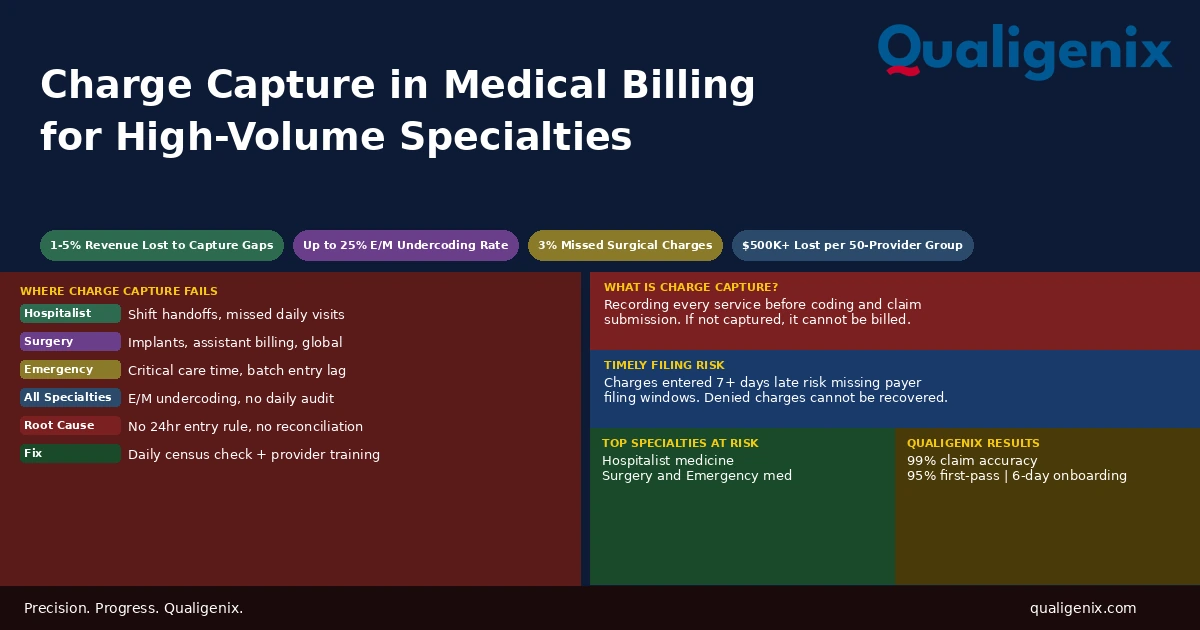
Charge capture in medical billing fails differently in high-volume specialties. Hospitalist, surgical, and emergency care practices lose revenue not because billing staff make errors, but because charge entry gaps happen at the point of care before billing even starts. Fixing it requires specialty-specific workflows, daily reconciliation, and clear charge entry deadlines for providers.
Most billing problems start at the back end. Charge capture problems start at the front. A hospitalist rounds on 15 patients before noon. A surgeon finishes three cases back to back. An EM physician turns a bay in under 20 minutes. In each scenario, the question isn’t whether the care was documented. It’s whether every billable element of that care made it into the billing system at all.
That’s the charge capture problem. And in high-volume specialties, it compounds fast. A missed charge here and a miscoded service there adds up to revenue that’s gone permanently once timely filing windows close. No appeal process brings it back.
This blog covers what charge capture in medical billing looks like across three high-risk specialties, where the gaps typically form, and what it takes to close them.
Charge capture in medical billing is the process of recording every service, procedure, and supply provided to a patient before coding and claim submission. In high-volume specialties, charge capture fails when providers see too many patients too quickly to enter charges accurately. The result is missed charges, undercoding, and late entries that miss timely filing windows. Practices typically lose 1% to 5% of total revenue to charge capture failures.
Charge Capture in Medical Billing: Key Numbers
| Metric | Data Point | Source |
|---|---|---|
| Revenue lost to charge capture failures | 1% to 5% of total practice revenue | MGMA Revenue Cycle benchmarks |
| Average charge lag in hospitalist programs | 2 to 5 days post-encounter | Hospitalist billing surveys |
| Missed charge rate in high-volume surgical practices | Up to 3% of billable services | RCM industry data |
| Typical payer timely filing window | 90 days to 1 year from date of service | Payer contract standards |
| E/M undercoding rate in hospitalist billing | 15% to 25% of encounters | Coding audit benchmarks |
| Annual revenue lost per 1 missed charge/shift (50-provider hospitalist group) | $500,000 or more | Qualigenix revenue analysis |
| Emergency medicine charge capture failure rate | 2% to 4% of encounters | Emergency billing surveys |
| Charge lag threshold before denial risk rises significantly | Over 7 days from date of service | Payer filing requirement data |
| Surgical supply charge missed rate in high-volume OR settings | 5% to 8% of implant and supply line items | OR charge reconciliation studies |
| Qualigenix first-pass acceptance rate | 95% | Qualigenix performance data |
| Qualigenix claim accuracy rate | 99% | Qualigenix performance data |
| Qualigenix average collection cycle | 36 days | Qualigenix performance data |
What Charge Capture Actually Means in a High-Volume Setting
Charge capture is the step between delivering care and billing for it. A provider sees a patient, documents the visit, performs a procedure, or administers a treatment. Charge capture is the act of recording what was done in a format the billing system can use to generate a claim. Without it, no claim gets created. No claim, no reimbursement.
In a low-volume setting, this is manageable. A primary care physician sees 20 patients a day in a predictable workflow. Each visit has a natural end point where the provider or a scribe enters the charge before moving to the next patient. The process is tight.
High-volume specialties don’t work that way. A hospitalist may see 15 to 25 patients across multiple hospital floors before their shift ends. A surgeon may complete three cases before noon and not touch the billing system until that evening. An emergency physician turns patients continuously in a fast-moving bay environment. In each case, charge entry is deferred, rushed, or done from memory. That’s where revenue walks out the door.
The core problem with charge capture in high-volume medical billing is not that providers don’t want to enter charges. It’s that their clinical workflow was designed around patient care, not billing entry. When charge capture isn’t built into the clinical workflow as a required step, it becomes optional by default.
The financial impact of this is not theoretical. At 1% to 5% of total revenue lost to charge capture failures, a 10-provider hospitalist group generating $4 million in annual billings could be leaving $40,000 to $200,000 on the table. Multiply that across a 50-provider program and the number is in the hundreds of thousands, every year, without a single payer contract issue or coding error to explain it.
Hospitalist Billing: Where Charge Capture Breaks Down Daily
Hospitalist medicine is the highest-risk specialty for charge capture failures. The reasons are structural. Hospitalists don’t have a fixed schedule with appointment slots. They manage a census, and that census changes throughout the day as patients are admitted, transferred, and discharged. Every change in patient status is a potential billing event. And billing events that happen in motion get missed.
The Daily Census Problem
The most basic charge capture failure in hospitalist billing is the missed daily visit. Inpatient subsequent care codes (99231, 99232, 99233) require a billable visit each calendar day a hospitalist sees the patient. When a provider sees 20 patients and enters charges for 19, that one missed charge is invisible to billing staff unless someone runs a census reconciliation that day.
Most hospitalist programs don’t run daily census reconciliation. They run weekly reviews at best. By then, five or six days of missed visits may be sitting uncaptured. The provider who missed the entry has moved on to new patients and can’t accurately recall which day the gap occurred. The charge gets written off or entered late with questionable documentation to support it.
Warning: Shift changes in hospitalist programs are a consistent charge capture failure point. When a provider hands off a patient mid-stay, the outgoing provider may not enter charges for encounters that happened close to the handoff time. The incoming provider doesn’t bill for services they didn’t perform. The result: a gap in billing with no one at fault and no one aware it happened.
Undercoding in Hospitalist E/M Billing
Missed charges are one problem. Undercoded charges are another. Hospitalist billing surveys consistently show that 15% to 25% of inpatient E/M charges are billed at a lower level than the documented visit supports. A provider who spent 40 minutes managing a complex patient with multiple comorbidities may enter 99232 out of habit rather than confirming that the documentation supports 99233.
This isn’t fraud. It’s a combination of time pressure, lack of coding education, and default behavior. Providers who have always billed 99232 will keep billing 99232 unless someone pulls their code distribution reports and shows them the pattern. A coding audit that identifies a 20% undercoding rate across 15 hospitalists is the kind of finding that produces immediate revenue recovery without touching a single denial.
Concurrent Care Gaps
Hospitalist patients are frequently seen by multiple specialists on the same day. A patient admitted for heart failure may be visited by the hospitalist, the cardiologist, and the nephrologist within 12 hours. Each provider can bill for their own visit as concurrent care, provided each visit is medically necessary and distinctly documented. When concurrent care documentation isn’t in place, payers deny all but the primary physician’s claim.
Charge capture workflows for hospitalist programs need to include a concurrent care flag so billing staff know to verify documentation before submission. This is a workflow design issue, not a coder issue. The coders can only work with what charge capture sends them.
Surgical Specialties: Three Charge Capture Failures That Cost the Most
Surgical billing has its own charge capture profile. The OR environment moves fast, implants and supplies get used without being formally logged, and the global period rules create billing restrictions that providers often don’t fully understand. The result is a mix of missed revenue and compliance risk that billing teams in surgical specialties deal with constantly.
Missed Implant and Supply Charges
Every implant used in a surgical procedure has a separate billable component. Pacemakers, joint replacements, surgical mesh, bone grafts: each one carries a charge that must be captured and submitted alongside the surgical CPT code. In high-volume OR settings, implant charge capture depends on a chain of documentation that runs from the scrub tech to the OR charge nurse to the supply chain system to billing.
That chain breaks. Supply chain systems don’t always sync with billing software. Charge nurses document implants used but the data doesn’t flow through to the claim. Billing staff create the claim from the operative report, which may not itemize every supply. Research on OR charge capture consistently shows that 5% to 8% of implant and supply line items go unbilled in high-volume surgical programs.
For surgical practices, implant and supply charge capture requires a dedicated reconciliation step between the OR supply log, the scrub tech’s count sheet, and the billing system. This is a separate workflow from coding the operative report and must be treated as one.
Assistant Surgeon and Co-Surgeon Billing
When a surgery requires an assistant surgeon or a co-surgeon, each provider’s participation must be captured and coded separately. The primary surgeon’s charge gets entered. The assistant surgeon’s charge often doesn’t, either because no one flagged the case as requiring assistant documentation, or because the assistant surgeon’s practice and the primary surgeon’s practice have separate billing systems with no coordination between them.
This is especially common in academic medical centers and large group practices where surgeons work alongside residents, PAs, and other attending surgeons. The assistant billing modifier (modifier 80, 81, or 82 depending on the circumstance) has to be applied correctly, and payers have specific coverage policies on when they’ll reimburse for assistants. Charge capture that doesn’t flag the assistant involvement from the start sends billing staff working with incomplete information.
Global Period Miscounts
Surgical procedures have a global period: a window of 0, 10, or 90 days during which pre-operative and post-operative care is bundled into the surgical fee and cannot be billed separately. Charge capture systems that don’t track global periods by procedure and date of service will generate separate E/M charges for post-operative visits that payers will deny as included in the global.
The flip side also happens. A patient who presents with a new problem during the global period can be billed for that separate visit with the appropriate modifier (modifier 24 for unrelated E/M during global period). If charge capture doesn’t flag this as a separate billable event, the practice loses that visit’s reimbursement entirely.
Emergency Medicine: Volume and Speed Make Every Gap Expensive
Emergency medicine is a different animal. EM physicians see patients around the clock with no scheduled appointments, no predictable acuity, and no natural pause in the workflow for charge entry. The department charges multiple service types simultaneously: facility charges from the hospital, professional charges from the EM physician group, and ancillary charges for imaging, labs, and procedures. Each runs through a separate billing system. Each has its own capture requirements.
The Professional Charge Lag Problem
EM physician groups typically use mobile charge capture applications or EHR charge entry tools. Providers are expected to enter charges during or immediately after the encounter. In practice, many EM physicians batch their entries at the end of a shift or the next morning. A 10-hour shift with 25 patient encounters gets entered from memory 12 hours later.
Memory-based charge entry produces two specific problems. First, complex encounters get simplified. A level 5 EM visit with multiple procedures and critical care time gets entered as a level 4 because the provider doesn’t want to look up the documentation and code it accurately. Second, short encounters and incidental procedures get dropped entirely. A brief revisit to a patient already seen earlier in the shift may not get entered at all.
Critical Care Billing Gaps in the ED
Critical care time is one of the highest-value billable components in emergency medicine, and one of the most under-captured. CPT code 99291 covers the first 30 to 74 minutes of critical care. CPT 99292 covers each additional 30 minutes beyond that. Both require specific documentation of the time spent and the direct involvement of the physician in managing life-threatening conditions.
EM physicians who spend 45 minutes managing a critically ill patient in the ED often don’t capture it as critical care time. They default to a high-level E/M code. The difference in reimbursement between a level 5 E/M and a properly documented critical care charge can be $80 to $120 per encounter depending on the payer. Across a busy ED seeing 80,000 patients annually, the cumulative impact of under-captured critical care is substantial.
Warning: EM providers who separately bill for procedures performed during a critical care encounter need to know which procedure codes are bundled into critical care and which are billable separately. Coding a procedure as a standalone charge when it’s included in the critical care time triggers an automated denial. This is a charge capture education issue, not a payer issue.
The 6-Step Charge Capture Fix for High-Volume Practices
There’s no single tool that solves charge capture across all three of these specialties. What works is a combination of workflow design, provider education, and daily reconciliation. Here’s what the fix looks like in practice.
- Map every service type to a charge entry point. List every service your specialty delivers and identify exactly where in the workflow it gets entered. Find the steps where services are delivered but no entry requirement exists. Those are your gaps.
- Set a 24-hour charge entry rule. All charges must be entered within 24 hours of the encounter. This is the single most effective change a high-volume practice can make. It eliminates memory-based entry, reduces lag, and keeps every charge well within timely filing windows.
- Run a daily census reconciliation. Compare the daily patient census, the OR schedule, or the ED patient log against charges submitted each day. Any patient without a corresponding charge is an immediate follow-up item. Don’t wait for weekly reviews.
- Pull monthly E/M code distribution reports. Look at the bell curve of codes your providers are billing. If 80% of your hospitalists’ inpatient visits bill at 99232 and none bill at 99233, you have a systematic undercoding problem that an audit will confirm. Address it with documentation education before it compounds further.
- Train providers on specialty rules once per quarter. Global periods, concurrent care documentation, critical care time requirements, modifier usage: these rules change and providers forget them. A 30-minute quarterly charge capture training prevents thousands of dollars in missed or denied charges.
- Review charge lag reports weekly. Track the average days between date of service and charge entry by provider. Any individual consistently entering charges more than 3 days late needs a workflow conversation. Any lag over 7 days is a timely filing risk that requires immediate action.
How Qualigenix Supports Charge Capture in High-Volume Billing
At Qualigenix, we work with practices across 38+ specialties, including hospitalist programs, surgical groups, and emergency medicine. We don’t just process claims. We look at the full cycle from charge entry to payment posting to find where revenue is leaking before it becomes a pattern.
Our billing team runs charge reconciliation as a standard part of our workflow, not an add-on. We pull census-to-charge comparisons, flag lag outliers by provider, and identify E/M code distribution anomalies that signal undercoding. When we find them, we document the finding, brief the practice leadership, and work with providers on the specific rules that apply to their specialty.
We also handle the credentialing and payer enrollment infrastructure that makes charge capture worth doing. A perfectly captured charge for a provider who isn’t enrolled with the right payer still results in a denial. We manage both sides so your revenue cycle functions as a connected system, not a series of disconnected steps.
Our numbers reflect this approach: a 99% claim accuracy rate, a 95% first-pass acceptance rate, a 30% reduction in AR days, and an average 36-day collection cycle. We onboard new clients in as few as 6 days.
Learn more: Payer Enrollment Services | Provider Credentialing | Payment Posting in Medical Billing
Charge Capture Audit Checklist for High-Volume Specialties
- All providers have a 24-hour charge entry deadline in place
- Daily census or schedule reconciliation runs against charges submitted
- E/M code distribution reports pulled and reviewed monthly
- Charge lag tracked by provider and reviewed weekly
- Hospitalist shift handoff protocol includes charge entry verification
- Concurrent care documentation flagged in charge capture workflow
- Surgical implant and supply charges reconciled against OR log each case
- Assistant surgeon and co-surgeon charges captured with correct modifiers
- Global period tracking built into billing system by procedure and date
- EM critical care time documentation reviewed quarterly for capture accuracy
Frequently Asked Questions: Charge Capture Medical Billing
What is charge capture in medical billing?
Charge capture in medical billing is the process of recording every service, procedure, and supply provided to a patient so it can be coded and submitted to a payer for reimbursement. It bridges clinical care and the billing system. If a service isn’t captured, it doesn’t get coded, no claim gets submitted, and the revenue is lost. No appeal process recovers a charge that was never entered.
Why does charge capture matter more in high-volume specialties?
In high-volume specialties, providers see dozens of patients per shift across multiple locations, and each encounter generates charges. Even a small percentage of missed or miscoded charges compounds into significant lost revenue at scale. A 2% charge capture failure rate in a 50-provider hospitalist group can represent $500,000 or more in uncollected revenue annually.
What are the most common charge capture errors in medical billing?
The most common charge capture errors are missed charges, E/M undercoding, late entry past timely filing windows, wrong modifier selection, and missing supply or implant charges. In hospitalist billing, shift handoff gaps and concurrent care documentation failures are the top causes. In surgical billing, implant charges and global period miscounts are the biggest revenue leaks.
How does hospitalist charge capture differ from outpatient billing?
Hospitalist billing uses inpatient E/M codes requiring daily documentation across a moving patient census, while outpatient billing is encounter-based at a fixed visit point. Hospitalists must capture a billable visit for each calendar day they see a patient, manage concurrent care documentation when multiple specialists are involved, and handle frequent shift changes that create entry gaps. Outpatient billing doesn’t have these structural pressures.
What is a charge capture lag and why does it cause denials?
Charge capture lag is the delay between when a service is delivered and when it is entered into the billing system. Payers have timely filing windows ranging from 90 days to 1 year from the date of service. Charges entered too late miss these windows and result in denials that can’t be appealed. In surgical and emergency care settings, lag builds up when providers batch their charge entry days after the encounter.
How do surgical specialties lose revenue through charge capture?
Surgical practices lose revenue when implant and supply charges aren’t captured, when assistant surgeon billing is missed, and when global period rules cause post-operative visits to be billed or skipped incorrectly. Research shows 5% to 8% of surgical implant and supply line items go unbilled in high-volume OR settings. Each missed implant charge is a direct revenue loss with no recovery path after the encounter closes.
What is concurrent care and how does it affect charge capture?
Concurrent care is when two or more physicians from different specialties provide distinct, medically necessary services to the same patient on the same day. Each can bill separately with proper documentation. Poor charge capture processes miss the concurrent care documentation requirement, and payers deny all but the primary physician’s claim. A concurrent care flag in the charge capture workflow prevents this.
Can charge capture software fully prevent missed charges?
No. Charge capture software reduces missed charges but doesn’t eliminate them. Software depends on provider input and EHR integration quality. In high-volume settings, providers under time pressure skip entries or use default codes instead of accurate ones. Technology helps, but workflow design, provider training, and daily charge reconciliation audits are still required to close the gap.
How often should practices audit their charge capture process?
High-volume specialties should run charge reconciliation audits at minimum monthly, and ideally daily or weekly. Daily census-to-charge comparisons catch gaps before timely filing windows close. Monthly E/M code distribution reviews catch undercoding patterns. Waiting for quarterly audits means some missed charges are already past the recovery point and some undercoding patterns have already cost months of revenue.
What is the difference between charge capture and coding?
Charge capture is recording that a service occurred. Coding is assigning the correct CPT, ICD-10, and modifier values to that service. Both must be accurate for a clean claim. A service can be captured but miscoded, or correctly coded but never captured in the first place. Either failure results in lost revenue. Charge capture happens at the clinical level. Coding happens at the billing level. The two must be connected by a clear, accountable workflow.
Related Resources from Qualigenix
- Payer Enrollment Services
- Provider Credentialing Services
- Payment Posting in Medical Billing
- CAQH Profile Management
- Re-credentialing Services
- Telehealth Provider Credentialing
- CMS Physician Fee Schedule (CMS.gov)
- Contact
Losing Revenue to Charge Capture Gaps? We Find Them.
Qualigenix audits your charge capture workflow, identifies missed and undercoded charges, and builds the reconciliation process your high-volume practice needs. We handle billing, credentialing, and enrollment as a connected system.
Our team delivers 99% claim accuracy, a 95% first-pass acceptance rate, an average 36-day collection cycle, and a 30% reduction in AR days. We onboard in as few as 6 days.
Precision. Progress. Qualigenix.
What’s Next

Outsourced vs. in-house behavioral health billing: which actually costs less?
For most behavioral health practices, outsourced billing costs less than in-house once you count the true price of a...
12 Questions to Ask a Medical Billing Company Before You Sign
The right billing company protects your revenue. The wrong one quietly drains it while sending you clean-looking reports....
Denial Management in 2026: The Top 10 Codes and the Appeal Playbook for Each
Denials cluster around a small set of codes, and each one has a different correct response. Some need a...