

What Is Medicare Billing and How the Process Works
The Qualigenix Editorial Team consists of certified billing and coding experts with over 40 years of experience across 38+ medical specialties. Our content is rigorously researched against CMS, AMA, and payer-specific guidelines to ensure total compliance and accuracy. We apply the same elite standards to our resources as we do our client work, consistently delivering high claim accuracy and significant reductions in AR days.

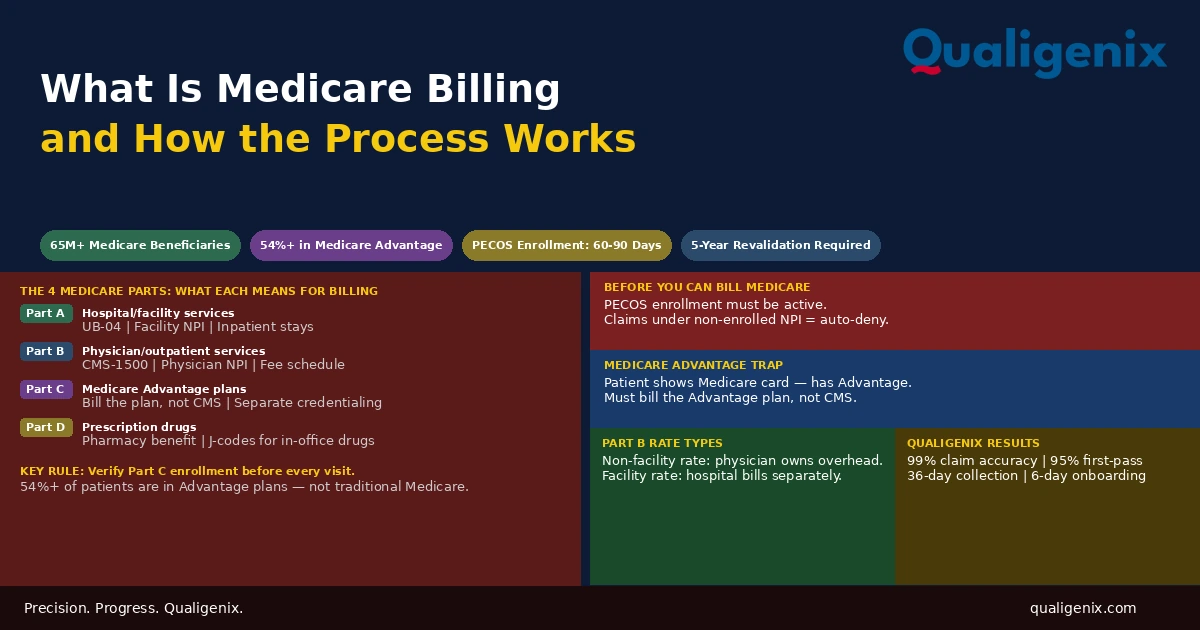
Medicare billing covers four distinct Parts, each with different covered services, claim forms, billing entities, and payment structures. For most physician practices, Medicare Part B is the primary billing concern. But with over 54% of Medicare enrollees now in Medicare Advantage plans, the majority of Medicare patients don’t bill to traditional Medicare at all. They bill to private Advantage plans that require separate credentialing, have their own fee schedules, and operate with their own prior authorization rules. A practice that understands traditional Medicare billing but hasn’t built a parallel process for Medicare Advantage is missing the majority of what Medicare billing actually requires in 2026.
Medicare is the largest single payer in most physician practices. For practices serving patients 65 and older or patients with qualifying disabilities, Medicare claims can represent 30% to 50% of total billing volume. Getting Medicare billing right isn’t a specialty skill. It’s foundational.
And yet Medicare billing is misunderstood in specific, costly ways. Practices submit claims under providers who aren’t enrolled. They bill traditional Medicare for patients who switched to Advantage plans. They miss the revalidation deadline that deactivates billing privileges. They forget the ABN when a service is likely non-covered and absorb the cost when Medicare denies. They bill at the wrong place-of-service code and get paid at the wrong rate or trigger a post-payment audit.
None of these are complicated failures. They are the product of not understanding how Medicare billing actually works at each stage. This blog covers that: what Medicare is, how each Part creates a different billing obligation, what the enrollment requirements are, and where the revenue losses happen that practices consistently miss.
Medicare billing is the process of submitting claims to the federal Medicare program for reimbursement of covered services provided to Medicare beneficiaries. Medicare Part A covers inpatient and facility services billed on the UB-04. Medicare Part B covers physician and outpatient services billed on the CMS-1500 under the physician’s NPI. Medicare Advantage (Part C) routes claims to private plans that require separate credentialing. Each billing pathway has distinct enrollment requirements, fee schedules, and claim rules that must be followed for claims to be paid.
Medicare Billing: Key Numbers and Program Data
| Metric | Data Point | Source |
|---|---|---|
| Total Medicare Part B beneficiaries (2026) | Over 65 million | CMS enrollment data |
| Medicare Advantage (Part C) enrollment share (2026) | Over 54% of Medicare enrollees | KFF Medicare Advantage data |
| Medicare Advantage plans available nationally (2026) | Over 4,000 plans | CMS plan data |
| Medicare PECOS enrollment timeline | 60 to 90 days | CMS enrollment benchmarks |
| Medicare timely filing window | 12 months from date of service | CMS claims processing manual |
| Medicare clean claim electronic payment timeline | 14 to 30 days | CMS payment processing standards |
| Medicare revalidation cycle | Every 5 years for most providers | CMS revalidation policy |
| Non-participating provider limiting charge | Up to 15% above Medicare-approved amount | CMS Medicare participation policy |
| Medicare as share of US healthcare spending | Approximately 21% | CMS National Health Expenditure data |
| Medicare Part B first-submission denial rate | 10% to 15% of claims | Healthcare billing industry benchmarks |
| Qualigenix first-pass acceptance rate | 95% | Qualigenix performance data |
| Qualigenix claim accuracy rate | 99% | Qualigenix performance data |
| Qualigenix average collection cycle | 36 days | Qualigenix performance data |
| Qualigenix client onboarding time | 6 days | Qualigenix operations data |
The Four Parts of Medicare and What Each Means for Billing
Medicare is divided into four parts, each covering different categories of healthcare services and each creating a different billing obligation for providers. Understanding which Part applies to a specific service and patient determines every downstream billing decision.
Medicare Part A: Hospital and Facility Services
Medicare Part A is the hospital insurance component. It covers inpatient hospital stays after the beneficiary meets their Part A deductible, skilled nursing facility stays following a qualifying inpatient hospital stay, hospice care, and limited home health services. Part A is primarily a facility billing concern. Hospitals, skilled nursing facilities, and hospice organizations bill Part A claims on the UB-04 claim form under the facility’s Type II NPI.
Physician practices don’t typically bill Part A directly. However, physicians who provide services in inpatient settings need to understand the distinction between what the facility is billing under Part A and what they are billing separately under Part B. A physician’s professional service during a hospital stay is a Part B claim. The hospital’s facility costs for that same stay are a Part A claim. Both go to Medicare but through different claim forms, different NPIs, and different fee schedules.
Medicare Part B: Physician and Outpatient Services
Medicare Part B is the billing concern for most physician practices. It covers physician professional services regardless of where they’re delivered, outpatient hospital services, preventive care, durable medical equipment, and certain home health services not covered by Part A. Part B claims use the CMS-1500 form and are submitted under the rendering physician’s individual NPI with the billing entity’s NPI and Tax ID.
Part B is paid according to the Medicare Physician Fee Schedule, a national schedule of payment rates for covered services calculated using relative value units (RVUs) and adjusted for geographic practice costs. The fee schedule is updated annually. CPT codes and their associated RVU values change each year, which means billing staff must review and update their coding and expected payment data at the start of each calendar year.
Medicare Part B pays different rates depending on where a service is delivered. The non-facility rate applies when the physician bears the overhead cost, typically in an office setting. The facility rate (lower) applies when the service is delivered in a hospital outpatient department, ambulatory surgery center, or other facility setting where the facility receives a separate payment for overhead costs. Billing Part B at the non-facility rate for services delivered in a facility setting is a place-of-service error that triggers denial, underpayment, or post-payment recoupment.
Medicare Part C: Medicare Advantage
Medicare Advantage is the private insurance alternative to traditional Medicare. CMS contracts with private insurance companies to offer Medicare Advantage plans, which must cover at least the same benefits as traditional Medicare Parts A and B (and usually Part D as well) but may offer additional benefits and different cost-sharing structures.
Over 54% of Medicare enrollees are now in Medicare Advantage plans. This is the most significant structural change in Medicare billing for practices over the past decade. When a patient is enrolled in a Medicare Advantage plan, the claim does not go to traditional Medicare. It goes to the private Advantage plan. Each Advantage plan has its own network, its own fee schedule (which may be higher or lower than the traditional Medicare fee schedule), its own prior authorization requirements, and its own denial and appeal processes.
A provider enrolled with traditional Medicare is not automatically in-network with any Medicare Advantage plan. Each Advantage plan requires a separate credentialing and contracting process, similar to commercial payer credentialing. Given that there are over 4,000 Medicare Advantage plans nationally, most practices don’t participate in all of them, but they must actively manage credentialing for the plans whose members represent their patient population.
Medicare Part D: Prescription Drug Coverage
Medicare Part D covers outpatient prescription drugs. It is administered through private drug plans and is relevant to physician billing primarily in the context of medication prior authorization (which runs through the Part D plan) and in the buy-and-bill context for physician-administered drugs billed under Part B. Most physician-administered drugs, such as infusions and injections given in the office, are actually billed under Part B using J-codes (HCPCS codes), not through Part D. Part D is the pharmacy benefit for drugs the patient fills at a pharmacy.
Medicare Enrollment: PECOS and the Billing Prerequisite
Before a provider can submit a single Medicare claim that gets paid, they must have an active enrollment through PECOS, the Provider Enrollment, Chain, and Ownership System. PECOS is the CMS online portal where providers submit their enrollment application, update their information when it changes, and complete revalidation every five years.
PECOS enrollment typically takes 60 to 90 days from application submission to active status. Claims submitted under a provider’s NPI before PECOS enrollment is active deny automatically. There is no retroactive payment for services delivered during the enrollment gap at most payers. This is the most common and most expensive Medicare billing error in practices that hire new providers and allow them to start seeing patients before enrollment is confirmed.
Participation Status: Participating vs. Non-Participating vs. Opted-Out
Medicare providers have three possible participation statuses, each with different billing implications.
Participating providers accept Medicare’s approved payment as full payment for covered services, collect only the patient’s copayment and deductible on top of the Medicare payment, and are listed in the Medicare provider directory as accepting assignment. Most physicians are participating providers.
Non-participating providers are enrolled with Medicare but do not accept assignment on all claims. They may charge up to 15% above the Medicare-approved amount, known as the limiting charge. Non-participating providers must still be enrolled with Medicare to bill. They cannot exceed the limiting charge.
Opted-out providers have formally notified Medicare that they do not participate in the program. They cannot bill Medicare for most services and must have a private contract with each Medicare patient they see. Patients seeing opted-out providers pay entirely out of pocket for most services, and Medicare cannot be billed regardless of the service. Very few physicians opt out, but practices must track the opt-out status of any provider they employ.
Medicare Eligibility Verification: The Part That Changes Most Often
With over 54% of Medicare beneficiaries in Medicare Advantage plans, eligibility verification for Medicare patients requires more than confirming the patient has Medicare. It requires identifying which specific type of Medicare coverage is active.
The HIPAA Eligibility Transaction System (HETS) provides real-time Medicare eligibility information through 270/271 electronic transactions. A 270 query returns the patient’s active coverage status, Part A and Part B enrollment, MBI, and importantly, whether the patient has a Medicare Advantage plan that replaces traditional Medicare benefits. The 271 response includes a coordination of benefits flag when a Medicare Advantage enrollment is present.
Warning: A patient enrolled in a Medicare Advantage plan who presents with their red, white, and blue Medicare card does not receive traditional Medicare benefits. The Advantage plan has replaced traditional Medicare for them. Submitting a claim to traditional Medicare for a Medicare Advantage patient produces a denial because the patient’s benefits are administered by the Advantage plan, not by CMS directly. The claim must go to the Advantage plan. Only a real-time eligibility check confirms which applies before the service is delivered.
Related: Verify Medicare Eligibility for Providers: 2026 Changes
The Medicare Beneficiary Identifier: Getting It Right on Every Claim
The Medicare Beneficiary Identifier replaced the Social Security-based Health Insurance Claim Number in 2018. Every Medicare claim must use the patient’s current MBI. The MBI is an 11-character alphanumeric code unique to each beneficiary.
Claims submitted with an incorrect MBI, a prior HICN number, or a transposed digit reject before adjudication. The correction requires updating the patient’s record with the correct MBI and resubmitting the claim. For a practice that collects MBIs only at initial intake and never updates them, a patient whose Medicare card was reissued or whose MBI changed will produce rejections until the updated identifier is collected.
The safest workflow is to collect and verify the MBI at every visit where a Medicare claim will be generated, not just at initial intake. The MBI is on the patient’s Medicare card. It takes seconds to confirm. The alternative is discovering a stale MBI when a claim rejects and working backward to identify and correct the error.
Medicare Part B Coding: E/M Services and the 2021 Changes
The most significant change to Medicare Part B physician billing in recent years was the restructuring of Evaluation and Management coding that took effect in January 2021. CMS eliminated the requirement to document exam components for most outpatient E/M codes and shifted selection criteria to either medical decision making (MDM) or total time on the date of the encounter.
This change was designed to reduce documentation burden. In practice, it also changed how E/M code selection is justified, which requires updated coder training and physician education to implement correctly. Practices that continued applying the old documentation framework after 2021 may be either undercoding visits that would support higher levels under the new MDM criteria or spending time documenting exam elements that no longer affect code selection.
Medical Decision Making: The Three Categories
Under the current MDM-based E/M selection framework, the code level is determined by the complexity of medical decision making across three elements: the number and complexity of problems addressed, the amount and complexity of data reviewed and analyzed, and the risk of complications and morbidity associated with the treatment decision. Each element is classified on a defined scale from straightforward to high complexity.
A practice performing E/M coding audits using the 2021 MDM framework rather than older documentation-volume approaches will find that many visits support higher code levels than are being billed. The documentation is often already there in the clinical note. The code selection hasn’t caught up to the updated selection criteria.
Medicare Advance Beneficiary Notice: When It Matters and When It’s Missed
An Advance Beneficiary Notice of Noncoverage is a CMS-standardized form that a provider must give to a Medicare beneficiary before delivering a service Medicare is likely to deny as not medically necessary or not covered. The ABN informs the patient that Medicare may not pay, explains why, and gives the patient the option to receive the service and pay out of pocket or decline the service.
When a valid ABN has been properly executed before the service, the provider can bill the patient if Medicare denies the claim. Without a valid ABN, the provider cannot collect from the patient on a non-covered service. The provider absorbs the cost entirely. The ABN must be given before the service, not after. It must use the current CMS-approved form. It must identify the specific service and the reason Medicare may not cover it. A generic ABN or an ABN given after the service is considered invalid.
ABN requirements apply to participating providers when services may not meet Medicare’s medical necessity standards or when frequency limitations apply (such as routine annual screenings performed more frequently than covered). The categories of services most likely to require an ABN are services with diagnosis-specific coverage requirements, services that have exceeded frequency limits, and services that are investigational or not on the Medicare covered services list.
Medicare Advantage Billing: The Parallel Process Most Practices Under-Manage
With the majority of Medicare patients now in Advantage plans, Medicare Advantage billing deserves its own operational framework inside the practice. This is not the same as traditional Medicare billing run through a different clearinghouse. It is a fundamentally different set of processes.
Credentialing With Each Plan
Every Medicare Advantage plan the practice wants to participate with requires a separate credentialing and contracting process. The practice must submit an application, the plan verifies the provider’s credentials, and a participating provider agreement is executed. This process takes 90 to 120 days per plan. A practice whose providers see a significant volume of Advantage patients must actively manage the Advantage credentialing pipeline just as they manage commercial payer credentialing.
When a Medicare Advantage patient is seen by a provider who is not in-network with their specific plan, the claim either denies as out-of-network or is paid at significantly reduced out-of-network rates. For plans with no out-of-network coverage, the denial is complete. The practice sees a patient, delivers care, submits the claim to the right Advantage plan, and receives a denial that has nothing to do with coding accuracy.
Plan-Specific Prior Authorization
Medicare Advantage plans have their own prior authorization requirements that differ from traditional Medicare. Services that don’t require PA under traditional Medicare may require PA under a specific Advantage plan. Prior authorization requirements change annually as plans update their coverage policies. The practice must track PA requirements not just at the traditional Medicare level but at the plan level for each Advantage plan in their patient population.
Plan-Specific Fee Schedules
Each Medicare Advantage plan negotiates its own fee schedule with participating providers. Some plans pay at or above the traditional Medicare fee schedule. Others pay below it. The negotiation happens at contracting and can be revisited at contract renewal. Practices that accept Advantage plan contracts without reviewing the fee schedule against traditional Medicare rates may be accepting lower reimbursement than they would receive from traditional Medicare on the same services.
Medicare Revalidation: The Five-Year Renewal Most Practices Miss
CMS requires Medicare providers to revalidate their enrollment every five years. Revalidation is completed through PECOS and requires the provider to confirm their enrollment information is current, update any changes, and re-attest to the accuracy of their record. Missing a revalidation deadline results in deactivation of Medicare billing privileges.
CMS sends revalidation notices to the address and email on file in PECOS. If a practice has moved, changed billing contacts, or simply not updated PECOS with current contact information, the revalidation notice may never be received. The practice continues billing unaware that revalidation is due. The deadline passes. Billing privileges are deactivated. Claims start denying. Billing staff investigate the denial pattern and trace it back to a revalidation that was never completed because the notice went to an old address.
The prevention is straightforward: log into PECOS annually for every enrolled provider, confirm that all contact information is current, and check the revalidation due date. If a revalidation is within 120 days, start the process immediately. If it’s further out, set a calendar reminder to initiate it at the 120-day mark.
Related: What Is Recredentialing and Why Missing the Deadline Costs More
Medicare Secondary Billing and Crossover Claims
Many Medicare beneficiaries carry secondary insurance to cover their Part B cost-sharing obligations. The most common secondary payers for Medicare patients are Medigap (Medicare Supplement) plans, employer-sponsored retiree coverage, and Medicaid for dual-eligible patients.
Medicare is always the primary payer for Medicare beneficiaries. After Medicare adjudicates and pays, the secondary insurance is billed for the remaining patient cost-sharing obligation. For Medigap plans, Medicare has an automated crossover claims process in many states where Medicare automatically forwards the claim information to the Medigap plan after adjudication, reducing the administrative burden of separate secondary claim submission.
For dual-eligible patients with both Medicare and Medicaid, the billing sequence is fixed: Medicare first, then Medicaid as the payer of last resort for any remaining cost-sharing. Billing Medicaid before Medicare for a dual-eligible patient produces a Medicaid denial that is correct under coordination of benefits rules. The error cannot be fixed on the Medicaid claim. It requires starting over with Medicare primary submission.
How Qualigenix Manages Medicare Billing
At Qualigenix, we manage the full Medicare billing cycle for practices across 38+ specialties. That means PECOS enrollment management for every provider, Medicare Advantage credentialing across the plans relevant to our clients’ patient populations, real-time Medicare eligibility verification that identifies Advantage plan enrollment before every encounter, and billing workflows that correctly distinguish traditional Medicare claims from Advantage plan claims.
We track PECOS revalidation deadlines for every enrolled provider, initiating the renewal process 120 days before the deadline. We manage CAQH profiles that support Medicare Advantage credentialing. When a new provider joins a practice, we start PECOS enrollment and Advantage plan credentialing simultaneously so the billing gap is as short as possible on both tracks.
Our billing team applies current Medicare E/M coding standards, applies correct place-of-service codes, and processes ABN documentation as part of the clinical workflow for services approaching Medicare coverage thresholds. Our 99% claim accuracy rate and 95% first-pass acceptance rate reflect a process that handles Medicare-specific requirements correctly at first submission rather than discovering errors in the denial queue.
Related: Provider Credentialing | What Is RCM in Medical Billing
Medicare Billing Readiness Checklist
- All providers have active PECOS enrollment before seeing any Medicare patients
- PECOS contact information current (address, email) for all enrolled providers
- PECOS revalidation due dates tracked with 120-day advance renewal initiation
- Real-time HETS eligibility verification run before every Medicare patient visit
- Eligibility check identifies Medicare Advantage enrollment and specific plan
- Provider credentialed and in-network with all relevant Medicare Advantage plans
- MBI collected and verified at every Medicare patient visit
- E/M code selection based on 2021 MDM or total time criteria
- Place-of-service codes verified accurate for all service delivery locations
- ABN process in place for services at risk of Medicare non-coverage
- Medicare Advantage PA requirements tracked per plan for high-risk service types
- Secondary billing initiated within 5 days of Medicare ERA receipt
- Medicare Advantage fee schedules reviewed at contract renewal against Medicare rates
Frequently Asked Questions: Medicare Billing
What is Medicare billing?
Medicare billing is the process of submitting claims to the Medicare program for covered services provided to Medicare beneficiaries. Part A covers inpatient and facility services billed on the UB-04. Part B covers physician and outpatient services billed on the CMS-1500 under the physician’s NPI. Part C routes claims to private Medicare Advantage plans that require separate credentialing. With over 54% of Medicare patients in Advantage plans, most Medicare claims today go to private plans rather than to traditional Medicare directly.
What is the difference between Medicare Part A and Part B billing?
Part A covers inpatient and facility services and is billed by hospitals and skilled nursing facilities on the UB-04 form under the facility NPI. Part B covers physician professional services and outpatient care, billed on the CMS-1500 under the physician’s individual NPI. A physician treating a hospitalized patient bills Part B for their professional fee while the hospital separately bills Part A for facility costs. Both claims go to Medicare but follow completely different billing pathways, forms, and fee schedules.
How does Medicare Advantage billing differ from traditional Medicare?
Medicare Advantage claims go to the private plan administering the patient’s coverage, not to Medicare directly. Each plan has its own network, fee schedule, and prior authorization requirements. A provider enrolled with traditional Medicare is not automatically in-network with any Advantage plan. Separate credentialing is required with each plan, taking 90 to 120 days. With over 54% of Medicare patients in Advantage plans, managing Advantage credentialing is now as important as managing traditional Medicare enrollment.
What does Medicare billing require before providers can bill?
Before billing Medicare, a provider must have an active PECOS enrollment with their NPI linked to an approved Medicare enrollment record. PECOS enrollment takes 60 to 90 days. Claims submitted under a non-enrolled provider deny automatically with no retroactive payment at most payers. Starting PECOS enrollment the day a new provider hire is confirmed is the only way to minimize the billing gap between their first patient encounter and their first collectible Medicare claim.
What is the Medicare timely filing deadline?
Medicare requires claims within 12 months of the date of service. This is one of the most generous timely filing windows in healthcare billing. However, it is not unlimited. Claims submitted after 12 months deny and cannot be appealed based on late filing. Charge lag, pending claim holds, and billing backlogs can all push claims past even this extended window. Proactive charge entry standards and weekly pending claim reviews prevent timely filing from becoming a write-off category.
What is the Medicare MBI and why does it matter?
The Medicare Beneficiary Identifier is the unique 11-character alphanumeric code required on all Medicare claims, replacing the prior Social Security-based HICN. Claims submitted with an incorrect or outdated MBI reject before adjudication. MBIs should be verified at every visit rather than relying on intake records. A patient whose card was reissued or whose MBI was updated will cause rejections if the old identifier remains in the practice’s billing system without correction.
What is a Medicare ABN and when is it required?
An Advance Beneficiary Notice is a required written notice given to a Medicare patient before a service Medicare is likely to deny, allowing the provider to collect from the patient if Medicare doesn’t pay. Without a valid ABN, the provider cannot collect from the patient on a non-covered service and absorbs the full cost. The ABN must be given before the service, use the current CMS-approved form, and identify the specific service and the reason Medicare may not cover it.
What is Medicare revalidation and what happens if it is missed?
Medicare revalidation is the five-year renewal of a provider’s PECOS enrollment. Missing the deadline results in deactivation of Medicare billing privileges, causing all Medicare claims to deny until revalidation is completed. CMS sends notices to the address and email in PECOS. Outdated contact information means the notice is never received. Checking PECOS annually for every enrolled provider to confirm contact information is current and reviewing the revalidation due date is the only reliable prevention.
Related Resources from Qualigenix
Medicare Is Your Highest-Volume Payer. Bill It Right.
Qualigenix manages Medicare billing, PECOS enrollment, Medicare Advantage credentialing, and revalidation tracking for practices across 38+ specialties. We close the gaps that produce Medicare denials before they cost you revenue.
Our team delivers 99% claim accuracy, a 95% first-pass acceptance rate, an average 36-day collection cycle, and a 30% reduction in AR days. We onboard in as few as 6 days.
Precision. Progress. Qualigenix.
What’s Next

The Real Cost of Billing Staff Turnover: A Practice-by-Practice Model
TL;DR — Key Takeaway: Billing staff turnover costs far more than a recruiting fee. Replacing one biller runs...

Value-based care contracts: how quality reporting gaps turn into withheld reimbursement
In a value-based care contract, part of your payment is held back until your quality reporting proves the...
CMS Prior Authorization Rules: What Every Practice Must Know to Protect Revenue
Prior authorization denial rates jumped 31% in 2026. That number alone should concern every practice manager, hospital administrator, and...