

Insurance Denial Appeals: What Practices Miss
The Qualigenix Editorial Team consists of certified billing and coding experts with over 40 years of experience across 38+ medical specialties. Our content is rigorously researched against CMS, AMA, and payer-specific guidelines to ensure total compliance and accuracy. We apply the same elite standards to our resources as we do our client work, consistently delivering high claim accuracy and significant reductions in AR days.

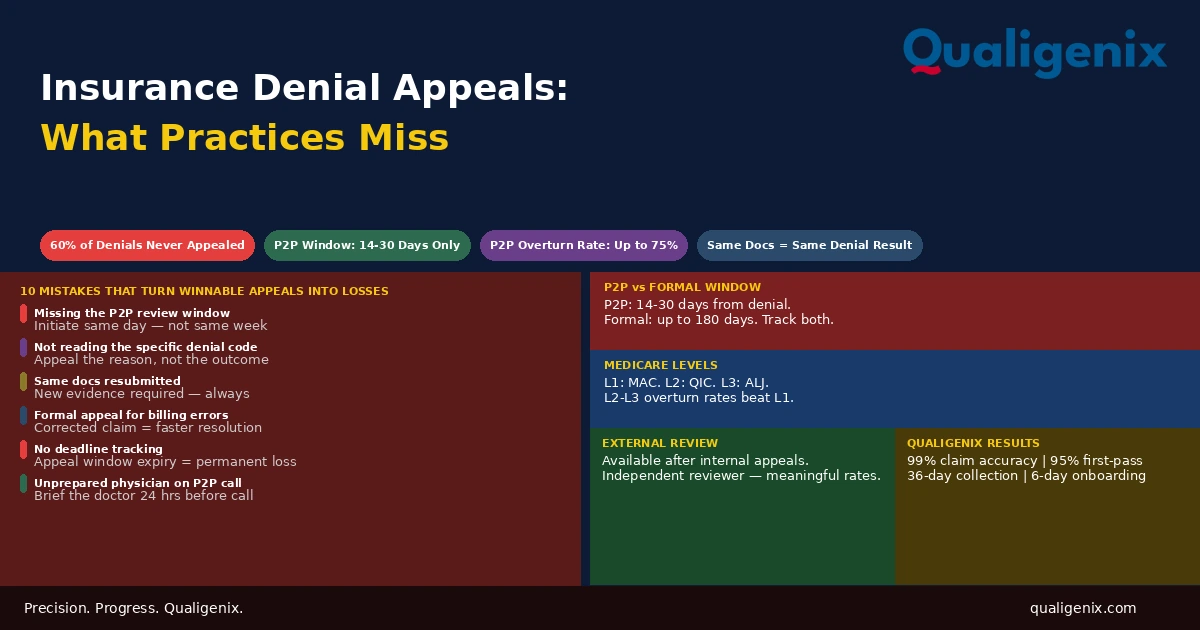
Most insurance denial appeals that fail don’t fail because the clinical case was weak. They fail because the appeal was executed incorrectly. The peer-to-peer review window passed before anyone requested it. The appeal letter restated the original claim without addressing the specific denial reason. The same documentation that generated the denial was resubmitted without new evidence. The deadline was missed while the denial sat in a queue waiting for someone to act on it. The clinical case that would have overturned the denial on day 14 is still winning on day 29. On day 31, the peer-to-peer window closes and the same case is now a formal appeal with a lower overturn rate. On day 180, the appeal window closes and the revenue is permanently gone. The denial didn’t win. The process lost.
Approximately 60% of insurance claim denials are never appealed. For practices with a 10% denial rate generating $4 million in annual charges, that 60% represents roughly $240,000 in denied revenue that is written off without any attempt at recovery not because recovery was impossible, but because no one pursued it.
Of the 40% that are appealed, a significant portion fail not on the merits but on execution. The appeal letter didn’t address the denial reason. The physician wasn’t available for the peer-to-peer review in time. The supporting documentation addressed the clinical appropriateness of the service in general rather than the specific coverage criterion the payer applied. The appeal was submitted two weeks before the deadline but the response was never tracked, so when it denied, no one filed a second-level appeal within the window that was still open.
This blog covers the specific mistakes practices make when appealing insurance denials, why each one converts a winnable case into a permanent loss, and what the correct approach looks like for each mistake category.
The most common insurance denial appeal failures are: missing the peer-to-peer review window for medical necessity denials, submitting appeals that don’t address the specific denial reason, resubmitting the same documentation that generated the original denial, using formal appeal for denials that should be corrected claims, failing to track appeal deadlines until they expire, and not escalating to external review after an internal appeal fails. Each converts a recoverable denial into a permanent revenue loss through process failure rather than clinical weakness.
Insurance Denial Appeal: Key Benchmarks
| Metric | Data Point | Source |
|---|---|---|
| Denied claims never appealed | Approximately 60% | Healthcare billing industry data |
| Medical necessity denials overturned after peer-to-peer | Up to 75% | AMA PA reversal data |
| Peer-to-peer review window — most commercial payers | 14 to 30 days from denial date | Payer PA appeal policies |
| Formal appeal window — most commercial payers | 30 to 180 days from denial date | Commercial payer contract standards |
| Medicare redetermination window | 120 days from denial date | CMS Medicare appeals process |
| Denial rate benchmark | Under 5% of submitted claims | MGMA / HFMA standards |
| Average practice denial rate | 6% to 12% | Industry billing benchmarks |
| Cost to rework one denied claim | $25 to $118 | HFMA denial cost analysis |
| Qualigenix claim accuracy rate | 99% | Qualigenix performance data |
| Qualigenix first-pass acceptance rate | 95% | Qualigenix performance data |
| Qualigenix average collection cycle | 36 days | Qualigenix performance data |
| Qualigenix client onboarding time | 6 days | Qualigenix operations data |
The Foundation: Reading the Denial Correctly Before Appealing It
The most common source of failed appeals is not the appeal itself. It is the failure to correctly understand what the denial actually says before deciding how to respond to it. A practice that reads a denial notice, sees “claim denied,” and submits a generic appeal letter explaining why the service was medically appropriate has responded to a general impression of the denial rather than to its specific content.
Every denial has a specific denial reason code on the explanation of benefits or denial notice. That code tells the practice exactly why the payer declined to pay, and the appeal must address that exact reason to have any probability of reversal. “Denial reason CO-50: not medically necessary” requires a different response than “denial reason CO-4: the procedure code is inconsistent with the modifier” or “denial reason CO-15: the authorization number is missing.” All three will appear as claim denials. All three require completely different resolution pathways.
Reading the denial reason correctly also identifies which appeal pathway is appropriate. A coding error is not appealed through a formal medical necessity appeal. It is corrected and resubmitted as a corrected claim. A prior authorization denial is not resolved through a peer-to-peer review — it requires an authorization request or retroactive authorization investigation. Using the wrong pathway for the denial type doesn’t just fail to resolve the denial. It consumes the time and resources of an appeal process that was never going to succeed on the grounds it was pursuing.
Mistake 1: Missing the Peer-to-Peer Review Window
For medical necessity denials, the peer-to-peer review is the highest-probability appeal pathway available. A direct conversation between the treating physician and the payer’s medical reviewer overturns medical necessity denials at rates up to 75% when the physician presents a prepared clinical case. No other appeal pathway for a medical necessity denial has a comparable success rate at this cost.
The peer-to-peer review window is short. Most commercial payers allow peer-to-peer review requests within 14 to 30 days of the denial date. Some payers have windows as short as 10 days. When a medical necessity denial arrives and the billing team routes it to the denial management queue — where it waits two weeks before anyone reviews it and initiates a peer-to-peer request the window may have already closed. The clinical case that would have overturned the denial in a 20-minute peer-to-peer conversation now requires a formal written appeal with lower overturn probability.
Warning: The peer-to-peer review window is not the formal appeal window. They are different timelines with different clocks. A payer with a 180-day formal appeal window and a 14-day peer-to-peer window requires the peer-to-peer request to be initiated by day 14. Practices that read “180-day appeal window” and assume they have 180 days to initiate a peer-to-peer review lose the highest-probability pathway on the first day of the 15th week. The two clocks must be tracked separately for every medical necessity denial.
The correct protocol is immediate: every medical necessity denial triggers a peer-to-peer review request the same day it is received, regardless of where it falls in the denial management queue. The request goes to the physician immediately. The physician reviews the denial reason, prepares the clinical rationale, and initiates the peer-to-peer call within the window. The formal appeal process runs as a backup track in case the peer-to-peer doesn’t resolve the denial it is not the first option.
Mistake 2: Appealing Without Addressing the Specific Denial Reason
An appeal that doesn’t address the specific reason the payer denied the claim has no basis for changing the outcome. The payer denied the claim because a specific criterion was not met. If the appeal doesn’t demonstrate that the criterion is met, the payer reviews the appeal and reaches the same conclusion it reached the first time.
This mistake appears most commonly in two forms. The first is a generic appeal letter that explains the clinical appropriateness of the service without referencing the specific coverage criterion cited in the denial. “This patient has a medical condition requiring this treatment” is a statement of general appropriateness. “The payer’s denial cited failure to meet criterion 3B of the coverage policy, which requires two prior treatment failures. The attached documentation demonstrates failure of treatments X and Y administered on [dates]” is a response to the specific denial reason. The second letter has a realistic probability of reversal. The first does not.
The second form is appealing a coverage determination denial as though it were a medical necessity denial. When a payer denies a service because it is not a covered benefit under the patient’s specific plan, a clinical appeal arguing that the service was medically necessary doesn’t address the denial. The service may be medically necessary and still not be covered under the patient’s plan. These are different determinations that require different responses, a coverage determination dispute versus a medical necessity appeal and conflating them wastes the appeal window on an argument the payer will not consider relevant to the denial reason.
Mistake 3: Resubmitting the Same Documentation That Generated the Original Denial
An appeal is only as strong as the evidence it presents. When the documentation submitted with the appeal is the same documentation that was submitted with the original claim, the appeal is asking the payer to reach a different conclusion from the same evidence. That almost never happens. The payer reviewed the documentation, applied its coverage criteria, and denied. Without new evidence, the appeal review reaches the same conclusion.
Effective appeals add something the original claim didn’t have. For a medical necessity denial, this might be a detailed physician letter explaining the clinical rationale that wasn’t captured in the original note, specialist consultation notes that weren’t attached to the original claim, imaging results that weren’t referenced, prior treatment documentation that establishes step therapy compliance, or published clinical guidelines supporting the appropriateness of the service for the patient’s documented condition. Each of these provides evidence that addresses the specific criterion the payer cited as unmet.
The question to ask before submitting an appeal is: what does this appeal contain that the original claim didn’t? If the answer is “nothing new,” the appeal will fail for the same reason the claim did. The appeal process requires genuine additional evidence or a genuine clinical argument that the payer’s criteria were already met by evidence that was present but not explicitly identified in the original submission.
Mistake 4: Using Formal Appeal for Denials That Should Be Corrected Claims
Not every denied claim should go through the formal appeal process. Administrative denials claims denied because of a correctable billing or coding error rather than a coverage or medical necessity determination are resolved more efficiently through corrected claim resubmission than through formal appeal. A claim denied because modifier 25 was missing, because the authorization number wasn’t included, or because the wrong place-of-service code was used doesn’t need a letter to a payer’s appeals department. It needs a corrected claim with the error fixed.
Routing administrative denials through the formal appeal process adds time, consumes billing staff capacity on a workflow that isn’t necessary, and delays resolution compared to the corrected claim pathway. Most payers process a corrected claim within the standard adjudication window of 14 to 30 days. A formal appeal may take 30 to 60 days to process. For a claim that could have been paid in two weeks through corrected submission, sending it through a 60-day formal appeal process doubles the collection timeline unnecessarily.
The routing decision corrected claim versus formal appeal should be made at denial categorization, not after the denial has already been placed in the formal appeal workflow. The question is: is this a clinical or coverage determination (formal appeal), or is this a correctable administrative error (corrected claim)? The answer determines the pathway, and the pathway determines how quickly the revenue is recovered.
Mistake 5: Not Tracking Appeal Deadlines Until They’ve Expired
Every appeal has a deadline. The deadline is not the same for every payer, not the same for every denial type within the same payer, and not the same across the multiple appeal levels that most payers offer. A practice that submits an appeal and doesn’t track its status is practicing denial management passively hoping the payer will respond in time and act appropriately on the appeal without any follow-up.
Passive appeal tracking produces two specific failure modes. The first is the appeal that was submitted but never received a response before the second-level appeal window opened and closed. The payer reviews the first-level appeal and issues a denial. The practice doesn’t notice the second-level appeal window because no one was tracking it. The second-level appeal window which might have been a different argument with higher probability of success closes unexercised. The first-level denial becomes final.
The second is the appeal that was submitted correctly but wasn’t tracked for response, so when the payer denied it, no one followed up within the next-level window. The case was strong enough to win at the second level. Nobody filed the second-level appeal because nobody was watching the first-level denial response timeline.
Every appeal submitted must have three things tracked in the appeal management system: the submission date, the payer’s stated response window, and the follow-up date when the practice will check on the appeal status if no response has been received. Missing any of these means the appeal is managed reactively — acted on when a denial notice arrives — rather than proactively, which means the highest-value next action (second-level appeal, external review request) may only become visible after the window for that action has closed.
Mistake 6: Not Using Peer-to-Peer Review Correctly
The peer-to-peer review is the highest-probability appeal tool available for medical necessity denials, but its success rate is heavily dependent on how prepared the physician is when the call happens. A physician who participates in a peer-to-peer review without having reviewed the denial reason, without knowing the specific coverage criterion cited, and without preparing the clinical argument for why the criterion is met produces a peer-to-peer conversation that is much less likely to succeed than one where the physician walks in with the complete clinical case organized.
Effective peer-to-peer preparation requires the physician to know three things before the call: exactly what the payer denied and why, exactly what clinical evidence in the patient’s record supports the medical necessity of the service, and exactly what clinical guidelines or specialty society recommendations can be cited to support the appropriateness of the service for the patient’s documented condition. A physician who can walk through the denial criterion point by point, citing specific clinical findings and guideline references, presents a persuasive case. A physician who explains in general terms that the patient needed the service provides less compelling evidence for reversal.
The billing team’s role in supporting the peer-to-peer is preparing a brief for the physician before the call: the denial reason and specific criterion cited, the relevant clinical documentation for the denied service, and any applicable clinical guidelines. A five-minute brief given to the physician the night before or the morning of the peer-to-peer call produces significantly better outcomes than a cold call where the physician is learning the denial reason in real time.
Mistake 7: Treating All Denial Appeals the Same Way
A medical necessity denial requires a clinical appeal by a physician. An authorization denial requires documentation of prior treatment, step therapy compliance, or retroactive authorization investigation. A coding denial requires technical correction. An eligibility denial requires coverage investigation and resubmission to the correct payer. A bundling denial requires modifier addition and corrected resubmission. Each of these requires a different action by a different person with different expertise.
Practices that route all denials to a single billing staff member who works them in order of receipt without specialized routing produce slower resolution times on every category and lower success rates on clinical denials that require physician involvement. A single billing generalist can work administrative denials effectively. Medical necessity denials that require peer-to-peer review need to reach the physician within hours, not days. Authorization denials that need clinical documentation assembled and submitted quickly need specialty knowledge of the payer’s authorization criteria. Treating these as equivalent items in a single queue consistently produces the worst outcome for the categories where speed and specialization matter most.
Mistake 8: Giving Up After the First-Level Internal Appeal
Most payers offer multiple levels of internal appeal before external review becomes available. A first-level internal appeal denial is not the end of the appeal road. It is the end of the first stage. The practice that receives a first-level appeal denial and writes off the balance has not exhausted its appeal options it has abandoned them after the first resistance.
The appeal levels available vary by payer and by whether the coverage is subject to ERISA, state insurance regulation, or federal Medicare/Medicaid rules. For commercial insurance, most plans offer first-level appeal, second-level appeal, and in many cases an independent external review. For Medicare, the process includes redetermination (first level), reconsideration by a Qualified Independent Contractor (second level), Administrative Law Judge hearing (third level), Medicare Appeals Council review (fourth level), and federal court review (fifth level). Not every denied claim warrants pursuing every level. High-value claims with strong clinical evidence and a defensible case on the payer’s own criteria are candidates for full escalation. Low-value claims or cases where the denial is technically defensible on coverage grounds are better candidates for earlier write-off decisions.
The escalation decision should be made deliberately based on claim value, clinical strength, and payer track record at higher appeal levels — not by default when the first appeal fails.
Mistake 9: Not Requesting External Review When It’s Available
External review is an appeal pathway available in most states that allows an independent clinical reviewer not affiliated with the payer to evaluate a denied claim. It is available after internal appeals have been exhausted and is particularly valuable for medical necessity denials where the payer and the physician have a genuine clinical disagreement rather than a documentation gap.
External reviewers overturn payer denials at meaningful rates — particularly for services with strong supporting clinical literature or where the payer’s clinical criteria are more restrictive than the standards applied by the medical specialty involved. The external review process typically takes 30 to 60 days and involves submitting the clinical record, the denial notices, the prior appeal materials, and a clinical justification letter to the independent review organization assigned by the state.
Most practices never request external review because they are unaware it exists or because the prior appeal failures have created an assumption that the denial is final. For high-value claims where the clinical case is genuinely strong and the internal appeal process failed on the payer’s application of clinical criteria rather than on the quality of the clinical documentation, external review is the appropriate next step rather than write-off.
Mistake 10: Not Closing the Loop from Appeals Back to Upstream Prevention
Every appeal, whether successful or not, contains information that should feed back into the upstream billing process. A medical necessity denial that was overturned through peer-to-peer review because the physician documented the clinical rationale during the call information that wasn’t in the original note identifies a documentation gap that, if addressed prospectively, prevents the next denial in that category from requiring an appeal at all.
An authorization denial that was overturned because the practice submitted retroactive documentation of step therapy compliance identifies an authorization workflow gap: the authorization request wasn’t submitted with the step therapy documentation the payer requires. Fixing that gap means the next patient receiving the same treatment gets an approval on first submission rather than a denial that requires a retroactive appeal.
Practices that treat each appeal as an isolated claim event rather than as a data point in a process improvement system continuously regenerate the same denial categories month after month. The appeals team works the same denial types repeatedly without the upstream process ever changing. Sustainable denial reduction requires connecting appeal outcomes to upstream process fixes and tracking whether those fixes are implemented and whether the affected denial categories subsequently decline in volume.
Related: Denial Management: Common Denials and How to Fix Them | What Is Health Insurance Pre-Authorization
The Medicare Appeals Process: What’s Different
Medicare has a structured, multi-level appeals process that is distinct from commercial payer appeals. Understanding the specific levels and timelines prevents practices from missing the windows at each stage.
| Medicare Appeal Level | Who Reviews | Filing Window | Response Timeline |
|---|---|---|---|
| Level 1: Redetermination | Medicare Administrative Contractor (MAC) | 120 days from denial | 60 days after receipt |
| Level 2: Reconsideration | Qualified Independent Contractor (QIC) | 180 days from Level 1 decision | 60 days after receipt |
| Level 3: ALJ Hearing | Administrative Law Judge | 60 days from Level 2 decision | 90 days after receipt |
| Level 4: Medicare Appeals Council | Departmental Appeals Board | 60 days from Level 3 decision | 90 days after receipt |
| Level 5: Federal Court | Federal District Court | 60 days from Level 4 decision | Varies |
The most common Medicare appeal mistake is not pursuing Levels 2 and 3 for high-value denials after a Level 1 redetermination fails. Level 2 reconsideration by the QIC and Level 3 ALJ hearings have historically had overturn rates above Level 1 redeterminations for claims with strong clinical evidence, because the reviewers at higher levels apply independent clinical judgment rather than applying the MAC’s initial determination criteria.
How Qualigenix Manages Insurance Denial Appeals
At Qualigenix, every denial is categorized by type at receipt and routed to the appropriate resolution pathway within 72 hours. Medical necessity denials trigger a same-day peer-to-peer review request. Administrative errors are corrected and resubmitted within 48 hours as corrected claims rather than routed to the formal appeal process. Authorization denials are investigated for retroactive authorization availability immediately.
We prepare physician peer-to-peer briefs — the denial reason, the applicable coverage criterion, the relevant clinical documentation, and any supporting guidelines — and deliver them to the physician at least 24 hours before the peer-to-peer call. We track every open appeal in a management system that shows submission date, response window, follow-up date, and escalation decision if the first-level appeal fails. No appeal ages through a level without a tracked decision on whether to escalate to the next one.
We also track appeal outcomes by denial category and payer over time, connecting appeal pattern data to upstream process improvement recommendations. When the same denial category appears repeatedly in the appeal queue, we identify the upstream root cause — a documentation gap, an authorization workflow failure, a scrubber rule that needs updating — and communicate the fix to the practice with a defined implementation timeline and a tracking metric to confirm the category subsequently declines.
Related: Accounts Receivable Medical Billing | Insurance Authorization for Specialty Practices | What Is RCM in Medical Billing
Insurance Denial Appeal Process Checklist
- Every denial read for specific denial reason code before routing — not just “denied”
- Denial type identified: medical necessity, authorization, coding, eligibility, timely filing, bundling, or credentialing
- Medical necessity denials trigger same-day peer-to-peer review request
- Peer-to-peer review window tracked separately from formal appeal window
- Physician peer-to-peer brief prepared at least 24 hours before the call
- Administrative errors corrected and resubmitted as corrected claims — not routed to formal appeal
- Appeal documentation contains new evidence not present in original submission
- Appeal letter addresses specific denial criterion — not general clinical appropriateness
- Every appeal submission date, response window, and follow-up date tracked in management system
- Second-level appeal evaluated when first-level fails — not automatically written off
- External review evaluated for high-value denials after internal appeals exhausted
- Appeal outcomes tracked by denial category — recurring categories escalated for upstream process fix
Frequently Asked Questions: Appealing Insurance Denials
What is the most effective way to appeal an insurance denial?
For medical necessity denials, peer-to-peer review is the most effective pathway overturning denials at rates up to 75% when the physician presents a prepared clinical case directly to the payer’s medical reviewer. For administrative errors, a corrected claim resubmission is faster and more efficient than formal appeal. For authorization denials, retroactive authorization investigation is the first step. The correct pathway depends entirely on the specific denial reason, using the wrong pathway for the denial type is itself a common cause of failed appeals.
What is the biggest mistake practices make when appealing insurance denials?
The single biggest mistake is submitting the same documentation that generated the original denial without addressing the specific reason the payer cited. The payer denied on a specific criterion. Resubmitting without demonstrating that the criterion is met produces the same denial on appeal. The second biggest mistake is missing the peer-to-peer review window by routing medical necessity denials to a general denial queue where they wait days before anyone initiates the peer-to-peer request. Both are process failures that convert clinically winnable cases into permanent losses.
How long do you have to appeal an insurance denial?
Formal appeal windows are 30 to 180 days for most commercial payers and 120 days for Medicare redeterminations. Peer-to-peer review windows are shorter — typically 14 to 30 days from the denial date — and must be tracked separately from the formal appeal deadline. Missing either window makes the denial final. Every denial should have both deadlines calendared in the appeal management system from the day it is received, not from the day someone decides to act on it.
Should you appeal every insurance denial?
Every denial should receive an appeal decision — but not every denial type warrants a formal appeal. Timely filing denials are essentially unappealable. Administrative errors are more efficiently resolved as corrected claims than formal appeals. Medical necessity denials with strong clinical documentation should go to peer-to-peer review immediately. The appeal decision framework is based on denial type and clinical strength, and it should be applied consistently rather than left to the billing team’s capacity on a given week. The 60% of denials that are never appealed include many cases that would have been overturned with the right process.
What should an insurance denial appeal letter include?
An effective appeal letter must include: the patient’s identifying information and claim number, the specific denial criterion quoted from the payer’s denial notice, a direct response to each criterion element with supporting documentation, and new clinical evidence not present in the original submission. A letter that explains the clinical appropriateness of the service without referencing the payer’s specific denial criterion is not addressing the denial — it is arguing a general clinical case to a reviewer whose question is whether a specific coverage criterion was met. The letter must answer the specific question the payer asked.
What is external review for insurance denials?
External review is independent clinical review of a denied claim by a reviewer not affiliated with the payer, available after internal appeals are exhausted in most states. External reviewers apply independent clinical judgment rather than the payer’s proprietary clinical criteria, which produces meaningful overturn rates for services with strong clinical guideline support. Most practices never request external review. For high-value denials where the internal appeal process failed on a clinical criteria disagreement rather than a documentation gap, external review is the appropriate escalation pathway rather than passive write-off acceptance.
Related Resources from Qualigenix
- Denial Management: Common Denials and How to Fix Them
- What Is Health Insurance Pre-Authorization
- Insurance Authorization for Specialty Practices
- Accounts Receivable Medical Billing
- What Is Aging Accounts Receivable
- What Is RCM in Medical Billing
The Denial Didn’t Win. The Process Lost. We Fix the Process.
Qualigenix manages insurance denial appeals for practices across 38+ specialties — same-day peer-to-peer initiation, physician-prepared briefs, deadline tracking, corrected claim routing, second-level escalation, and upstream process fixes that prevent the same denial categories from recurring month after month.
Our team delivers 99% claim accuracy, a 95% first-pass acceptance rate, an average 36-day collection cycle, and a 30% reduction in AR days. We onboard in as few as 6 days.
Precision. Progress. Qualigenix.
What’s Next
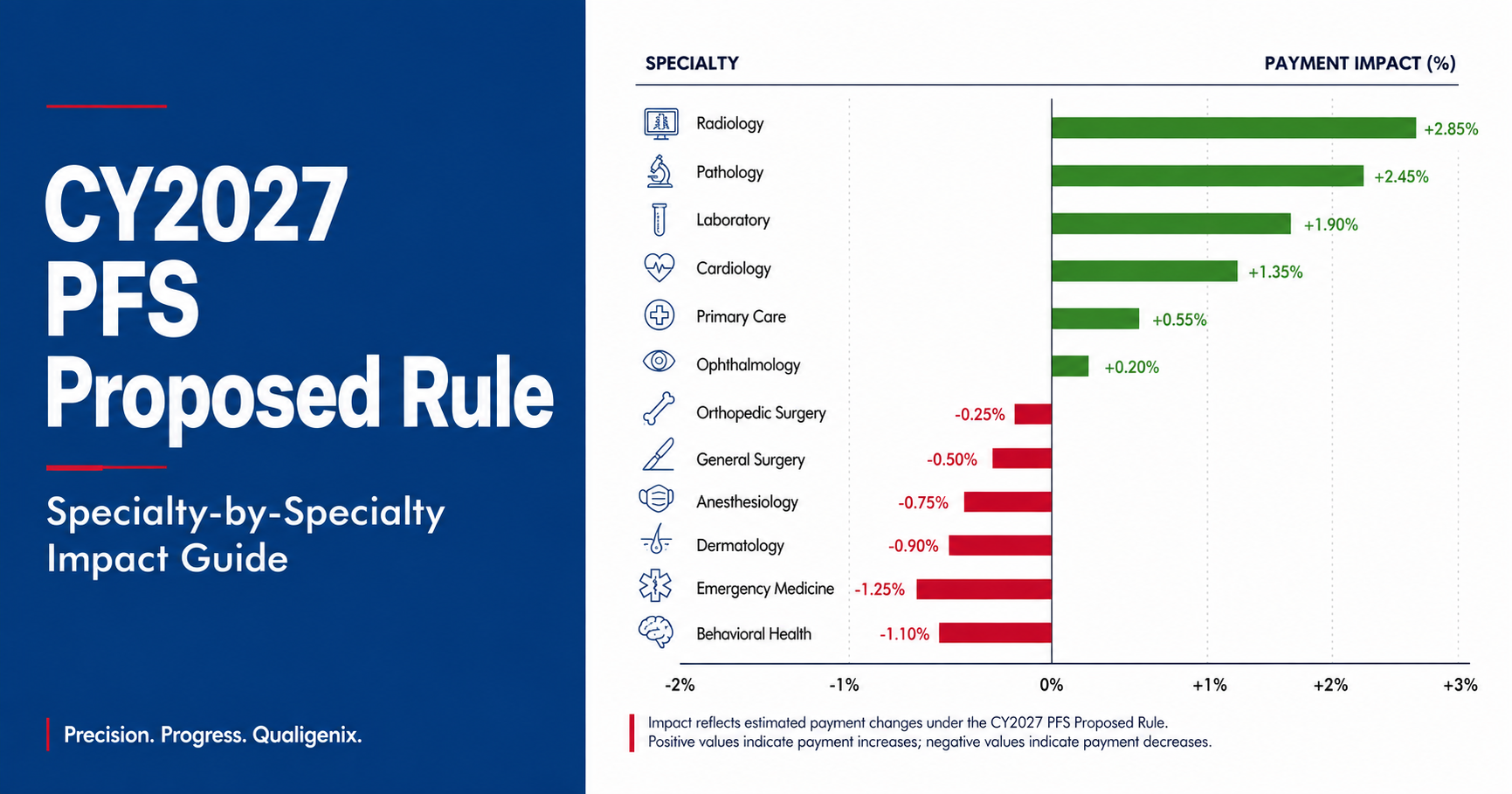
CY2027 Medicare PFS Proposed Rule: Specialty-by-Specialty Impact Guide
The CY2027 PFS proposed rule cuts the conversion factor to $32.84 for non-APM clinicians, but the real story...

Real-time eligibility returned active and the claim still denied: the five reasons why
An “active” eligibility result only proves the policy is in force. It never proves the service is covered, that...
Prior authorization turnaround requirements under the CMS interoperability rule: what changed for practices
The CMS interoperability rule (CMS-0057-F) forces impacted payers to decide standard prior authorizations in 7 calendar days and...