

Home Health Billing Guidelines: Complete Compliance Guide 2026
The Qualigenix Editorial Team consists of certified billing and coding experts with over 40 years of experience across 38+ medical specialties. Our content is rigorously researched against CMS, AMA, and payer-specific guidelines to ensure total compliance and accuracy. We apply the same elite standards to our resources as we do our client work, consistently delivering high claim accuracy and significant reductions in AR days.

Home health billing guidelines cover Medicare eligibility, homebound documentation, physician certification, OASIS accuracy, PDGM diagnosis coding, and LUPA thresholds. Documentation deficiencies are the leading cause of claim denials and audit findings. Agencies that embed compliance into daily billing workflows, not just pre-submission reviews consistently outperform on clean claim rates, AR days, and audit outcomes.
Home health agencies are operating under more scrutiny than at any point in recent memory. Medicare audits are increasing, PDGM’s diagnosis-driven payment model demands coding precision that wasn’t required under the old visit-volume system, and documentation that once passed review is now being flagged line by line. A single missing signature or a vague homebound narrative can void payment for an entire 30-day period — even when every clinical service was appropriate and properly delivered.
The stakes are real. OIG’s annual Work Plan consistently identifies home health as a high-priority fraud and improper payment target. MAC contractors actively review claims for OASIS accuracy, face-to-face compliance, and PDGM grouping validity. Agencies that treat billing compliance as a back-office administrative function rather than a core operational control are the ones most exposed when audits come.
This guide covers every element of 2026 home health billing guidelines your billing and clinical teams need to understand: Medicare eligibility rules, documentation requirements, PDGM coding standards, LUPA thresholds, and the compliance mistakes that most consistently result in denials, recoupments, and extended audits.
Home health billing guidelines are the Medicare and payer rules governing eligibility verification, documentation, diagnosis coding, and claim submission for home-based care services. Key requirements include documented homebound status, timely physician certification, accurate OASIS assessments, PDGM-compliant diagnosis sequencing, and visit utilization above LUPA thresholds. Documentation deficiencies — not service delivery – are the most common cause of home health claim denials.
Home Health Billing Compliance: Key Numbers at a Glance
| Metric | Value / Detail |
|---|---|
| PDGM payment periods per 60-day episode | 2 periods of 30 days each |
| LUPA threshold range (visits per 30-day period) | 2–6 visits depending on case-mix group |
| Face-to-face encounter window (before SOC) | Up to 90 days prior to start of care |
| Face-to-face encounter window (after SOC) | Within 30 days after start of care |
| Medicare timely filing limit (home health claims) | 1 year from date of service |
| PDGM clinical groupings | 12 clinical groups |
| PDGM functional impairment levels | 3 (Low, Medium, High) |
| PDGM comorbidity adjustment tiers | None, Low, High |
| OIG home health audit priority ranking | Consistently in top 5 Medicare fraud targets annually |
| Leading cause of home health denials | Documentation deficiencies (OASIS, F2F, visit notes) |
| Qualigenix claim accuracy rate | 99% |
| Qualigenix first-pass acceptance rate | 95% |
| Qualigenix reduction in AR days | 30% |
| Qualigenix average collection cycle | 36 days |
| Qualigenix average onboarding time | 6 days |
What Are Home Health Billing Guidelines?
Home health billing guidelines are the regulatory requirements, documentation standards, and billing procedures that home health agencies must follow to receive reimbursement from Medicare and commercial payers. They cover who qualifies for home health benefits, how services must be documented, how diagnoses must be coded, and when claims must be submitted.
While commercial payers have their own rules, Medicare’s guidelines are the most detailed and carry the highest audit risk — which is why most agencies structure their entire compliance framework around Medicare standards, even for commercially insured patients. Agencies that stay current with these rules consistently see better claim acceptance rates, faster payment cycles, and significantly fewer audit complications.
Why does home health billing compliance directly affect cash flow?
When agencies follow billing rules correctly, claims move through payer systems without friction — fewer denials, fewer resubmissions, faster payment. When they don’t, the impact is immediate: claims get held, payments delayed, and previously paid episodes get recouped. Audit-related payment suspensions can freeze cash flow for months. Compliance isn’t a documentation exercise — it’s a revenue protection function.
Medicare Rules That Govern Home Health Billing
Medicare’s home health benefit has four core eligibility requirements. Every patient must meet all four before billing can begin — and each one must be documented in the clinical record, not just assumed.
Eligibility and Homebound Status
To qualify for Medicare-covered home health services, a patient must be under the care of a physician, require skilled care (skilled nursing, physical therapy, speech-language pathology, or occupational therapy), be homebound, and receive services under an approved plan of care.
Homebound status is the eligibility requirement most often challenged in audits. Being homebound doesn’t mean the patient never leaves home — it means leaving requires a considerable and taxing effort due to illness, injury, or functional limitation. Absences from home must be infrequent, of short duration, or for medical treatment.
Common audit trigger: Vague or generic homebound documentation — phrases like “patient is unable to leave home” or “homebound due to illness” — are a leading cause of home health claim denials on audit review. Documentation must describe the specific functional limitations that make leaving home a significant undertaking for that particular patient. Specific beats generic every time.
Physician Certification and Plan of Care
Medicare requires a physician or allowed non-physician practitioner to certify that the patient qualifies for home health services. The certification must confirm the patient is homebound, needs skilled care, and will receive services under an approved plan of care. It must be completed and signed within required timeframes — missed deadlines can void the entire billing period even when services were delivered appropriately.
For ongoing care, providers must complete recertifications at each new certification period. These aren’t rubber-stamp renewals. Each recertification must reflect the patient’s current condition, continued medical necessity, and updated care goals — and must be supported by the clinical record.
Documentation Requirements Under Home Health Billing Guidelines
Documentation is where home health billing succeeds or fails. The services can be clinically appropriate, medically necessary, and perfectly delivered — but without complete, accurate, and consistent documentation, claims can’t be supported and won’t survive review.
OASIS Documentation Accuracy
OASIS (Outcome and Assessment Information Set) assessments drive PDGM case-mix grouping, quality reporting, and payment rates. They’re required at defined time points: start of care, resumption of care, recertification, and discharge. Every assessment must be complete, accurate, and submitted to CMS within required timeframes.
The most common OASIS compliance problems are inconsistency — when the OASIS scores don’t align with visit notes, the plan of care, or observed functional status. Auditors look specifically for these discrepancies. When the OASIS paints a different picture than the clinical record, it signals either inaccurate assessment or documentation that wasn’t updated as the patient’s condition changed.
Face-to-Face Encounter Documentation
The face-to-face encounter requirement means a physician or qualified practitioner must evaluate the patient within 90 days before or 30 days after the start of home health care. The documentation must include a narrative — written by the certifying physician — that explains why skilled care is medically necessary for this specific patient.
Generic or copied language kills F2F claims. Statements like “patient requires skilled nursing” or “patient needs physical therapy” aren’t sufficient. The narrative must connect the patient’s specific clinical presentation to the need for skilled services. When agencies submit incomplete or templated F2F documentation, payers frequently deny the claim outright.
Visit Notes and Clinical Support Documentation
Every visit requires documentation that shows the skilled nature of the service provided. Notes must describe the patient’s current condition, what skilled intervention was performed, the clinical rationale, and progress toward treatment goals. This isn’t a checkbox exercise — auditors read visit notes to determine whether the services delivered were genuinely skilled or could have been performed by a non-skilled caregiver.
Consistency matters across all records. When visit notes don’t match OASIS data or the plan of care, it signals documentation failure — and that inconsistency raises audit risk for the entire episode.
PDGM Rules and Billing Guidelines for Home Health Agencies
The Patient-Driven Groupings Model reshaped home health reimbursement when it took effect in 2020, and its billing requirements remain the most technically demanding aspect of home health compliance. Under PDGM, payment isn’t driven by how many visits a patient received — it’s driven by who the patient is clinically, where they came from, and how complex their condition is.
Case-Mix Grouping and Diagnosis Coding
Each 30-day payment period is assigned to a case-mix group based on: the primary diagnosis clinical group, referral source (institutional vs. community), timing within the episode (early vs. late), functional impairment level from OASIS, and comorbidity tier. The primary diagnosis must be the condition most related to the plan of care — correctly coded, correctly sequenced, and supported by clinical documentation.
Inaccurate coding or unsupported diagnoses don’t just affect one claim. They can downgroup an episode from a higher-paying clinical category to a lower one, resulting in systematic underpayment across a patient’s entire stay — and they can trigger post-payment review if the pattern is identified across multiple episodes.
What is a LUPA and how does it affect reimbursement?
LUPA stands for Low-Utilization Payment Adjustment. Under PDGM, each 30-day period has a LUPA threshold — a minimum number of visits required to receive the full case-mix-adjusted payment rate. The threshold varies by case-mix group, ranging from 2 to 6 visits. If the patient receives fewer visits than their threshold, Medicare pays a per-visit rate instead — which is almost always significantly less than the full episode rate. Monitoring utilization against LUPA thresholds is a critical billing and clinical coordination function.
Visit Utilization and LUPA Threshold Management
LUPA risk isn’t just a billing problem — it’s a clinical coordination problem. When visit counts fall below the threshold due to patient refusal, scheduling gaps, or poor care coordination, the financial impact is immediate. Billing teams can’t manufacture visits that didn’t happen, so the fix has to happen upstream: monitoring utilization in real time and flagging at-risk periods before the 30-day window closes.
Agencies that track LUPA exposure proactively — not reactively — consistently protect more revenue per episode than those that discover the shortfall after the period has ended.
Common Home Health Billing Compliance Mistakes
Most home health billing problems aren’t caused by bad intent — they’re caused by workflow gaps, rushed documentation, and staff turnover. Here are the four mistakes that consistently show up in denials and audit findings.
Late or Incomplete Documentation
Delayed documentation is one of the most common reasons claims are held or denied. Missing OASIS assessments, unsigned physician orders, or late visit notes prevent timely billing and push AR days higher. Every day a claim sits unbilled because documentation is incomplete is a day closer to the timely filing deadline — and home health agencies with chronic documentation delays consistently carry higher-than-average AR aging in the 60+ and 90+ day buckets.
Physician Certification and Authorization Gaps
Missing prior authorizations or late physician certifications can invalidate entire billing periods. Tracking certification renewal deadlines, recertification windows, and authorization requirements for each active patient requires a structured system — not a manual reminder process. Agencies that rely on clinicians to track their own certification deadlines consistently experience gaps that billing teams discover only after payment has been denied.
Incorrect Diagnosis Sequencing and Coding
Under PDGM, diagnosis sequencing isn’t just a coding preference — it’s a payment determinant. The primary diagnosis drives clinical group assignment. Secondary diagnoses affect comorbidity tier adjustments. Codes that aren’t supported by clinical documentation, or diagnoses that are sequenced incorrectly, change the case-mix group and the reimbursement rate for the entire 30-day period. This is the area where a specialist coder who understands PDGM grouping logic pays for itself within the first month.
OASIS Score Inconsistencies
When OASIS functional scores don’t match what’s described in visit notes or what’s reflected in the plan of care, auditors flag it as a documentation integrity issue. Sometimes the inconsistency is because OASIS was completed at intake and never updated as the patient improved or declined. Sometimes it’s because clinicians complete OASIS and visit notes independently without cross-referencing. Either way, the result is the same: heightened audit exposure for the entire episode.
Home Health Billing Compliance Checklist for 2026
Use this checklist to audit your agency’s current compliance workflow against the 2026 home health billing guidelines:
- ☐ Eligibility verified before admission: Patient meets all four Medicare criteria — physician care, skilled need, homebound, and active plan of care
- ☐ Homebound status documented specifically: Clinical record describes the exact functional limitations that make leaving home a significant effort — not generic language
- ☐ Face-to-face encounter complete and timely: F2F occurred within the required window; documentation includes specific medical necessity narrative, not templated text
- ☐ Physician certification signed on time: Certification and all recertifications signed within required timeframes; deadline tracking system in place
- ☐ OASIS submitted at all required time points: Start of care, resumption, recertification, and discharge assessments completed accurately and on time
- ☐ OASIS consistent with visit notes and POC: Functional scores, clinical findings, and care goals align across all documentation
- ☐ Primary diagnosis correctly coded and sequenced: Diagnosis is the condition most related to the plan of care; supported by clinical documentation; correctly grouped under PDGM
- ☐ Comorbidities coded and documented: Secondary diagnoses affecting clinical complexity captured accurately for comorbidity tier adjustment
- ☐ LUPA threshold monitored per period: Visit utilization tracked in real time against threshold for each 30-day period; at-risk periods flagged before the window closes
- ☐ Visit notes document skilled services: Every visit note describes the specific skilled intervention, clinical rationale, and patient response — not just task completion
- ☐ Claims submitted within timely filing window: Internal submission deadlines set well ahead of Medicare’s one-year timely filing limit
How Qualigenix Supports Home Health Billing Compliance
Qualigenix supports home health agencies by embedding compliance into daily billing workflows — not treating it as a pre-submission checklist that runs after documentation problems have already been created. Our approach is upstream: catching eligibility gaps, OASIS inconsistencies, and coding errors before claims are submitted, so they don’t become denials to chase later.
Here’s what that looks like in practice:
- PDGM coding validation: Our certified coders review diagnosis sequencing, clinical group assignment, and comorbidity coding for every 30-day period to ensure case-mix grouping is accurate and supported by clinical documentation. Correct PDGM coding is where revenue is protected or lost — and it requires coders who understand PDGM grouping logic, not just ICD-10 codes.
- OASIS documentation review: We review OASIS assessments for completeness and consistency with visit notes and the plan of care before claims are finalized. Inconsistencies flagged early cost minutes to fix. Inconsistencies discovered during audit cost months of appeals and recoupment risk.
- Eligibility verification: Our team confirms patient Medicare eligibility and homebound documentation before the billing cycle begins, catching the issues that cause the most common episode-level denials before they occur.
- Authorization and certification tracking: We maintain structured tracking of physician certification deadlines, recertification windows, and prior authorization requirements so billing gaps don’t emerge because a clinician missed a renewal date.
- Denial management: When denials do occur, our team analyzes root causes, corrects errors, and files appeals within payer windows. Pattern analysis prevents the same denial from repeating across multiple episodes.
- AR follow-up: Our AR follow-up services monitor outstanding home health claims and address adjudication issues before they age into the 60+ and 90+ day buckets.
The result: a 99% claim accuracy rate, a 95% first-pass acceptance rate, and a 30% reduction in AR days — across home health and 38+ other specialties. We onboard in as few as 6 days, beginning with a comprehensive AR assessment that identifies exactly where compliance gaps are affecting your agency’s revenue right now.
Frequently Asked Questions: Home Health Billing Guidelines
What are home health billing guidelines?
Home health billing guidelines are the regulatory requirements, documentation standards, and billing procedures that home health agencies must follow to receive Medicare and commercial payer reimbursement. They cover patient eligibility, homebound status documentation, physician certification, OASIS assessment accuracy, PDGM diagnosis coding, visit utilization, and claim submission timelines.
What documentation is required for home health billing?
Required documentation includes signed physician orders, completed OASIS assessments at all required time points (start of care, resumption, recertification, and discharge), face-to-face encounter records with a medical necessity narrative, visit notes for every clinical encounter, a signed plan of care, and any prior authorization records required by the payer.
Why is PDGM important in home health billing?
PDGM determines reimbursement based on patient clinical characteristics and diagnosis codes rather than service volume. The primary diagnosis drives case-mix group assignment, which sets the payment rate for the entire 30-day period. Incorrect coding or unsupported diagnoses can lower the case-mix group and underpay the episode — or trigger post-payment review if the pattern repeats across multiple patients.
What is a LUPA in home health billing?
LUPA stands for Low-Utilization Payment Adjustment. Each PDGM 30-day period has a minimum visit threshold — ranging from 2 to 6 visits depending on the case-mix group. If a patient receives fewer visits than the threshold, Medicare pays a per-visit rate instead of the full case-mix-adjusted rate. This is almost always significantly lower, so LUPA risk must be tracked in real time, not discovered after the period has closed.
What is homebound status and why does it matter?
Homebound status is a Medicare eligibility requirement for home health benefits. A patient is homebound when leaving home requires a considerable and taxing effort due to illness, injury, or functional limitation. It must be documented with specific clinical language describing the patient’s limitations — not vague statements. Vague homebound documentation is one of the most common reasons home health claims fail audit review.
What happens if home health billing guidelines are not followed?
Noncompliance can result in claim denials, delayed payments, payment recoupments for previously paid episodes, extended MAC audits, and increased regulatory scrutiny. Repeated patterns of noncompliance can trigger expanded audit activity that affects multiple years of claims simultaneously — a situation that destabilizes agency cash flow for months.
How often do home health billing rules change?
Medicare updates home health billing rules annually through the Home Health Prospective Payment System (HH PPS) Final Rule, effective each January 1. CMS also releases guidance updates, transmittals, and MAC-specific policies throughout the year. Agencies need ongoing policy monitoring — not just an annual review of the final rule.
Can home health billing be outsourced?
Yes. Outsourcing home health billing to a specialized RCM partner helps agencies maintain compliance, reduce PDGM coding errors, track certification and authorization deadlines, and improve clean claim rates. Qualigenix provides home health billing services with a 99% claim accuracy rate and onboards new clients in as few as 6 days — starting with a free AR assessment that identifies where compliance gaps are currently affecting revenue.
Related Qualigenix Resources
Service Pages:
- Home Health Billing Services
- Medical Coding Services
- Denial Management Services
- Insurance Eligibility Verification Services
- AR Follow-Up Services
Blog Guides:
- Home Health Revenue Cycle Management: Challenges and Solutions
- Patient Eligibility Verification: Workflow, Tools & ROI for 2026
- What Is a Clean Claim Rate? Benchmarks and Best Practices
- How to Reduce Medical Claim Denials: Your 2025 Guide
- Healthcare Billing Process Explained: End-to-End Workflow
- Denial Management in Medical Billing: 7 Common Causes
Stop Letting Compliance Gaps Cost Your Agency Revenue
Home health billing compliance isn’t a back-office function — it’s a revenue protection system. Whether your agency is dealing with OASIS inconsistencies, PDGM coding errors, LUPA exposure, or escalating denial rates, Qualigenix has the expertise to fix it upstream before claims are filed incorrectly.
Our team delivers 99% claim accuracy, a 95% first-pass acceptance rate, a 30% reduction in AR days, and an average 36-day collection cycle. We onboard in as few as 6 days — starting with a free AR assessment that quantifies exactly where compliance gaps are affecting your revenue right now.
Precision. Progress. Qualigenix.
What’s Next
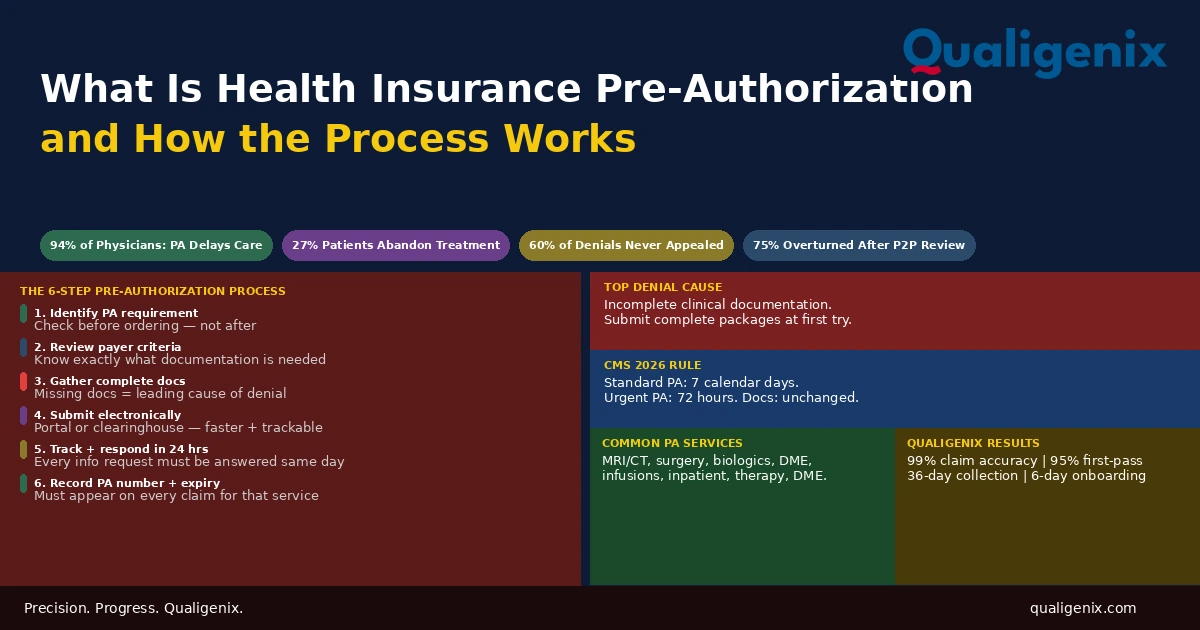
What Is Health Insurance Pre-Authorization and How It Works
Health insurance pre-authorization is the approval step that sits between a physician’s clinical decision and a patient’s access to...
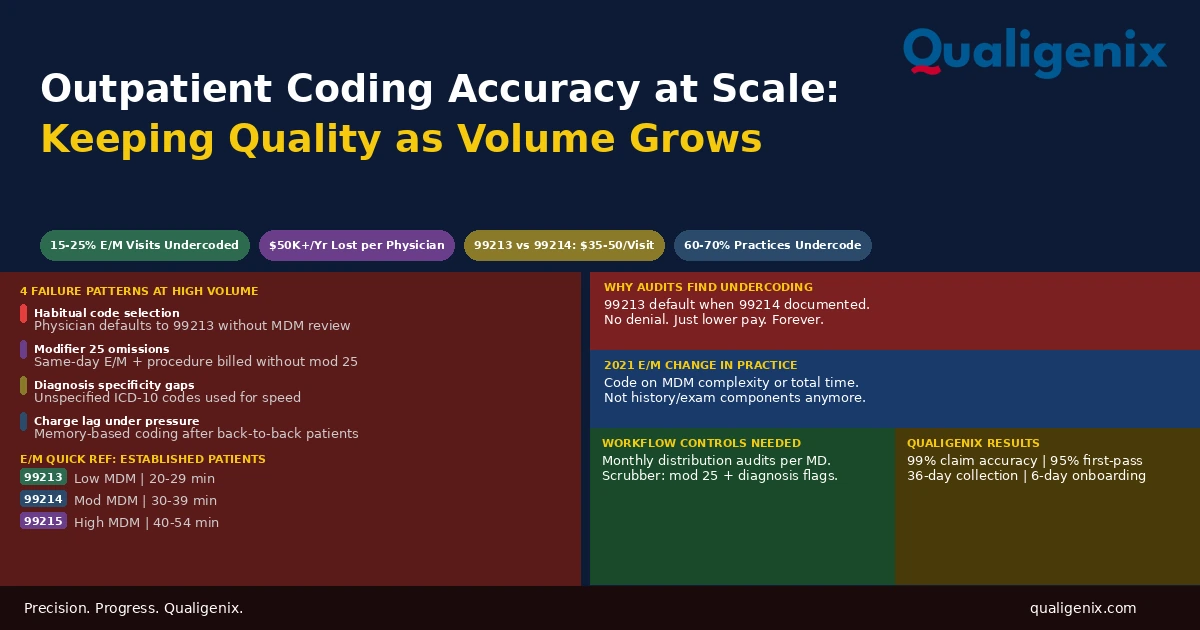
Outpatient Coding for High-Volume Practices: Keeping Accuracy at Scale
Outpatient coding accuracy is manageable when a physician sees 10 patients a day. It degrades predictably when they see...
Medicare Physician Fee Schedule 2026: What Every Practice Must Know
The 2026 Medicare Physician Fee Schedule (CMS-1832-F) introduces two separate conversion factors for the first time: $33.57 for qualifying...