

Outsourcing Medical Billing: Complete Guide 2026
The Qualigenix Editorial Team consists of certified billing and coding experts with over 40 years of experience across 38+ medical specialties. Our content is rigorously researched against CMS, AMA, and payer-specific guidelines to ensure total compliance and accuracy. We apply the same elite standards to our resources as we do our client work, consistently delivering high claim accuracy and significant reductions in AR days.

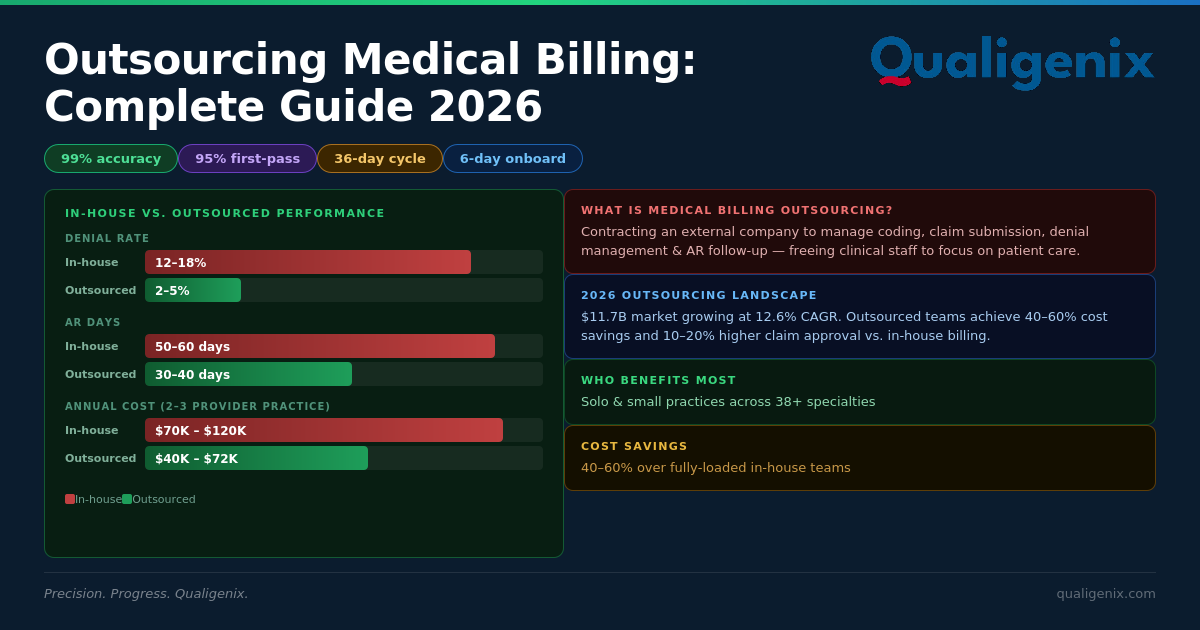
Outsourcing medical billing means handing your revenue cycle — coding, claim submission, denial management, and AR follow-up — to an external specialist so your team can focus on patient care. In 2026, outsourced billing delivers denial rates of 2–5% versus 12–18% in-house, AR cycles of 30–40 days versus 50–60 days, and cost savings of 40–60% over fully loaded internal teams. If your denial rate is over 10% or your AR days exceed 45, you’re likely leaving significant revenue uncollected every month.
You went into medicine to treat patients — not to chase down unpaid claims, retrain billing staff every quarter, or decode payer rejection codes at the end of a 12-hour shift. Yet for thousands of practices across the US, that’s where a significant chunk of time, money, and mental energy goes each week. Revenue leakage from missed follow-ups, underpayments, and coding errors quietly drains thousands of dollars every month. And the problem is accelerating.
In 2026, healthcare billing is more complex than it has ever been. The ICD-10-CM update effective October 1, 2025 added 487 new codes. CPT 2026 introduced 418 changes (including 288 new codes). CMS and commercial payers are ramping up post-payment audits with AI-assisted review. Denial rates in practices without dedicated billing expertise remain stubbornly high — between 12% and 18% (24/7 Medical Billing Services, 2026). Each denied claim costs $25–$100 in staff time to rework and resubmit.
Outsourcing medical billing is the strategic answer. This guide covers everything — the definition, the cost model, the in-house vs. outsourced comparison, the warning signs that tell you it’s time to switch, and exactly how Qualigenix medical billing outsourcing services deliver a 99% claim accuracy rate and 95% first-pass acceptance for practices across 38+ specialties.
What Is Outsourcing Medical Billing?
Outsourcing medical billing is the practice of contracting an external third-party company to manage a healthcare provider’s revenue cycle functions — including insurance coding, claim submission, denial management, AR follow-up, and payment posting — instead of maintaining an in-house billing department. The outsourcing partner becomes responsible for the financial back-end of the practice, freeing clinical staff to focus entirely on patient care.
Outsourced medical billing isn’t simply handing off paperwork. A qualified billing company becomes a performance partner — one that specializes exclusively in revenue cycle management, holds payer-specific expertise across specialties, and deploys technology that most practices could never afford to build internally. The result is a structural improvement to your entire revenue cycle, not just a cost substitution.
The scope of outsourcing can vary. Some practices outsource their full revenue cycle from charge entry through collections. Others outsource specific functions — denial management only, AR follow-up only, or coding only — while keeping claim submission internal. Full-service outsourcing delivers the strongest ROI for most small-to-mid-sized practices because it eliminates the coordination gaps between functions that most often cause revenue leakage.
Outsourcing Medical Billing: Key Statistics and Benchmarks 2026
| Metric | Value / Benchmark |
|---|---|
| Medical billing outsourcing market size (2022) | $11.7 billion — projected CAGR of 12.6% through 2030 (ZipDo) |
| In-house denial rate | 12–18% (without dedicated denial management focus) |
| Outsourced denial rate | 2–5% (specialized payer expertise and systematic prevention) |
| In-house AR cycle | 50–60 days (limited follow-up and staffing constraints) |
| Outsourced AR cycle | 30–40 days (consistent follow-up and automated workflows) |
| In-house biller annual cost (fully loaded) | $70,000–$120,000 (salary, benefits, software, training, turnover) |
| Outsourced billing fee (% of collections) | 4–10% of net collections (most practices pay 5–8%) |
| Cost savings vs. in-house (reported) | 40–60% overall cost savings (24/7 Medical Billing Services, 2026) |
| Claim approval rate improvement | 10–20% higher than in-house teams (ZipDo industry data) |
| Cardiology practice example: denial reduction | 60% reduction in denied claims after outsourcing (ClearDesk, 2026) |
| In-house billing staff turnover rate 2026 | ~40% (24/7 Medical Billing Services, 2026) |
| Time to measurable results | 60–90 days (most practices) — Qualigenix: 6-day onboarding |
| Qualigenix claim accuracy rate | 99% across all specialties and payer types |
| Qualigenix AR days reduction | 30% average reduction post-transition |
What Are the Key Benefits of Outsourcing Medical Billing?
The case for outsourcing isn’t just about cutting costs — though the cost savings are real. It’s about buying back your time, building redundancy into a critical function, and replacing generalist billing staff with specialists who do nothing but revenue cycle management, all day, every day.
Lower Denial Rates — Immediately
In-house billing teams without dedicated denial management expertise see denial rates between 12% and 18%. Outsourced billing companies with payer-specific expertise consistently achieve 2–5% denial rates through systematic prevention: specialty-trained coders, payer-specific edit rules, pre-submission scrubbing, and dedicated denial management workflows. Each percentage point matters. If your practice submits 500 claims per month at an average value of $300, moving from a 15% denial rate to a 4% denial rate means recovering approximately $16,500 per month in claims that would otherwise require rework — or never get resubmitted at all.
Faster Cash Flow and Shorter AR Cycles
Practices managing billing internally typically experience AR cycles of 50–60 days. Staff vacations, sick days, turnover, and competing priorities all create gaps in follow-up that age claims. Outsourced billing reduces AR cycles to approximately 30–40 days through consistent daily claim submission, automated status tracking, and dedicated follow-up teams who treat your aged AR as a metric they own. Qualigenix achieves a 36-day average collection cycle — 14–24 days faster than typical in-house performance. That speed difference translates directly to working capital your practice can use today.
Cost Savings of 40–60% Over Fully Loaded In-House Teams
The sticker price comparison — outsourcing fee versus biller salary — misses the full picture. True in-house billing cost for a small practice (2–3 providers, ~3,000 encounters per year) runs $70,000–$120,000 annually when you add up salary, payroll taxes, benefits, billing software licenses, annual code update training, and the $5,000–$15,000 per event disruption cost of turnover (A-Z Medical Billing, 2026). Outsourced billing at 5–8% of collections on the same practice typically costs $40,000–$72,000 — and that fee includes all technology, all training, all staff redundancy, and continuous compliance monitoring.
Specialty Expertise Your In-House Team Can’t Match
A generalist biller knows the basics. They do not know cardiology modifiers for catheterization procedures, behavioral health time-based coding requirements, or the specific prior authorization workflows that Aetna applies to orthopedic surgery. Outsourced billing companies with specialty expertise close that gap. They’ve already coded thousands of claims in your specialty, built payer-specific rule libraries, and know exactly which documentation gaps trigger denials for your procedure types.
Elimination of Staffing Risk and Turnover Disruption
In-house billing departments in 2026 face a turnover rate approaching 40% (24/7 Medical Billing Services, 2026). When a single biller leaves, claims often don’t get submitted for weeks while the practice scrambles to hire and train a replacement. Outsourced billing uses team-based models — there is no single point of failure. If one specialist is out, the workflow continues uninterrupted. Your claims get submitted every day, regardless of what’s happening on the administrative side of your practice.
In-House vs. Outsourced Medical Billing: Full Comparison 2026
| Factor | In-House Medical Billing | Outsourced Medical Billing |
|---|---|---|
| Annual cost (2–3 provider practice) | $70,000–$120,000 (fully loaded) | $40,000–$72,000 (5–8% of collections) |
| Denial rate | 12–18% (without dedicated denial focus) | 2–5% (specialty expertise and systematic prevention) |
| Average AR days | 50–60 days | 30–40 days |
| First-pass acceptance rate | 75–85% (typical in-house) | 90–99% (outsourced specialists) |
| Staff turnover impact | High — claims stop when biller leaves | None — team-based model with no single point of failure |
| Coding expertise | Generalist — limited specialty depth | Specialty-trained coders per practice type |
| Regulatory compliance | Practice responsible — internal bandwidth risk | Billing company monitors and applies updates continuously |
| Technology cost | Included in overhead — software + annual updates | Included in service fee — vendor manages all technology |
| Scalability | Requires hiring as volume grows | Scales automatically with claim volume |
| Visibility and reporting | Dependent on internal systems and staff discipline | Real-time dashboards — quality partners exceed internal visibility |
| Best for | Large practices (10+ providers) with specialized billing management | Solo to mid-sized practices, high-growth practices, specialty groups |
What Are the Warning Signs That You Should Outsource Medical Billing?
When Does Staying In-House Become a Revenue Risk?
Five warning signs tell you that your current billing setup is holding back your revenue, not protecting it: (1) denial rate consistently exceeds 10%; (2) AR days exceed 45; (3) you can’t get clear metrics from your billing team; (4) billing staff turnover has disrupted your submission workflow in the past 12 months; (5) your physicians are regularly pulled into billing discussions. Each one of these signals a structural problem that will recur.
- Denial rate above 10%: Industry best practice is 5–8%. Specialists achieve 2–5%.
- AR days above 45: Cash flow is suffering. Strong operations keep this under 40.
- No clear billing metrics: If you can’t answer “what’s our net collection rate?” you lack revenue visibility.
- Staff turnover has disrupted submissions: Single-person billing has no redundancy — one absence stalls revenue.
- Providers spending time on billing issues: Physician time costs $200+/hour. This is a costly use of clinical resources.
Is Outsourcing Medical Billing Safe and HIPAA Compliant?
Yes — reputable outsourced billing companies are required to be HIPAA compliant and must execute a Business Associate Agreement (BAA) with your practice before accessing any patient health information. The BAA legally binds the billing company to the same HIPAA data protection standards as covered entities, including data encryption, access controls, audit logs, and breach notification requirements.
Before contracting any billing partner, verify their BAA process, and review their data breach response protocol. The risk with outsourcing isn’t HIPAA compliance — quality billing companies have invested far more in compliance infrastructure than most practices could build internally. The actual risk is in choosing a low-quality vendor that cuts corners on compliance. That’s why vetting the partner is the most important step in the outsourcing decision.
How Does Qualigenix Handle Outsourced Medical Billing?
Qualigenix’s medical billing outsourcing services cover every step of the revenue cycle — from insurance eligibility verification before the patient visit, through ICD-10 and CPT coding, clean claim submission, real-time denial management, AR follow-up, and payment posting with ERA auto-reconciliation. The result is an end-to-end workflow where revenue leakage is eliminated at every stage.
What makes Qualigenix different is the combination of specialty expertise and performance accountability. With a 99% claim accuracy rate and 95% first-pass acceptance across 38+ specialties, Qualigenix delivers outcomes that most in-house billing teams — and many competitors — cannot match consistently. The 30% reduction in AR days and 36-day average collection cycle reflect a systematic approach to revenue cycle management, not a one-time improvement.
Onboarding is designed to minimize disruption. The 6-day average onboarding time includes EHR/PM integration, payer credential migration, historical AR assessment, and a gap analysis that identifies exactly where your practice is losing revenue. From Day 7, your billing workflow is running under Qualigenix management.
The denial management services include root-cause analysis for every rejected claim, payer-specific appeals, and a feedback loop to coding that prevents the same denial from recurring. The AR follow-up services track every unpaid claim with systematic aging workflows — nothing ages out unaddressed. Practices also get transparent, real-time reporting dashboards showing denial rates, AR aging, net collection rates, and first-pass acceptance by payer.
What Is the Cost of Keeping Billing In-House?
The true all-in cost of in-house billing for a 2–3 provider practice runs $70,000–$120,000 annually — salary, payroll taxes, benefits, software licenses, annual code update training, and $5,000–$15,000 per event disruption cost of turnover (A-Z Medical Billing, 2026). Outsourced billing at 5–8% of collections on the same practice typically costs $40,000–$72,000 — and includes all technology, all training, all staff redundancy, and continuous compliance monitoring.
How Do You Choose the Right Medical Billing Outsourcing Company?
The right medical billing partner has four non-negotiable characteristics: specialty experience, transparent real-time reporting, documented HIPAA compliance, and a verifiable first-pass acceptance rate above 90%. Beyond those four baselines, evaluate whether they assign a dedicated account manager, provide root-cause analysis on denied claims, and can demonstrate their denial rate and AR performance with actual client data from your specialty.
Ask for a reference from a practice your size, in your specialty, who has been a client for at least 12 months. One conversation with a real client tells you more than any sales presentation. And always insist on a clearly written service agreement that specifies what “denial management” actually means — how quickly will they resubmit, what is their appeals process, and what happens to claims that age past 90 days without resolution?
Outsourcing Medical Billing Readiness Checklist: 10 Steps Before You Transition
- ☐ Baseline your current metrics: Pull denial rate, AR days, net collection rate, and first-pass acceptance before you start. You need these numbers to measure improvement.
- ☐ Define scope clearly: Decide upfront whether you’re outsourcing full RCM or targeted functions (denial management, AR follow-up, coding only). Full-service delivers the strongest ROI.
- ☐ Verify specialty experience: Confirm the billing company has current clients in your specialty and can provide references from your procedure types and payer mix.
- ☐ Confirm HIPAA compliance documentation: Request the BAA before any conversation involving PHI and their incident response policy.
- ☐ Evaluate reporting capabilities: Insist on real-time dashboards. If the billing company can only provide monthly PDF reports, they can’t surface issues fast enough to protect your revenue.
- ☐ Understand the pricing model: Percentage of collections aligns incentives — the billing company only earns when you collect. Flat fees do not. Confirm what’s included vs. billed separately.
- ☐ Assess EHR/PM integration approach: Confirm how claim data flows between your clinical system and the billing company. Native API integration is faster and less error-prone than manual export.
- ☐ Define denial management expectations explicitly: Ask how quickly they resubmit denials, what their appeals process covers, and what happens to claims approaching timely filing deadlines.
- ☐ Plan the transition timeline: Identify who manages in-flight claims during the handoff period. A quality partner handles this systematically — not by starting fresh on Day 1.
- ☐ Set 90-day performance review criteria: Define what improvement in denial rate, AR days, and first-pass acceptance rate you expect to see within 90 days. Hold the partner accountable to those numbers.
Frequently Asked Questions About Outsourcing Medical Billing
What is outsourcing medical billing?
Outsourcing medical billing means contracting an external company to manage your practice’s entire revenue cycle — coding, claim submission, denial management, AR follow-up, and payment posting — instead of employing an in-house billing team. The billing company becomes responsible for the financial back-end of your practice, and you pay a percentage of what they collect on your behalf.
Unlike hiring a billing service to do one task, true outsourcing transfers accountability for your entire revenue cycle performance. A quality partner like Qualigenix owns your metrics — denial rate, AR days, net collection rate — and is accountable for improving them.
How much does outsourcing medical billing cost?
Outsourcing medical billing typically costs 4–10% of monthly net collections, with most practices in the 5–8% range. Flat fee models are also available. When compared against the true all-in cost of in-house billing — salary, benefits, software, training, and turnover — outsourcing delivers savings of 40–60% for most small-to-mid-sized practices.
The key insight is that outsourcing converts a fixed cost (salary + overhead regardless of collections) into a variable cost (percentage of what you actually collect). If your practice has a slow month, your billing cost drops proportionally. That alignment of incentives doesn’t exist with an in-house team.
What is included in outsourced medical billing services?
Full-service outsourced medical billing typically includes: insurance eligibility verification, charge capture review, medical coding (ICD-10-CM, CPT, HCPCS), clean claim submission, claim tracking and status monitoring, denial management and appeals, AR follow-up, payment posting, ERA/EOB reconciliation, patient statement processing, and performance reporting.
Not all billing companies offer all of these functions. Some specialize in coding-only or denial management-only services. Before signing, explicitly confirm which functions are included in your fee and what, if anything, is billed separately.
How long does it take to see results after outsourcing?
Most practices begin seeing measurable improvements — lower denial rates, faster reimbursements, improved AR performance — within 60–90 days of outsourcing their billing. Qualigenix delivers results faster, with a 6-day average onboarding time that includes an immediate AR assessment to identify gaps and address existing aged claims from Day 1.
By Day 90, your baseline metrics should show measurable improvement against the numbers you tracked before the transition. The 60–90 day window allows time for the billing company to learn your payer mix, configure specialty-specific rules, and clear any existing AR backlog.
Will I lose control of my billing if I outsource?
No — with a quality billing partner, you actually gain more visibility into your revenue cycle than most in-house setups provide. Real-time dashboards showing denial rates, AR aging, clean claim rates, and net collection rates give you data that most practices never had from their in-house team. What changes is who does the work — not who owns the results.
The perceived loss of control is the most common objection to outsourcing, and it’s often the opposite of reality. When your billing team is external and held to performance SLAs, you have leverage you never had over an internal employee.
Is outsourcing right for small practices?
Yes — outsourcing often delivers the greatest benefit for small practices (1–5 providers) because the fixed cost of maintaining even one competent in-house biller is disproportionately high for the claim volume they generate. Small practices also lack the redundancy to handle biller turnover or absences without revenue disruption, which outsourcing eliminates entirely.
Solo physicians and small group practices with 500–2,000 claims per month benefit from outsourcing because they gain access to specialty coding expertise, dedicated denial management, and systematic AR follow-up that would require 2–3 full-time employees to replicate internally — at a fraction of the cost.
Related Qualigenix Resources
Service Pages:
- Medical Billing Outsourcing Services — End-to-end RCM for US providers
- Revenue Cycle Management Services — Full-service RCM through collections
- Denial Management Services — Systematic denial prevention and appeals
- AR Follow-Up Services — Recover unpaid claims before they age out
- Claim Submission Services — Clean electronic claims for faster reimbursements
Blog Guides:
- In-House vs. Outsourced Medical Billing: Full Cost and Performance Comparison
- Outsourcing Revenue Cycle Management: How It Works End-to-End
- What Is Revenue Cycle Management? A Beginner’s Guide
- How to Select the Best Denial Management Service
- Best RCM Companies in the USA
- Denial Management Process: 5 Essential Steps
- How to Reduce Medical Claim Denials: Your 2026 Guide
- Healthcare Billing Process Explained: End-to-End Workflow
Stop Leaving Revenue on the Table. Start Today.
Qualigenix handles your entire billing cycle — coding, claims, denials, and AR — while you focus on patient care. With 99% claim accuracy, 95% first-pass acceptance, and 6-day onboarding, you’ll see the difference in your first 90 days.
Our team delivers 99% claim accuracy, a 95% first-pass acceptance rate, an average 36-day collection cycle, and a 30% reduction in AR days. We onboard in as few as 6 days.
Precision. Progress. Qualigenix.
What’s Next
Best RCM Outsourcing Companies for Specialty Practices
Running a specialty practice is a full-time hustle. Between delivering top-tier patient care, managing staff, and keeping up with...

Outsourcing Revenue Cycle Management: How It Works
The current trends in the Healthcare industry have shown a bit of a perfect storm turn for the entities...