

Outsourcing Revenue Cycle Management: How It Works
The Qualigenix Editorial Team consists of certified billing and coding experts with over 40 years of experience across 38+ medical specialties. Our content is rigorously researched against CMS, AMA, and payer-specific guidelines to ensure total compliance and accuracy. We apply the same elite standards to our resources as we do our client work, consistently delivering high claim accuracy and significant reductions in AR days.


The current trends in the Healthcare industry have shown a bit of a perfect storm turn for the entities navigating the realm. The complexity of claim rules is increasing, and there are higher chances of payer audits. Moreover, the time taken for reimbursement is longer than ever before. On the other hand, healthcare facilities are also facing challenges related to staffing shortages, increasing labor costs, and administrative pressures. Even a small mistake in coding or a delay in follow-up can result in revenue leakage.
To stay financially stable, many providers across the globe are rethinking how they manage billing operations. Instead of expanding in-house teams, they are turning to outsourcing revenue cycle management as a solution that is both practical and scalable. By partnering with specialized RCM outsourcing services, healthcare organizations can reduce denials, stabilize cash flow, and ease the administrative burden without compromising compliance or visibility. Let’s dive deep into understanding how outsourcing revenue cycle management works, why providers choose it, and when it makes sense for your organization.
What Is Outsourcing Revenue Cycle Management
Outsourcing revenue cycle management involves the transfer of a portion or the entire billing process of a healthcare organization to a third-party vendor who has the expertise to handle such processes. These vendors provide organized healthcare revenue cycle management services that involve the entire financial process of a patient from eligibility verification to the final payment posting.
Instead of handling the billing process within the organization, providers use trained personnel, optimized processes, and billing systems managed by the revenue cycle management vendor. The aim is not only to submit claims but to minimize errors, increase payments, and establish a predictable flow of revenue. Organizations begin with partial revenue cycle outsourcing or full end-to-end outsourcing, depending on the complexity and capacity of the organization.
What Functions Are Commonly Outsourced
Often, healthcare organizations choose to manage their entire revenue cycle outsourcing at one time. Rather, they begin by outsourcing those functions that create the greatest pain in their operations, as well as those that cause delays or revenue shortfalls. These functions are often those that require constant interaction with payers, intimate knowledge of regulations, or ongoing follow-up.
Commonly outsourced functions include:
- Insurance eligibility and benefits verification, where patient insurance, co-payments, deductibles, and authorizations are verified prior to service delivery to avoid post-service denial of claims.
- Medical coding and charge capture via medical coding outsourcing, where CPT, ICD-10, and modifiers are accurately captured based on clinical documentation in accordance with payer-specific billing guidelines.
- Claim preparation and submission, where claims are generated and submitted electronically to minimize rejections and expedite processing.
- Payer follow-through via claims processing vendors, where skilled teams can monitor claim status, address inquiries from payers, and address delays prior to impacting revenue.
- Denial resolution and denial management outsourcing, which involves analyzing rejection reasons, correcting errors, filing timely appeals, and preventing repeat denials through pattern analysis.
- Accounts receivable and AR follow-up services, which concentrate on the collection of outstanding payments, handling the aging of accounts, and ensuring that payments are received within a reasonable timeframe.
- Payment posting, reconciliation, and reporting, which ensure the accuracy of financial statements, detect underpayments or adjustments, and provide valuable information regarding revenue performance.
How Outsourcing Revenue Cycle Management Works Step by Step
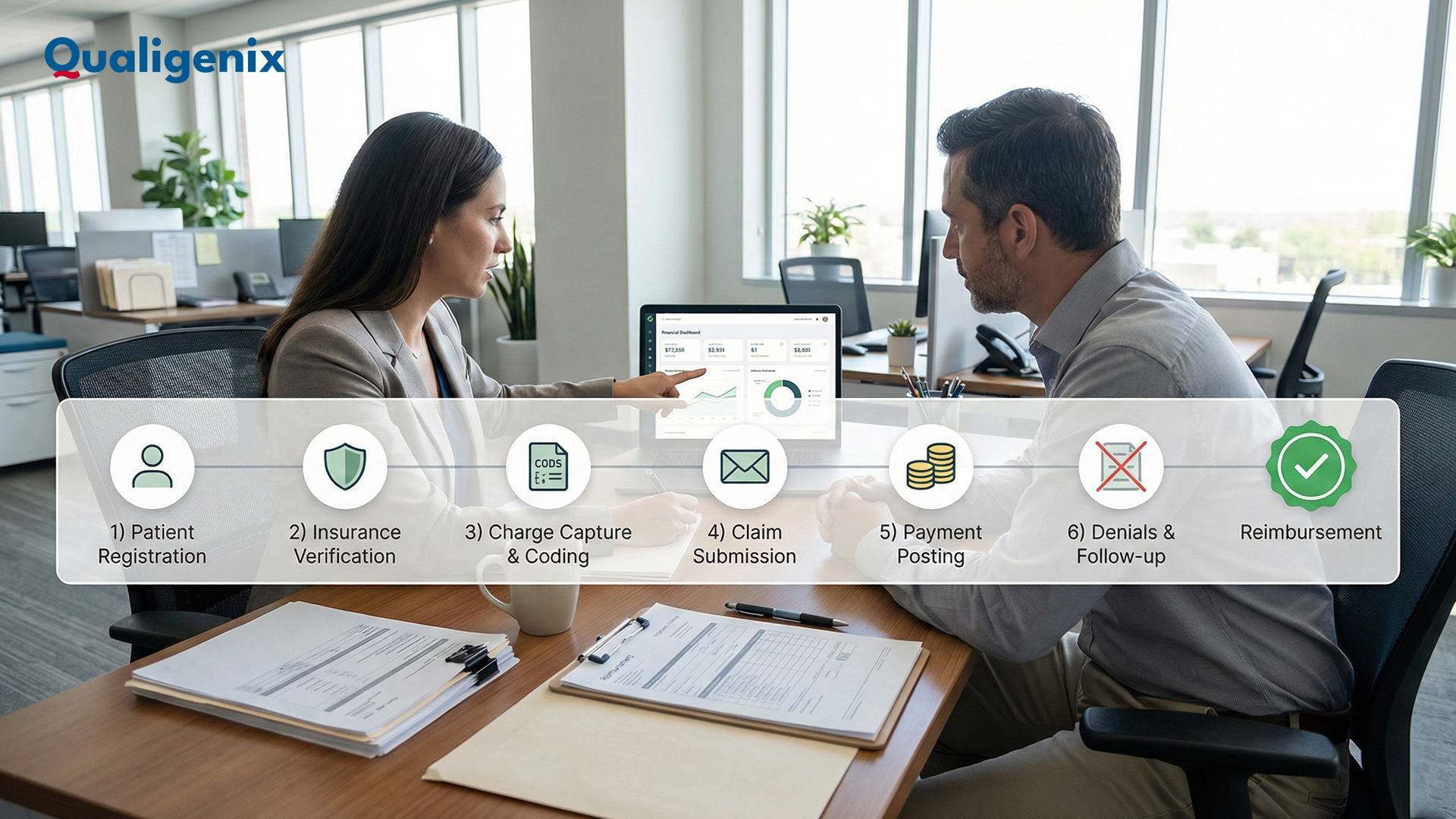
The RCM outsourcing services are not a handoff into the unknown. When done correctly, revenue cycle outsourcing is a process that follows a structured and transparent process that keeps providers in control while reducing the strain of operations.
Data Integration and Onboarding
The process begins with onboarding and system integration. The RCM partner will securely connect with the provider’s EHR, practice management system, and billing software. The patient demographics, clinical documentation, and payer information will all flow into a shared workflow.
The protocols for access, role-based permissions, and compliance measures will ensure that the handling of data is in line with privacy regulations. This enables the billing workflow automation process without affecting clinical operations.
Coding and Claim Preparation
After the clinical services have been recorded, the coding teams, who work outside the organization, check the records for accuracy and completeness. CPT, ICD-10, and modifier codes are also checked to ensure that they comply with the guidelines set by the insurance companies.
This is an important step in revenue leakage prevention, for inaccurate coding can lead to underpayment, non-compliance, and high rates of initial claim rejections
Claim Submission and Payer Follow-Up
The claims are then submitted electronically to the insurance companies. After the claims have been submitted, they are actively tracked instead of waiting passively for payment.
The outsourced teams are very keen on the timelines set by the insurance companies and follow up on claims that are overdue and also on inquiries from the insurance companies. Many practices use the claims processing vendors to handle communications with the various insurance companies across different regions and specialties.
Denial Management and Appeals
Even clean claims may be denied and the key to making that happen is through speed and accuracy in reaction. In denial management outsourcing, denied claims are assessed for underlying causes such as gaps in documentation, authorizations, or coding discrepancies.
Errors are corrected promptly, appeals are filed on time, and trends are analyzed to avoid future denials. This forward-thinking strategy safeguards income that could otherwise be expensed
Payment Posting and Reporting
Payments are posted and matched against anticipated reimbursements with errors, partial payments, and underpayments getting indicated as soon as they are received.
Providers are provided with organized reports that highlight collection patterns, denial data, payer performance, and outstanding AR. This helps ensure that outsourcing does not mean a lack of visibility.
Why Providers Choose RCM Outsourcing Services
Healthcare companies do not choose to outsource billing as a means of lowering expenses. This is normally a decision that is made due to a combination of factors, including financial necessity, operational constraints, and complexity of compliance.
Faster Reimbursements
Skilled billing staff are aware of the behavior and requirements of payers and their knowledge of payer regulations means that there is less back-and-forth, faster approvals, and faster payments. This results in faster reimbursements and less reliance on credit or reserves.
Lower Billing Costs
It costs money to have billing staff in-house. This includes salaries, benefits, training, and turnover costs. Outsourcing billing means that these fixed costs are converted to predictable service costs. The cost reduction in healthcare billing is particularly true for many providers who opt to use offshore billing models responsibly.
Reduced Compliance Risk
Payer regulations and guidelines are constantly evolving, experienced RCM partners can help with payer compliance support on an ongoing basis, ensuring that claims remain in line with current guidelines.
When Outsourcing Revenue Cycle Management Makes Sense
Not all organizations require complete outsourcing right away, but in some situations, RCM outsourcing services are particularly beneficial. Growth can put a strain on in-house billing operations, causing delays and missed follow-ups. High denial rates indicate underlying workflow problems that in-house staff may not have time to address. Turnover can impact collections and reporting.
Multi-location practices and growing specialties can benefit from streamlined billing processes. In these situations, outsourcing revenue cycle management helps maintain consistency without introducing complexity.
How Qualigenix Helps With Outsourcing Revenue Cycle Management

Healthcare organizations require specialized expertise to maintain financial stability. Qualigenix provides a comprehensive suite of services to manage the complete billing lifecycle effectively.
- End-to-End Revenue Oversight The team oversees every stage from initial eligibility checks to final payment collection. Their experts handle medical coding and accounts receivable with total transparency.
- Technology-Driven Global Delivery Advanced technology and global delivery models drive the entire financial workflow. This structure provides medical practices with full visibility and maximizes total revenue.
- Seamless Integration and Compliance Staff members integrate with existing infrastructure to ensure strict compliance with security standards. These secure processes minimize claim denials and protect sensitive patient records.
Gain Growth and Confidence Through Outsourcing!
Outsourcing revenue cycle management is no longer a cost-saving measure. It has become a strategic approach that enables healthcare organizations to safeguard their revenue, reduce administrative burdens, and scale their operations with confidence.
As the level of scrutiny from payers continues to rise and the need for internal resources continues to be limited, outsourcing becomes a systematic approach to improve financial performance without losing control.
FAQs
1. What does outsourcing revenue cycle management include?
Outsourcing revenue cycle management generally encompasses eligibility verification, coding, claim submission, AR follow-ups, denial management, payment posting, and financial reporting.
2. Is RCM outsourcing secure for patient data?
Yes, reliable RCM outsourcing vendors adhere to rigorous guidelines for protecting patient data and ensuring compliance.
3. How long does it take to see results from RCM outsourcing?
Most practices see positive results in denial rates and cash flow within 60 to 90 days, depending on the volume of claims and existing workflow problems.
4. Can small practices use RCM outsourcing services?
Yes, RCM outsourcing is scalable and beneficial for small practices that do not have billing staff or want predictable billing expenses.
5. Does outsourcing replace in-house billing teams?
Some practices implement a hybrid approach where in-house staff handle the front-end process and outsource complex billing and follow-ups, so you need not necessarily replace in-house billing teams.
6. How do providers track performance when they outsource
Performance is tracked through dashboards and regular reports covering KPIs such as AR days, denial rates, collections, and payer performance.
What’s Next
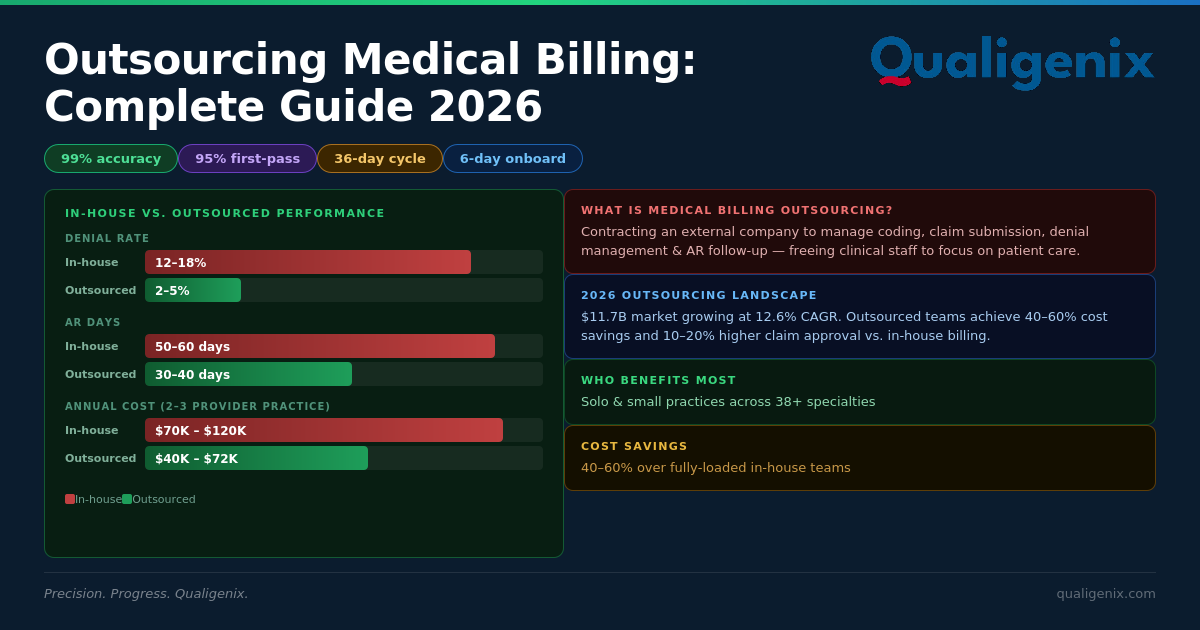
Outsourcing Medical Billing: Complete Guide 2026
Outsourcing medical billing means handing your revenue cycle — coding, claim submission, denial management, and AR follow-up — to...
Best RCM Outsourcing Companies for Specialty Practices
Running a specialty practice is a full-time hustle. Between delivering top-tier patient care, managing staff, and keeping up with...