
Revenue Integrity in Healthcare: 8 Key Components Explained (2026)
The Qualigenix Editorial Team consists of certified billing and coding experts with over 40 years of experience across 38+ medical specialties. Our content is rigorously researched against CMS, AMA, and payer-specific guidelines to ensure total compliance and accuracy. We apply the same elite standards to our resources as we do our client work, consistently delivering high claim accuracy and significant reductions in AR days.

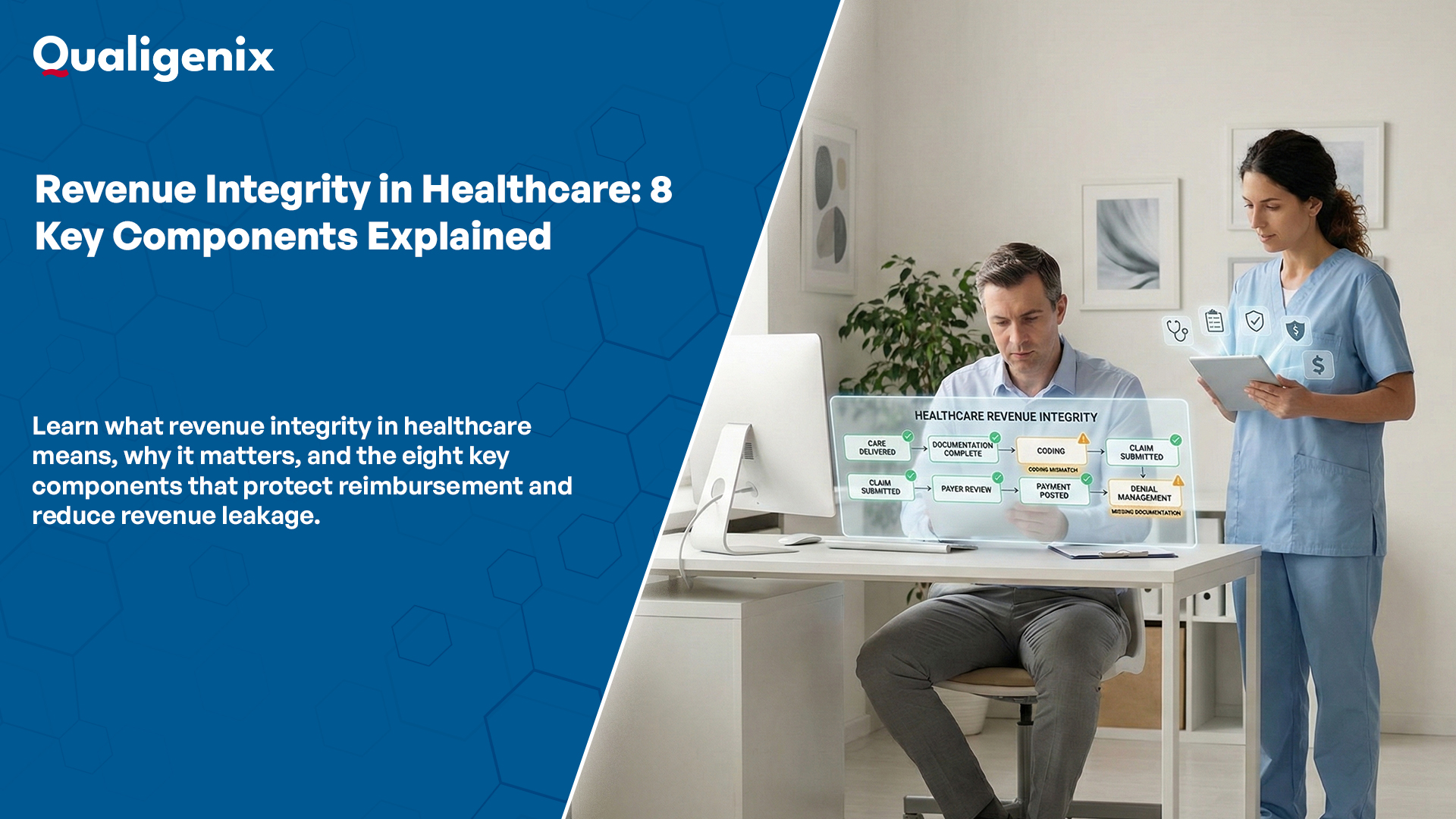
| Summary Revenue integrity in healthcare ensures that every service delivered is accurately documented, coded, charged, and reimbursed – while remaining fully compliant. In 2026, with payers using AI-driven audits and pre-bill risk reviews up 30%, revenue integrity is a critical operating model, not just a billing checkpoint. The 8 core components span clinical documentation, charge capture, coding accuracy, compliance, denial management, payer contracts, technology, and staff training. Qualigenix delivers 99% claim accuracy and a 30% reduction in AR days through embedded revenue integrity controls. |
Why Revenue Integrity in Healthcare Is a 2026 Strategic Priority
Revenue integrity is not a billing department function – it is an enterprise operating model. Healthcare organizations that treat it as a back-office audit process are consistently losing revenue they have already earned. In 2026, payers use AI to review claims with greater precision than ever before, pre-bill audits increased by 30% in 2025 (Medical Billers and Coders), and 35% of hospitals face losses exceeding $50 million due to exhausted appeals (Xsolis / Healthcare IT Today).
The financial stakes are clear. McKinsey & Company research presented at an HFMA webinar estimates $265 billion in potential savings available through improved revenue cycle management across the US healthcare industry. For individual practices and health systems, the gap between what they earn through clinical delivery and what they actually collect through billing is the revenue integrity gap – and it is larger than most organizations realize.
Strong revenue integrity in healthcare closes that gap by aligning clinical documentation, coding accuracy, charge capture, compliance, and payer contract management into one continuous, proactive system. This guide breaks down all 8 components – what they are, why each one matters, and what best-in-class performance looks like for each.
What Is Revenue Integrity in Healthcare?
| Revenue integrity in healthcare is the coordinated system of processes that ensures every service a provider delivers is accurately documented, correctly coded, completely charged, and fully reimbursed – in compliance with all payer rules and regulatory requirements. It sits upstream of traditional revenue cycle management and prevents revenue leakage before claims are ever submitted, rather than recovering lost revenue after denials occur. |
The simplest definition: revenue integrity ensures that what is delivered is billed, and what is billed is delivered – accurately, completely, and compliantly. It is the bridge between clinical care and financial performance.
Revenue integrity has traditionally been associated with compliance audits and post-bill reviews. That model no longer works in 2026. Organizations that embed revenue integrity across the revenue cycle – from patient registration through final payment – identify risk earlier, correct it faster, and build measurable financial stability. Those that treat it as an isolated function continue reacting to denials and audits rather than preventing them.
Revenue Integrity in Healthcare: 2026 Benchmarks and Data
| Metric | Value / Benchmark |
| Annual Revenue at Risk from Leakage | $265 billion (McKinsey / HFMA) |
| Hospitals Facing Losses >$50M from Exhausted Appeals | 35% (Healthcare IT Today / Xsolis) |
| Industry Average Clean Claim Rate Target | 95%+ |
| Industry Average Denial Rate (2026) | 11.8% – up from 10.2% (HFMA) |
| Manual Coding Error Rate | 26.8% (Qualify Health benchmarks) |
| Pre-Bill Risk Audit Growth (2025) | #ERROR! |
| Administrative Spend as % of US Healthcare Costs | 25% of $4 trillion annually (Xsolis) |
| Average A/R Days Target | Under 35 days |
| Qualigenix Claim Accuracy Rate | 99% |
| Qualigenix First-Pass Acceptance Rate | 95% |
| Qualigenix AR Days Reduction | 30% average client reduction |
| Qualigenix Average Collection Cycle | 36 days |
What Are the 8 Key Components of Revenue Integrity in Healthcare?
Revenue integrity is not a single process – it is an ecosystem of eight interconnected functions that must work together. A weakness in any one component creates revenue leakage that compounds across the others. Here is a complete breakdown of each component and what strong performance looks like in 2026.
Component 1: Clinical Documentation Integrity (CDI)
Clinical documentation integrity is the foundation of every other revenue integrity component. If the medical record does not accurately and completely reflect the complexity of care delivered, no amount of billing expertise can recover that revenue. Payers now use Natural Language Processing (NLP) to compare CPT and ICD-10 codes against clinical notes – documentation that is vague, incomplete, or misaligned with the codes submitted triggers automatic denials.
CDI programs work prospectively – identifying documentation gaps while the patient is still in the facility or immediately post-encounter, before the claim is created. A CDI specialist reviews charts for missing diagnoses, unsupported severity indicators, incomplete procedure descriptions, and ambiguous physician language that coders cannot translate accurately.
- Best Practice: Embed CDI specialists who query physicians in real time, not just retrospectively. Practices with active CDI programs see clean claim rates above 95% and significantly fewer medical necessity denials.
- 2026 Watch: Payers using AI audits now flag documentation drift – the gradual decline in note specificity – across provider populations. CDI programs must monitor this at the provider level, not just the claim level.
Component 2: Charge Capture Accuracy
Charge capture is the process of recording every billable service before claims are created. It is one of the largest – and most invisible – sources of revenue leakage in healthcare. Unlike a denied claim, a missed charge never triggers a denial and never appears on a report. The service was delivered, the revenue was earned, and it simply vanishes before billing ever begins.
For high-complexity specialties – orthopedics, wound care, anesthesia, oncology – missed charges commonly include unbilled implant costs, overlooked modifier-eligible procedures in multi-unit cases, and post-operative services absorbed inside global period windows that could have been separately billed. Medical Billers and Coders report that organizations identify an average of $180,000 in per-provider annual leakage from charge capture failures alone during initial revenue integrity audits.
- Best Practice: Implement automated charge capture tools integrated with your EHR that flag billable services not yet mapped to charges. Daily charge reconciliation prevents leakage from accumulating over billing cycles.
- 2026 Watch: AI-powered charge capture platforms now cross-reference procedure notes, OR logs, and supply records to identify billable services that manual entry misses – a significant upgrade from spreadsheet-based reconciliation.
Component 3: Coding Accuracy and Compliance
Accurate medical coding is where clinical reality becomes financial reality. Every service, diagnosis, and procedure must be translated into the correct CPT, ICD-10, and HCPCS codes – with appropriate modifiers – that payers use to determine coverage and reimbursement. Manual coding carries a 26.8% error rate (Qualify Health), meaning more than one in four manually coded claims contains at least one error that affects reimbursement.
Coding errors create two distinct problems. Undercoding – assigning lower-complexity codes than documentation supports – results in systematic underpayment that practices rarely detect. Overcoding – assigning higher-complexity codes than documentation justifies – creates compliance risk and audit exposure. Revenue integrity demands accurate coding in both directions: capturing the full value of care delivered without overclaiming.
- Best Practice: Run pre-submission coding reviews against payer-specific edit libraries. Qualigenix achieves 99% claim accuracy through specialty-trained coder teams and automated code scrubbing before every claim submission.
- 2026 Watch: CMS has expanded NCD/LCD requirements for several specialty procedure categories. Coders must stay current on local coverage determination updates for your specific payer mix and state market.
Component 4: Compliance and Regulatory Adherence
Revenue integrity without compliance is a liability waiting to surface. Healthcare billing must adhere to HIPAA privacy and security rules, CMS billing guidelines, the No Surprises Act (2022, still active in 2026), payer-specific participation agreements, and state-level regulations – all simultaneously. Non-compliance does not just create audit risk; it exposes organizations to False Claims Act liability, repayment demands, and reputational damage that affects payer relationships and patient trust.
The compliance component of revenue integrity focuses on building internal controls that make accurate billing the default – not the exception. Regular internal audits, compliance training programs, and clear policies for handling gray-area billing situations are the baseline. In 2026, compliance programs must also address the CMS Prior Authorization Rule, which requires API-enabled prior authorization workflows for impacted payer types.
- Best Practice: Conduct quarterly internal billing audits with a structured sample methodology – by provider, by payer, by procedure category. Audits catch drift before it becomes a pattern that triggers external review.
- 2026 Watch: The transition from retrospective audits to predictive compliance monitoring is accelerating. Organizations that embed compliance checks into pre-submission workflows catch problems before claims are filed – not after audits arrive.
What Is the Difference Between Revenue Integrity and Revenue Cycle Management?
Revenue cycle management (RCM) focuses on the end-to-end process of collecting payment for services – from patient registration through final remittance. Revenue integrity focuses on accuracy and compliance within that process, ensuring that what gets billed reflects what was actually delivered and that every dollar earned is actually captured. RCM is the pipeline; revenue integrity is the quality control system that prevents leakage throughout it. Strong revenue integrity makes every RCM function – coding, billing, claims, AR follow-up – more efficient and more accurate.
Component 5: Denial Management and Prevention
Denial management sits at the intersection of revenue integrity and collections – and it is where organizations most visibly see the cost of upstream failures. Every denied claim is a symptom of a breakdown somewhere in the revenue integrity chain: a documentation gap, a coding error, an eligibility issue, a missing authorization. A strong denial management component does not just appeal individual claims – it traces each denial to its root cause and fixes the upstream workflow.
In 2026, the most forward-thinking organizations have moved from reactive denial management – appealing claims after rejection – to predictive denial prevention – using analytics to identify high-risk claims before submission. AI-powered denial tools now predict the probability of denial for each claim based on payer history, code combinations, documentation completeness, and eligibility status.
- Best Practice: Track denial patterns by payer, procedure category, and provider – not just total denial rate. Root-cause analysis by denial category reveals the specific upstream failures driving revenue loss.
- Qualigenix Advantage: Our denial management services combine real-time dashboards, specialty-trained appeal writers, and root-cause analytics to deliver a 95% first-pass acceptance rate – well above the 85–88% industry average.
Component 6: Payer Contract Management and Underpayment Recovery
Payer contracts define exactly how much your organization should be paid for every procedure code – and most organizations are being paid less than they should. Payer underpayments are systematic, quiet, and cumulative. A commercial payer consistently processing a specific CPT code at 92% of the contracted rate may go undetected for years without active contract management. Over a full practice volume, that 8% gap compounds into significant annual revenue loss.
Payer contract management as a revenue integrity component requires maintaining an accurate, up-to-date fee schedule for every payer and comparing actual reimbursements against contracted rates on every explanation of benefits (EOB). Discrepancies must be flagged, tracked, and formally disputed within payer-specified timely filing windows.
- Best Practice: Implement automated ERA/EOB reconciliation that compares every payment against the contracted fee schedule. Flag underpayments above a defined threshold for formal dispute.
- 2026 Watch: The No Surprises Act and increased price transparency requirements create compliance obligations around patient cost estimates and payer contract accuracy that overlap with revenue integrity program responsibilities.
How Does Clinical Documentation Integrity (CDI) Affect Revenue Integrity?
CDI is the upstream driver of revenue integrity. If the medical record does not fully capture the complexity, acuity, and scope of care delivered, every downstream process – coding, billing, appeals – operates from an incomplete foundation. Incomplete documentation leads to undercoded claims, medical necessity denials, and failed appeals that cannot be overturned because the clinical record does not support the level of service billed. Organizations with active CDI programs consistently outperform those without them on clean claim rates, denial rates, and net collection ratios.
Component 7: Technology and Automation Integration
Revenue integrity at scale requires technology – no manual process can match the speed, consistency, and analytical depth needed to protect revenue in a modern payer environment. EHR systems, practice management platforms, AI-powered coding tools, real-time eligibility verification systems, and denial analytics dashboards must all work together in an integrated revenue integrity technology stack.
In 2026, the technology requirements have expanded significantly. Payers use AI to review claims at submission. Revenue integrity programs must use AI on the provider side to pre-screen claims, identify documentation gaps, flag high-denial-risk procedure/payer combinations, and automate eligibility verification before the patient even arrives for care.
- Best Practice: Integrate real-time eligibility verification at scheduling – not just at check-in. Eligibility errors caught 48–72 hours before an appointment can be corrected without disrupting care delivery.
- 2026 Watch: Healthcare organizations that have adopted AI-powered revenue integrity tools report significantly higher clean claim rates and lower denial rates than those relying on manual pre-submission review alone.
Component 8: Staff Training and Revenue Integrity Culture
Technology and processes only work when the people using them understand why accuracy matters. Revenue integrity is ultimately a culture initiative as much as a technical one. Physicians who understand how documentation specificity affects reimbursement write better notes. Coders who receive continuous education on payer updates catch changes before they cause denials. Billing staff who understand the cost of errors build habits that prevent them.
A formal revenue integrity culture includes regular training for all stakeholders – clinical, coding, and billing – with role-specific content rather than generic compliance courses. It also includes transparent internal reporting: teams should see their individual coding accuracy rates, denial rates, and charge capture performance regularly, not just at annual reviews.
- Best Practice: Implement monthly revenue integrity rounds that bring together clinical documentation, coding, and billing leadership. Use denial data and coding audit findings as the agenda – not abstract policy discussions.
- 2026 Watch: With AI taking over routine coding and billing tasks, staff training in 2026 is increasingly focused on exception handling – reviewing AI-flagged claims, managing complex appeals, and interpreting analytics dashboards.
Revenue Integrity vs. Traditional RCM: Key Differences
| Dimension | Traditional RCM | Revenue Integrity Program |
| Focus | Collect payment for submitted claims | Ensure every dollar earned is billed accurately |
| Timing | Post-submission: react to denials | Pre-submission: prevent denials before they occur |
| Scope | Billing and collections workflow | Clinical + coding + billing + compliance + contracts |
| Denial Approach | Appeal individual denied claims | Root-cause analysis; fix upstream workflows |
| Charge Capture | Relies on manual entry by clinical staff | Automated, reconciled against clinical records daily |
| Documentation Role | Reviewed after coding; rarely queried | CDI specialists engage physicians proactively |
| Technology | Practice management system + clearinghouse | AI coding, real-time eligibility, denial analytics |
| Compliance Posture | Retrospective audit-driven | Embedded pre-bill controls and continuous monitoring |
What KPIs Should a Revenue Integrity Program Track?
A strong revenue integrity program tracks clean claim rate (target: 95%+), denial rate by payer and procedure (target: below 8%), AR days (target: under 35), charge capture reconciliation rate, coding accuracy rate, underpayment recovery rate, and first-pass acceptance rate. These KPIs should be reviewed at least monthly – broken down by provider, payer, and specialty – not just reported as aggregate practice-wide figures. Granular tracking reveals the specific workflows driving leakage and enables targeted intervention before performance gaps compound.
How Qualigenix Embeds Revenue Integrity Across Your Revenue Cycle
Qualigenix builds revenue integrity into every layer of the revenue cycle – from front-end eligibility verification through final payment posting and AR recovery. Our approach treats revenue integrity not as a periodic audit but as a continuous operating standard. Here is how we deliver it:
- 99% Claim Accuracy: Pre-submission coding review, payer-specific edit scrubbing, and clinical documentation alignment checks ensure claims are clean before they reach the payer – delivering 99% claim accuracy across our client base.
- 95% First-Pass Acceptance: Our front-end controls – real-time eligibility verification, prior authorization tracking, charge reconciliation – result in 95% of claims clearing payer adjudication on the first submission, eliminating the cost and delay of rework.
- 30% Reduction in AR Days: By catching errors upstream rather than appealing them downstream, our clients reduce average AR days by 30%, improving cash flow predictability and reducing the administrative burden on clinical staff.
- Real-Time Revenue Integrity Dashboards: Every Qualigenix client gets real-time access to their revenue integrity KPIs – clean claim rate, denial rate by category, AR aging, and charge capture reconciliation – through dedicated account dashboards, not monthly PDF reports.
- Specialty-Specific Expertise: Revenue integrity requirements differ significantly across specialties. Our teams are trained by specialty – behavioral health, cardiology, orthopedics, DME, home health, and 38+ others – with payer-specific rule knowledge for every major US payer.
Related resource: Revenue Cycle Management Services
10-Point Revenue Integrity Checklist for Healthcare Providers
- CDI Program Active: Do you have CDI specialists querying physicians on documentation gaps before claims are created?
- Charge Capture Reconciliation: Is every billable service reconciled against procedure logs and supply records daily before billing?
- Coding Accuracy Rate: Is your coding accuracy above 95%? Are you tracking it by provider and payer monthly?
- Clean Claim Rate: Is your first-pass acceptance rate at 95% or above? If not, do you know which payers and codes are driving misses?
- Denial Rate by Category: Are you tracking denial root causes – not just total denial rate – and using that data to fix upstream workflows?
- Payer Contract Reconciliation: Are actual reimbursements being compared against contracted rates on every ERA/EOB processed?
- Real-Time Eligibility Verification: Is eligibility confirmed at scheduling – not just at check-in – so coverage gaps are corrected before the appointment?
- Compliance Program Active: Are internal billing audits conducted quarterly with a structured sample methodology by provider and payer?
- Technology Integration: Are your EHR, practice management system, clearinghouse, and denial analytics tools sharing data in real time?
- Staff Revenue Integrity Training: Do clinical, coding, and billing staff receive role-specific revenue integrity training – not just generic compliance courses?
Frequently Asked Questions: Revenue Integrity in Healthcare
What does revenue integrity mean in healthcare?
Revenue integrity in healthcare means ensuring that every clinical service delivered is accurately documented, correctly coded, completely charged, and fully reimbursed – in compliance with all applicable regulations and payer requirements. It is an operating model that prevents revenue leakage across the entire revenue cycle rather than addressing gaps reactively after denials occur. Strong revenue integrity aligns clinical, coding, billing, and compliance functions around one shared goal: accurate, compliant payment for every service provided.
What are the 8 key components of a revenue integrity program?
The 8 key components are: (1) Clinical Documentation Integrity (CDI), (2) Charge Capture Accuracy, (3) Coding Accuracy and Compliance, (4) Regulatory Adherence, (5) Denial Management and Prevention, (6) Payer Contract Management and Underpayment Recovery, (7) Technology and Automation Integration, and (8) Staff Training and Revenue Integrity Culture. Each component addresses a specific failure point in the path from clinical service delivery to final reimbursement. Weakness in any one component creates leakage that compounds through the others.
How much revenue do healthcare organizations lose to revenue integrity failures?
McKinsey & Company estimates $265 billion in potential savings available through improved revenue cycle management across the US healthcare system. At the practice level, Medical Billers and Coders report an average of $180,000 in per-provider annual leakage from charge capture failures alone – before accounting for undercoding, denied claims, and underpayments. Organizations without formal revenue integrity programs typically recover 60–80 cents for every dollar earned; strong programs push that toward 95 cents or above.
What is the difference between CDI and revenue integrity?
Clinical Documentation Integrity (CDI) is one of the eight components of a revenue integrity program – specifically, the component that ensures medical records accurately reflect the complexity and scope of care delivered. Revenue integrity is the broader operating model that encompasses CDI along with charge capture, coding, compliance, denial management, payer contracts, technology, and training. CDI is the upstream driver; revenue integrity is the complete system that converts accurate documentation into accurate reimbursement.
How does revenue integrity reduce claim denials?
Revenue integrity reduces denials by addressing their root causes before claims are submitted – not after they are rejected. Pre-submission documentation reviews eliminate medical necessity denials. Real-time eligibility verification prevents coverage-related rejections. Accurate coding with payer-specific edit scrubbing removes modifier and code-mismatch denials. Prior authorization tracking prevents authorization-gap rejections. Organizations with mature revenue integrity programs consistently achieve denial rates below 5%, compared to the industry average of 11.8% in 2026.
How does Qualigenix support revenue integrity for specialty practices?
Qualigenix embeds revenue integrity controls across all eight program components for specialty practices across 38+ clinical specialties. Our approach includes specialty-trained CDI support, automated charge capture reconciliation, payer-specific coding review, real-time eligibility verification, and dedicated denial analytics dashboards. Clients achieve 99% claim accuracy, 95% first-pass acceptance, and a 30% reduction in AR days – with 6-day average onboarding and an immediate AR assessment at no cost.
What technology does a revenue integrity program need in 2026?
A 2026 revenue integrity technology stack requires: real-time eligibility verification integrated at scheduling, AI-powered coding review and code scrubbing against payer-specific edits, automated charge capture reconciliation, denial analytics platforms with root-cause reporting, ERA/EOB reconciliation tools for underpayment detection, and real-time performance dashboards. These tools must integrate with your EHR and practice management system – not operate as disconnected point solutions. Qualigenix clients access all of these capabilities through our integrated RCM platform without managing separate vendor relationships.
Related Qualigenix Resources
Revenue Cycle Management Services – End-to-end RCM with embedded revenue integrity controls
Denial Management Services – Proactive denial prevention and root-cause analytics
Medical Coding Services – 99% coding accuracy for US specialty practices
Charge Entry Services – Accurate charge capture and reconciliation for clean claims
Insurance Eligibility Verification Services – Real-time eligibility checks that prevent coverage-related denials
Charge Capture in Healthcare: Common Errors & How to Fix Them – Deep dive into charge capture failure patterns and solutions
RCM KPI Benchmarking in Healthcare – How to measure and improve your revenue integrity KPIs
How to Select the Best Denial Management Service – Evaluation guide for denial management partners
Healthcare Performance Reporting – Real-time dashboards for revenue integrity monitoring
Medical Billing Outsourcing Services – Full-service outsourcing with built-in revenue integrity programs
| 📞 Protect Every Dollar Your Practice Earns Revenue integrity failures cost US healthcare providers hundreds of billions annually – and most of that leakage is preventable. Qualigenix delivers 99% claim accuracy, 95% first-pass acceptance, and a 30% reduction in AR days with 6-day average onboarding. Book a free consultation and get an immediate AR assessment at no cost. 👉 Book Your Free Consultation: qualigenix.com/contact-us/ |
What’s Next
Retro Authorization: Which Payers Grant It and What Documentation They Require
Retro authorization is payer approval you request after a service is already done. Most Medicaid programs, Medicaid managed care,...

Structuring patient payment plans without increasing your bad debt
A payment plan only helps if it finishes. Take 20 to 25 percent down, size the installment to the...

Renegotiating payer contracts: what your current fee schedule data needs to say first
Most practices walk into a rate conversation with a number the payer already knows is wrong. Before you ask...