

Top 5 Revenue Cycle Management Trends to Watch in 2026
The Qualigenix Editorial Team consists of certified billing and coding experts with over 40 years of experience across 38+ medical specialties. Our content is rigorously researched against CMS, AMA, and payer-specific guidelines to ensure total compliance and accuracy. We apply the same elite standards to our resources as we do our client work, consistently delivering high claim accuracy and significant reductions in AR days.


In 2026, revenue cycle management is being reshaped by five forces: AI-driven automation, regulatory pressure from value-based care, rising patient financial expectations, real-time data analytics, and cybersecurity resilience. Teams that act on all five will outperform on cash flow, compliance, and patient trust. Teams that don’t will fall behind fast.
First-pass denial rates hit nearly 12% in 2024, and they’re still climbing. Meanwhile, payers are demanding cleaner data faster, compliance rules are shifting every quarter, and patients expect the same billing transparency from their doctor’s office as they get from their bank.
Revenue cycle management isn’t getting simpler. It’s getting more technical, more regulated, and more patient-centered all at once. If your RCM strategy is even 18 months old, it’s likely already showing cracks.
The five revenue cycle management trends below aren’t predictions. They’re already happening. This guide breaks down what each trend means, what’s driving it, and what your practice should do right now.
What are the top revenue cycle management trends in 2026? The five biggest RCM trends are: AI and automation scaling beyond pilot programs, regulatory pressure from value-based care and CMS rule changes, patient financial engagement becoming a revenue driver, unified data analytics and real-time dashboards, and cybersecurity as a core billing infrastructure requirement.
2026 RCM Benchmark Statistics
| Metric | Value | Source / Context |
|---|---|---|
| Industry first-pass denial rate (2024) | ~12% | HFMA |
| RCM leaders expanding AI in 2026 | 92% | PR Newswire / Industry survey |
| Denial reduction from AI adoption | 13–37% | PR Newswire RCM AI study |
| Eligibility / auth workflows running autonomously (2026 target) | >50% | R1 RCM / Industry projection |
| Patient payment rate lift — digital statements | 20–25% | Industry benchmark |
| Manual payment posting by end of 2026 | <25% | Automation adoption projection |
| Qualigenix claim accuracy rate | 99% | Qualigenix operational data |
| Qualigenix first-pass acceptance rate | 95% | Qualigenix operational data |
| Qualigenix average AR reduction for clients | 30% | Qualigenix client outcomes |
| Qualigenix average collection cycle | 36 days | Qualigenix operational data |
| Qualigenix average onboarding time | 6 days | Qualigenix operational data |
| Specialties served by Qualigenix | 38+ | Qualigenix service catalog |
Trend 1: AI and Automation Have Moved Past the Pilot Stage
Revenue cycle teams aren’t testing AI anymore. They’re deploying it at scale. Over 92% of RCM leaders plan to expand AI initiatives in 2026 across eligibility verification, coding, and payment posting. The results back up the investment — organizations that fully operationalize AI report 13 to 37% fewer denials and a sharp drop in labor cost per claim.
This isn’t about replacing billing staff. It’s about removing the repetitive work that slows everything down and causes preventable errors. Staff should be focused on complex cases, payer escalations, and denial appeals — not re-keying demographic data or manually checking every claim field.
Predictive Analytics for Denial Prevention
Predictive models now analyze payer patterns, documentation gaps, and coding errors before a claim goes out. They flag risk in real time, which lets billing teams fix problems upstream rather than deal with denial letters weeks later. Cleaner submissions mean faster reimbursement and fewer appeals.
RPA for Claim Scrubbing and Repetitive Tasks
Robotic process automation has evolved well beyond basic macros. Modern RPA systems check thousands of claim fields, validate codes, and confirm demographic data in seconds. They don’t get tired, they don’t miss fields, and they apply the same standard to every claim. That consistency is hard to replicate at scale with manual teams.
Automation in Eligibility, Authorizations, and Payment Posting
The front and back ends of the revenue cycle are both seeing strong automation gains. Eligibility checks happen instantly at scheduling. Prior authorizations route through payer APIs electronically. Payment posting processes the moment ERA files hit the system. The net effect: lower AR days, fewer errors, and staff who can actually focus on strategy instead of data entry.
What should practices do now? Appoint an RCM automation lead. Treat AI as infrastructure, not a one-time project. Invest in data governance and workflow redesign before adding new tools — bad data flows through automation just as fast as good data.
Trend 2: Regulatory Changes and Value-Based Care Are Reshaping Reimbursement
Technology can accelerate claims, but regulation decides the rules. CMS, commercial payers, and federal legislators are all rewriting how revenue is earned, documented, and audited in 2026. Compliance isn’t a department anymore — it’s a revenue function.
Practices that treat regulatory change as a compliance team problem will end up with denied claims, recoupment demands, and delayed reimbursements. The ones building regulatory monitoring into their RCM operations will stay ahead of it.
Bundled Payments and Value-Based Reimbursement Models
CMS is piloting additional bundled payment programs in 2026, tying reimbursement directly to patient outcomes, cost efficiency, and care coordination. Hospitals and health systems now need RCM operations that can track quality metrics alongside financial ones. If your billing system can’t distinguish between fee-for-service and value-based claims, you’ll underreport quality — and leave money behind.
Transparency Requirements and Patient Billing Rules
Updated federal rules require clear, itemized cost estimates and patient-friendly billing statements. This isn’t just a consumer-experience issue — it’s a collections issue. Providers that integrate cost transparency directly into their RCM platforms see fewer billing disputes and higher patient payment rates. The ones that don’t will face both regulatory risk and collection losses.
Telehealth and Remote Monitoring Billing Updates
CMS 2026 rules introduce new CPT codes for telehealth services and remote patient monitoring while reinstating some pre-pandemic geographic restrictions. Every change requires updates to coding logic and payer configuration. Miss one update and you’ve created a denial pattern that could take months to unwind. Ongoing regulatory monitoring built into your RCM dashboard is no longer optional.
What should practices do now? Embed regulatory monitoring directly into your RCM workflows. Align coding, compliance, and finance teams to review rule changes together — not in separate silos. Treat telehealth billing compliance as a revenue strategy, not a back-office task.
Trend 3: Patient Financial Engagement Is Now a Revenue Strategy
Patient collections used to sit at the end of the revenue cycle. Now they’re built into the beginning. Practices that give patients upfront cost estimates, mobile-friendly payment tools, and clear billing statements are seeing measurable gains — 20 to 25% higher patient payment rates, fewer billing disputes, and shorter collection cycles.
Patients are driving this shift. They expect the same clarity from their provider as they get from any other digital service. When they don’t get it, they delay payment — or dispute it entirely.
Upfront Cost Estimates and Point-of-Service Collections
Automated tools integrated with eligibility checks can now calculate out-of-pocket costs before a visit happens. Patients who know what they’ll owe are more likely to pay it. Digital payment terminals at check-in let them settle balances on the spot. That shift reduces billing friction later and improves front-end collections significantly.
Self-Service Portals and Mobile-First Billing
Patients want to manage their own accounts without waiting on hold. Secure self-service portals let them view balances, set up payment plans, and communicate with billing teams on their own schedule. Text-to-pay and automated reminders are quickly becoming standard — not premium features. Practices that haven’t deployed these tools are watching their collection window stretch longer every month.
Transparent Statements That Actually Reduce Disputes
Clear, itemized billing statements aren’t just good patient experience — they’re a compliance requirement and a cash flow tool. Patients who understand what they’re being charged for dispute bills less and pay faster. Real-time notifications tied to billing events (claim submission, payer payment, balance due) keep patients in the loop and reduce inbound calls to your billing team.
What should practices do now? Treat billing like a consumer product. Test new payment experiences. Track patient NPS on every financial interaction. If patients find your billing confusing, they’ll delay — and your AR days will show it.
Trend 4: Data Visibility and Real-Time Analytics Are Driving RCM Decisions
Revenue cycle leaders can’t fix what they can’t see. The shift happening in 2026 is from monthly reporting to real-time visibility — unified dashboards that pull together EHR data, clearinghouse feeds, payer information, and AR metrics into a single view. When a problem develops, you see it in hours, not weeks.
Practices still relying on end-of-month reports are making decisions based on outdated data. In a fast-moving payer environment, that lag is expensive.
Unified Dashboards and Real-Time Performance Tracking
Modern RCM platforms merge data from multiple sources into dashboards that update throughout the day. Denial rates, AR aging, payer mix, and collection trends are visible in real time. Leaders can identify a spike in a specific denial code within 24 hours instead of finding out at month-end when AR is already damaged.
API-Driven Integration Across EHR and Billing Systems
True interoperability is finally becoming a reality. API-first integrations connect EHR, billing, and analytics platforms, removing the silos that have slowed RCM performance for years. When data flows cleanly between systems, claims come out cleaner. Re-keying errors disappear. Payer configuration stays current because updates propagate automatically across connected platforms.
Predictive Analytics for Revenue Leakage and Financial Forecasting
Revenue leaders are now using AI models to forecast payer mix shifts, predict payment delays, and flag potential revenue leakage before it hits cash flow. At Qualigenix, we use this data to help CFOs plan staffing, budgets, and capital decisions with real numbers — not gut estimates. Predictive analytics isn’t a luxury tool anymore. It’s how high-performing RCM teams stay ahead of the curve.
Trend 5: Cybersecurity Has Become a Core RCM Infrastructure Requirement
Cyberattacks on healthcare billing systems rose sharply in 2024, disrupting claim flows, delaying payments, and exposing patient data. In 2026, a single breach can take down an entire revenue cycle for days. That’s not just an IT problem — it’s a revenue continuity problem.
RCM vendors are now being evaluated on their security posture, not just their billing features. Practices that choose vendors without strong cybersecurity frameworks are accepting operational and financial risk they may not fully see until it’s too late.
Encryption, Zero-Trust, and SOC 2 Certification Standards
Leading RCM vendors now implement AES-level encryption, zero-trust network frameworks, and SOC 2 Type II certification as baseline requirements. These aren’t optional add-ons — they’re becoming contractual expectations in enterprise healthcare contracts. If your billing partner can’t demonstrate these certifications, that’s a gap worth addressing before your next contract renewal.
Remote and Hybrid RCM Teams With Secure Cloud Access
Cloud-based RCM platforms let billing teams access data securely from anywhere. Multi-factor authentication and endpoint monitoring maintain compliance across distributed workforces. This flexibility also supports 24/7 processing, which shortens the time from claim submission to payment posting in organizations with global teams.
Multi-Clearinghouse Failover and Redundancy Planning
High-performing revenue cycle teams now build redundancy into their claim routing. Multi-clearinghouse failover systems keep claims moving even during outages or vendor incidents. Automated backup systems protect data integrity. Downtime recovery is measured in hours, not days. If your current RCM setup doesn’t have a documented failover plan, you’re one incident away from a significant cash flow disruption.
What should practices do now? Add cybersecurity to your RCM leadership agenda — not just your IT agenda. Require SOC 2 Type II certification from all billing vendors. Build a documented resilience plan that includes failover paths and recovery timelines.
How Qualigenix Helps You Keep Up With All Five Trends
At Qualigenix, we’ve built our RCM platform around exactly the shifts described above. We don’t wait for trends to force our hand — we design for where healthcare billing is going, not where it’s been.
Our clients across 38+ specialties get AI-powered claim scrubbing, real-time analytics dashboards, and end-to-end compliance support — all in a system that’s already aligned with CMS 2026 telehealth rules, transparency requirements, and cybersecurity standards. We manage the complexity so your team can focus on patient care.
Here’s what working with Qualigenix looks like in practice:
In-House RCM vs. Qualigenix — Side-by-Side
| RCM Function | Typical In-House | Qualigenix |
|---|---|---|
| First-pass acceptance rate | 75–85% | 95% |
| Denial detection | After submission | Before submission (AI-driven) |
| AR days | 45–65 days | 36 days average |
| CMS 2026 telehealth compliance | Manual updates, risk of lag | Built into platform, auto-updated |
| Cybersecurity posture | Varies by IT budget | SOC 2 Type II, AES encryption, zero-trust |
| Onboarding time | 30–90 days | As few as 6 days |
2026 RCM Readiness Checklist
Use this to gauge where your practice stands today:
- ☐ AI-powered claim scrubbing deployed before submission
- ☐ Eligibility verification automated at scheduling
- ☐ Prior authorization routing through payer APIs
- ☐ Real-time denial rate dashboard in place
- ☐ Telehealth CPT codes updated for CMS 2026
- ☐ Upfront cost estimates available before patient visits
- ☐ Self-service billing portal and text-to-pay active
- ☐ Unified analytics dashboard pulling EHR and payer data
- ☐ SOC 2 Type II certification confirmed for all billing vendors
- ☐ Multi-clearinghouse failover and documented recovery plan in place
Warning: If you checked fewer than 6 items, your practice is carrying avoidable financial risk in 2026. Revenue leakage, denial backlogs, and compliance gaps tend to compound — the longer they go unaddressed, the more costly they become to fix.
Frequently Asked Questions About RCM Trends in 2026
What is the biggest revenue cycle management trend in 2026?
AI-driven automation combined with predictive denial prevention is the biggest shift in 2026. Over 92% of RCM leaders plan to expand AI deployment this year. The focus has moved from pilots to full-scale operational rollouts across eligibility, coding, and payment posting workflows.
How does AI reduce claim denials in RCM?
AI analyzes payer behavior patterns, documentation gaps, and coding accuracy before claims are submitted. It flags risk in real time so billing teams can correct errors upstream. Organizations using predictive AI for denial prevention report 13 to 37% fewer denials compared to those relying on traditional claim scrubbing alone.
Will value-based care replace fee-for-service billing?
Not entirely. Fee-for-service remains the dominant model for many care types. But CMS is expanding bundled payments and outcome-based reimbursements, which means more practices need RCM systems capable of handling both models at once. Practices that can’t track quality metrics alongside financial ones will leave value-based payments on the table.
How long does RCM automation take to show results?
Most practices start seeing measurable improvements within 60 to 90 days. Common early wins include a higher clean claim rate, fewer denials, and reduced AR days as manual steps are removed from billing workflows. At Qualigenix, we typically see meaningful performance gains within the first billing cycle after onboarding.
How is patient billing changing in 2026?
Patients now expect upfront cost estimates, flexible payment options, and clear itemized billing statements. Practices that deliver these tools are seeing 20 to 25% higher patient payment rates. Those that don’t are seeing billing disputes rise and collection cycles lengthen. Text-to-pay and automated reminders are becoming standard — not optional.
Why is cybersecurity a revenue cycle issue, not just an IT issue?
A cyberattack on a billing system can stop claim submissions, delay payments, and expose patient data for days or weeks. That’s a direct hit to cash flow and compliance. In 2026, cybersecurity requirements are being written into vendor contracts. Practices need RCM partners with SOC 2 Type II certification, multi-clearinghouse failover, and documented recovery plans.
What RCM tools help identify revenue leakage?
Unified dashboards that merge EHR, clearinghouse, and payer data — combined with AI forecasting models — can identify revenue leakage weeks before it impacts cash flow. These tools surface underpayments, missing charges, and denial patterns automatically. Predictive analytics turns revenue leakage from a mystery into a manageable metric.
How does Qualigenix stay current with 2026 RCM changes?
Our team monitors CMS rule changes, payer policy updates, and CPT/ICD-10 revisions continuously. We update coding logic and payer configuration across the platform as rules change — not after a denial spike forces the issue. Clients don’t have to track regulatory updates themselves; we build that into every engagement.
Related Resources From Qualigenix
- Revenue Cycle Management Services
- What Is Revenue Cycle Management?
- What Is RCM in Medical Billing
- HIPAA Compliance Billing Checklist
- Medical Billing Outsourcing Services
- Healthcare Operations and Cost Optimization Consulting
Ready to Build an RCM Strategy That Keeps Up With 2026?
Your revenue cycle doesn’t have to fall behind regulatory changes, rising denials, or patient billing expectations. Qualigenix handles all of it — so you can focus on care.
Our team delivers 99% claim accuracy, a 95% first-pass acceptance rate, an average 36-day collection cycle, and a 30% reduction in AR days. We onboard in as few as 6 days.
Precision. Progress. Qualigenix.
What’s Next
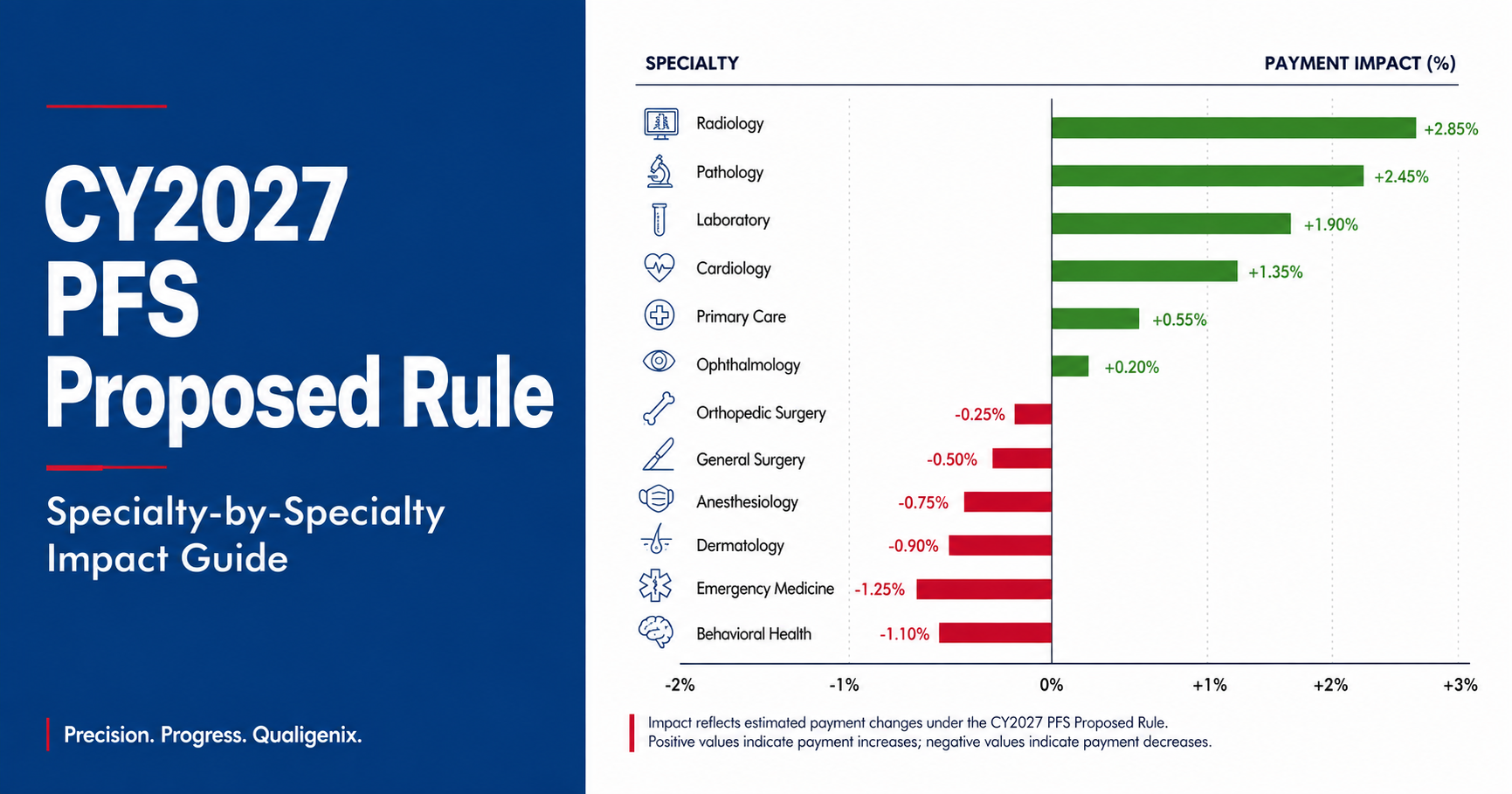
CY2027 Medicare PFS Proposed Rule: Specialty-by-Specialty Impact Guide
The CY2027 PFS proposed rule cuts the conversion factor to $32.84 for non-APM clinicians, but the real story...
Real-time eligibility returned active and the claim still denied: the five reasons why
An “active” eligibility result only proves the policy is in force. It never proves the service is covered, that...
Prior authorization turnaround requirements under the CMS interoperability rule: what changed for practices
The CMS interoperability rule (CMS-0057-F) forces impacted payers to decide standard prior authorizations in 7 calendar days and...