

Vendor Credentialing Management for Healthcare Organizations: Keeping Compliance Current Across Every Vendor
The Qualigenix Editorial Team consists of certified billing and coding experts with over 40 years of experience across 38+ medical specialties. Our content is rigorously researched against CMS, AMA, and payer-specific guidelines to ensure total compliance and accuracy. We apply the same elite standards to our resources as we do our client work, consistently delivering high claim accuracy and significant reductions in AR days.

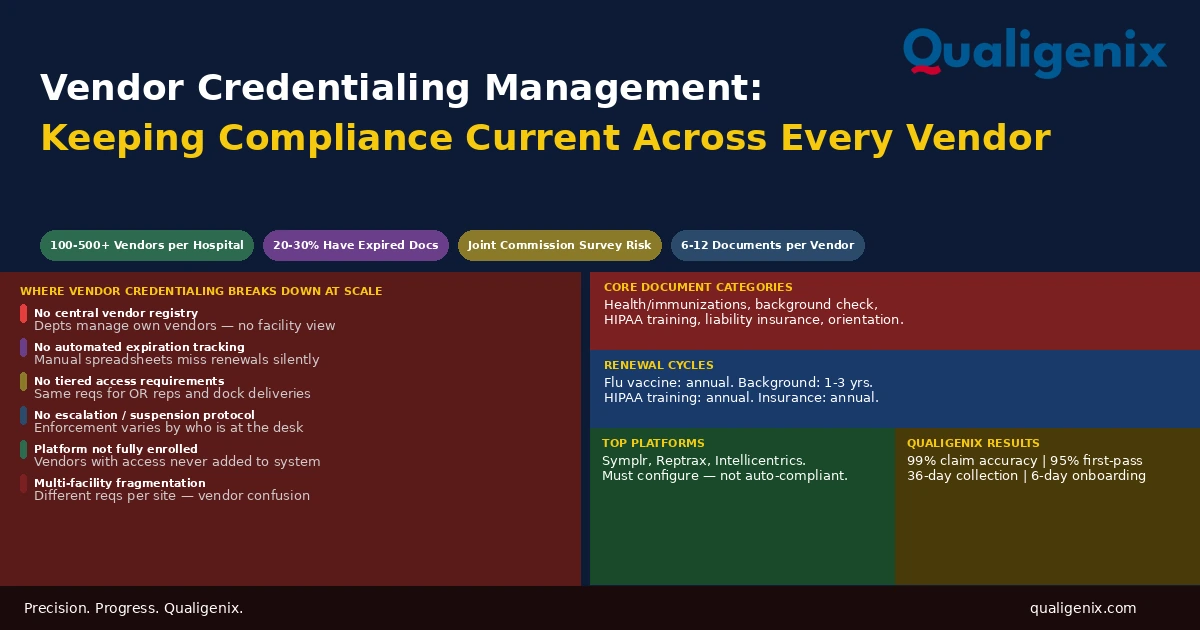
Vendor credentialing is the process by which healthcare facilities verify that vendors, sales representatives, and third-party service providers meet required health, safety, and compliance standards before granting facility access. Managing it for one or two vendors is straightforward. Managing it for 100 or 500 vendors, each with different document types, different expiration schedules, and different access requirements across multiple facilities, is a continuous operational function that most healthcare organizations understaff and under-systematize until a compliance gap surfaces during a survey or incident review.
A medical device representative shows up at the OR desk at 6:45 AM for a scheduled procedure. The circulating nurse checks their access badge on the facility’s vendor management system and it flags red. Their annual flu vaccination record expired three weeks ago. They can’t enter. The case proceeds without them. The surgeon has a question mid-procedure that the rep would have answered in 30 seconds. It now takes three phone calls and a delay.
That scenario happens in hospitals and surgery centers every week. It’s not a failure of the vendor credentialing requirement. It’s a failure of the credentialing management process — the part that should have flagged the expiration three weeks earlier and given both the vendor and the facility time to address it before it became a disruption at the point of care.
This blog explains what vendor credentialing requires, what the compliance challenge looks like at scale, where management systems break down, and how healthcare organizations can build a vendor credentialing program that keeps compliance current without relying on last-minute remediation.
Vendor credentialing in healthcare is the process of verifying that vendors, sales representatives, and third-party service providers meet a facility’s health, safety, and compliance requirements before they are granted access to clinical areas, operating rooms, patient care units, or sensitive systems. Requirements typically include immunization records, TB testing, background checks, HIPAA training, and liability insurance documentation. Managing these requirements across a large vendor population requires a centralized tracking system, tiered access requirements, automated expiration alerts, and a defined suspension and reinstatement protocol.
Vendor Credentialing Management: Key Numbers for Healthcare Organizations
| Metric | Data Point | Source |
|---|---|---|
| Typical active vendor population at a mid-size hospital | 100 to 500+ vendors | Healthcare vendor management surveys |
| Vendors with at least one expired document (without active management) | Estimated 20% to 30% at any given time | Credentialing compliance benchmarks |
| Annual flu vaccination renewal requirement | Every 12 months | Standard healthcare facility policy |
| Background check renewal cycle | Every 1 to 3 years depending on facility | Facility credentialing policies |
| HIPAA training recertification requirement | Annually at most facilities | HIPAA compliance best practices |
| Liability insurance certificate renewal cycle | Annually at policy renewal | Standard insurance certificate timelines |
| TB test renewal requirement | Every 1 to 2 years depending on facility | Facility infection control policies |
| Most widely used vendor credentialing platforms | Symplr, Reptrax, Intellicentrics | Healthcare vendor management industry |
| Recommended advance notice for expiring vendor documents | 60, 30, and 14 days before expiration | Vendor credentialing best practices |
| Number of distinct document types in a standard vendor credential set | 6 to 12 per vendor depending on access tier | Healthcare facility credentialing policies |
| Qualigenix first-pass acceptance rate | 95% | Qualigenix performance data |
| Qualigenix claim accuracy rate | 99% | Qualigenix performance data |
| Qualigenix average collection cycle | 36 days | Qualigenix performance data |
| Qualigenix client onboarding time | 6 days | Qualigenix operations data |
What Vendor Credentialing Actually Covers
Vendor credentialing is the verification process healthcare facilities use to confirm that the people entering their clinical spaces are who they say they are, are healthy enough to safely interact with patients and staff, understand and agree to comply with privacy and safety requirements, and carry the insurance coverage to support their activities on the premises.
The category of people this applies to is broader than most organizations initially realize. Medical device sales representatives who attend surgical cases. Pharmaceutical sales representatives who meet with clinical staff in patient care areas. Equipment service technicians who maintain imaging systems, infusion pumps, or ventilators in clinical spaces. IT vendors who access systems containing protected health information. Surgical supply reps who bring trays into the OR suite. Construction or facilities contractors whose work takes them into occupied clinical areas.
The unifying characteristic of all these vendor types is that they enter clinical environments where they have contact with patients, patient care equipment, or protected health information without being employees of the facility. Vendor credentialing is how the facility extends its safety and compliance standards to people it does not directly employ but whose presence in its spaces creates real risk if unvetted.
The specific requirements a facility imposes on vendors vary based on the type of access being granted. A vendor who attends surgical cases in the OR faces more stringent requirements than a vendor who delivers supplies to the loading dock. A vendor who accesses electronic health record systems faces specific HIPAA training requirements that a vendor who only enters administrative spaces may not. Building a credentialing program that differentiates by access type rather than applying the same requirements universally is both more defensible from a compliance perspective and more practical from an administrative one.
The Core Document Categories in Vendor Credentialing
Most healthcare facility vendor credentialing programs require documentation across five broad categories. Each category has its own renewal cycle and its own compliance verification method.
Health and Immunization Records
This is the highest-priority category from an infection control standpoint and the one that generates the most compliance lapses. Required immunizations typically include annual influenza vaccination, hepatitis B series or documented declination, MMR (measles, mumps, rubella), varicella, and Tdap. TB status documentation is also required, typically through a two-step TB skin test for initial clearance followed by annual symptom screening or periodic retesting per facility policy.
The annual flu vaccination is the most commonly lapsed document in vendor credentialing programs. The flu season creates a compressed renewal window every fall, and vendors who delay vaccination until late in the season often find themselves with an expired prior year record and no current year documentation when facilities begin enforcing the new season’s requirement. Facilities that don’t enforce the renewal window consistently face the same problem at the point of access that the opening scenario described.
Background Checks
Background checks confirm that vendors do not have criminal histories that would disqualify them from healthcare facility access. Most facilities require a background check at initial credentialing and periodic renewal, typically every one to three years depending on facility policy. Some facilities require national background checks. Others accept state-level checks. The specific scope and acceptable providers vary by facility and state regulatory requirements.
Background check management is complicated by the fact that individual vendor representatives change jobs or territories. A background check completed by a vendor representative when they were employed by one company doesn’t automatically transfer when they move to a new company. Facilities that don’t verify background check currency at the company level, not just the individual level, may have vendor access records that reflect a prior employment context.
HIPAA Training and Privacy Compliance
Any vendor whose facility access could expose them to protected health information must demonstrate HIPAA training completion. For vendors who access EHR systems, imaging archives, or patient records directly, this is clearly applicable. For vendors who work in patient care areas where they may overhear or observe patient information, it also applies. Most facilities require annual HIPAA training recertification, and many use their vendor credentialing platform to track completion rather than relying on individual vendors to self-report.
Liability Insurance
Vendors operating in healthcare facilities must carry general liability insurance at minimums the facility specifies, and many categories of vendors are also required to carry professional liability or errors and omissions coverage. The vendor’s insurance certificate must reflect current policy dates. An expired insurance certificate in the vendor credentialing record means the facility has no current documentation that the vendor’s activities on its premises are insured. This is both a compliance gap and a liability exposure for the facility itself.
Insurance certificates expire annually when policies renew. They are among the most consistently overlooked renewal items in vendor credentialing programs because vendors assume their insurance is current without thinking about whether their facility credentialing record reflects the renewed certificate.
Facility-Specific Training and Orientation
Many facilities require vendors to complete facility-specific orientation or code-of-conduct training before their initial access is granted, and some require periodic recertification. This training covers facility-specific safety protocols, patient interaction policies, emergency procedures, and expectations for vendor behavior in clinical spaces. Completion is tracked through the vendor credentialing platform and must be current for access to be maintained.
Where Vendor Credentialing Management Breaks Down at Scale
The credentialing requirements for a single vendor are manageable. Track six to twelve documents per person, note the expiration dates, send a reminder, collect the updated document. For a small facility with fifteen vendors, a spreadsheet and a calendar event work adequately.
A mid-size hospital with 300 active vendors, each carrying 8 to 10 document types, many of which expire on different cycles, distributed across multiple departments that each manage their own vendor relationships, is a different operational challenge. The total number of active document expiration dates being tracked simultaneously is in the thousands. Without a system designed to handle this volume, specific and predictable failure patterns emerge.
Failure Pattern 1: No Centralized Vendor Registry
In facilities without a centralized vendor credentialing program, individual departments manage their own vendor relationships and their own access authorization decisions. The OR has its device rep list. Facilities management has its contractor list. IT has its system vendor list. Pharmacy has its pharmaceutical rep list. None of these lists talks to the others. There is no facility-wide view of who has access, what their credential status is, or when their documentation expires.
The compliance consequence of this fragmentation is that the facility cannot demonstrate to Joint Commission surveyors, state health department inspectors, or its own risk management team that vendor access is being managed consistently. If an unvetted or lapsed-credential vendor is present during a patient care incident, the absence of centralized records significantly complicates the facility’s response.
Failure Pattern 2: No Automated Expiration Tracking
Manual tracking of vendor document expirations across a large vendor population is inherently unreliable. Someone has to remember to check the spreadsheet. Someone has to notice that a renewal date is approaching. Someone has to contact the vendor in time for them to gather updated documentation, submit it, and have it verified before the current record expires.
Warning: The most expensive vendor credentialing failure isn’t a vendor who is blocked at the door. It’s a vendor who has been accessing clinical areas for weeks or months after their documentation lapsed because no one noticed the expiration. This creates retroactive compliance exposure, potential Joint Commission findings, and in infection control contexts, potential patient safety documentation gaps that are far harder to address than a prospective access suspension would have been.
Failure Pattern 3: No Tiered Access Requirements
Applying identical credential requirements to every vendor regardless of their access level creates two problems. It overburdens vendors whose access is limited to administrative areas with clinical requirements they don’t need, creating friction in the vendor relationship. And it potentially under-protects clinical access areas if the flat requirement set doesn’t reflect the higher risk associated with OR or ICU access.
A vendor who delivers to the loading dock and never enters patient care areas doesn’t need annual flu vaccination documentation at the same urgency as a device rep who stands at the OR table for three-hour procedures. Differentiated requirements based on documented access tiers create a more defensible and more operationally efficient program.
Failure Pattern 4: No Escalation Protocol for Lapsed Credentials
What happens when a vendor’s documentation expires? If the answer varies by department, by who is working that day, or by how much the facility needs that vendor’s presence for a scheduled procedure, the program has no consistent enforcement standard. Inconsistent enforcement creates compliance exposure because it means the facility cannot demonstrate to a surveyor that its vendor access control policy is applied uniformly.
A defined, automated suspension at the point of expiration, with a clear reinstatement process, removes the judgment call from individual staff members and creates a defensible audit trail showing that the policy was applied consistently.
Vendor Credentialing Platforms: What They Do and What They Don’t
The healthcare industry has developed several purpose-built vendor credentialing platforms that address many of the management challenges described above. Symplr (which acquired Vendormate), Reptrax, and Intellicentrics are the most widely adopted. Each operates as a shared platform where both facilities and vendors maintain accounts. Facilities configure their requirements and expiration rules. Vendors upload their documentation. The platform tracks compliance status, sends automated alerts, and integrates with access control systems to enforce credential status at facility entry points.
These platforms work well when they are configured correctly, when vendors are properly enrolled, and when the facility’s requirements in the platform accurately reflect its actual policies. The common implementation failures are requirements configured incompletely, vendors who were never enrolled despite having active access, and platform configuration that hasn’t been updated to reflect policy changes the facility made after initial setup.
A vendor credentialing platform is only as effective as the data in it. A platform showing 95% vendor compliance is reassuring only if the 5% flagged as non-compliant represents the actual non-compliant population, not an undercounting caused by vendors with facility access who were never enrolled in the system. Facilities that implement a platform without auditing their actual vendor population against the platform enrollment list will consistently undercount their compliance gaps.
Vendors operating across multiple health systems face the additional burden of maintaining profiles on multiple platforms simultaneously, each with different requirements, different document upload processes, and different renewal notification systems. A device rep who calls on 12 hospitals may need to maintain active profiles on three or four different platforms, each with different expiration calendars. Vendor companies with large sales forces have dedicated compliance coordinators to manage this. Smaller vendors or independent contractors often struggle to stay current across all the platforms their customer facilities use.
The Joint Commission, CMS CoP, and Regulatory Risk
Vendor credentialing is not simply an administrative preference. It is part of the compliance infrastructure healthcare organizations are expected to maintain under several overlapping regulatory frameworks.
The Joint Commission’s standards on infection prevention and control (IC chapter), environment of care (EC chapter), and human resources management (HR chapter) collectively address how organizations manage persons who provide care, treatment, or services within the facility who are not employees. Joint Commission surveys assess whether organizations can demonstrate that vendor access is controlled, that vendors operating in clinical areas meet defined health and safety requirements, and that documentation is maintained to verify compliance. A survey finding related to vendor access control can generate a requirement for improvement that affects accreditation status.
CMS Conditions of Participation similarly require that participating hospitals maintain infection control programs and environment of care standards that address the risk of persons entering the facility. Vendor access controls are part of the operational evidence that a facility’s infection control program is functioning as described in its policies.
State health department licensing requirements add another layer. Many states have specific regulations governing vendor access to healthcare facilities, particularly around background check requirements for persons who may have unsupervised contact with patients. A vendor credentialing program that meets Joint Commission and CMS expectations but misses state-specific requirements can still generate regulatory findings during a state licensure survey.
Vendor Credentialing Across Multiple Facilities
Health systems with multiple hospitals, outpatient clinics, and ambulatory surgery centers face a vendor credentialing challenge that is exponentially more complex than a single-facility operation. The same vendor may access five different facilities within the health system. Each facility may have slightly different requirements, use different credentialing platforms, and have different compliance enforcement timelines.
Health systems that have not standardized their vendor credentialing requirements across facilities find themselves managing vendor relationships that are fully compliant at some facilities and partially lapsed at others. A device rep blocked from one hospital in a system while fully credentialed at the system’s other three hospitals is a management and service delivery problem that stems from requirement fragmentation.
Standardization across facilities, with a single platform and a single set of baseline requirements that all facilities use, is the operational goal for multi-facility health systems. Individual facilities can add requirements above the system baseline for specific access contexts, such as additional training for OR access or specific background check scoping for pediatric units. But the baseline should be consistent so that vendors, compliance teams, and facility staff are all working from the same framework.
Building a Vendor Credentialing Program That Scales
The operational elements of a vendor credentialing program that manages compliance reliably across a growing vendor population are consistent across facility types and sizes.
Tiered Access Requirements
Categorize all vendors by access type and assign a specific credential set to each tier. A four-tier model works for most organizations: Tier 1 for unrestricted clinical access including OR and ICU, Tier 2 for general clinical areas including patient floors and procedure rooms, Tier 3 for administrative and non-clinical areas, and Tier 4 for remote or system-only access with no physical facility presence. Each tier has a defined document set. Vendors are assigned to tiers based on their actual access requirements, and the credential requirements follow the tier assignment.
Platform-Enforced Compliance
Select a vendor credentialing platform that integrates with your access control system so that expired credentials result in automatic access suspension rather than manual enforcement. Platforms that flag expired credentials but require staff to act on the flag before access is affected create the enforcement inconsistency gap described earlier. Automated enforcement removes the human variable from the compliance decision.
Proactive Expiration Notification
Configure the platform to send notifications at 60, 30, and 14 days before each document expiration. Notifications should go to both the individual vendor representative and their company’s compliance contact. Individual reps change territories, take leave, or leave companies. If the only notification goes to the rep’s email and they’re no longer in the role, the notification disappears and the expiration goes unaddressed. Company compliance contacts provide a backup channel that survives individual rep turnover.
Quarterly Compliance Audits
Run a full compliance audit quarterly. Pull every active vendor’s status across all document categories. Identify any vendor who is in good standing in the platform but whose physical access records show activity in areas inconsistent with their access tier. Look for vendors who are not enrolled in the platform at all but have active badge access. Check for document types that are consistently lapsing, which may indicate a requirement that isn’t generating adequate vendor response and needs a stronger enforcement signal.
Vendor Onboarding Protocol
Every new vendor relationship should trigger a formal onboarding process: access tier determination, platform enrollment, document collection, verification, and access authorization. Facilities that allow vendor access before the onboarding process is complete create the compliance gaps that quarterly audits will eventually surface. The same urgency that drives a clinical team to want a device rep present for a next-day procedure cannot override the time required to verify their credentials. A temporary access waiver process with defined limits and sign-off requirements is better than informal exceptions that never get formalized.
How Vendor Credentialing Connects to Provider Credentialing
Healthcare organizations managing vendor credentialing are often managing provider credentialing simultaneously through a separate but structurally similar process. Provider credentialing verifies clinician qualifications for payer enrollment and clinical privileges. Vendor credentialing verifies third-party access for facility compliance. Both require document collection, expiration tracking, renewal management, and enforcement of lapsed credentials.
The operational lesson that applies to both is the same: the failure mode is not the requirements themselves. Requirements are well understood. The failure mode is the management infrastructure. Practices and facilities that manage credentialing reactively, responding to payer notices or vendor access flags rather than proactively tracking expiration calendars, accumulate gaps that surface at the worst possible times.
At Qualigenix, we manage provider-side credentialing: the payer enrollment, CAQH profile maintenance, recredentialing renewals, and Medicare revalidation tracking that keep clinicians’ billing credentials current and complete. For healthcare organizations navigating both provider and vendor credentialing challenges, we bring the same systematic approach to the provider side that the operational frameworks in this blog describe for the vendor side.
Related services: Provider Credentialing | Payer Enrollment | Re-credentialing Services | CAQH Profile Management
Vendor Credentialing Program Readiness Checklist
- All vendors with facility access identified and enrolled in the vendor credentialing system
- Access tiers defined with specific credential requirements assigned to each tier
- Vendor credentialing platform configured with current facility requirements and expiration rules
- Automated notifications set at 60, 30, and 14 days before each document expiration
- Notifications routed to both individual vendor representatives and company compliance contacts
- Automatic access suspension at expiration configured in platform and access control integration
- Clear reinstatement process documented and communicated to all active vendors
- Quarterly compliance audits scheduled with assigned owner
- New vendor onboarding protocol defined with no access before credential verification complete
- Multi-facility requirements standardized at baseline with facility-specific additions documented
- Joint Commission and CMS CoP requirement mapping completed against current program
- Annual program review scheduled to update requirements for policy or regulatory changes
Frequently Asked Questions: Vendor Credentialing
What is vendor credentialing in healthcare?
Vendor credentialing in healthcare is the process of verifying that vendors, sales representatives, and third-party service providers meet a facility’s health, safety, and compliance requirements before being granted access to clinical areas, patient care spaces, or systems containing protected health information. Requirements typically include immunization records, TB testing, background checks, HIPAA training, and liability insurance. Managing these requirements across a large vendor population requires a centralized tracking system, tiered requirements by access level, and automated expiration management.
Who requires vendor credentialing?
Hospitals, health systems, ambulatory surgery centers, physician practices, and any healthcare organization that allows third-party vendors into clinical areas typically requires vendor credentialing. The Joint Commission, CMS Conditions of Participation, and state health department regulations all include standards related to vendor access controls and infection prevention that drive these requirements. Organizations that are Joint Commission-accredited or CMS-certified have regulatory obligations to demonstrate vendor access control compliance.
What documents are required for vendor credentialing?
Standard vendor credentialing requirements include proof of current immunizations such as flu, hepatitis B, MMR, varicella, and Tdap, TB testing documentation, a background check, HIPAA training completion, and current liability insurance certificate. Facilities with OR or ICU access requirements often add facility-specific orientation completion and drug screening. Requirements vary by facility and by the vendor’s access tier within the facility. Clinical access vendors face more requirements than administrative-access vendors.
What happens when a vendor’s credentialing lapses?
When vendor credentialing lapses, the facility revokes the vendor’s access to clinical areas until expired documentation is updated and compliance is re-verified. For medical device or pharmaceutical representatives, this means they cannot attend procedures, service equipment in clinical spaces, or access restricted areas. Proactive expiration management through automated alerts and platform-enforced suspension prevents the scenario where a lapsed credential is discovered at the point of access rather than weeks before.
What are the main vendor credentialing platforms used in healthcare?
The most widely used vendor credentialing platforms include Symplr, Reptrax, and Intellicentrics. These platforms allow facilities to configure requirements, collect vendor documentation, track compliance status, and control access digitally. Vendors operating across multiple health systems may need to maintain profiles on multiple platforms simultaneously, each with different requirements and renewal cycles. Platform effectiveness depends on complete vendor enrollment and accurate requirement configuration at implementation.
How does vendor credentialing relate to The Joint Commission standards?
Joint Commission standards on infection control, environment of care, and human resources management require organizations to manage risks associated with non-employees who provide care, treatment, or services in the facility. Vendor credentialing is part of how accredited facilities demonstrate compliance with these standards. Survey findings related to vendor access control can generate requirements for improvement affecting accreditation status. Facilities must be able to produce documentation demonstrating that vendor access policies are applied consistently.
What breaks down in vendor credentialing management at scale?
At scale, vendor credentialing breaks down through fragmented departmental management with no central registry, manual expiration tracking that misses renewals, identical requirements applied to all vendors regardless of access level, and inconsistent enforcement that allows access for lapsed-credential vendors. Without a centralized platform, automated alerts, tiered requirements, and automated suspension, the program’s compliance depends on individual staff remembering to act on expiring documents across a population of hundreds of vendors with thousands of active document expiration dates.
What is the difference between vendor credentialing and provider credentialing?
Provider credentialing verifies a clinician’s qualifications, licensure, and training for payer enrollment and clinical privileges. Vendor credentialing verifies that third-party vendors meet a facility’s health, safety, and compliance requirements for physical access to clinical spaces. Provider credentialing is a billing prerequisite. Vendor credentialing is a facility access prerequisite. Both require document collection, expiration tracking, and consistent renewal management. Both accumulate compliance gaps when managed reactively rather than proactively.
Can healthcare facilities face regulatory consequences for poor vendor credentialing management?
Yes. Facilities can face Joint Commission findings, CMS Conditions of Participation deficiencies, and state health department citations for inadequate vendor access controls. In the event of an infection control breach or HIPAA violation involving a vendor, a facility without documented credentialing management faces increased liability exposure. Robust vendor credentialing management is part of the compliance infrastructure that protects both the facility and its patients, and its absence is visible to surveyors reviewing access control policies and records.
Related Resources from Qualigenix
- Provider Credentialing Services
- Payer Enrollment Services
- Re-credentialing Services
- CAQH Profile Management
- Insurance Credentialing for Multi-Provider Practices
- What Is Recredentialing and Why Missing the Deadline Costs More
- The Joint Commission (jointcommission.org)
Credentialing Compliance Gaps Cost More to Fix Than to Prevent.
Qualigenix manages provider credentialing, payer enrollment, CAQH profiles, and recredentialing renewals for practices and health systems across 38+ specialties. We keep the provider side of your credentialing program current so billing never stops and compliance is never reactive.
Our team delivers 99% claim accuracy, a 95% first-pass acceptance rate, an average 36-day collection cycle, and a 30% reduction in AR days. We onboard in as few as 6 days.
Precision. Progress. Qualigenix.
What’s Next

Behavioral Health Credentialing Services: How to Get Paneled Faster Without the Backlog
Behavioral health credentialing takes 60 to 120 days, and most of the delay comes from stale CAQH data, closed...
Credentialing for Doctors: How to Choose the Right Credentialing Service
A credentialing service verifies your providers and enrolls them with payers so they can bill sooner. The best ones...
Nurse Practitioner Credentialing Services: When In-House Stops Scaling
In-house NP credentialing works until your provider count, payer list, or state footprint grows past what one coordinator can...