
DME Revenue Cycle Management: All You Need to Know (2026)
The Qualigenix Editorial Team comprises certified medical billing professionals, CPC-credentialed coders, prior authorization specialists, and revenue cycle consultants with more than 40 years of combined hands-on experience serving solo physicians, group practices, hospitals, and ASCs across 38+ specialties in the United States. Every guide, article, and resource published on the Qualigenix blog is researched against current CMS guidelines, Federal Register notices, AMA policy updates, and payer-specific billing rules — and reviewed for compliance accuracy before publication. Our content reflects the same standards we apply to our client work: 99% claim accuracy, 95% first-pass acceptance, and a 30% average reduction in AR days.


Durable Medical Equipment (DME) billing is among the most complex and tightly controlled areas of the healthcare revenue cycle management. Unlike the bill-paying process for physicians or hospitals, the process for DME reimbursement is subject to strict payer controls, extensive documentation requirements, recurring bill-paying structures, and heightened audit scrutiny, especially by Medicare.
For DME suppliers, loss of revenue is common, not due to a lack of demand but to missing documentation, gaps in authorization, incorrect Healthcare Common Procedure Coding System (HCPCS) coding, rental vs. purchase, and delayed follow-ups. Medicare dominance in the DME payer mix further exposes it to denials, recoupments, and post-payment audits.
This guide is a step-by-step explanation of DME revenue cycle management. You will learn how the process works, where revenue leakage occurs, and common billing issues that occur, as well as best practices DME suppliers can implement to reduce denials and improve reimbursement performance.
What Is DME Revenue Cycle Management?
DME revenue cycle management is the end-to-end process of managing the billing, compliance, documentation, claims processing, reimbursement, and follow-up process for durable medical equipment.
- The cycle starts when a physician prescribes equipment and does not end until the supplier gets paid in full and on time, or formally resolves a denied claim.
- Unlike traditional healthcare billing, DME revenue cycle management involves constant monitoring throughout the life cycle of the equipment.
- Many of the items include rental billing over several months, continued documentation validation, and payer-specific compliance checks long after initial claim submission.
- Effective DME revenue cycle management combines the processes of durable medical equipment billing, payer documentation rules, authorization management, denial control, and AR follow-up into one coordinated workflow.
How is DME Revenue Cycle Management Different from Other Specialties?
DME billing is significantly different from other healthcare specialties because of a number of unique factors:
-
HCPCS-based billing structure
DME claims are based mostly on HCPCS Level II codes as opposed to CPT codes. Therefore, selection of accurate codes, use of modifiers, and fee schedule conformity are important for reimbursement.
-
Rental vs Purchase Billing Rules
Many DME items are billed as capped rental, where recurring monthly claims are made prior to ownership being transferred to the patient. Incorrect type or timing of the bill can lead to instant denials.
-
Hazardous and Recurring Claims Management
Unlike one-off procedures, DME frequently requires repeated claims over a period of time, which increases the risk of errors being made cumulatively and delayed payments being made.
-
Frequent documentation requirements
Certificates of Medical Necessity, along with physician progress notes, proof of delivery, and documentation of continued medical need, are required for payment.
-
Increased audit risk and recoupment risk
Medicare DME claims are often audited, subject to take-backs, and post-payment reviews, so compliance is a key issue.
These differences make specialized DME billing services and workflows an absolute necessity for financial stability.
How the DME Revenue Cycle Management Process Works?

The DME revenue cycle is a rather structured sequence of steps, and each step has a direct impact on reimbursement outcomes.
-
Prescription and Documentation Intake
The process begins when the supplier receives the physician’s prescription and supporting documentation. This includes patient demographics, diagnosis codes, equipment specifications, and proof of medical necessity. Teams must align all documents with payer policies and local coverage determinations.
When intake errors occur, such as incomplete orders or incorrect diagnosis codes, they trigger downstream denials that are difficult and time-consuming to reverse.
-
Eligibility and Coverage Verification
Eligibility and coverage verification are important to ensure the eligibility of the patient’s insurance plan to cover the prescribed equipment. This step involves checking benefit limits, frequency restrictions, rental requirements, and payer-specific conditions.
For Medicare DME claims, suppliers are required to ensure that the equipment complies with the coverage requirements and that frequency limits have not been exceeded.
-
HCPCS Coding and Pricing Validation
Accurate HCPCS coding DME is not only key to correct reimbursement. Each code will need to represent the equipment provided with documentation and billed with the appropriate modifiers. Pricing needs to be consistent with payer fee schedules and competitive bidding requirements where applicable. Incorrect coding can lead to underpayments, denials, or audit flags.
-
Claim Filing and Follow-Up
Once proven, claims are sent electronically to the payer. For rental equipment, claims are made on a monthly basis for the rental period. Continuous tracking is necessary in order to monitor claim status, recognize delays, and react to payer requests. Without proactive follow-up, claims may go unpaid for a long period of time.
-
Posting of Payment and AR Management
Once the payer issues payment, teams post it to the patient account and review the remittance details. Any unpaid or partially paid claims move into the DME AR management workflow. At this stage, timely follow-up becomes critical. Delays can cause accounts to age beyond appeal deadlines and reduce the chances of successful recovery.
Common Challenges in DME Revenue Cycle Management
Most revenue loss in DME billing is the result of process gaps and not merely payer behavior. Let’s look at the most common breakdowns that create these losses:
-
Missing or Incomplete Certificate of Medical Necessity (CMNs)
A missing or incomplete certificate of medical necessity is one of the most common reasons for DME claim denials. CMNs must be accurate, signed, dated, and supported by physician documentation. Even small differences can cause automatic denials.
-
Prior Authorization and Limits to Frequency
Many payers require the use of prior authorization DME approval before equipment delivery. Failure to get or track authorization results in insured claims not being payable, regardless of clinical need. Frequency limits place further restrictions on the frequency of billing equipment.
-
Rental vs Purchase Billing Error
Incorrectly billing rental equipment as a purchase, or vice versa, leads to a rejection or recoupment. Suppliers must keep track of rental schedules and ownership transition rules very precisely.
-
High Denial and Audit Risk
DME suppliers are also at increased audit risk because of Medicare oversight. Documentation gaps identified during audits frequently result in retroactive take-back of payments with a significant effect on revenue.
How DME Revenue Cycle Management Affects Cash Flow?
Inefficient DME revenue cycle management has a direct impact on the predictability of cash flow. Delayed authorizations, repeated denials, and lengthy AR cycles lengthen reimbursement cycles that can get beyond 90 to 120 days.
As unpaid claims pile up, suppliers suffer from revenue leakage and from the extra administration costs and lack of flexibility in their operations. Strong revenue cycle controls are necessary for keeping the revenues stable in a high-compliance environment.
Best Practices to Enhance DME Revenue Cycle Management
Given the strict documentation, authorization, and audit requirements in DME billing, improving revenue cycle performance requires a proactive, compliance-driven approach. The following best practices address the most common breakdown points that lead to denials, delays, and revenue leakage:
-
Documentation Validation Before Filing a Claim
Front-end documentation checks CMNs, prescriptions, and medical records to meet the requirements of the payer before claims go to payers. This goes a long way toward reducing the amount of avoidable denials.
-
Authorization and Compliance Tracking
Structured tracking of authorisations, rental timelines, and compliance requirements ensures that billing is not interrupted, and deadlines are met.
-
Proactive Denial Management
Early identification of DME claim denials makes timely appeals and resubmissions of claims possible. Organized appeal workflows lead to a better reimbursement recovery rate.
-
Aging and Follow-Up Discipline (AR)
AR teams should segment accounts by aging buckets and prioritize high-dollar and time-sensitive claims. Scheduled follow-up cycles, payer call logs, and escalation protocols help resolve stalled claims faster. Consistent AR discipline reduces write-offs and shortens overall payment cycles.
How Qualigenix Supports DME Revenue Cycle Management

Qualigenix offers customized DME revenue cycle management assistance that is aimed at meeting the unique challenges of durable medical equipment billing.
Qualigenix handles documentation validation, HCPCS coding accuracy, prior authorization management, claims management, denial management, and DME AR management. By aligning the workflows for billing with the payer documentation rules and compliance requirements, Qualigenix helps providers reduce audit risk, improve reimbursements, and have better visibility into the performance of their revenues.
Make DME Revenue Cycle a Priority!
DME revenue cycle management demands precision, compliance discipline, and specialty expertise. With stringent payer controls, recurring billing structures, and increased audit exposure, even small gaps in the workflow can lead to huge revenue loss.
Providers that have structured documentation processes, proper coding practices, active denial management, and disciplined AR follow-up are better positioned to protect revenue and reduce payer friction. In 2026, effective DME revenue cycle management is NOT optional – it’s an alien need in order to sustain in the long run.
FAQs
1. What does DME revenue cycle management entail?
This includes documentation intake, eligibility verification, HCPCS coding, claim submission, payment posting, denial management, and AR follow-up.
2. Why are DME claims being denied so frequently?
DME claims are often denied because of missing documentation, lack of prior authorization, coding errors, and violations of frequency limits.
3. What is a certificate of medical necessity?
A certificate of medical necessity is documentation of the clinical justification of the DME equipment, which is needed for reimbursement approval by Medicare and many payers.
4. How long does it take for DME reimbursement?
DME reimbursement timelines will vary from payer to payer but generally range from 30 to 120 days, depending on authorization and documentation requirements.
5. How can DME providers minimize AR aging?
Consistent follow-up, timely appeals, accurate front-end documentation, and denial prevention strategies minimize AR aging.
6. Is DME revenue cycle management outsourced?
Yes. Outsourcing is helpful when there is a lack of specialized DME billing, compliance, and denial management expertise within the internal teams.
What’s Next
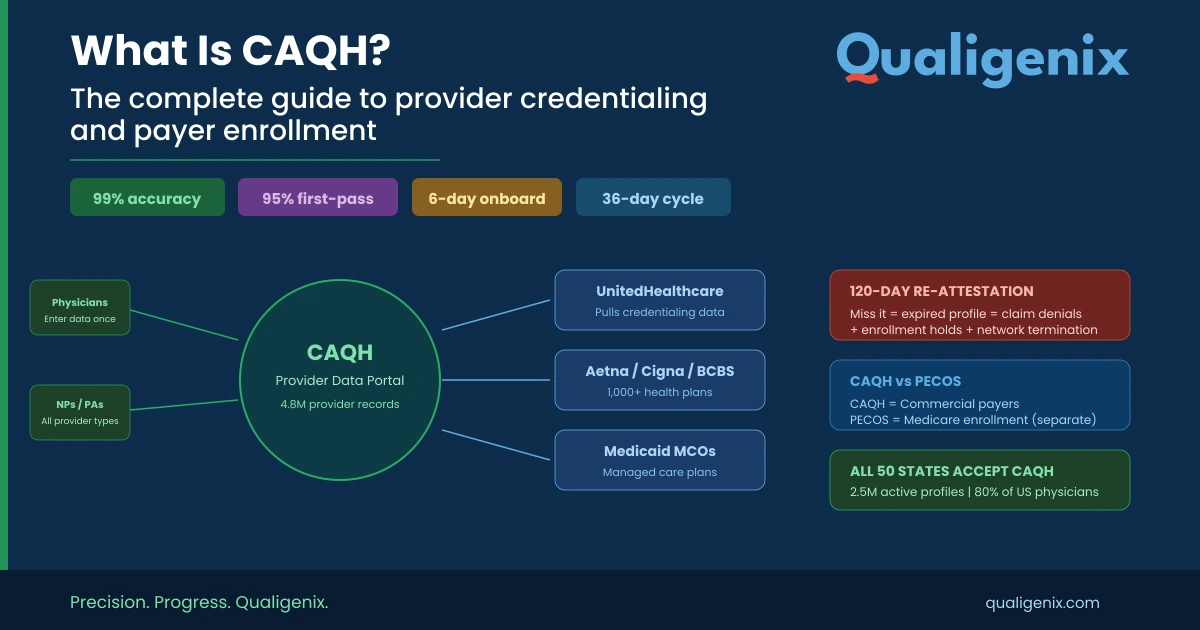
What Is CAQH? The Complete Guide to Provider Credentialing, ProView Setup, and Payer Enrollment
Summary: CAQH (Council for Affordable Quality Healthcare) is a nonprofit that operates the most widely used provider credentialing...

What is the Provider Enrollment Process? Step-by-Step Guide
Ever wonder why claims sit unpaid even after credentialing is complete? In many cases, the real bottleneck is the...

How to Appeal an Insurance Claim Denial: Step-by-Step Guide
A provider treats a patient, documents the visit carefully, and submits a clean claim. Two weeks later, the payer...