

What Is Mental Health Billing and How It Works
The Qualigenix Editorial Team consists of certified billing and coding experts with over 40 years of experience across 38+ medical specialties. Our content is rigorously researched against CMS, AMA, and payer-specific guidelines to ensure total compliance and accuracy. We apply the same elite standards to our resources as we do our client work, consistently delivering high claim accuracy and significant reductions in AR days.


Mental health billing is not medical billing with different codes. It is a distinct billing framework with its own CPT code set, time-based documentation requirements that directly determine code selection, a separate managed behavioral health organization layer that processes claims independently of the medical payer for many patients, session-block authorization structures that require renewal before sessions continue, DSM-5-aligned diagnosis coding that must establish medical necessity for the level and frequency of treatment, and federal parity law requirements that affect what insurers can and cannot do when restricting behavioral health coverage. A practice that applies medical billing logic to mental health services produces a higher denial rate, undercollects on correctly delivered services, and misses the parity violation appeals that would recover improperly denied claims.
A therapist completes a 55-minute session with a patient. She selects 90837, the CPT code for psychotherapy of 53 or more minutes. The claim goes to the patient’s insurance company. It denies. The explanation of benefits says “services not authorized.” The practice hadn’t realized that this patient’s employer health plan routes behavioral health benefits through a managed behavioral health organization that requires separate authorization — and that authorization was never obtained because the practice submitted directly to the medical payer without verifying the MBHO layer first.
This is among the most common mental health billing failures, and it is entirely preventable with front-end verification. The therapist did everything clinically correct. The code was right. The documentation supported the code. The service was delivered. The billing failed at a process step that occurs before the session begins — and the result is an uncompensated hour of clinical work.
Mental health billing has a higher density of these specific, preventable failures than most other specialties because the billing framework contains more moving parts with more specialty-specific rules that don’t apply in medical billing. Understanding each part is what makes the difference between a behavioral health practice that collects for the work it delivers and one that absorbs a denial rate that is consistently above benchmark.
Mental health billing uses a distinct CPT code set where therapy code selection is based on session time: 90832 (16-37 min), 90834 (38-52 min), 90837 (53+ min). Initial evaluations use 90791 or 90792. Prescribers use E/M codes with psychotherapy add-on codes for combined sessions. Behavioral health claims route to a managed behavioral health organization for many plans rather than directly to the medical payer. Authorization for ongoing therapy requires session-count tracking and clinical renewal documentation. Federal parity law requires that mental health coverage limitations cannot be more restrictive than comparable medical coverage.
Mental Health Billing: Key CPT Codes and Standards
| CPT Code | Service Description | Who Bills It | Key Requirement |
|---|---|---|---|
| 90791 | Psychiatric diagnostic evaluation (no medical services) | Therapists, psychologists, prescribers | Comprehensive initial psychiatric assessment |
| 90792 | Psychiatric diagnostic evaluation with medical services | Prescribers (psychiatrists, NPs) | Evaluation includes medication assessment |
| 90832 | Individual psychotherapy, 16 to 37 minutes | All licensed mental health providers | 16-37 min face-to-face psychotherapy time documented |
| 90834 | Individual psychotherapy, 38 to 52 minutes | All licensed mental health providers | 38-52 min face-to-face psychotherapy time documented |
| 90837 | Individual psychotherapy, 53 or more minutes | All licensed mental health providers | 53+ min face-to-face psychotherapy time documented |
| 90847 | Family psychotherapy with patient present | All licensed mental health providers | Patient participates in session |
| 90846 | Family psychotherapy without patient present | All licensed mental health providers | Patient not present — family session only |
| 90853 | Group psychotherapy | All licensed mental health providers | Multiple unrelated patients; not family therapy |
| 90833 | Psychotherapy add-on, 16-37 min (with E/M) | Prescribers billing E/M + psychotherapy | Billed with E/M code; separate psychotherapy time documented |
| 90836 | Psychotherapy add-on, 38-52 min (with E/M) | Prescribers billing E/M + psychotherapy | Billed with E/M code; separate psychotherapy time documented |
| 90838 | Psychotherapy add-on, 53+ min (with E/M) | Prescribers billing E/M + psychotherapy | Billed with E/M code; separate psychotherapy time documented |
| 90785 | Interactive complexity add-on | All licensed mental health providers | Specific communication complications present — documented |
| Qualigenix claim accuracy rate | 99% | Qualigenix performance data | N/A |
How Mental Health Billing Differs from Medical Billing
Mental health billing differs from medical billing in ways that matter for every claim the practice submits. Understanding these structural differences is the starting point for understanding why behavioral health practices have higher denial rates and what to do about each specific difference.
Code Selection Is Time-Based, Not Complexity-Based
In medical billing, E/M code selection is based on medical decision making complexity or total time on the date of service. In mental health billing, the primary therapy codes — 90832, 90834, and 90837 — are selected based on the total face-to-face time of the psychotherapy component of the session. A 45-minute therapy session is coded at 90834. A 60-minute session is coded at 90837. A 25-minute session is coded at 90832.
The documented time must match the code billed. A claim for 90837 on an encounter where the note documents only 40 minutes of therapy time is overcoding — the documentation supports 90834, not 90837. A claim for 90832 when the note documents 50 minutes of therapy is undercoding — the documentation supports 90834. The time is the code, and the documentation of time is the code selection justification. This is categorically different from E/M code selection and must be understood as such by anyone managing mental health billing.
The most common mental health billing coding error is applying a habitual default code — typically 90837 — to every session regardless of actual session duration. A practice where 100% of individual therapy sessions are billed at 90837 is almost certainly overcoding some sessions and undercoding others, and the overcoding creates both a compliance exposure and a denial risk when auditors or payers review the uniformity of the distribution. Session time must be documented in each note and the code selected must match the documented time.
Claims Route to a Separate Payer Entity for Many Patients
For a large proportion of commercially insured patients, behavioral health benefits are managed by a managed behavioral health organization — a separate entity contracted by the health plan to handle mental health and substance use disorder benefits independently of medical benefits. The MBHO has its own provider network, its own authorization process, its own claims submission portal, and its own adjudication rules.
When a patient’s plan uses an MBHO, mental health claims must go to the MBHO, not to the primary medical payer. A practice that submits therapy claims to the medical payer when the plan uses an MBHO receives an automatic denial — the medical payer doesn’t cover behavioral health for that patient, and the claim is returned. Identifying the MBHO at insurance verification — before the first session — is a required step in behavioral health front-end workflow.
Common MBHOs include Optum Behavioral Health, Magellan Health, Beacon Health Options, and New Directions Behavioral Health. Each has its own credentialing requirements, portal processes, and authorization standards. A therapist who is credentialed with the medical payer may not be credentialed with the MBHO — and cannot bill MBHO claims until MBHO credentialing is complete.
Authorization Works in Session Blocks With Renewal Requirements
Medical authorization is typically service-specific: a specific procedure or imaging study is authorized, delivered, and billed. Mental health authorization is ongoing and cumulative: an insurer authorizes a block of therapy sessions — typically 6 to 12 at a time — and the practice delivers sessions against that block. When the block is exhausted, clinical renewal documentation must be submitted and approved before the next sessions are covered.
This session-block authorization model requires active session-count tracking against the authorized block. A practice that doesn’t track how many sessions have been delivered against the authorization risks delivering sessions 13 through 16 when authorization was only granted for sessions 1 through 12. Sessions 13 through 16 deny for lack of authorization — not because the sessions weren’t clinically appropriate but because the authorization wasn’t renewed before the block was exhausted.
The renewal documentation is also a clinical documentation requirement in its own right. It must demonstrate continued medical necessity: the diagnosis remains active and clinically significant, treatment is progressing (with documented response to treatment), the treatment goals are not yet fully met, and ongoing therapy at the authorized frequency is clinically indicated. A renewal submission that doesn’t address each of these elements may be denied — the payer may determine that treatment is complete based on insufficient documentation, even if the therapist knows clinically that continuation is warranted.
Related: What Is Health Insurance Pre-Authorization
The Psychiatric Diagnostic Evaluation: First-Session Billing
The first one or two sessions with a new patient are typically billed as a psychiatric diagnostic evaluation rather than as therapy. CPT 90791 is used for an evaluation that doesn’t include medical services — appropriate for therapists, psychologists, and licensed counselors conducting an intake assessment. CPT 90792 is used for an evaluation that includes medical services — appropriate for prescribers who are also conducting medication assessment as part of the evaluation.
The diagnostic evaluation code is not simply “a first appointment.” It represents a comprehensive psychiatric assessment that includes mental status examination, psychiatric history, review of prior treatment, diagnostic formulation, and development of an initial treatment plan. Documentation must support this comprehensive evaluation, not just a brief intake screening. A first session documented as “patient completed intake paperwork and discussed presenting concerns” does not support 90791. A first session documented with a complete mental status examination, DSM-5 diagnostic assessment, history of presenting illness, and preliminary treatment plan does support it.
The diagnostic evaluation typically spans the first session and may extend to a second session for complex presentations. After the evaluation is complete, subsequent sessions are billed with the appropriate therapy CPT code based on session time. Billing 90791 for every session of an ongoing therapy case is an error — the diagnostic code applies to the initial evaluation, not to ongoing treatment.
Psychotherapy Add-On Codes for Prescribers
When a prescriber — psychiatrist, psychiatric nurse practitioner, or other licensed prescriber — provides both medication management (an E/M service) and psychotherapy during the same session, both services can be billed using an add-on code structure. The E/M code captures the medication management component. The psychotherapy add-on code captures the separate psychotherapy component.
The add-on codes — 90833 (16-37 min psychotherapy), 90836 (38-52 min psychotherapy), and 90838 (53+ min psychotherapy) — are billed alongside the appropriate E/M code and cannot be billed without the primary E/M code. The psychotherapy time documented in the note must be separate from the E/M time. If a 60-minute appointment includes 20 minutes of medication management (an E/M service) and 40 minutes of psychotherapy, the claim would include the appropriate E/M code for a psychiatric medication management visit and 90836 for the 40-minute psychotherapy add-on.
This add-on code structure is frequently misused in prescriber practices. The most common errors are billing 90833/90836/90838 without a corresponding E/M code (the add-on codes cannot stand alone), documenting the psychotherapy time as part of the E/M time rather than separately (the payer cannot verify the psychotherapy time to support the add-on), or billing the add-on when the session was entirely medication management without a separately identifiable psychotherapy component.
ICD-10 Diagnosis Coding in Mental Health Billing
Mental health billing uses ICD-10-CM codes from the F chapter (F01-F99, Mental, Behavioral and Neurodevelopmental Disorders) that correspond to DSM-5 diagnoses. The coding standard requires that the diagnosis reflect the clinician’s current clinical formulation and that it be specific enough to establish medical necessity for the treatment being billed.
The most important ICD-10 coding standard in mental health billing is using the most specific code available. Major depressive disorder has codes that specify episode type (single vs. recurrent), severity (mild, moderate, severe, with psychotic features), and remission status. Anxiety disorder has codes for generalized anxiety disorder, panic disorder, social anxiety disorder, and other specified anxiety disorders. PTSD has codes for acute versus chronic presentation. Using “F32.9 — major depressive disorder, single episode, unspecified” when the documentation clearly supports “F32.1 — major depressive disorder, single episode, moderate” is an ICD-10 specificity failure that may affect medical necessity determination for the treatment plan.
Warning: Mental health payers apply medical necessity criteria to both the diagnosis and the treatment plan. A diagnosis code that is too general may not meet the payer’s covered diagnosis criteria for the service billed. More specifically, a patient with a diagnosis code of “F41.9 — anxiety disorder, unspecified” receiving weekly therapy at 90837 may face a medical necessity denial if the payer’s criteria for weekly high-frequency therapy require documentation of a specific anxiety disorder diagnosis with documented severity indicators. The same treatment plan with a diagnosis of “F41.1 — generalized anxiety disorder” and documented symptom severity is more likely to meet medical necessity criteria. Specificity is not just a coding accuracy issue — it is a coverage determination input.
The Managed Behavioral Health Organization: What Practices Must Know
The MBHO layer is the single most common source of mental health billing failures that are entirely preventable with correct front-end verification. A practice that doesn’t identify the MBHO before the first session submits to the wrong payer, receives a denial, and then must identify the correct MBHO, verify provider credentialing with the MBHO, obtain retroactive authorization (which may or may not be available), and resubmit — all while the patient continues treatment and the sessions stack up against an authorization that doesn’t exist yet.
The identification question is simple: does this patient’s health plan route behavioral health through a separate managed behavioral health organization? The answer is found in the patient’s insurance card (some cards list the MBHO), through the patient’s explanation of benefits from prior mental health services, through a direct call to the health plan’s member services line, or through the 270/271 eligibility verification response which may identify the behavioral health carve-out administrator.
Once the MBHO is identified, the practice must confirm two things. First, is the provider credentialed and enrolled with the MBHO? Being in-network with the medical payer does not automatically make a provider in-network with the MBHO. Each must be credentialed separately. Second, does the MBHO require prior authorization for the planned services? Most MBHOs require authorization for ongoing therapy, and the authorization must be obtained from the MBHO, not from the health plan’s medical authorization department.
Mental Health Parity: Federal Law That Affects Every Denial
The Mental Health Parity and Addiction Equity Act (MHPAEA) is the federal law that requires health plans to apply the same treatment limitations and coverage criteria to mental health and substance use disorder benefits as they apply to comparable medical and surgical benefits. This law affects mental health billing in a specific and actionable way: when a mental health claim is denied for a reason that would not apply to a comparable medical service under the same plan, the denial may be a parity violation.
Parity violations in mental health billing most commonly appear as session limits that don’t apply to comparable medical services, prior authorization requirements for therapy that don’t apply to comparable medical treatments, and medical necessity criteria for behavioral health that are more restrictive than the plan’s criteria for comparable medical services. For example, if a plan requires prior authorization for every six sessions of outpatient psychotherapy but does not require prior authorization for comparable outpatient physical therapy sessions, the more restrictive authorization requirement for mental health may be a parity violation.
When a mental health denial appears to be based on criteria that are more restrictive than what would apply to a comparable medical service, parity is a basis for appeal. The appeal must request the payer’s comparative analysis — the documentation of how the plan compares its mental health criteria against its medical criteria — and demonstrate that the denied mental health service is subject to more restrictive standards than the comparable medical service. Parity appeals have a legal basis that most other insurance appeals don’t, and they can be escalated to state insurance commissioners and federal regulators when internal appeals fail.
Telehealth Billing in Mental Health
Mental health services are among the most commonly delivered via telehealth, and the billing requirements for telehealth therapy differ from in-person therapy in ways that produce specific denial categories if not applied correctly.
Telehealth mental health services are billed with the same therapy CPT codes as in-person services, but with a modifier that identifies the service as telehealth and the place-of-service code that reflects the delivery setting. Modifier GT (interactive audio-video) or modifier 95 is applied to the therapy code to signal telehealth delivery. The place-of-service code varies by payer policy: some payers require POS 02 (telehealth provided other than in patient’s home), some require POS 10 (telehealth in patient’s home), and some require the office POS code (POS 11) with a telehealth modifier.
The telehealth billing rules for mental health evolved significantly during and after the COVID-19 public health emergency, and payer-specific policies on telehealth coverage, modifiers, and place-of-service codes are not uniform. A practice billing telehealth mental health services must verify each payer’s current telehealth requirements rather than applying a single rule across all payers. Applying the wrong modifier or place-of-service code for telehealth produces a claim that adjudicates incorrectly — either denying or paying at the wrong rate for the delivery modality.
Interactive Complexity: When to Bill 90785
CPT add-on code 90785 is billed with a primary psychotherapy code when specific communication complications are present during the session that require additional clinical effort beyond what standard psychotherapy requires. The conditions that support billing interactive complexity include patient behaviors that complicate the delivery of care (uncooperative behavior, imminent risk requiring safety planning during the session, or the patient communicating through a third party rather than directly), mandated reporting requirements arising during the session, or sessions involving family members who have conflicting agendas that complicate the therapeutic work.
Interactive complexity is legitimately applicable in certain clinical situations, but it is also among the most audited add-on codes in behavioral health billing because it is sometimes billed without adequate documentation of the specific conditions that support it. The documentation must explicitly identify which of the qualifying conditions was present during the session and how it complicated the delivery of care. “Patient was difficult” is not sufficient documentation for 90785. “Patient became agitated during session and required extended de-escalation, requiring modification of planned therapeutic intervention” is closer to the documentation standard required.
Group Therapy: What Billing Requires
Group psychotherapy — CPT 90853 — is billed for each patient who participates in a group session, with each patient billed separately for their group attendance. The session must involve multiple unrelated patients receiving therapy as a group, with the therapist facilitating the group process rather than providing individual therapy to each patient sequentially. Family therapy involving related family members is coded differently (90847 or 90846) and should not be coded as group therapy.
Documentation for group therapy should identify the session date, the participants, the group process facilitated, and each patient’s individual participation and response. The CPT description for 90853 does not specify a time threshold in the way that individual therapy codes do — group therapy is billed per session rather than per time increment — but documentation should capture the session duration as part of the complete clinical record.
Authorization for group therapy may differ from individual therapy authorization under some plans. Some MBHOs require separate authorization for group therapy participation, and the medical necessity criteria may include documentation of why the patient is appropriate for group modality versus individual therapy. Verifying group-specific authorization requirements at the front end prevents the denial that results from discovering the plan requires separate group authorization when the session has already been delivered.
Provider Credentialing in Behavioral Health: The MBHO Layer
Behavioral health credentialing is distinct from medical credentialing because it requires credentialing with both the health plan and, when applicable, the MBHO. A therapist who completes credentialing with Blue Shield of California is credentialed to receive reimbursement from Blue Shield for covered medical services. If Blue Shield uses Optum as its behavioral health carve-out, the therapist must also be credentialed with Optum to receive reimbursement for behavioral health services from Blue Shield’s insured patients who receive their mental health benefits through Optum.
This dual credentialing requirement is the most common credentialing gap in behavioral health practices, particularly for newly starting therapists who don’t realize that being accepted by the health plan doesn’t automatically make them in-network with the plan’s MBHO. The credentialing gap produces a specific denial pattern: claims from a non-credentialed provider, denied regardless of service appropriateness. The resolution requires completing MBHO credentialing — which takes 90 to 120 days — and in some cases requesting retroactive enrollment effective dating to cover sessions delivered during the credentialing window.
Related: Provider Credentialing Services | Payer Enrollment Services
How Qualigenix Manages Mental Health Billing
At Qualigenix, we manage mental health billing as a specialty-specific function that accounts for the MBHO layer, session-block authorization, time-based code selection, and parity compliance requirements that distinguish behavioral health billing from medical billing.
Our front-end verification process identifies MBHO routing for every new patient before the first session. We credential providers with both the health plan and the applicable MBHO as part of the same engagement. We maintain session-count tracking for every active patient against the authorized block and initiate renewal requests with complete clinical documentation before the block is exhausted.
We apply time-based code selection from documented session time rather than from a default code. We review telehealth claims for payer-specific modifier and place-of-service requirements before submission. We flag parity-related denials for appeal rather than passive write-off, and we pursue parity appeals with the comparative analysis documentation that payers are required to produce under MHPAEA.
Related: What Is RCM in Medical Billing | Denial Management: Common Denials and Fixes | What Is Healthcare Coding
Mental Health Billing Readiness Checklist
- MBHO routing confirmed for every new patient before first session
- Provider credentialed with MBHO separately from health plan where applicable
- Authorization obtained from MBHO, not from medical payer, when MBHO is in place
- Session-count tracking maintained against authorized session block per patient
- Authorization renewal initiated before block is exhausted — not after sessions deny
- Renewal documentation includes diagnosis, treatment progress, goals not yet met, and continued necessity
- Session time documented in every clinical note — matches CPT code billed
- 90791/90792 used for initial diagnostic evaluation — not 90837
- Psychotherapy add-on codes billed with E/M code — not as standalone
- Psychotherapy time documented separately from E/M time for combined sessions
- Interactive complexity (90785) documentation identifies the specific qualifying condition
- ICD-10 codes at highest specificity the documentation supports
- Telehealth modifier and POS code verified per payer before submission
- Parity-related denials flagged for appeal — not passively written off
Frequently Asked Questions: Mental Health Billing
What is mental health billing?
Mental health billing is the process of submitting insurance claims for behavioral health services using CPT codes where therapy code selection is based on session time, DSM-5-aligned ICD-10 diagnosis codes, and authorization management through session-block approval structures. It differs from medical billing in code set, documentation requirements, claims routing (often to a separate MBHO), authorization mechanics, and federal parity law protections. A practice that applies medical billing logic to mental health services produces a higher denial rate and undercollects on correctly delivered services.
What CPT codes are used in mental health billing?
The primary mental health CPT codes are 90791 (diagnostic evaluation without medical services), 90792 (diagnostic evaluation with medical services), 90832/90834/90837 (individual psychotherapy at 16-37, 38-52, and 53+ minutes), 90853 (group therapy), 90847/90846 (family therapy with/without patient), and 90833/90836/90838 (psychotherapy add-ons for combined E/M and therapy sessions). Therapy code selection is determined by the documented session time, not by clinical complexity. The documented time must match the code billed on every claim.
What is a managed behavioral health organization and why does it matter?
An MBHO is a company contracted by a health plan to manage behavioral health benefits separately from medical benefits. Mental health claims for patients whose plans use an MBHO must go to the MBHO — not the medical payer — or they will be denied automatically. Providers must also be credentialed with the MBHO separately from the health plan. Identifying the MBHO at insurance verification before the first session is a required front-end step in mental health billing that prevents the most common and most avoidable category of behavioral health claim denials.
How does time-based billing work in mental health?
Psychotherapy CPT codes are selected based on the total face-to-face time of the psychotherapy component: 90832 for 16-37 minutes, 90834 for 38-52 minutes, 90837 for 53 or more minutes. The documented time must match the code billed. Habitually billing 90837 for all sessions regardless of actual session duration is a compliance exposure and creates a denial risk when payers review the uniform distribution. Session time must be explicitly documented in every clinical note and the code must reflect the actual documented time, not a default or assumption about typical session length.
What is the Mental Health Parity Act and how does it affect billing?
MHPAEA requires that health plans apply the same treatment limitations, authorization requirements, and coverage criteria to mental health benefits as they apply to comparable medical and surgical benefits. When mental health claims are denied under criteria that are more restrictive than what would apply to a comparable medical service, the denial may be a parity violation. Parity appeals have a legal basis that standard medical necessity appeals don’t — and they can be escalated to state insurance commissioners when internal appeals fail. Practices that passively write off parity-violating denials are leaving recoverable revenue on the table and failing to assert patient rights under federal law.
How does authorization work for ongoing mental health treatment?
Most commercial plans authorize ongoing therapy in session blocks — typically 6 to 12 sessions at a time. When the block is exhausted, clinical renewal documentation must be submitted and approved before additional sessions are covered. Renewal documentation must demonstrate continued medical necessity: active diagnosis with documented severity, treatment progress, goals not yet achieved, and clinical rationale for the authorized frequency. Session-count tracking against the authorized block is the process control that ensures renewal is initiated before the block runs out — preventing the delivery of unauthorized sessions that will deny regardless of clinical appropriateness.
Related Resources from Qualigenix
- What Is RCM in Medical Billing
- What Is Health Insurance Pre-Authorization
- What Is Healthcare Coding and How It Works
- Insurance Denial Appeals: What Practices Miss
- Contact Qualigenix Healthcare
Behavioral Health Billing Done Right. Every Session Collected.
Qualigenix manages mental health billing for behavioral health practices — MBHO identification, dual credentialing, session-block tracking, time-based code selection, telehealth modifier compliance, and parity-based denial appeals — so the clinical work your providers deliver generates the revenue it’s entitled to.
Our team delivers 99% claim accuracy, a 95% first-pass acceptance rate, an average 36-day collection cycle, and a 30% reduction in AR days. We onboard in as few as 6 days.
Precision. Progress. Qualigenix.
What’s Next
Denial Management in 2026: The Top 10 Codes and the Appeal Playbook for Each
Denials cluster around a small set of codes, and each one has a different correct response. Some need a...

ASC Billing: Where Facility Fees and Physician Fees Get Miscoded Together
ASC facility and physician claims both go out on a CMS-1500 form with the same CPT code and place...
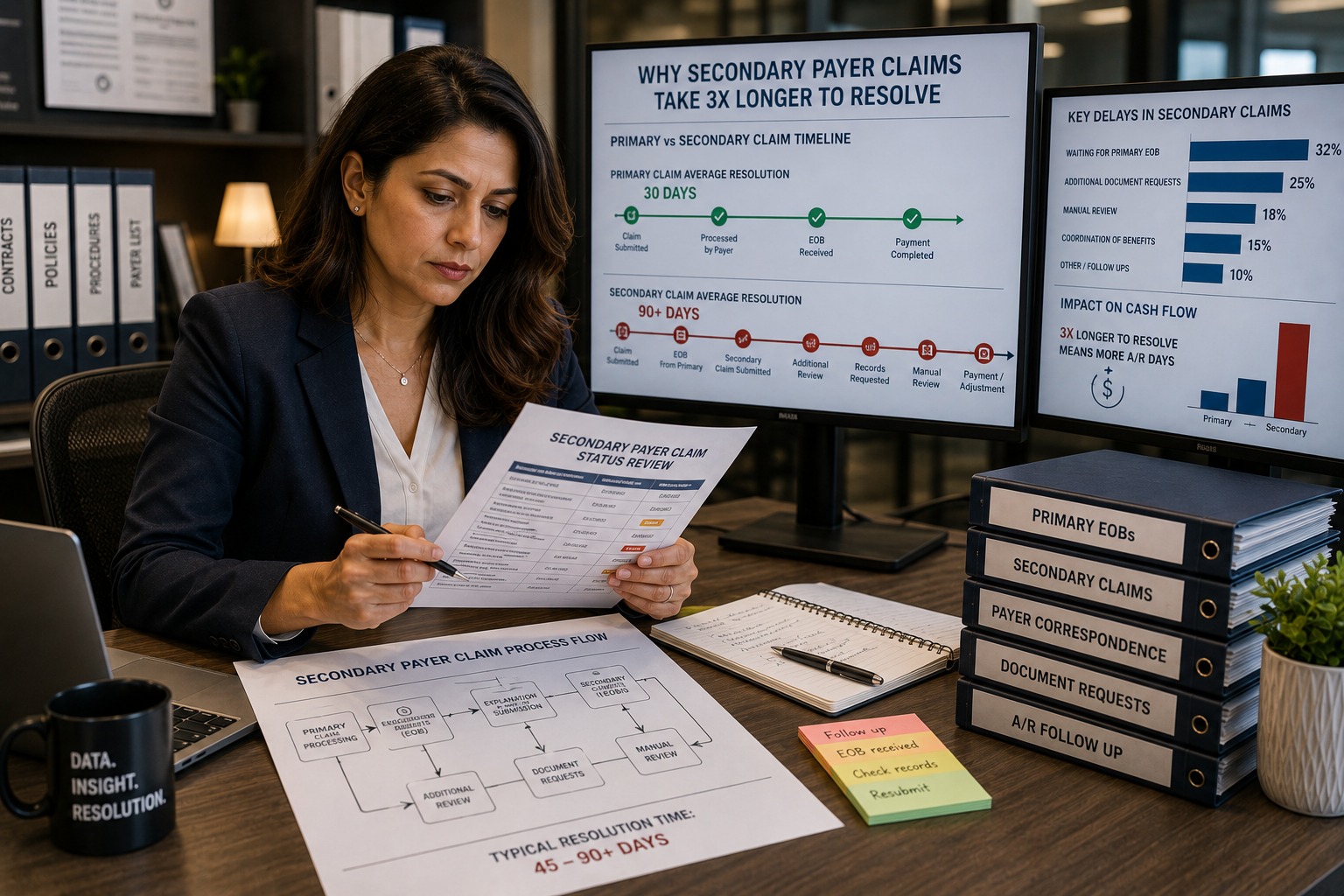
Coordination of benefits errors: why secondary payer claims take 3x longer to resolve
Secondary payer claims stall because coordination of benefits errors, wrong payer order, outdated COB records, and missing primary...