

What Is Physician Billing and Why Most Practices Are Losing Revenue Without Knowing It
The Qualigenix Editorial Team consists of certified billing and coding experts with over 40 years of experience across 38+ medical specialties. Our content is rigorously researched against CMS, AMA, and payer-specific guidelines to ensure total compliance and accuracy. We apply the same elite standards to our resources as we do our client work, consistently delivering high claim accuracy and significant reductions in AR days.

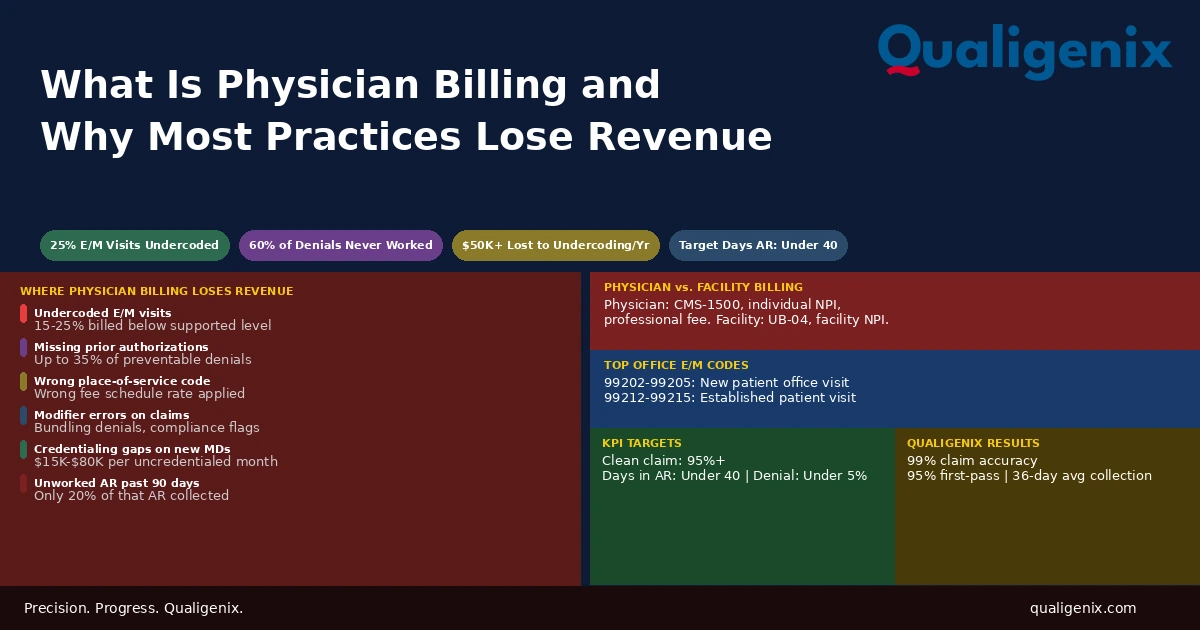
Physician billing is the full process of collecting payment for a physician’s professional services, from patient intake through final payment. Most practices think of it as claim submission. It isn’t. It’s eight interconnected steps, and a failure at any one of them reduces what every step after it can collect. The revenue most practices are losing isn’t visible in a denial report. It’s sitting in undercoded visits, lapsed credentialing, and AR that aged past recovery without anyone noticing.
Ask most practice managers what physician billing is and they’ll describe claim submission. A physician sees a patient, someone codes the visit, a claim goes to the payer, and money comes back. That’s the visible part. What most practices don’t see is everything that determines whether the money actually comes back, how much of it comes back, and how long it takes.
The revenue that practices leave behind isn’t usually dramatic. It doesn’t show up as a single large denial or a sudden drop in collections. It accumulates quietly: an undercoded E/M here, an authorization that wasn’t obtained before a procedure there, a new physician who started seeing patients three weeks before credentialing was confirmed, a batch of denials that sat in a queue past the appeal deadline. None of these events send a warning. They just reduce the number at the bottom of the monthly collections report, and most practices attribute that number to payer behavior rather than their own process.
This blog explains what physician billing actually covers, how it differs from facility billing, and where the revenue losses that most practices don’t know about are actually happening.
Physician billing is the process of submitting claims for professional physician services using the CMS-1500 claim form, CPT procedure codes, and ICD-10 diagnosis codes billed under the physician’s individual NPI. It covers everything from patient registration and insurance verification through medical coding, claim submission, payment posting, denial management, and accounts receivable follow-up. Every stage in the process affects what the practice ultimately collects.
Physician Billing: Key Benchmarks and Numbers
| Metric | Benchmark / Data Point | Source |
|---|---|---|
| Industry benchmark clean claim rate | 95% or higher | MGMA Revenue Cycle benchmarks |
| Average physician practice first-submission denial rate | 10% to 15% of claims | Healthcare billing industry data |
| Target denial rate for well-run physician billing | Under 5% | Revenue cycle performance standards |
| Physician E/M visits billed below the supported level | 15% to 25% of encounters | Coding audit benchmarks |
| Revenue lost to undercoding per physician annually | $10,000 to $50,000+ depending on specialty | Physician revenue analysis |
| Target days in AR for physician practices | Under 40 days | MGMA physician practice benchmarks |
| AR past 90 days collection probability | Approximately 20% | Healthcare AR aging data |
| Revenue lost to uncollected AR annually | Up to 7% of net revenue | MGMA revenue cycle survey |
| Denied claims never reworked by practices | Approximately 60% | Change Healthcare denial data |
| Cost to rework one denied claim | $25 to $118 per claim | MGMA administrative cost data |
| Average physician credentialing timeline (commercial payer) | 90 to 120 days | Payer credentialing benchmarks |
| Revenue lost per uncompensated physician month | $15,000 to $80,000+ depending on specialty | Practice revenue benchmarks |
| Qualigenix first-pass acceptance rate | 95% | Qualigenix performance data |
| Qualigenix claim accuracy rate | 99% | Qualigenix performance data |
| Qualigenix average collection cycle | 36 days | Qualigenix performance data |
| Qualigenix AR days reduction | 30% | Qualigenix performance data |
Physician Billing vs. Facility Billing: Why the Distinction Matters
One of the most common points of confusion in healthcare billing is the difference between what a physician bills and what a facility bills. For many patients, they feel like one transaction. For billing purposes, they are two entirely separate claims with different forms, different payer relationships, and different reimbursement structures.
Physician billing covers the professional services a physician provides during a patient encounter: the clinical judgment, the examination, the medical decision making, the procedure. It uses the CMS-1500 claim form and bills under the physician’s individual NPI. The payer reimburses from the physician fee schedule, which sets rates based on the relative value of the service performed in a given setting.
Facility billing covers the overhead cost of the location where services were delivered: the building, the equipment, the nursing staff, the supplies. It uses the UB-04 claim form and bills under the facility’s NPI. Hospitals, outpatient clinics, and ambulatory surgery centers are facility billers. Their reimbursement comes from facility fee schedules, which are calculated differently from physician fee schedules.
A patient who receives a procedure at a hospital outpatient department will receive two separate bills: one from the hospital for the facility fee and one from the physician for the professional fee. Both are billed separately to the same payer. Physicians who work in hospital-based settings must understand this split because the place-of-service code they use on the CMS-1500 directly affects their reimbursement rate.
Why this matters for physician billing: a physician who performs a service in a hospital outpatient department must bill with place-of-service code 22. Medicare pays a lower professional fee in this setting because the facility is separately reimbursed for overhead. A physician who bills with place-of-service code 11 (office) when the service was delivered in a hospital outpatient setting is billing incorrectly. The payer will either deny the claim or, in a post-payment audit, recoup the overpayment. Either outcome is avoidable with accurate place-of-service coding.
The 8 Stages of Physician Billing and Where Revenue Leaks at Each One
Physician billing isn’t a single event. It’s a sequence of eight operational steps, and each one has specific failure modes that reduce what the practice collects. Understanding where the leaks are is the first step toward closing them.
Stage 1: Patient Registration
Every physician billing encounter starts with patient data. The name, date of birth, insurance member ID, group number, and secondary coverage captured at registration flow directly into the claim. An error at this stage produces a claim that fails payer edits before it ever reaches adjudication.
The most common registration errors are transposed member ID digits, insurance cards that belong to a prior plan year, missing group numbers for commercial policies, and patients who have changed insurance since their last visit. Practices that don’t verify demographics at each visit treat registration as a one-time intake task. It isn’t. Insurance information changes mid-year, and every claim submitted against stale data is a potential denial.
Stage 2: Insurance Eligibility Verification
Verifying that a patient’s coverage is active before a visit is not optional in a well-run physician billing operation. It’s a front-end function that prevents a specific and expensive class of denials: claims submitted to inactive policies, claims submitted as in-network for out-of-network physicians, and claims that hit a deductible the practice didn’t know about.
Real-time eligibility verification using HIPAA 270/271 electronic transactions returns active coverage status, plan type, deductible status, copay amounts, and coordination of benefits information in under three seconds. Practices that skip this step or verify only at initial intake are running blind into every visit where coverage may have changed.
Warning: Medicare Advantage enrollment is now above 54% of all Medicare beneficiaries. A patient who appears as a standard Medicare beneficiary in your records may have enrolled in a Medicare Advantage plan that requires a separate network check. Billing traditional Medicare for a patient enrolled in a Medicare Advantage plan produces a denial that requires rework and delays payment by weeks. Only a real-time eligibility check catches this before the visit.
Stage 3: Prior Authorization
Many payers require authorization before a physician can perform specific procedures or order certain services. The authorization requirement doesn’t care how medically necessary the service is. If the payer requires it and the practice didn’t get it, the claim denies. The service has already been delivered. There is no way to undo the clinical work and redo the authorization process.
Authorization requirements change constantly. Payers add new codes to their authorization lists, modify existing requirements, and occasionally remove them. A practice operating from a static list of “services that need auth” that was built two years ago is almost certainly missing current requirements. The only way to stay current is to check payer authorization lists regularly and verify requirements individually for procedures that may have changed.
Stage 4: Medical Coding
Medical coding is where clinical reality becomes billing data. The codes assigned to a physician encounter must accurately represent what was documented in the medical record. CPT codes describe the service. ICD-10 codes describe the diagnosis. Modifiers provide context that changes how the claim is adjudicated.
Two coding failures dominate physician billing. The first is undercoding: billing a lower E/M level than the documentation supports. The second is modifier errors: missing a modifier that should be present, or applying one incorrectly. Both create revenue loss, and both are systemic rather than random. They appear as patterns across specific physicians or service types.
Stage 5: Claim Building and Submission
A correctly coded encounter still needs to be built into a clean claim and submitted within the payer’s timely filing window. The CMS-1500 must include the rendering physician’s NPI, the billing provider’s NPI and Tax ID, the correct place-of-service code, the service date, and all CPT and diagnosis codes in the correct fields.
Claim scrubbing software catches common errors before submission. Practices without a scrubber or with outdated scrubber rules submit claims with fixable errors that the payer catches instead, adding days or weeks to the payment timeline and requiring staff time to correct and resubmit.
Stage 6: Payment Posting
When a payer processes a claim, a remittance advice arrives showing what was paid, what was adjusted, and what was denied. Payment posting is the act of recording that information accurately. It sounds administrative. It’s actually a revenue protection function.
Accurate posting reveals underpayments. If a payer paid $92 on a claim that your contract says should reimburse $118, that difference is a contractual underpayment that should be challenged. Practices that post in lump sums or delay posting by several days lose visibility into these discrepancies until they’ve accumulated across dozens of claims.
Stage 7: Denial Management
Despite a well-run front end, some claims will deny. Denial management is the process of working those denials: identifying the cause, correcting the error or building an appeal, and resubmitting within the payer’s appeal window. About 60% of denied claims are never reworked by physician practices. That’s not a data point about a few isolated practices. It’s consistent across the industry, and it represents a recoverable revenue stream that most practices write off instead of pursuing.
The more important part of denial management is root cause analysis. If the same denial code is appearing repeatedly across multiple claims, the cause is upstream from billing. It may be a registration error, a coding pattern, a missing authorization, or a credentialing gap. Working individual denials without analyzing the pattern treats symptoms. Finding and fixing the cause prevents the next hundred claims from generating the same denial.
Stage 8: Accounts Receivable Follow-Up
Outstanding balances age. The older they get, the less of them get collected. AR past 90 days has approximately a 20% collection probability. Every dollar that sits in the 90-plus day bucket without active follow-up is a dollar moving toward write-off territory.
Healthy physician billing operations work AR by aging bucket with escalating urgency: a follow-up call or electronic status check at 30 days, a formal appeal or secondary billing at 45 days, and escalated outreach at 60 days before the balance crosses into the high-risk zone. Patient balances follow a similar structure: statement at 30 days, second statement at 60, collections referral consideration at 90.
The Revenue Losses Most Practices Don’t See
The visible revenue losses in physician billing show up in denial reports. A claim denies, billing staff see it, and someone either works it or writes it off. What’s harder to see are the losses that never produce a denial at all.
Undercoding: Revenue Lost Before the Claim Is Ever Submitted
Undercoding is the most common silent revenue leak in physician billing. It happens when a physician documents a complex visit that supports a level 4 or level 5 E/M code but bills a level 3 out of habit, caution, or unfamiliarity with the 2021 E/M coding changes that shifted the selection criteria from note requirements to medical decision making and total time.
The financial impact is direct. The difference between a 99213 and a 99214 reimbursement under Medicare is approximately $35 to $50 per visit. For a physician seeing 20 patients per day with 15% to 25% of those visits undercoded, the annual revenue impact runs into the tens of thousands. For a 5-physician practice, it’s a material loss that shows up nowhere on a denial report because the claim was never denied. It was paid at the lower rate without question.
The fix is a code distribution audit. Pull the E/M code distribution for each physician and compare it against specialty benchmarks. A physician whose visits are clustered at 99213 when peers in the same specialty bill predominantly at 99214 has a pattern worth investigating. In most cases, it traces to habitual code selection rather than patient acuity, and documentation that would support a higher level already exists in the chart.
Credentialing Gaps: Denials That Start Before Any Claim Is Filed
A physician who is not credentialed and enrolled with a payer cannot bill that payer. Claims submitted under a physician without active enrollment deny automatically. There is no appeal that fixes a credentialing gap. The only resolution is completing the enrollment, and even then, most payers won’t reimburse retroactively for services delivered before the credentialing effective date.
This plays out in physician billing most often when a new physician joins a practice and begins seeing patients before their commercial payer credentialing is complete. Medicare enrollment takes 60 to 90 days. Commercial payers take 90 to 120 days. If a physician starts on day one and credentialing starts on the same day, there will be a billing gap. For a primary care physician seeing 15 patients per day, two months of uncompensated encounters represents $30,000 to $50,000 in lost revenue that no amount of billing accuracy can recover.
Physician credentialing must begin the day an offer is accepted, not the day a physician arrives. The timeline gap between hire confirmation and credentialing approval is the billing gap. Every day that application start is delayed extends the window of uncompensated patient encounters at the other end.
Revalidation creates the same problem on a recurring basis. Medicare requires physicians to revalidate enrollment every five years. Missing a revalidation deadline deactivates billing privileges without warning. A practice whose physician gets their Medicare billing deactivated mid-year will see a sudden, unexplained drop in collections that traces back not to a billing error but to an expired enrollment.
Related: Provider Credentialing Services | Payer Enrollment Services
Modifier Errors: Claims That Pay Wrong or Don’t Pay at All
Modifiers are two-digit codes that tell payers something important about how a service was delivered. Modifier 25 indicates a separate and significant E/M service was performed on the same day as a procedure. Modifier 59 indicates a distinct procedural service not normally reported together with another code. Modifier 51 applies to multiple procedures performed at the same session. Modifier 26 indicates the professional component of a diagnostic service.
Each of these modifiers affects adjudication. Missing modifier 25 on an E/M performed the same day as a minor procedure causes the payer to bundle the E/M into the procedure payment and deny the separate charge. Using modifier 59 incorrectly on procedures that are legitimately bundled is an unbundling error that payers flag in audits. Either direction creates a financial or compliance problem that traces back to modifier selection during coding.
Place-of-Service Errors: Paid at the Wrong Rate
Physician reimbursement rates differ based on where the service was delivered. Medicare pays a non-facility rate (higher) when a physician delivers services in their own office and bears the overhead cost directly. It pays a facility rate (lower) when services are delivered in a hospital or outpatient facility setting where the overhead is separately reimbursed to the facility.
A physician who bills office visits with POS code 11 when those visits occurred in a hospital outpatient clinic is billing at the non-facility rate for facility-based services. Medicare will either deny the claim during a claims review or recoup the overpayment during an audit. Neither outcome is better than getting the place of service right the first time.
What Physician Billing Performance Benchmarks Actually Tell You
Five KPIs tell you everything you need to know about whether your physician billing operation is performing or failing. If you only track one, make it days in AR. It’s the summary metric that reflects the accumulated effect of every upstream stage.
| KPI | What It Measures | Target | Warning Level |
|---|---|---|---|
| Clean Claim Rate | Claims paid on first submission without correction | 95% or higher | Below 90% |
| First-Pass Acceptance Rate | Claims accepted by payer on first submission | 95% or higher | Below 90% |
| Days in AR | Average days from service to payment | Under 40 days | Above 50 days |
| Denial Rate | Percentage of submitted claims denied | Under 5% | Above 10% |
| Net Collection Rate | Percentage of collectible revenue actually collected | 95% or higher | Below 90% |
A practice with a clean claim rate below 90% is spending excessive staff time correcting and resubmitting claims that should have been right the first time. A practice with days in AR above 50 has a systemic problem somewhere in the cycle that the AR number is reflecting but not identifying. A net collection rate below 90% means the practice is writing off revenue that a functional denial management workflow would have recovered.
If your numbers are in the warning zone on any of these, the problem isn’t random bad luck. It’s a specific process failure at a specific stage of the billing cycle. The KPIs tell you the system is broken. The root cause analysis tells you where.
How Qualigenix Manages Physician Billing End to End
At Qualigenix, we manage the complete physician billing cycle for practices across 38+ specialties. That means every stage from eligibility verification and prior authorization through coding review, claim submission, payment posting, denial management, and AR follow-up. We also handle the credentialing and payer enrollment infrastructure that makes billing work in the first place.
Our billing team doesn’t just submit claims. We audit code distribution reports to identify undercoding patterns, track authorization requirements by payer and by service type, monitor AR aging with active follow-up before balances enter the high-risk zone, and run monthly root cause analysis on denial trends so the upstream fix happens before the downstream damage compounds.
Our credentialing team starts physician enrollment applications the day a hire is confirmed. We manage Medicare enrollment through PECOS, track revalidation deadlines, and handle commercial payer applications in priority order by patient volume so the credentialing gap between a physician’s start date and their first billable date is as short as possible.
Our performance numbers reflect a system that functions end to end: 99% claim accuracy rate, 95% first-pass acceptance rate, 30% reduction in AR days, and an average 36-day collection cycle. We onboard new clients in as few as 6 days.
Related: What Is RCM in Medical Billing | Payment Posting in Medical Billing | CAQH Profile Management
Physician Billing Health Checklist
- Insurance eligibility verified before every patient visit using real-time 270/271 transactions
- Prior authorization obtained and documented before applicable procedures are performed
- E/M code distribution reviewed monthly per physician against specialty benchmarks
- Place-of-service codes confirmed accurate for every service location in the practice
- Modifier usage reviewed quarterly for accuracy and compliance
- Claims scrubbed before submission with scrubber rules updated quarterly
- Payment posting completed within 48 hours of ERA receipt
- Denial management workflow with payer-specific appeal deadlines tracked
- Root cause analysis run monthly on top denial reason codes
- AR aging reviewed weekly with active follow-up on balances over 30 days
- All physician Medicare enrollments and revalidation dates tracked in PECOS
- New physician credentialing started on day of offer acceptance
Frequently Asked Questions: Physician Billing
What is physician billing?
Physician billing is the process of submitting claims to insurance payers for professional services rendered by a licensed physician, using the CMS-1500 claim form, CPT procedure codes, and ICD-10 diagnosis codes billed under the physician’s individual NPI. It covers the full cycle from patient registration and eligibility verification through coding, claim submission, payment posting, denial management, and AR follow-up. Every stage affects what the practice ultimately collects.
What is the difference between physician billing and facility billing?
Physician billing covers professional services billed on the CMS-1500 under the physician’s individual NPI. Facility billing covers overhead costs billed on the UB-04 under the facility NPI. A hospital outpatient visit generates two separate claims: one from the physician for the professional fee and one from the hospital for the facility fee. Physicians working in hospital settings must use the correct place-of-service code or risk paying the wrong fee schedule rate.
What CPT codes are used in physician billing?
Physician billing uses CPT codes to describe services, with E/M codes being the most commonly used category: 99202 to 99215 for office visits, 99221 to 99233 for inpatient visits. Procedure codes, diagnostic codes, and add-on codes are also used depending on the specialty. Each CPT code must be supported by clinical documentation matching the level of service billed. Selecting a code not supported by the documentation is either an undercoding or overcoding error.
Why do physician billing claims get denied?
The most common denial causes in physician billing are incorrect patient demographics, missing prior authorization, CPT codes that don’t match the diagnosis, modifier errors, billing under a non-enrolled physician NPI, duplicate submissions, and timely filing violations. Most denials are preventable with a front-end process that catches eligibility and authorization issues before the visit and a coding review process that catches errors before the claim is submitted.
What is the CMS-1500 form used in physician billing?
The CMS-1500 is the standard claim form for physician billing. It captures patient insurance information, rendering provider NPI and credentials, service date, place of service, CPT codes, ICD-10 diagnosis codes, and modifiers. Errors on any field cause the claim to fail payer edits. Electronic submission of the CMS-1500 through a clearinghouse is the standard method; paper submission is slower and subject to manual entry errors on the payer’s side.
What is undercoding in physician billing and why does it matter?
Undercoding is selecting a CPT code that reflects a lower service level than what the documentation supports, resulting in lower reimbursement than the physician is entitled to collect. Studies show 15% to 25% of physician E/M visits are billed below the supported level. The revenue impact per physician runs $10,000 to $50,000 annually depending on specialty and visit volume. Undercoding produces no denial and no audit flag. It just quietly reduces collections every day it continues.
What is a place of service code in physician billing?
A place of service code identifies where the physician delivered the service and directly affects reimbursement rates. Office is POS 11, outpatient hospital is POS 22, inpatient hospital is POS 21, and telehealth uses POS 02 or 10 depending on the payer and service type. Medicare pays different fee schedule rates depending on the setting because facility-based settings receive a separate facility payment. Using the wrong POS code produces either an underpayment or a recoupment request during audit.
How does physician credentialing connect to billing?
A physician must be credentialed and enrolled with each payer before claims can be submitted under their NPI with that payer. Claims submitted under a non-enrolled physician deny automatically with no retroactive recovery path at most payers. Commercial credentialing takes 90 to 120 days. For a new physician seeing 15 patients per day, a two-month credentialing gap represents $30,000 to $50,000 in unrecoverable lost revenue. Starting credentialing on the day of hire confirmation, not the start date, is the only way to minimize this gap.
What is a modifier in physician billing?
A modifier is a two-digit code appended to a CPT code that tells the payer something specific about how the service was delivered. Common physician billing modifiers include 25 (separate E/M on the same day as a procedure), 59 (distinct procedural service), 26 (professional component only), and 51 (multiple procedures). Missing modifier 25 on a legitimate same-day E/M causes the payer to bundle it into the procedure payment and deny the separate charge. Incorrect modifier use is both a revenue and a compliance risk.
What KPIs should a physician practice track for billing performance?
The five core physician billing KPIs are clean claim rate (target 95% or higher), first-pass acceptance rate (target 95% or higher), days in AR (target under 40), denial rate (target under 5%), and net collection rate (target 95% or higher). All five together give a complete picture of revenue cycle health. Days in AR is the most useful single metric because it reflects the cumulative effect of every upstream process stage and immediately signals when something in the cycle is broken.
Should a physician practice outsource billing?
Outsourcing physician billing makes sense for most practices because specialized billing teams consistently achieve higher clean claim rates, lower denial rates, and shorter AR cycles than in-house teams without dedicated billing expertise. The cost comparison often favors outsourcing too: staff salaries, software, compliance training, and denial management capacity combined typically exceed the cost of a billing partner. The performance gap between a specialist billing team and a generalist in-house operation is where the real financial argument lives.
Related Resources from Qualigenix
Your Physician Practice Is Leaving Revenue Behind. We Find It.
Qualigenix manages the full physician billing cycle for practices across 38+ specialties. We close the gaps in undercoding, credentialing, authorization, and denial management that quietly reduce your collections every month.
Our team delivers 99% claim accuracy, a 95% first-pass acceptance rate, an average 36-day collection cycle, and a 30% reduction in AR days. We onboard in as few as 6 days.
Precision. Progress. Qualigenix.
What’s Next

Outsourced vs. in-house behavioral health billing: which actually costs less?
For most behavioral health practices, outsourced billing costs less than in-house once you count the true price of a...
12 Questions to Ask a Medical Billing Company Before You Sign
The right billing company protects your revenue. The wrong one quietly drains it while sending you clean-looking reports....
Denial Management in 2026: The Top 10 Codes and the Appeal Playbook for Each
Denials cluster around a small set of codes, and each one has a different correct response. Some need a...