

What is the Physician Credentialing Process? Step-by-Step
The Qualigenix Editorial Team consists of certified billing and coding experts with over 40 years of experience across 38+ medical specialties. Our content is rigorously researched against CMS, AMA, and payer-specific guidelines to ensure total compliance and accuracy. We apply the same elite standards to our resources as we do our client work, consistently delivering high claim accuracy and significant reductions in AR days.

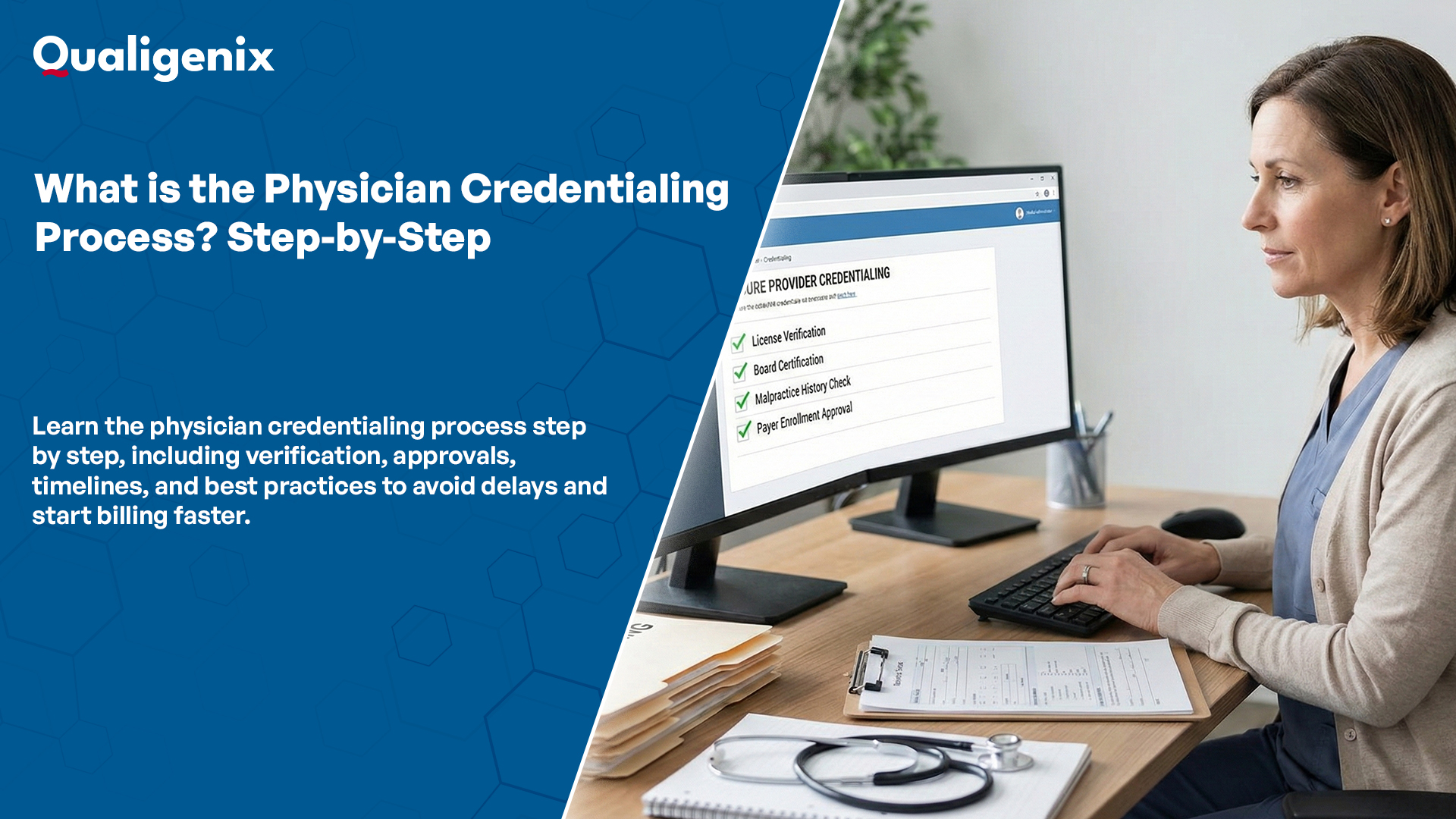
Every day a physician sits uncredentialed is a day of lost appointments, delayed payments, and growing frustration for your team. Payers are stricter. Networks move more slowly. And small errors now trigger big setbacks. That is why the physician credentialing process is no longer “just paperwork.” It directly controls when providers can treat patients and when your practice can start billing insurance.
If credentialing feels confusing or unpredictable, you are not alone. Many clinics struggle with unclear steps, back-and-forth requests, and endless follow-ups. In fact, the average physician credentialing process takes 90-120 days to complete. If there are complex cases, it can further delay provider onboarding by 4-6 months. This step-by-step guide cuts through that noise. It walks you through what actually happens behind the scenes, where delays usually occur, and how to keep things moving. Think of this as your practical playbook for faster onboarding and smoother revenue flow.
What Is the Physician Credentialing Process?
The physician credentialing process is the formal system that verifies a doctor’s qualifications before they can join insurance networks or practice at healthcare facilities. During this process, credentialing specialists verify everything, including medical school degrees, board certifications, and state licenses. They will also assess the provider’s work history, malpractice claims, and professional references.
The process gives absolute confidence in a provider’s competence and legitimacy. Moreover, the physician credentialing process protects patients from unqualified practitioners. It shields healthcare organizations from liability risks.
Why Credentialing Is Required Before Billing
Without proper credentialing, providers can’t bill insurance, and patients can’t use their coverage. That’s why understanding this process is non-negotiable for anyone in healthcare administration. Here are some reasons why the verification step is mandatory:
- Patient Safety and Quality Assurance: Credentialing verifies that providers have legitimate medical training, active licenses, and clean histories. It protects patients from unqualified or fraudulent practitioners who could cause serious harm.
- Payer Compliance and Network Standards: Insurance companies must comply with state and federal regulations that demand provider verification. The physician credentialing process ensures every provider meets the benchmarks and legal requirements.
- Reimbursement Eligibility and Claims Processing: Without credentialing approval, providers cannot bill insurance for services they provided. Payers will reject claims from non-credentialed providers. As a result, your practices could end up with zero revenue. Moreover, your patients will face unexpected out-of-pocket costs.
- Legal Liability Protection: Healthcare organizations face malpractice and negligence risks when they hire unverified providers. Proper credentialing includes a documented verification trail that protects facilities from legal consequences.
Key Stakeholders in the Provider Credentialing Process
The physician credentialing process involves multiple people working together, which sometimes might cause delays. Let us take a look at the key stakeholders involved in the process to help you identify where delays happen:
Providers and Practice Administrators
Providers must gather and submit extensive documentation for the credentialing process. It includes medical degrees, board certifications, state licenses, DEA (Drug Enforcement Administration) certificates, malpractice insurance, work history, and professional references. Practice administrators manage this collection process. They ensure every document is current, complete, and accurate.
Where Delays Occur:
- Providers often underestimate documentation gathering time. Obtaining official transcripts or verification letters can take 2-4 weeks alone.
- Incomplete applications can cause credentialing delays.
- A single typo in a license number or an expired certificate can extend the weeks to the timeline.
Payers and Credentialing Committees
Once applications are submitted, payers and credentialing committees conduct primary source verification. They contact medical schools, licensing boards, and previous employers directly to confirm credentials are legitimate. Committees review verified information during scheduled meetings, typically monthly or quarterly. To decide on the providers’ network participation approval.
Where Delays Occur:
- Committee meeting schedules create bottlenecks. Applications arriving just after meetings wait 30-90 days for the next review.
- Discrepancies discovered during verification can restart parts of the process entirely.
Physician Credentialing Process Step by Step

The physician credentialing process follows a series of steps from initial application to final approval. Skipping or rushing any stage can cause delays. Here’s the step-by-step guide to help you out:
Step 1: Document Collection and Application Setup
The process starts with gathering documentation. Providers need to compile their complete professional history and supporting credentials. Start collecting early, as some documents take weeks to obtain from issuing institutions. Required documents include:
- Medical school diploma and transcripts
- Residency and fellowship certificates
- Current state medical licenses (all states)
- DEA and CDS certificates
- Board certification documents
- National Provider Identifier (NPI)
- Malpractice insurance coverage (current and tail coverage)
- Work history for the past 5-10 years
- Professional references (typically 3-5)
- Hospital privileges documentation
- CV or resume
Step 2: CAQH Profile Creation and Attestation
The Council for Affordable Quality Healthcare (CAQH) operates a centralized database that most payers use. Providers create a single CAQH profile containing all their credentials and professional information. This profile prevents duplicate data entry across multiple insurance companies. Instead of filling out dozens of separate applications, providers maintain one master profile that payers can access.
However, your CAQH profile must be 100% accurate. Payers pull directly from this database, so errors replicate across all applications. Providers must attest to their profile’s accuracy every 120 days, or it becomes inactive.
Step 3: Primary Source Verification
Payers verify every credential directly with the issuing organization through a process called primary source verification. Credentialing specialists contact medical schools to confirm degrees, check with state boards to verify licenses are active and unrestricted, and contact previous employers to validate work history.
They also check the National Practitioner Data Bank for malpractice claims and disciplinary actions. Verification depends on how quickly third parties respond to inquiries, which is completely outside your control.
Step 4: Payer Application Submission
Once verification is complete, credentialing specialists submit applications to individual insurance payers. Each payer has unique application requirements, forms, and documentation standards.
Medicare, Medicaid, and commercial insurers all have different processes. Some accept CAQH data directly, while others require supplemental forms. Multi-state practices face additional complexity since applications must be submitted for each state’s network.
Step 5: Credentialing Committee Review
Applications don’t get approved automatically. Credentialing committees, including physicians and administrative leaders, review each application during scheduled meetings.
These committees meet monthly, bimonthly, or quarterly, depending on the organization. They evaluate qualifications, review any red flags from verification, and vote on approval. If concerns arise, they may request additional documentation or defer decisions to the next meeting.
Step 6: Final Approval and Network Participation
Once the committee approves credentialing, you receive official notification and an effective date. This is when providers can finally start seeing insured patients and billing for services. Payers issue provider numbers and add you to their networks. Patients can now use their insurance when visiting you. Claims submitted after the effective date will be processed and reimbursed.
How Long Does the Physician Credentialing Process Take?
The physician credentialing process timeline varies based on complexity, payer requirements, and application accuracy. Here’s a simple Standard Timeline Breakdown:
- Simple credentialing (single state, established provider): 90-120 days
- Complex credentialing (multi-state, new graduates): 120-180 days
- Hospital credentialing with privileges: 90-150 days
- Medicare/Medicaid enrollment: 60-90 days
- Commercial payer credentialing: 30-90 days per payer
Common Reasons Credentialing Gets Delayed
Most causes for delays are preventable issues. It includes:
- Unresponsive Third-Party Verifications: Medical schools and previous employers often take 4-6 weeks to respond to verification requests, with international institutions requiring 8-12 weeks.
- Payer Processing Backlogs: Insurance companies experience seasonal backlogs, particularly in Q1 and Q4, causing applications to sit in queues for weeks.
- Committee Meeting Schedules: Applications arriving just after monthly or quarterly committee meetings wait 30-90 days for the next review cycle.
- Expired Credentials During Processing: Licenses or certifications expiring mid-process require updated documents and restart portions of the verification timeline.
Common Mistakes That Slow Down Credentialing
Avoid the following mistakes to keep your applications moving forward.
Incomplete Applications
Leaving fields blank or marking sections “N/A” triggers automatic rejections. Credentialing specialists can’t submit incomplete applications to payers.
Common Omissions
- Gaps in work history without explanations
- Missing hospital privileges documentation
- Incomplete malpractice claim details
- Unsigned attestation forms
- Missing state license information for locum work
Solution: If you don’t have information, provide a written explanation rather than leaving it blank.
Outdated or Incorrect Provider Data
Small errors create big problems. A transposed digit in your NPI number or an old address on your license causes verification failures.
Frequent Data Errors
- Expired licenses or certifications
- Old addresses that don’t match current records
- Name changes without supporting documentation
- Incorrect DEA numbers or expiration dates
- Outdated malpractice insurance information
What Happens: Payers can’t match your information with official records. Verification attempts fail, triggering requests for corrected documentation. You must obtain updated documents, resubmit them, and wait for re-verification.
Solution: Always verify your documents match across all sources before submitting.
Poor Follow-Up With Payers
Applications don’t notify you of problems automatically. Many stall silently while waiting for information or are stuck in processing queues.
What happens: Weeks pass with no progress. Applications expire or get closed due to inactivity. By the time you notice, you have lost 60-90 days and must restart the process.
Solution:
- Check application status weekly
- Document every phone call and email
- Maintain a credentialing tracking spreadsheet
- Set calendar reminders for follow-ups
- Request status updates from payer representatives
How Credentialing Impacts Revenue and Billing Readiness
The physician credentialing process directly affects your bottom line. Here’s how it impacts your revenue and billing readiness:
- Immediate Revenue Impact: Non-credentialed providers can’t bill insurance. Patients must pay out-of-pocket or reschedule for after credentialing is complete. Most patients choose to reschedule, leaving appointment slots empty and revenue at zero.
- Cash Flow Disruption: Healthcare organizations plan hiring around expected revenue generation. Credentialing delays disrupt these projections. You’re paying a provider’s salary, benefits, and overhead with zero incoming revenue to offset costs.
- Operational Scheduling Challenges: You’ve hired a provider and promised patients expanded access. But credentialing delays force you to keep those appointments blocked. Patient satisfaction drops, and your reputation suffers.
How Qualigenix Helps With the Physician Credentialing Process?

Qualigenix specializes in accelerating the physician credentialing process while ensuring complete accuracy and compliance. Our credentialing experts manage every step, eliminating delays and getting providers to billing readiness faster. Here’s what we do:
- Create customized checklists, verify document authenticity, track expirations, and maintain organized digital files for complete applications
- Build and maintain 100% accurate CAQH profiles with automatic re-attestations every 120 days and error-free data verification
- Manage verification process with persistent weekly follow-up, real-time tracking, and escalation to keep applications moving
- Handle simultaneous applications across all payers, complete payer-specific forms, and manage supplemental requests
- Contact payers weekly, resolve bottlenecks immediately, respond within 24-48 hours, and provide real-time status dashboards
- Reduce standard credentialing to 60-75 days and complex cases to 90-120 days, with 98% first-time acceptance
- Provide experienced specialists as a single point of contact with proactive communication and transparent reporting
Accelerate Your Physician Credentialing Process with Qualigenix!
The physician credentialing process is a revenue-critical workflow that directly impacts your practice’s financial health. Clinics that maintain data accuracy across all platforms, conduct proactive follow-ups with payers, and coordinate credentialing timelines efficiently onboard providers faster and avoid costly billing delays. Every day your provider waits for approval represents lost revenue and missed patient care opportunities. Ready to reduce payer approval delays and get your providers billing faster? Partner with Qualigenix to streamline the entire physician credentialing process, ensure compliance, and accelerate approvals.
FAQs
1. What is the physician credentialing process?
The physician credentialing process verifies medical licenses, board certifications, education, work history, and malpractice insurance through primary source verification. It ensures providers meet payer and facility standards before assuring network participation and billing privileges.
2. How long does provider credentialing usually take?
Credentialing timelines typically range from 90 to 120 days. However, the timeline varies based on the Payer credentialing requirements, application completeness, and verification response times.
3. Is credentialing the same as payer enrollment?
No. Credentialing verifies qualifications through primary source verification, while payer enrollment registers verified providers in billing systems. The provider enrollment workflow requires both processes to be aligned.
4. Why do credentialing applications get rejected?
Even minor errors can cause rejections, and you have to restart the process, which could extend payer approval delays. Common causes include:
- incomplete credentialing documentation checklist items,
- expired licenses,
- name inconsistencies across databases,
- work history gaps, and missing malpractice coverage.
5. Is CAQH mandatory for credentialing?
CAQH profile management isn’t universally mandatory. But most commercial payers require this centralized database to streamline medical credentialing steps by storing verified provider data. It enables faster insurance network participation across multiple payers simultaneously with less or no paperwork.
6. Can credentialing be outsourced?
Yes. Specialized partners manage the entire provider enrollment workflow, handle recredentialing cycles, payer credentialing requirements, and reduce payer approval delays. They also support delegated credentialing arrangements to reduce admin burden and speed up network participation.
What’s Next

Retro Authorization: Which Payers Grant It and What Documentation They Require
Retro authorization is payer approval you request after a service is already done. Most Medicaid programs, Medicaid managed care,...

Structuring patient payment plans without increasing your bad debt
A payment plan only helps if it finishes. Take 20 to 25 percent down, size the installment to the...

Renegotiating payer contracts: what your current fee schedule data needs to say first
Most practices walk into a rate conversation with a number the payer already knows is wrong. Before you ask...