

How to Select the Best Denial Management Service in 2026
The Qualigenix Editorial Team consists of certified billing and coding experts with over 40 years of experience across 38+ medical specialties. Our content is rigorously researched against CMS, AMA, and payer-specific guidelines to ensure total compliance and accuracy. We apply the same elite standards to our resources as we do our client work, consistently delivering high claim accuracy and significant reductions in AR days.


| Summary:
Claim denial rates hit 11.8% in 2024 and continue rising in 2026 as payers deploy AI-driven audits. Selecting the best denial management service requires evaluating root-cause analytics, appeal overturn rates, specialty-specific workflows, real-time reporting, and proactive prevention — not just reactive claim rework. Qualigenix delivers 99% claim accuracy, 95% first-pass acceptance, and a 30% reduction in AR days. |
Why Choosing the Right Denial Management Service Matters More Than Ever
Claim denials are no longer just a billing nuisance — they are a strategic revenue threat. In 2026, the average denial rate across US healthcare providers sits at 11.8%, up from 10.2% just a few years ago (HFMA, 2024). For specialty practices and hospitals operating on thin margins, unmanaged denials translate directly to cash flow instability, inflated AR days, and revenue write-offs that compound over time.
Payers have significantly raised the bar. Insurance companies now use AI-driven claim review systems that automatically flag documentation discrepancies, medical necessity gaps, and modifier mismatches before a human reviewer ever sees the claim. According to MD Clarity, denial rates for complex specialized care exceeded 20% in 2026 — nearly double the 12% rate recorded in 2022. Matching that sophistication requires the right denial management partner, not just a billing team doing reactive rework.
Selecting the best denial management service means finding a partner that prevents denials at the source, recovers revenue through structured appeals, and continuously improves your clean claim rate through data-driven root-cause analysis. This guide tells you exactly what to look for — and what separates high-performing denial management from expensive mediocrity.
What Is a Denial Management Service in Medical Billing?
| A denial management service is a structured medical billing function that identifies denied insurance claims, determines why they were rejected, corrects and appeals eligible denials, and implements prevention workflows to stop repeat occurrences. The best services combine real-time analytics, payer-specific intelligence, and proactive front-end controls to protect provider revenue from the moment a claim is created. |
Denial management goes far beyond filing appeal letters. A comprehensive service ties together front-end eligibility verification, clinical documentation integrity, coding accuracy, and payer communication into one continuous revenue protection cycle. When a denial occurs, a strong service diagnoses the root cause — not just the individual claim — and uses that data to prevent the same denial pattern from appearing next month.
For practices and health systems looking to stabilize cash flow and reduce AR aging, investing in specialized denial management in medical billing is one of the highest-ROI decisions available. The American Hospital Association reported that providers spent $19.7 billion in 2022 solely on appeals and overturning denied claims — a figure that has only grown since.
Denial Management Industry Benchmarks: 2026 Data
| Metric | Value / Benchmark |
| Industry Average Denial Rate (2026) | 11.8% — up from 10.2% in 2022 (HFMA) |
| Specialty Care Denial Rate | 20%+ for complex specialty procedures |
| Annual Revenue Lost to Denials | $262 billion industry-wide |
| Cost to Rework a Denied Claim | $25–$181 per claim |
| Preventable Denials | 86% of all claim denials (industry estimate) |
| Qualigenix Claim Accuracy Rate | 99% |
| Qualigenix First-Pass Acceptance Rate | 95% |
| Qualigenix AR Days Reduction | 30% average reduction |
| Qualigenix Average Collection Cycle | 36 days |
| Qualigenix Average Onboarding Time | 6 business days |
| CFOs Using AI for RCM (2025) | 46% currently; 49% planning adoption (BDO) |
| TREND Health Partners Overturn Rate | 20% above industry benchmark |
What Are the Core Features of the Best Denial Management Services?
Not all denial management companies are built the same. The market ranges from reactive billing teams that rework individual claims to full-service revenue cycle partners that use AI analytics, dedicated appeal specialists, and real-time dashboards to systematically protect your revenue. Here is what the top-tier services consistently deliver:
- Root-Cause Analytics: The service identifies denial patterns across payers, procedure types, and providers — not just individual claim errors. Without analytics, you fix one denial and the same problem reappears next month.
- Proactive Prevention Workflows: Front-end controls including eligibility verification, prior authorization tracking, and documentation pre-checks stop denials before claims are submitted. This is the difference between reactive and preventive denial management.
- Payer-Specific Intelligence: Every major commercial payer, Medicare, and Medicaid plan has unique billing rules, modifier requirements, and timely filing windows. Top services maintain payer-specific rule libraries and update them continuously as policies change.
- Structured Appeal Management: Effective appeals require clinical documentation, payer contract knowledge, and firm deadline tracking. The best services have dedicated appeal writers who know exactly what each payer needs to overturn a denial.
- Real-Time Reporting Dashboards: You should always know your denial rate by payer, denial category, and provider — not just at month-end. Real-time visibility allows your team to intervene before AR aging worsens.
- Specialty-Specific Workflows: A cardiology practice has different denial triggers than a behavioral health group or a DME supplier. The best services customize workflows to your specialty’s coding, documentation, and payer rules.
What Is the Difference Between Denial Management and Claim Rework?
Claim rework corrects individual billing errors — a missing modifier, a wrong diagnosis code, a late submission. Denial management addresses the systemic cause of those errors — a gap in eligibility verification, a training deficiency in documentation, or a payer rule change that no one caught. The best denial management service does both: it recovers revenue from existing denials and eliminates the workflows that caused them.
Think of it this way: reworking a claim denied for missing prior authorization recovers one payment. Denial management asks why authorization was missed in the first place — and fixes the intake workflow so it never happens again for that payer or procedure type.
How Do You Evaluate and Compare Denial Management Companies?
The denial management market is crowded, and marketing language rarely tells you what you need to know. When evaluating companies, ask specific performance questions and request verifiable data — not just promises. Use this structured comparison framework
| Evaluation Factor | What to Ask | Red Flag to Watch |
| First-Pass Acceptance Rate | What is your average clean claim rate? | Anything below 90% or evasive answers |
| Appeal Overturn Rate | What percentage of appeals do you win? | No data available or below 50% |
| Root-Cause Reporting | Can you show denial trend analytics by payer/code? | Reactive only — no prevention analytics |
| Specialty Experience | Do you have billers and coders in my specialty? | Generalist team with no specialty knowledge |
| Payer Coverage | Which payers do you work with in my state? | Limited payer network or no Medicare experience |
| Technology Platform | What tools do you use for denial tracking and appeals? | Manual tracking in spreadsheets |
| Reporting Access | Do I have real-time access to my denial data? | Monthly reports only — no live dashboard |
| Onboarding Speed | How long until you are fully operational? | 30+ day onboarding with no clear timeline |
| Contract Terms | Is there a long-term lock-in or flexible agreement? | Multi-year lock-in with no performance guarantees |
| HIPAA Compliance | How do you protect PHI in your denial workflows? | No BAA offered or vague compliance statements |
What Types of Denials Should a Best-in-Class Service Target First?
Prioritization matters. Not all denials are worth the same administrative effort. The best denial management services triage denials by dollar value, appeal success likelihood, and root-cause category. Here are the most impactful denial types to address immediately:
- Medical Necessity Denials: These require detailed clinical documentation and physician-level appeals. They are high dollar and highly winnable when the documentation supports the service. Practices need appeal writers with clinical knowledge — not just billing staff.
- Prior Authorization Denials: In 2026, the CMS Prior Authorization Rule has introduced stricter API-enabled authorization requirements. Practices without compliant workflows see significantly higher auth-related denials. A strong service monitors auth status in real time.
- Coding and Modifier Denials: Payers now use NLP (Natural Language Processing) to validate CPT and ICD-10 codes against clinical notes. Mismatches are flagged automatically. Top services run pre-submission code scrubbing against payer-specific edits.
- Eligibility and Coverage Denials: These are almost entirely preventable. Real-time eligibility verification at scheduling and point of service eliminates the majority of coverage-related denials before a claim is ever created.
- Timely Filing Denials: Once a timely filing deadline passes, the revenue is almost always unrecoverable. A denial management service must track filing windows by payer and alert teams well in advance — not after the fact.
- Duplicate Claim Denials: Often triggered by system errors or resubmissions without proper tracking. A good service runs claim deduplication checks before submission.
How Does AI Change Denial Management in 2026?
In 2026, AI has become a two-sided force in denial management. Payers use AI to deny claims faster and more precisely. The best denial management services use AI on the provider side to predict denial risk before submission, automate appeal generation, and identify denial root causes at scale.
According to Phoenix Strategy Group, 83% of healthcare organizations using AI-powered denial management reported at least a 10% drop in denials within six months. AI tools analyze historical claims data, payer responses, and denial codes to generate risk scores — allowing billing teams to intervene on high-risk claims before they ever go out the door. This is what separates modern denial prevention from traditional reactive rework.
What Should You Expect From Denial Management Pricing and Contract Terms?
Pricing models vary widely across denial management companies. Understanding the structure helps you avoid paying for volume without results:
- Percentage of Collections: The most common model — typically 3–8% of net collections recovered. Aligns incentives: the vendor only makes money when you do. Watch for caps that limit recovery on large claims.
- Per-Claim Fee: A fixed fee per denied claim worked, regardless of outcome. Predictable cost but no direct incentive to maximize recovery. Works for practices with high claim volume and relatively low-dollar denials.
- Flat Monthly Retainer: Common for full-service RCM partnerships. Covers denial management within a broader revenue cycle scope. Best suited for practices outsourcing their entire billing operation.
- Contingency-Only Models: Some specialty denial companies charge only on successfully recovered dollars — typically 20–35% of recovered revenue. High cost per dollar but zero upfront risk. Common for aged AR recovery and complex clinical denials.
Key contract terms to verify: performance guarantees (minimum appeal overturn rates), data portability (you own your denial data), HIPAA Business Associate Agreement (non-negotiable), and termination clauses (avoid 12-month+ lock-ins without performance benchmarks).
Is Outsourcing Denial Management Better Than Keeping It In-House?
For most independent practices and mid-size specialty groups, outsourcing denial management to a specialized service outperforms in-house teams on cost, expertise, and results. In-house teams often lack payer-specific training, appeal writing skills, and analytics tools — and they cannot scale during denial spikes without adding headcount.
The comparison changes for large health systems with dedicated revenue cycle departments and existing technology infrastructure. But even there, outsourcing targeted high-complexity denial categories — clinical denials, Workers’ Compensation, Medicare audits — to specialists consistently outperforms generalist in-house teams on those specific denial types.
How Qualigenix Delivers Best-in-Class Denial Management
Qualigenix approaches denial management as a proactive revenue protection system, not a reactive claims cleanup service. Our denial management services are built on four pillars that consistently outperform industry benchmarks:
- 99% Claim Accuracy Rate: Our coding and pre-submission review processes catch errors before claims reach payers, driving a 95% first-pass acceptance rate that eliminates the majority of preventable denials at the source.
- Root-Cause Denial Analytics: Every denial is categorized, tracked, and analyzed by payer, code, provider, and facility. Our clients receive real-time dashboards showing denial trends — not just monthly summaries — so interventions happen before AR ages.
- Specialty-Specific Appeal Workflows: Our team includes specialty-trained billers and appeal writers across 38+ specialties. Appeal letters are written with clinical and payer-policy context, not generic templates — which is why our overturn rates consistently outperform industry averages.
- 6-Day Average Onboarding: Most practices are fully operational with Qualigenix within six business days of signing. We conduct an immediate AR assessment to identify your highest-priority denial categories and begin recovery while prevention controls are being implemented.
Related Qualigenix resource: What Is the Denial Management Process? 5 Essential Steps
10-Point Checklist: How to Select the Best Denial Management Service
- First-Pass Acceptance Rate: Confirm the vendor achieves 90%+ clean claim rate — Qualigenix delivers 95%.
- Root-Cause Analytics Capability: Verify the service tracks denial patterns by payer, code category, and provider — not just individual claims.
- Specialty-Specific Experience: Confirm they have billers and appeal writers trained in your specific specialty’s CPT codes, modifiers, and payer rules.
- Payer Coverage and Intelligence: Ask specifically about your top five payers — do they have active working knowledge of each payer’s denial patterns in your state?
- Appeal Overturn Rate Data: Request verifiable appeal success metrics — not marketing claims. Industry leaders exceed 50% overturn rates on clinical denials.
- Real-Time Reporting Access: Insist on live dashboards, not monthly PDF reports. You should be able to see your denial rate by payer at any time.
- AI-Powered Prevention Tools: Ask about pre-submission claim scrubbing, eligibility verification automation, and prior authorization tracking technology.
- HIPAA Business Associate Agreement: Non-negotiable. Any denial management partner must execute a BAA before accessing your patient or claims data.
- Flexible Contract Terms: Avoid long-term lock-ins without performance benchmarks. Insist on defined SLAs for denial response times and appeal submission deadlines.
- Onboarding Speed and Transition Support: Confirm the vendor provides a clear onboarding timeline with an immediate AR assessment — Qualigenix averages 6 business days.
Frequently Asked Questions: Denial Management Services
What is the best denial management service for small practices?
For small and solo practices, the best denial management service is one that combines eligibility verification, proactive coding review, and structured appeal management without requiring a large upfront contract. Small practices benefit most from percentage-of-collections models where the vendor’s fee is tied directly to recovery outcomes. Qualigenix serves practices of all sizes with flexible engagement models and specialty-specific expertise.
How much does a denial management service cost?
Denial management service pricing ranges from 3–8% of net collections recovered for percentage-based models, to fixed per-claim fees of $15–$50 per worked denial, to flat monthly retainers within full RCM contracts. Contingency-only models for aged AR recovery typically run 20–35% of recovered revenue. The cost is almost always justified: unmanaged denials typically cost practices 5% of net patient revenue annually — far more than a managed service fee.
What denial rate should my practice target?
The industry average denial rate in 2026 is 11.8%, but best-in-class practices with strong denial management achieve 5–8% or below. Qualigenix clients consistently maintain denial rates well below industry average through proactive prevention workflows and a 99% claim accuracy rate. For specialty practices, even a 2–3% reduction in denial rate can represent six figures in recovered annual revenue.
How long does it take to appeal a denied insurance claim?
Most commercial payers allow 30–180 days for claim appeals; Medicare and Medicaid have program-specific deadlines ranging from 120 days to 180 days depending on the appeal level. A well-organized denial management service tracks these windows automatically and submits appeals with complete documentation well ahead of deadlines — preventing the permanent revenue loss that comes from missed timely filing.
Can a denial management service prevent future denials, not just appeal past ones?
Yes — and prevention is where the highest ROI lies. The best denial management services use root-cause analytics to identify systemic workflow gaps that generate repeated denial patterns, then implement front-end controls — eligibility verification, prior authorization tracking, pre-submission code scrubbing — that stop those denials before claims are submitted. Reactive appeal management recovers individual dollars; proactive prevention protects revenue at scale.
What makes Qualigenix different from other denial management companies?
Qualigenix combines specialty-trained billing experts with real-time analytics and a 6-day average onboarding to deliver 99% claim accuracy and 95% first-pass acceptance rates consistently. Unlike generalist RCM vendors, Qualigenix customizes denial workflows to your specific specialty, payer mix, and state market — and provides every client with a dedicated account manager and real-time dashboard access, not just monthly reports.
Should I outsource denial management or keep it in-house?
For most independent practices and specialty groups, outsourcing denial management delivers superior results at lower total cost than building equivalent in-house capability. In-house teams require ongoing training, technology investment, and staffing overhead — and they cannot match the payer-specific intelligence and scale that a specialized denial management partner brings. Qualigenix clients typically see a 30% reduction in AR days within the first few months of engagement.
Related Qualigenix Resources
What Is the Denial Management Process? 5 Essential Steps
Denial Management in Medical Billing: 7 Common Causes
How to Appeal an Insurance Claim Denial: Step-by-Step
Revenue Cycle Management Services
Medical Billing Outsourcing Services
RCM KPI Benchmarking in Healthcare
How to Reduce Medical Claim Denials
Top Revenue Cycle Management Companies in USA
What’s Next
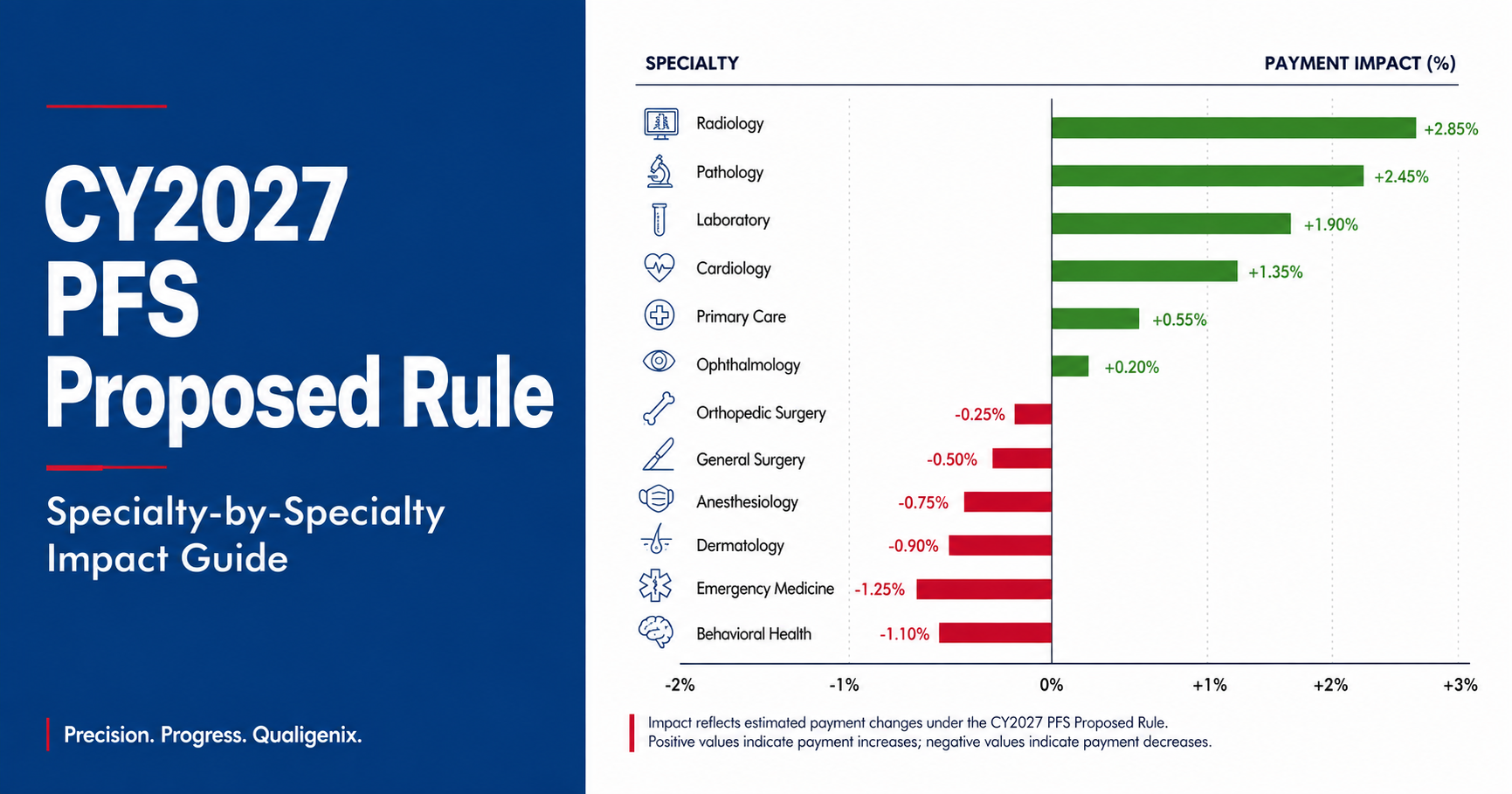
CY2027 Medicare PFS Proposed Rule: Specialty-by-Specialty Impact Guide
The CY2027 PFS proposed rule cuts the conversion factor to $32.84 for non-APM clinicians, but the real story...

Real-time eligibility returned active and the claim still denied: the five reasons why
An “active” eligibility result only proves the policy is in force. It never proves the service is covered, that...
Prior authorization turnaround requirements under the CMS interoperability rule: what changed for practices
The CMS interoperability rule (CMS-0057-F) forces impacted payers to decide standard prior authorizations in 7 calendar days and...