

Medicare Revalidation: Complete Guide 2026
The Qualigenix Editorial Team consists of certified billing and coding experts with over 40 years of experience across 38+ medical specialties. Our content is rigorously researched against CMS, AMA, and payer-specific guidelines to ensure total compliance and accuracy. We apply the same elite standards to our resources as we do our client work, consistently delivering high claim accuracy and significant reductions in AR days.

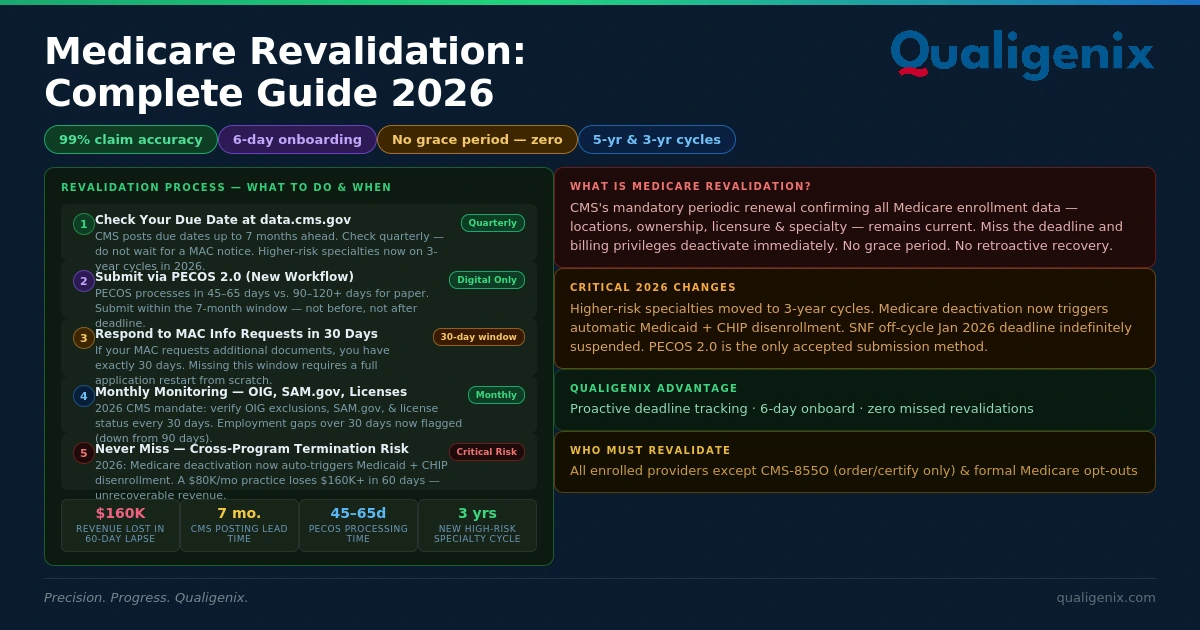
Medicare revalidation is CMS’s mandatory renewal process for keeping your billing privileges active. Miss the deadline and Medicare cuts your payments immediately — no grace period, no extensions, no retroactive recovery. Most providers revalidate every 5 years; DMEPOS suppliers every 3 years. In 2026, certain specialties moved to 3-year cycles, and a Medicare lapse can now trigger automatic Medicaid disenrollment. Check your due date quarterly at data.cms.gov. Submit within the 7-month window. Never wait for the notice.
Here’s a scenario that plays out dozens of times every year across the US. A practice administrator gets a letter in March from their Medicare Administrative Contractor. It’s a stop billing privileges notice. Not a request for documentation. Not a warning. A notification that Medicare enrollment has already been deactivated — effective the last day of February — because the practice missed its revalidation deadline. The practice hasn’t changed locations, hasn’t lost any licenses, hasn’t done anything wrong. They simply didn’t submit their revalidation on time. And now Medicare won’t pay a single claim until the entire enrollment is rebuilt from scratch.
That’s how quickly medicare revalidation can go sideways. Unlike many CMS administrative processes, revalidation has no grace period. There’s no opportunity to call your MAC and explain that the notice went to an old email address. There’s no retroactive payment for services your providers delivered during the deactivated window. The billing gap — however long it takes to reactivate — is a permanent revenue loss, not a delayed payment. For a busy practice billing $80,000 per month to Medicare, even a 60-day reactivation window costs $160,000 in unrecoverable Medicare revenue.
The 2026 landscape adds additional stakes. New CMS cross-program termination rules mean a Medicare deactivation can now automatically trigger disenrollment from Medicaid and CHIP. Certain higher-risk specialties moved from 5-year to 3-year revalidation cycles. PECOS 2.0 changed the submission workflow. And the SNF off-cycle revalidation deadline that was supposed to hit January 1, 2026 was indefinitely suspended — creating confusion for skilled nursing facilities about their current obligations (CMS, 2026). This guide covers everything your practice needs to know about medicare revalidation in 2026 — what it is, when to act, how to complete it through PECOS 2.0, what happens when things go wrong, and how Qualigenix medicare revalidation services ensure no deadline ever slips through unnoticed.
What Is Medicare Revalidation?
Medicare revalidation is CMS’s mandatory periodic renewal process through which enrolled healthcare providers and suppliers confirm that all information on file with Medicare — practice locations, ownership, licensure, specialty designations, and reassignment records — remains current and accurate. Completing revalidation on time maintains active Medicare billing privileges. Missing the deadline causes immediate deactivation, with no grace period and no retroactive payment recovery.
Think of it this way: Medicare enrollment isn’t a one-time event that stays valid indefinitely. It’s more like a driver’s license — it expires, it needs renewal, and letting it lapse has real consequences. The difference is that a lapsed driver’s license gets you a ticket. A lapsed Medicare enrollment stops your revenue cold.
CMS introduced the revalidation requirement through the Affordable Care Act as part of a broader provider integrity framework. The legal authority sits in 42 CFR §§ 424.515, 410.41(c), and 424.57(g) — the same regulations that govern initial enrollment. Consequently, the revalidation process is not a bureaucratic formality. It’s a genuine re-verification. Your MAC checks current licensure against state boards, confirms ownership hasn’t changed, verifies specialty designations in NPPES, and confirms no new OIG exclusions or NPDB actions have surfaced since your last enrollment cycle. Anything that looks different from what’s on file triggers an information request that must be resolved before revalidation can close.
Who Is Required to Revalidate and Who Is Exempt?
Most actively enrolled providers and suppliers must revalidate on schedule. However, two categories of providers don’t revalidate at all. First, providers enrolled solely to order or certify items and services for Medicare patients (CMS-855O) are exempt — they don’t hold billing privileges to revalidate. Second, providers who have formally opted out of Medicare are also exempt from revalidation. Notably, this opt-out exemption does come with a practical caveat: as of June 3, 2024, physicians who certify the need for hospice services must be enrolled or opted out formally — so even some previously exempt providers now have an enrollment-adjacent obligation (CMS, 2024).
Medicare Revalidation: Key Statistics and 2026 Benchmarks
| Metric | Value / Benchmark |
|---|---|
| Standard revalidation cycle — most providers | Every 5 years (per 42 CFR §424.515) |
| DMEPOS supplier revalidation cycle | Every 3 years |
| 2026 — higher-risk specialties revalidation cycle | Shortened to 3 years under new CMS policy (DistilINFO, 2026) |
| CMS revalidation due date posting lead time | Up to 7 months in advance at data.cms.gov |
| Revalidation submission window | Within 7 months before due date — not earlier, not later |
| MAC revalidation notice lead time | 3–4 months before due date (email or US mail) |
| Information request response window (MAC) | 30 days — missing it requires full restart of the application |
| SNF off-cycle revalidation deadline (Jan 1, 2026) | Indefinitely suspended by CMS — voluntary submissions still accepted (CMS, 2026) |
| Cross-program termination risk (2026) | Medicare deactivation can now trigger automatic Medicaid + CHIP disenrollment |
| Monthly monitoring requirement (2026 CMS mandate) | OIG exclusions, SAM.gov, license status — every 30 days |
| Employment gap flagging threshold (2026) | Gaps longer than 30 days now flagged (reduced from 90-day prior threshold) |
| Revenue at risk — 60-day reactivation gap ($80K/mo Medicare) | $160,000 in unrecoverable Medicare revenue |
| Paper vs. PECOS processing time comparison | PECOS: 45–65 days; Paper: 90–120+ days |
| Qualigenix claim accuracy rate | 99% — with integrated revalidation and billing management |
| Qualigenix average onboarding time | 6 days — from engagement to active revalidation tracking |
What Are the Medicare Revalidation Cycles and How Have They Changed in 2026?
For most of Medicare’s history, the revalidation cycle has been simple: five years for most providers, three years for DMEPOS suppliers. That framework still holds for the majority of enrolled providers. However, 2026 brought meaningful changes that affect a significant subset of practices — particularly those in higher-risk categories that CMS has been scrutinizing more closely.
The Standard 5-Year and 3-Year Cycles
Under 42 CFR §424.515, most enrolled physicians, non-physician practitioners, group practices, hospitals, home health agencies, hospices, and skilled nursing facilities revalidate every five years. DMEPOS suppliers have always held a shorter 3-year cycle, reflecting their historically higher fraud exposure category. Consequently, if you’re unsure which cycle applies to your practice, the safest approach is to check data.cms.gov directly — your actual due date is more reliable than any assumption based on your enrollment date.
The 2026 Specialty-Specific Cycle Changes
New 2026 CMS policy changes shortened revalidation cycles from five years to three years for certain higher-risk provider specialties (DistilINFO, 2026). While CMS has not published a comprehensive list of which specialties fall into this accelerated category in plain-language format, providers receiving revalidation notices with a 3-year cycle should not assume this is an error. Instead, contact your MAC to confirm which enrollment record triggered the notice and whether the shortened cycle applies to your specialty designation. For practices managing multiple providers across specialties, this adds a layer of tracking complexity that spreadsheet-based systems struggle to handle reliably.
Off-Cycle Revalidations: CMS Can Request Anytime
Beyond the standard cycles, CMS reserves the right to request off-cycle revalidations at any time under 42 CFR §424.515. These requests are not routine — they typically target practices with ownership changes, adverse NPDB actions, or patterns flagged in the program integrity review process. However, they arrive with the same urgency as standard revalidations. If you receive an off-cycle revalidation notice, the same 30-day response rules apply. Delaying an off-cycle revalidation carries the same deactivation risk as missing a standard deadline.
The SNF Off-Cycle Revalidation Suspension
Skilled nursing facilities were facing a specific off-cycle revalidation deadline of January 1, 2026 — a CMS initiative to verify ownership and chain-of-ownership data across the SNF sector. That deadline was indefinitely suspended by CMS before it took effect (CMS, 2026). SNFs may still voluntarily submit their applications, and CMS has indicated it will not update the online Medicare Revalidation List to include the SNF off-cycle revalidation schedule while the suspension is in effect. For SNF administrators, this suspension means the obligation hasn’t disappeared — it’s merely deferred. Monitoring CMS announcements for when the suspension lifts should be an ongoing priority.
How Do You Find Your Medicare Revalidation Due Date?
Not knowing your revalidation due date is one of the most preventable reasons practices miss deadlines. The information is publicly available, it’s updated regularly, and checking it takes less than two minutes. The fact that billing privilege deactivations still happen at scale every year isn’t because the system is hard to use — it’s because busy practices don’t have a systematic process for checking it.
The Medicare Revalidation List at data.cms.gov
CMS posts all revalidation due dates on the Medicare Revalidation List at data.cms.gov. Search by NPI or organization name. If your due date appears, you are within the 7-month submission window and must act. If the date shows “TBD,” you are not yet in the window — but that doesn’t mean you should stop checking. Set a quarterly calendar reminder to revisit the list. Your due date can appear with as little as seven months of lead time, and missing the first check after it appears can eat significantly into your available preparation time.
MAC Revalidation Notices: Helpful But Not Sufficient
Your MAC sends a revalidation notice — either by email or US postal mail — approximately three to four months before your due date. This sounds like plenty of lead time. In practice, however, these notices frequently arrive at outdated email addresses, get flagged as spam, or land in a general inbox that nobody monitors consistently. CMS is explicit about this: providers are responsible for tracking their own revalidation deadlines, regardless of whether a notice is received (CMS Revalidation Guidance, 2026). In other words, “I didn’t get the notice” is not an accepted explanation for a missed deadline. The billing privilege deactivation stands.
⚠ Practice Tip — Update Your PECOS Contact Information Now: If your MAC’s revalidation notice lands at an email address or postal address that’s no longer current, you’ll miss it. Log into PECOS today and verify that your contact email, mailing address, and Authorized Official information are accurate. This single update costs five minutes and could prevent a multi-week billing disruption.
What Happens If You Miss the Medicare Revalidation Deadline?
Missing a revalidation deadline isn’t a clerical inconvenience that gets sorted out with a phone call. It’s a billing privilege deactivation with real, immediate revenue consequences that unfold in a specific sequence.
❌ What Happens When You Miss
- Medicare billing privileges deactivated effective due date
- Stop billing privileges letter issued by MAC
- PECOS portal access may be revoked
- All Medicare claims submitted after deactivation automatically denied
- No retroactive payment for services during the gap
- Full new enrollment application required to reactivate
- 2026: Potential Medicaid + CHIP cross-program disenrollment
- Reactivation processing time: 45–120+ days (PECOS or paper)
✅ What Happens When You Submit On Time
- Medicare billing privileges remain continuously active
- No payment interruption or claim denials
- PECOS pre-populates existing enrollment data
- MAC processes within standard 45–65 day window
- Revalidation cycle resets for another 5 (or 3) years
- Cross-program enrollment remains unaffected
- No restart, no revenue gap, no emergency escalation
The Cross-Program Termination Risk — New in 2026
Before 2026, a Medicare billing privilege deactivation was serious but relatively contained. It affected Medicare billing specifically. Under new 2026 CMS enforcement rules, however, a Medicare termination can now trigger automatic disenrollment from Medicaid, CHIP, and related programs (DistilINFO, 2026). For a practice that bills both Medicare and Medicaid — which describes most primary care, behavioral health, and geriatric practices — a single missed revalidation deadline can simultaneously shut down revenue from two or three payers at once.
Consider what that means for a family medicine practice where Medicare represents 35% of revenue and Medicaid represents 25%. A revalidation lapse doesn’t just pause 35% of their billing. It potentially pauses 60%. That’s not a cash flow problem — it’s a potential existential crisis that could take months to fully resolve across all affected programs.
Reactivating After Deactivation: The Long Road Back
Reactivating Medicare enrollment after deactivation isn’t a quick fix. The provider must submit a new, complete enrollment application through PECOS — not a shortened revalidation form. The MAC processes this as a new application, which means the full 45–65 day processing window applies. For providers who submitted paper applications, that timeline extends to 90–120+ days. Furthermore, Noridian has documented specifically that deactivation of a group organization causes no payment to be made for any providers associated with that organization during the lapse period — meaning individual providers reassigned to the group lose billing privileges alongside it (Noridian, 2026). The lapse doesn’t just affect one provider on the roster. It can affect everyone.
PECOS Revalidation vs. Paper CMS-855 Revalidation: Which Should You Use?
| Factor | PECOS 2.0 Revalidation | Paper CMS-855 Revalidation |
|---|---|---|
| Processing time | 45–65 calendar days (MAC standard) | 90–120+ calendar days (mail transit + manual entry) |
| Pre-population of existing data | Yes — PECOS 2.0 pre-fills all current enrollment info | No — provider re-enters all information from scratch |
| Real-time validation | Yes — PECOS flags missing fields and data mismatches immediately | No — MAC discovers errors after receipt, triggers information request |
| Supporting document upload | Electronic upload within PECOS portal | Physical mail to MAC — risk of loss, illegibility, misrouting |
| Signature method | Electronic via I&A authorized official | Wet ink signature on printed form — must be blue ink |
| Application status tracking | Real-time in PECOS dashboard | Phone inquiry to MAC only — no online tracking |
| Risk of information request delay | Lower — real-time validation catches most errors upfront | Higher — errors discovered weeks after mailing, 30-day response clock starts immediately |
| CMS recommendation | ✅ Strongly recommended for 95%+ of providers | Last resort — only when PECOS access is unavailable |
The choice here isn’t really a choice. PECOS 2.0 is faster, safer, and less error-prone in every measurable way. The only scenario where paper makes sense is if PECOS access is genuinely unavailable — and even then, the solution is resolving the I&A access issue, not defaulting to paper. A paper application that takes 120 days to process when the 7-month revalidation window is 7 months long leaves almost no margin for error.
How Has PECOS 2.0 Changed the Medicare Revalidation Workflow?
PECOS 2.0, CMS’s redesigned Provider Enrollment, Chain and Ownership System launched in 2025–2026, is the most significant upgrade to Medicare enrollment infrastructure in years. For revalidation specifically, it addresses the single biggest frustration of the old system: re-entering data that hadn’t changed. That friction wasted time and introduced errors that triggered MAC information requests.
Pre-Population and the Review-Only Model
When a provider opens a revalidation application in PECOS 2.0, the system pre-populates all existing enrollment information — every practice location, ownership record, specialty designation, and reassignment detail currently on file. The provider’s job shifts from data entry to data review. Consequently, completing a revalidation that would have taken several hours in the old system can now take significantly less time — provided the provider’s existing records are current and accurate.
That “provided” clause matters. Pre-population only saves time if the information it pulls is correct. A provider who hasn’t updated their practice address after relocating two years ago, or whose malpractice coverage details have changed but were never reflected in PECOS, will find those discrepancies during the pre-population review — and must correct them before submission. This is actually a feature, not a limitation. Discovering outdated information during revalidation is far less painful than having a MAC pull it during a post-payment audit.
Multi-Channel Notifications and Dashboard Visibility
PECOS 2.0 sends revalidation deadline alerts through multiple channels — both within the PECOS portal dashboard and via email to designated contacts. This multi-channel approach addresses one of the most common causes of missed deadlines: a single notification going to an inbox nobody monitors. Additionally, the PECOS 2.0 dashboard now presents active applications, pending revalidations, and completed enrollments in distinct sections — making it visually clear what requires attention without digging through menus.
The Sole Owner Dual-Application Rule in PECOS 2.0
One of the most operationally consequential PECOS revalidation rules affects sole owners — providers who practice as both an individual (Type I NPI) and as their own organizational entity (Type II NPI). If you are in this situation, you must submit two separate PECOS applications simultaneously: one CMS-855I for individual enrollment and one CMS-855B for the group enrollment. This requirement applies even if only one of the two enrollments received a revalidation notice from your MAC (Noridian, 2026). Failing to submit both means one enrollment revalidates and the other lapses — and the lapsed one deactivates on schedule regardless of the other’s active status.
📌 Sole Owner Rule in Practice: If your Type II (group) NPI is notified for revalidation but your Type I (individual) NPI is not yet in the window — you still submit both applications simultaneously in PECOS. One application for the 855I, one for the 855B. Check data.cms.gov for both NPIs independently and track them as separate revalidation events with separate monitoring reminders.
What Are the Most Common Medicare Revalidation Mistakes — and How Do You Avoid Them?
Why do practices keep missing deadlines they knew were coming?
Most revalidation failures aren’t caused by ignorance of the process — they’re caused by calendar gaps, inbox failures, and the assumption that the next notice will arrive with enough warning. In practice, the combination of a notice that arrived at a stale email address, a billing manager who handled it last time but has since left, and a 7-month window that felt generous in October but urgent by March produces most of the missed deadlines (Qualigenix client data, 2026).
Here are the five mistakes that account for the overwhelming majority of revalidation failures:
- Waiting for the MAC notice rather than proactively checking data.cms.gov quarterly: MAC notices go to stale contact information constantly. The practice that checks data.cms.gov four times per year never gets caught off guard by a notice that went to an old address.
- Submitting a revalidation earlier than 7 months before the due date: Applications submitted more than 7 months before the due date are returned as unsolicited by MACs. Consequently, this well-intentioned early submission wastes the preparation effort and requires resubmission within the actual window.
- Missing the sole owner dual-application requirement: This is the revalidation rule that surprises sole owners most often. Submitting one PECOS application when two are required leaves one enrollment unrevalidated — and it lapses on schedule regardless.
- Failing to respond to a MAC information request within 30 days: The 30-day response window is firm. Missing it means the application is rejected and the provider must restart the entire process — potentially starting after the due date has already passed, which means immediate deactivation upon restart.
- Assuming PECOS contact information is current: Many practices updated their PECOS records at initial enrollment and never revisited them. If the Authorized Official has changed, the email on file is outdated, or the mailing address reflects a previous location, the MAC notice goes nowhere and the practice misses the signal that revalidation is due.
What documents do you need for Medicare revalidation?
Medicare revalidation requires the same core documentation as initial enrollment — because it is essentially a fresh re-verification of everything on file, not a simple renewal stamp. PECOS 2.0 pre-populates your existing data, but your MAC will still verify key documents against current primary sources.
- Current state medical license(s): For every state where the provider is enrolled and practicing. Confirm the license is active, in good standing, and not approaching expiration during the revalidation processing window.
- DEA registration: Current certificate with expiration date visible. If DEA registration is expiring within 60 days of your revalidation submission, renew it first.
- Malpractice insurance face sheet: Current policy showing coverage amounts. Some MACs also verify claims history, particularly for providers with prior adverse actions.
- IRS letter confirming legal business name and Tax ID (EIN): Must match exactly what’s in PECOS. Any discrepancy between the IRS record and the PECOS record triggers a data mismatch that delays processing.
- Updated ownership documentation: If any ownership structure has changed since your last enrollment — new partners, new corporate entity, changes in managing organization — document and disclose those changes as part of revalidation. Failing to disclose ownership changes is one of the grounds for revocation, not just delay.
- Board certifications: If applicable to your specialty designation, confirm certifications are current and maintenance of certification requirements are met.
How does the 2026 cross-program termination rule change revalidation risk?
The 2026 CMS policy establishing cross-program termination rules fundamentally changes the risk calculus of a missed revalidation deadline for any practice billing multiple government programs. Under the new rules, a Medicare termination can now automatically trigger disenrollment from Medicaid and CHIP (DistilINFO, 2026) — simultaneously shutting down billing across multiple payers from a single missed deadline.
Furthermore, the 2026 policy established real-time license monitoring as the standard — replacing the older model of periodic checks every few years at recredentialing. Monthly OIG exclusion list checks and SAM.gov sanctions monitoring are now mandatory for CMS-regulated programs. What this means in practice: a provider whose license lapses for even 48 hours can trigger an automated exclusion flag that flows into the cross-program termination framework before anyone has a chance to catch and correct it manually. The margin for error in 2026 is genuinely smaller than it was 24 months ago.
How Does Qualigenix Manage Medicare Revalidation for Your Practice?
Revalidation tracking shouldn’t be something your billing manager does from memory. It shouldn’t live in a shared spreadsheet that one person maintains and everyone else ignores. And it definitely shouldn’t be driven by a MAC notice that may or may not arrive at a current email address. It should be a systematic, documented, proactively managed process — because the consequence of it failing isn’t a late fee. It’s a billing blackout.
Proactive Due Date Monitoring — No Surprises
Qualigenix tracks every provider’s revalidation due date on the Medicare Revalidation List at data.cms.gov — not quarterly, but continuously — as part of the standard credentialing management workflow. The medicare revalidation services include automated alerts at six months and three months before each provider’s due date, giving your practice two structured decision points well before the 7-month submission window closes. Furthermore, if a due date changes — as CMS occasionally adjusts dates in the system — Qualigenix catches the update and notifies your practice immediately, not at the next scheduled check.
PECOS Application Management and I&A Coordination
When a revalidation window opens, Qualigenix manages the full PECOS application process. That means reviewing the pre-populated enrollment data against current primary sources, identifying any outdated information that needs correction before submission, compiling supporting documents, and coordinating the I&A electronic signature with your Authorized Official. Nothing gets submitted with data mismatches. Nothing gets submitted with a missing document. The goal is a complete, correct first submission — because information request responses cost time, and time is what revalidation doesn’t have to spare.
MAC Follow-Up and Cross-Program Compliance
After submission, Qualigenix monitors the PECOS application status weekly. If a MAC issues an information request — which must be answered within 30 days — Qualigenix coordinates the response immediately, not on the next monthly billing review cycle. Additionally, the credentialing workflow includes monthly OIG exclusion, LEIE, and SAM.gov monitoring for every enrolled provider, ensuring that the cross-program termination risk is addressed continuously rather than discovered during a revalidation review. Consequently, practices working with Qualigenix don’t experience the scenario where a routine revalidation triggers an unexpected exclusion finding that cascades into a program-wide billing disruption.
The downstream revenue impact of getting revalidation right is straightforward: no billing gaps means no lost Medicare revenue, no emergency re-enrollment scrambles, and no disruption to the claims that your claim submission services are processing continuously. Combined with Qualigenix’s 99% claim accuracy rate and 95% first-pass acceptance, the integrated approach — revalidation managed alongside billing and denial management — produces the kind of stable revenue cycle performance that doesn’t depend on any single administrative deadline going right. It’s built to go right systematically.
For practices managing multiple providers across specialties, Qualigenix’s credentialing services maintain separate revalidation tracking for each provider and each enrollment — including the sole owner dual-application requirement, specialty-specific cycle changes for higher-risk categories, and DMEPOS 3-year cycles where applicable. Nothing is lumped together. Nothing is assumed. Each enrollment is tracked as its own obligation with its own deadline and its own documentation requirements.
Medicare Revalidation Readiness Checklist: 10 Steps to Protect Your Billing Privileges
- ☐ Check data.cms.gov quarterly — every quarter, without exception: Don’t wait for the MAC notice. Search both your Type I and Type II NPIs in the Medicare Revalidation List every 90 days. Your due date can appear with as little as 7 months of lead time.
- ☐ Set dual alerts at 6 months and 3 months before each due date: Two calendar alerts per provider. The 6-month alert is for document gathering. The 3-month alert is for PECOS submission. This cadence gives you recovery time if documents need renewal or I&A access needs updating.
- ☐ Verify PECOS contact information is current today: Log into PECOS and confirm the Authorized Official, email address, and mailing address are current. MAC notices go to what’s in PECOS — if that’s outdated, the notice goes nowhere.
- ☐ Confirm I&A access and multi-factor authentication are active: PECOS 2.0 requires I&A login before accessing any enrollment functions. Verify AO and DO accounts are working well before the revalidation window opens — not the day you’re trying to submit.
- ☐ Identify all sole owner dual-application obligations: If you have both Type I and Type II NPIs, document this clearly in your revalidation tracking system. When the window opens, prepare two simultaneous PECOS submissions — 855I and 855B — regardless of which one received the MAC notice.
- ☐ Gather documents at the 6-month mark, not at the 3-month mark: Start document collection when your 6-month alert fires. License renewals, malpractice policy renewals, and DEA registrations approaching expiration need to be addressed before submission, not discovered during MAC review.
- ☐ Never submit revalidation more than 7 months before the due date: Applications submitted outside the 7-month window are returned as unsolicited. Use data.cms.gov to confirm the window is open before submitting.
- ☐ Assign a 30-day response monitor immediately after submission: Designate a specific staff member to check PECOS application status every business week after submission. If your MAC issues an information request, the 30-day response clock starts from the request date — not the date someone notices it in the portal.
- ☐ Track specialty-specific cycle changes for higher-risk categories: If any of your providers received a revalidation notice with a 3-year cycle instead of 5 years, confirm with your MAC which specialty designation triggered the shorter cycle. Update your tracking system to reflect the new cycle length going forward.
- ☐ Implement monthly OIG, LEIE, and SAM.gov monitoring for all enrolled providers: The 2026 cross-program termination framework makes continuous provider monitoring more consequential than ever. A license lapse or exclusion flag that goes undetected for weeks can cascade into multi-program billing disruptions. Monthly monitoring is the minimum required standard under current CMS policy.
Frequently Asked Questions About Medicare Revalidation
What is Medicare revalidation?
Medicare revalidation is CMS’s mandatory periodic renewal process requiring enrolled providers and suppliers to re-confirm that all information on file with Medicare remains current and accurate. Completing revalidation on time preserves active billing privileges. Missing the deadline causes immediate deactivation with no grace period, no payment for services delivered during the gap, and — under 2026 rules — potential automatic disenrollment from Medicaid and CHIP.
Revalidation isn’t just paperwork renewal. It’s a genuine re-verification process. Your MAC checks your current licensure against state boards, confirms ownership records, verifies specialty designations in NPPES, and confirms no new OIG exclusions or NPDB actions have surfaced since your last enrollment. Anything that looks different from what’s on file generates a MAC information request that must be answered within 30 days.
How often does Medicare revalidation occur?
Most providers revalidate every five years. DMEPOS suppliers revalidate every three years. Additionally, certain higher-risk provider specialties moved to a 3-year cycle under 2026 CMS policy changes. CMS also reserves the right to request off-cycle revalidations at any time. Providers enrolled solely to order or certify (CMS-855O) and formally opted-out providers are exempt from revalidation entirely.
Importantly, the 5-year clock doesn’t reset from your original enrollment date — it resets from your last revalidation approval. Furthermore, if your group practice revalidates at a different time than your individual enrollment, both cycles run independently. Check data.cms.gov for both your Type I and Type II NPIs separately and track them as distinct obligations.
What is the 7-month revalidation window and why does it matter?
CMS posts revalidation due dates up to seven months in advance on the Medicare Revalidation List at data.cms.gov. Providers must submit their revalidation application within that 7-month window — no earlier (applications are returned as unsolicited) and no later (late submission causes deactivation). The window matters because it defines exactly when you’re allowed to act, not just when you should.
In practice, the 7-month window means you should submit roughly 3–4 months before your due date — early enough to allow processing time and MAC information request resolution, but within the window. If you check data.cms.gov and your due date shows “TBD,” you are not yet in the window. Set a reminder to check again in 30 days rather than assuming you have years before the deadline appears.
What happens if Medicare billing privileges are deactivated?
A Medicare billing privilege deactivation means CMS stops processing and paying all Medicare claims submitted after the deactivation date. A stop billing privileges letter is issued, PECOS portal access may be revoked, and reactivation requires a full new enrollment application — not a simplified revalidation form. Processing takes 45–120+ days depending on PECOS or paper submission. Under 2026 rules, deactivation can also trigger automatic Medicaid and CHIP disenrollment.
The financial impact accumulates immediately. For a practice billing $80,000 per month to Medicare, a 60-day reactivation window creates $160,000 in unrecoverable revenue — because Medicare won’t pay retroactively for services delivered during the lapse. Consequently, reactivation resolves the enrollment problem but does not restore the revenue lost during the gap.
Does the sole owner dual-application rule apply if only one enrollment was notified?
Yes. If you are a sole owner with both a Type I (individual) and Type II (group) NPI, you must submit two separate PECOS revalidation applications simultaneously — even if only one enrollment received a revalidation notice from your MAC. Submit a CMS-855I for your individual enrollment and a CMS-855B for your group enrollment. Revalidating only the notified enrollment leaves the other to lapse on its own schedule.
Noridian’s published guidance specifically documents this requirement and notes that deactivation of a group organization stops payment for all individual providers associated with that organization (Noridian, 2026). Consequently, a sole owner who revalidates only their individual enrollment but allows the group enrollment to lapse may find that their group NPI — the one tied to most of their billing — is deactivated even though their individual enrollment remained current.
What changed in the 2026 CMS revalidation rules?
Key 2026 Medicare revalidation changes include: certain higher-risk specialties now revalidate every 3 years instead of 5; the SNF off-cycle revalidation deadline (January 1, 2026) was indefinitely suspended; Medicare terminations now trigger automatic Medicaid and CHIP cross-program disenrollment; monthly real-time license monitoring replaced older periodic cycles; and employment gaps longer than 30 days are now flagged (reduced from the prior 90-day threshold). Additionally, PECOS 2.0 now pre-populates revalidation applications with existing enrollment data.
The cross-program termination change is arguably the most consequential for practices billing multiple government programs. Specifically, it means a single administrative oversight — a missed revalidation deadline — can cascade into simultaneous billing disruptions across Medicare, Medicaid, and CHIP. For practices where government program revenue exceeds 50% of total billing, that is a structurally different level of risk than existed 24 months ago.
How does Qualigenix handle Medicare revalidation tracking?
Qualigenix continuously monitors every enrolled provider’s revalidation due date on data.cms.gov and delivers advance alerts at six months and three months before each deadline. The revalidation management workflow includes PECOS application preparation, document compilation, I&A signature coordination, MAC information request response, monthly OIG and SAM.gov monitoring, and cross-program compliance checks — all integrated with the broader credentialing and billing management framework.
The result is a practice that never discovers a revalidation lapse through a stop billing privileges letter. Book a free consultation for an immediate audit of your current provider roster’s revalidation status — including due dates, cycle types, and any at-risk enrollments that need attention in the next 12 months.
Related Qualigenix Resources
Medicare Revalidation Services
Proactive due date tracking — no deadline ever slips through
Medical Credentialing Services
Full credentialing lifecycle — enrollment through recredentialing
Triennial cycles managed — no provider falls out of network
Medicare Credentialing: Complete Guide 2026
From PECOS enrollment to PTAN confirmation — full workflow
Medical Credentialing: Complete Guide 2026
The full credentialing process explained for US providers
Provider Enrollment Process Step-by-Step
From CAQH to confirmed effective billing date
How Payer Enrollment Services Speed Credentialing
Integrating enrollment strategy with the full credentialing workflow
Clean Medicare claims from credentialed providers — faster payment
Recover enrollment-related denials systematically
Revenue Cycle Management Services
End-to-end RCM with revalidation fully integrated
Don’t Let a Missed Revalidation Deadline Shut Down Your Medicare Billing
Qualigenix monitors every provider’s revalidation due date continuously, manages PECOS applications from start to approval, and maintains monthly compliance checks so your billing privileges never lapse.
Our team delivers 99% claim accuracy, a 95% first-pass acceptance rate, an average 36-day collection cycle, and a 30% reduction in AR days. We onboard in as few as 6 days.
Precision. Progress. Qualigenix.
What’s Next

CAQH Attestation Lapses: The 120-Day Cycle That Quietly Drops You From Panels
CAQH makes every provider re-attest their profile every 120 days. Miss the deadline and your profile goes inactive....
How long Medicare PECOS enrollment actually takes in 2026, by application type
There’s no single PECOS timeline. A clean individual (855I) application clears in 30 to 60 days, and some MACs...
Expanding to a New State: The Credentialing Timeline Nobody Budgets For
The credentialing timeline for a new state runs 90 to 180 days before most payers will pay a claim....