

How long Medicare PECOS enrollment actually takes in 2026, by application type
The Qualigenix Editorial Team consists of certified billing and coding experts with over 40 years of experience across 38+ medical specialties. Our content is rigorously researched against CMS, AMA, and payer-specific guidelines to ensure total compliance and accuracy. We apply the same elite standards to our resources as we do our client work, consistently delivering high claim accuracy and significant reductions in AR days.

There’s no single PECOS timeline. A clean individual (855I) application clears in 30 to 60 days, and some MACs approve clean web submissions in about a week. Group (855B) runs 45 to 65 days. Institutional (855A) runs 60 to 90 days, and a change of ownership can add 6 to 9 months. The one thing that decides your speed is whether your file is clean on the first pass.
Every practice asks the same question before onboarding a provider: when can we bill? The honest answer depends on which form you file and how clean it is. A solo physician and a hospital system live in different timelines. So do a first-time enrollment and a change of ownership. This guide breaks down what each PECOS application type really takes in 2026, and where the delays hide.
A clean electronic CMS-855I clears in 30 to 60 days, with fast MACs approving clean web submissions in roughly a week. Group 855B applications run 45 to 65 days. Institutional 855A enrollments run 60 to 90 days or more, and a CHOW can add 6 to 9 months for the CMS final determination. Missing information adds 15 to 35 days per development request.
Why “how long” has no single answer
PECOS processing time isn’t one number. It’s a range that moves with three things: the form, the filing method, and the file quality.
The form sets the floor. An individual physician on the 855I moves faster than a hospital on the 855A, because the MAC verifies far less. The filing method matters too. An online submission in PECOS runs 30 to 60 days for an individual, while the same application on paper stretches to 90 to 120 days. Electronic filing alone can cut the standard 60-day review closer to 45 days.
File quality is the real variable. Roughly 40% of applications need corrections, and each round adds 15 to 30 days. A clean web submission at one MAC averaged about 7 days. The same application with missing information averaged 35 days. Same form, five times slower, for one reason: it wasn’t clean.
Key PECOS timelines and rules at a glance (2026)
| Item | 2026 figure | Source |
|---|---|---|
| Clean 855I web submission (fast MAC) | ~7 days average | Palmetto GBA MAC data |
| Typical clean 855I online | 30 to 60 days | MAC / industry guidance |
| Paper 855I | 90 to 120 days | MAC guidance |
| Application with missing info | +15 to 35 days per request | MAC development data |
| Clean group 855B | 45 to 65 days | Industry benchmark |
| Standalone reassignment (via 855I) | 15 to 30 days | CMS / MAC guidance |
| Institutional 855A initial | 60 to 90+ days | MAC guidance |
| CHOW final determination (855A) | +6 to 9 months | FCSO / CMS timeframes |
| Share of applications needing corrections | ~40% | Industry data |
| 2026 fee (855A, 855B org, 855S) | $750 | CMS |
| Fee for individuals (855I, 855O) | $0 | CMS |
| 855I initial effective date backdating | Up to 30 days before filing | 42 CFR 424 Subpart P |
| Rejected application re-open window | 60 days | CMS |
| Reconsideration filing window | 60 days | CMS |
| Revalidation cycle | Every 3 or 5 years | CMS Revalidation List |
| Report ownership, location, adverse action | Within 30 days | CMS |
| Report all other changes | Within 90 days | CMS |
| CAQH re-attestation cycle | Every 120 days | CAQH |
CMS-855I: individual physicians and non-physician practitioners
The 855I is the form most providers file. Physicians and NPPs use it for a first enrollment, a revalidation, or a reactivation. It carries no application fee.
A clean 855I filed online in PECOS 2.0 usually clears in 30 to 60 days. At a fast MAC, a clean web submission can approve in about a week. Paper is the trap: it runs 90 to 120 days and invites the errors that trigger a development request.
One 2026 change matters here. The old CMS-855R reassignment is now merged into the 855I, so a provider reassigns billing rights inside Section 4F instead of filing a separate form. For a first-time individual enrollment, CMS can backdate your effective date up to 30 days before you filed, but never before you held every required credential, including your license and NPI. You still can’t bill until the PTAN lands.
CMS-855B: group practices, clinics, and organizational suppliers
Groups, clinics, ambulatory surgical centers, and IDTFs file the 855B to enroll, revalidate, or change information. This form carries the $750 application fee in 2026, except for physician and NPP organizations.
A clean 855B typically runs 45 to 65 days. Group enrollment adds verification the individual form skips: the legal business name, the Tax ID, ownership details, and authorized officials. Each of those is a place a mismatch can stall the file.
Timing the 855B with reassignments takes planning. A new provider can’t reassign billing to the group until the group is active in PECOS. File the group enrollment first, confirm it’s approved, then submit the individual 855I with the reassignment. Reverse that order and the reassignment sits in limbo until the group clears.
CMS-855A: hospitals, SNFs, and institutional providers
Institutional providers such as hospitals, skilled nursing facilities, and home health agencies file the 855A. It’s the slowest path in Medicare, and the $750 fee applies.
A clean initial 855A runs 60 to 90 days or longer, because the MAC verifies ownership structure, managing employees, and often coordinates a survey or accreditation review. The real outlier is a change of ownership. After the buyer files the CHOW, CMS can take an additional 6 to 9 months to issue a final determination, on top of the contractor’s normal processing time.
That gap catches acquiring organizations off guard. If your deal assumes billing continuity on day one, build the CHOW timeline into the purchase agreement. Certified providers keep their CCN and effective date through the transition, but the paperwork still runs long, and a rejected filing restarts the clock.
Reassignments, order-and-certify, and DMEPOS
Three shorter paths round out the picture, and each has its own clock.
Reassignment (now inside the 855I)
When both the individual and group records are active and clean, a standalone reassignment clears in 15 to 30 days. Its effective date is generally the date the MAC receives it, with no backdating like the initial 855I. If either record has a pending revalidation or an open development request, the MAC holds the reassignment until that clears.
CMS-855O (order and certify only)
Providers who only order or certify services, and never bill Medicare directly, use the 855O. It’s the lightest application and carries no fee, so it’s the quickest to process.
CMS-855S (DMEPOS suppliers)
DMEPOS suppliers file the 855S, meet 30 federal supplier standards, and usually complete a site visit and accreditation. It’s the most demanding supplier path. A nationwide moratorium that took effect in February 2026 also blocks new applications in several supply categories, so check moratorium status before filing.
Revalidation and change of information
Enrollment isn’t a one-time event. Every provider revalidates on a 3 or 5 year cycle, and CMS posts due dates on its Medicare Revalidation List. Don’t file early: submit only after your new due date appears on the tool. Miss the date and your billing privileges can be deactivated, which forces a reactivation and a gap in payment.
Change of information has hard deadlines too. Physicians and NPPs must report a change of ownership, practice location, or adverse legal action within 30 days. All other changes are due within 90 days. These updates process faster than a full enrollment, but a late report is a compliance problem, not a scheduling one.
What PECOS 2.0 changed about your timeline
PECOS 2.0 is the live system in 2026. CMS rolled it out in phases starting in late 2025, with full migration expected by the end of the year. It’s a full rebuild, not a face-lift.
The change that touches your timeline most is validation at the point of entry. The old system let errors through, then bounced them back weeks later as rejections that restarted everything. PECOS 2.0 checks data in real time and cross-references it against IRS and federal databases as you enter it. Clean applications move faster because fewer mistakes survive to become a development request.
The flip side: applications with stale or mismatched data can stall sooner. If your NPI, Tax ID, and legal name don’t agree across systems, the new checks catch it immediately. Institutional providers on the 855A also have to complete their migration into PECOS 2.0 to keep an active record, and login now runs through Identity and Access management with multi-factor authentication.
The real reason applications stall: development requests
A development request is a MAC’s formal ask for missing or corrected information, and it pauses your processing clock until you answer. It’s the single biggest reason a “30-day” application becomes a 90-day one.
The most common triggers are preventable. An expired CAQH profile is near the top: re-attest so it’s current within 120 days before you submit. Signature problems come next, whether a missing e-signature or the wrong Identity and Access role. Data mismatches between your NPI, license, and Tax ID round out the list.
If your application is rejected, you can re-open it in PECOS within 60 days, and you then have 120 days to modify it before it’s deleted. A rejection resets your timeline, which is why first-pass accuracy protects your speed more than anything else.
If a denial is wrong, you have a 60-day window to file for reconsideration. Track that date closely, because a missed reconsideration deadline can force you to start the whole enrollment over.
PECOS timelines by application type: side by side
| Application | Who files it | Clean timeline | 2026 fee |
|---|---|---|---|
| CMS-855I | Individual physicians and NPPs | 30 to 60 days (as fast as ~7) | $0 |
| CMS-855B | Groups, clinics, ASCs, IDTFs | 45 to 65 days | $750 (except physician/NPP orgs) |
| CMS-855A | Hospitals, SNFs, HHAs | 60 to 90+ days | $750 |
| 855A CHOW | Buyer in an ownership change | MAC time + 6 to 9 months | $750 |
| Reassignment (855I 4F) | Provider joining a group | 15 to 30 days | $0 |
| CMS-855O | Order/certify only | Fastest, minimal review | $0 |
| CMS-855S | DMEPOS suppliers | Longest; site visit + accreditation | $750 |
How Qualigenix keeps your enrollment on the fast timeline
Most PECOS delays trace back to a file that wasn’t clean on the first pass. That’s the part we control. Our team files the correct 855 form the first time, verifies your NPI, Tax ID, and license agree before submission, and keeps your CAQH current so it doesn’t trigger a development request.
We handle the full path: initial Medicare enrollment, revalidation tracking, reassignments, and change of information, plus provider credentialing and payer enrollment across all 50 states. We watch every application status and answer MAC requests inside their window, so a small ask doesn’t turn into a reset.
What practice managers say about working with Qualigenix
“Our two new physicians were billing Medicare in 34 days. Qualigenix caught an NPI-to-Tax-ID mismatch before submission, so we never got a development request that would have pushed us past 90 days.”
Danielle Ortiz
Practice Manager, Primary Care Group, Texas
“Our 855A change of ownership was the part I dreaded. Qualigenix filed it clean and managed the MAC follow-ups, and the final CMS determination came through without a single restart. That saved us months of blocked billing.”
Marcus Bell
Administrator, Skilled Nursing Facility, Ohio
“We had eight providers to reassign to a new group TIN. Every reassignment cleared inside 21 days because Qualigenix confirmed each individual record was active and revalidation-current first. No held applications.”
Priya Raman
Credentialing Lead, Multi-Specialty Group, California
“We missed a revalidation due date once and lost billing privileges for three weeks. Since Qualigenix started tracking our PECOS due dates, we have not missed one in two years and have had zero deactivations.”
Karen Whitfield
Office Manager, Cardiology Practice, Florida
PECOS enrollment readiness checklist
Run this before you submit any 855 application:
- ☐ NPI matches the exact legal name and Tax ID on the application
- ☐ Correct 855 form chosen for the entity type (I, B, A, S, or O)
- ☐ CAQH ProView re-attested and current within 120 days
- ☐ Active state license and any required certifications in hand
- ☐ $750 fee paid where it applies (855A, 855B org, 855S)
- ☐ Group enrollment approved before filing dependent reassignments
- ☐ E-signature completed with the correct Identity and Access role
- ☐ Ownership and managing-employee details complete for 855A and 855B
- ☐ Revalidation due date confirmed on the CMS tool before filing
- ☐ Application status monitored, with a plan to answer MAC requests fast
Frequently asked questions
How long does PECOS enrollment take in 2026?
A clean electronic 855I usually clears in 30 to 60 days, and some fast MACs approve clean web submissions in about a week. Group 855B runs 45 to 65 days. Institutional 855A runs 60 to 90 days or more. Missing information adds 15 to 35 days per development request.
Which PECOS application is the slowest?
The 855A, especially a change of ownership. CMS can take an extra 6 to 9 months to issue a CHOW final determination, on top of the MAC’s normal processing time.
Does PECOS 2.0 speed up enrollment?
For clean files, yes. Real-time validation catches errors at entry, so fewer applications trigger a development request. Files with mismatched data can stall sooner, because the new checks flag problems immediately.
Can I bill Medicare before PECOS approves me?
No. You can’t submit a claim until CMS issues your PTAN. For an initial 855I, your effective date can be backdated up to 30 days before you filed, but not before you held all required credentials.
How fast is a Medicare reassignment?
Usually 15 to 30 days when both the individual and group records are active and clean. It stalls if either has a pending revalidation or an open development request.
What happens if I miss my revalidation date?
Your billing privileges can be deactivated, which stops payment until you reactivate. File only after your new due date appears on the CMS Revalidation List, and don’t submit early.
Is there a fee to enroll in PECOS in 2026?
The 2026 fee is $750 for institutional providers and suppliers on the 855A, 855B (except physician and NPP organizations), and 855S. Individual physicians and NPPs pay no fee.
Related resources
Stop losing weeks to preventable PECOS delays
We file it clean the first time and manage every MAC request, so your providers start billing sooner. From initial enrollment to revalidation and reassignment, we keep your Medicare records current across all 50 states.
Our team delivers 99% claim accuracy, a 95% first-pass acceptance rate, an average 36-day collection cycle, and a 30% reduction in AR days. We onboard in as few as 6 days.
Precision. Progress. Qualigenix.
What’s Next
Expanding to a New State: The Credentialing Timeline Nobody Budgets For
The credentialing timeline for a new state runs 90 to 180 days before most payers will pay a claim....
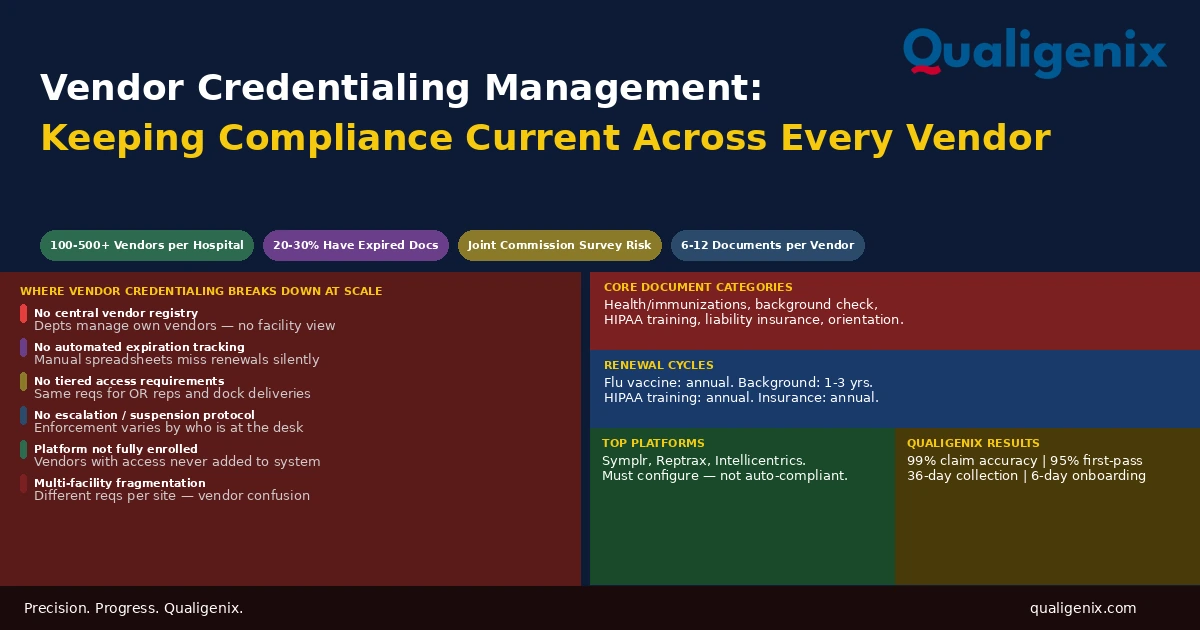
Vendor Credentialing Management for Healthcare Organizations: Keeping Compliance Current Across Every Vendor
Vendor credentialing is the process by which healthcare facilities verify that vendors, sales representatives, and third-party service providers meet...
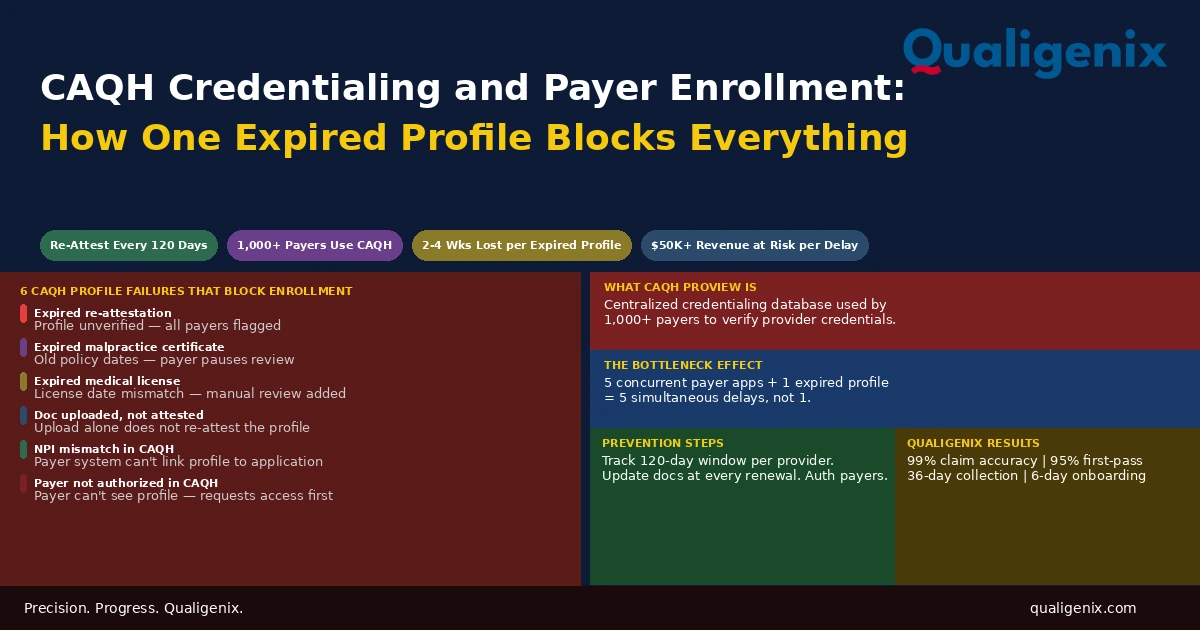
CAQH Credentialing and Payer Enrollment: How One Expired Profile Blocks Every Application Behind It
CAQH credentialing is the process of building and maintaining a provider’s profile in the CAQH ProView database, which...