

Q3 A/R Review: The Pre-Q4 Checklist Every Practice Needs Before Year-End
The Qualigenix Editorial Team consists of certified billing and coding experts with over 40 years of experience across 38+ medical specialties. Our content is rigorously researched against CMS, AMA, and payer-specific guidelines to ensure total compliance and accuracy. We apply the same elite standards to our resources as we do our client work, consistently delivering high claim accuracy and significant reductions in AR days.


Most write-offs are avoidable. Claims lose value fast after 90 days and become nearly uncollectible past 120. A Q3 A/R review finds the recoverable dollars while there’s still time to collect them. Sort your aging report, chase high-dollar and deadline-sensitive claims first, appeal denials inside the payer window, and route recurring errors back to your front desk and coders. Do it before Q4, not during it.
Your A/R doesn’t clean itself up in December. By the time year-end pressure hits, the claims you ignored in Q3 have aged past the point where payers pay. A focused Q3 A/R review, done now, catches the money still worth chasing. This checklist walks you through what to pull, what to work first, and what to write off before Q4 starts.
A Q3 A/R review is a structured cleanup of your accounts receivable before Q4. You pull your AR aging report, sort balances by age and dollar value, work the oldest recoverable claims first, appeal denials before filing deadlines close, and fix the front-end errors feeding the problem. The goal: enter Q4 with cash already moving.
Key A/R and denial benchmarks to review against
| Metric | Benchmark / Figure | Source |
|---|---|---|
| Median days in A/R (physician practices) | 47 days | MGMA 2024 Cost & Revenue Survey |
| Better-performer days in A/R | 36 days | MGMA 2024 |
| Top-performer days in A/R | Under 30 days | MGMA |
| HFMA days in A/R target range | 30-40 days | HFMA |
| Days in A/R signaling a structural problem | Above 50 days | MGMA / HFMA-aligned |
| A/R that should sit in the 0-30 day bucket | 50-65% of total | MGMA |
| A/R over 90 days (healthy ceiling) | Under 20% | MGMA |
| Collection probability at 0-30 days | 95-98% | Industry (MGMA-aligned) |
| Collection probability at 120+ days | Below 30% | Industry |
| 2024 initial claim denial rate | 11.8% | Kodiak Solutions / HFMA |
| HFMA denial rate benchmark | 5-10% | HFMA |
| Providers operating above a 10% denial rate | 41%+ | Experian 2025 State of Claims |
| Denied claims never reworked | 65% | Industry analysis |
| Cost to rework one denied claim | $25-$181 | MGMA |
| Medicare timely filing limit | 12 months from date of service | 42 CFR 424.44 |
| Qualigenix first-pass acceptance rate | 95% | Qualigenix |
Why your Q3 A/R review can’t wait until December
Cash sitting in aged claims is money you already earned. The longer it sits, the less of it comes back. Collection odds run 95 to 98% while a claim is 0 to 30 days old, and fall below 30% once it passes 120 days. Wait until year-end and you’re working claims that have already crossed that line.
Q3 is the right time because it leaves a full quarter to act. Denials you spot in September can still be appealed inside most payer windows. Claims near a filing deadline can still be filed. Front-end errors you catch now stop repeating before the busy year-end stretch.
Costs are climbing too. In a June 2025 MGMA poll, 90% of medical groups reported operating costs higher than the year before. When margins tighten, uncollected revenue hurts more. A clean A/R going into Q4 protects payroll and gives you room to plan.
There’s a compliance angle as well. Aged receivables distort your year-end financials and complicate any audit or valuation. Cleaning them up now means the numbers you report in January reflect reality.
Start with your AR aging report
Everything starts with the aging report. It’s the single document that shows where your money is stuck. Pull it for the full practice, then break it down by payer, by provider, and by specialty. Patterns hide in the segments, not the totals.
Read it by bucket. A healthy practice keeps 50 to 65% of total A/R in the 0 to 30 day bucket and under 20% over 90 days. If your over-90 column is fatter than that, you have a concentration problem worth fixing before Q4.
Check your days in A/R while you’re there. MGMA’s 2024 survey puts the median practice at 47 days, with better performers at 36 and top performers under 30. Anything consistently above 50 days signals that follow-up, denial work, or clean-claim rates have slipped.
Don’t stop at the number. A practice can hit an acceptable days-in-A/R figure and still carry a dangerous aging profile if too much sits past 90. The bucket mix tells you more than the average does. Sort by dollar value inside each bucket so you know which claims are worth your team’s hours.
How far back should a Q3 A/R review go? Review your full open A/R, but focus your energy on claims aged 60 days and older. That’s where recoverable dollars are actively slipping away.
The pre-Q4 A/R review checklist
Work these steps in order. Each one feeds the next.
- Pull the aging report. Run it practice-wide, then by payer, provider, and specialty for the trailing 90 days.
- Segment by age and dollar. Flag every claim over 90 days and every high-dollar claim regardless of age.
- Identify deadline-sensitive claims. Mark anything approaching a timely filing or appeal deadline for immediate action.
- Work denials by category. Group denials by reason code and route each group to the team that owns the fix.
- Appeal recoverable denials. File appeals on eligibility, coding, and authorization denials inside the payer window.
- Reconcile patient balances. Send statements on aged self-pay and set up payment plans where collection is realistic.
- Verify credentialing status. Confirm every provider is active with every payer so claims aren’t denied for enrollment gaps.
- Write off the dead claims. Formally clear anything past collection so your Q4 numbers are clean.
- Fix the root cause. Send recurring error patterns back to your front desk and coders before year-end volume climbs.
- Set your Q4 targets. Lock a days-in-A/R goal and a follow-up cadence for the new quarter.
Run this once in Q3 and you enter Q4 with a shorter, healthier worklist.
Work your aging buckets by dollar and by deadline
Not every aged claim deserves the same effort. Your team’s time is limited, so spend it where the return is highest. Two filters decide the order: dollar value and deadline.
Start with high-dollar claims that have a fixable reason. A surgical claim denied for a modifier mismatch can be worth hours of a biller’s time, while a small office-visit denial may not be. Build a dollar threshold into your worklist so big claims get full appeal treatment and small ones go through a quick-correction lane.
Then layer in deadlines. A claim worth $4,000 does you no good if the filing window closes next week. Sort your flagged claims by days-to-deadline and clear the urgent ones first, even the smaller ones, because a missed deadline turns a recoverable claim into a permanent loss.
The over-90 bucket needs the hardest look. Once A/R passes 120 days, collection odds drop below 30%, so be honest about what’s still worth chasing. Chase the winnable dollars hard. Clear the rest off your books so they stop inflating your aging report and hiding the claims that still matter.
What’s a good days-in-A/R target to set for Q4? Aim for under 40 days, the HFMA benchmark. Under 35 puts you in better-performer range. Under 30 is top-tier.
Kill timely filing write-offs before the calendar does
Timely filing denials are the most avoidable loss in your A/R, and the least forgivable. A CO-29 timely filing denial is almost always an operations failure: a claim sat in a queue or an error state long enough for the deadline to pass. Once that window closes, the money is gone. There’s usually no appeal.
Deadlines vary widely by payer. Medicare gives you 12 months from the date of service under 42 CFR 424.44, and it counts the receipt date, not the day you hit send. Many commercial payers give far less, some as little as 90 days. Your contract sets the exact window, so check it.
Build an appeals and filing calendar now. Track every open claim by payer, service date, and deadline, with an alert for anything getting close. During your Q3 review, pull every claim approaching a deadline and file or appeal it that week.
This is where a quarterly review earns its keep. Claims that would quietly die in a December backlog get caught in September while there’s still time to file them.
Warning: A missed timely filing deadline usually has no appeal path. Every claim you leave sitting past its window in Q3 is a guaranteed write-off by Q4.
Can you still appeal a claim after the filing deadline? Rarely. Timely filing denials usually have no appeal path. That’s why catching them in Q3 matters: the deadline is the one thing you can’t argue with.
Close the credentialing gaps that freeze your cash
A perfectly coded claim still gets denied if the provider isn’t active with the payer. Credentialing and enrollment gaps are a quiet cause of aged A/R, and they’re easy to miss because the denial looks like a billing problem, not an enrollment one.
Check every provider’s status during your Q3 review. Confirm active enrollment with each payer, current CAQH profiles, and no lapsed re-credentialing dates. A single expired credential can freeze every claim for that provider until it’s fixed, and the backlog piles up fast.
New providers are the biggest risk. If someone joined mid-year and their enrollment is still pending, their claims may be sitting unbilled or denied. Catch that in Q3 and you can bill retroactively where the payer allows it, instead of eating the loss.
This is where credentialing and billing have to talk to each other. When one team owns enrollment and another owns claims, gaps slip through. At Qualigenix, we tie credentialing status to the billing workflow so enrollment problems surface before they turn into denials. Fixing this before Q4 protects the revenue your newest providers are already generating.
How Qualigenix keeps A/R from piling up
Most A/R problems trace back to the front end, not the follow-up. We build denial prevention into every step before a claim goes out, so fewer claims come back. Qualigenix runs 99% claim accuracy and a 95% first-pass acceptance rate, which means less rework and a shorter aging report from the start.
Our team works A/R the way this checklist describes, every month, not once a quarter. We segment by dollar and deadline, appeal every recoverable denial inside the payer window, and feed error patterns back to coding so they stop repeating. Clients see an average 30% reduction in A/R days and a 36-day collection cycle across 38+ specialties.
We also tie credentialing to billing, so enrollment gaps get caught before they become denials. If your A/R keeps creeping up despite your team’s best effort, the fix is usually upstream. See how we handle claim denials, or talk to our team about a review of your current A/R.
What practice managers say about working with Qualigenix
“Our days in AR dropped from 58 to 34 in one quarter after Qualigenix took over our aging worklist. They caught $80,000 in claims we would have written off at year-end.”
Rebecca Alvarez
Practice Manager, Orthopedics, Texas
“We were losing claims to timely filing every month without realizing it. Qualigenix built us a deadline calendar and our over-90 bucket fell from 28% to 11%.”
David Whitfield
Administrator, Cardiology, Ohio
“Two of our new providers had enrollment gaps that were freezing their claims. Qualigenix found it during onboarding and recovered six weeks of revenue we thought was gone.”
Sandra Lin
Billing Director, Multi-specialty Group, California
“Their monthly A/R review replaced our once-a-year scramble. First-pass acceptance went from 82% to 95% and our collection cycle is under 40 days now.”
Marcus Reed
Practice Manager, Behavioral Health, Georgia
Your Q3 A/R review checklist
☐ Aging report pulled practice-wide and by payer, provider, and specialty
☐ Every claim over 90 days flagged and sorted by dollar value
☐ Deadline-sensitive claims identified and worked first
☐ Denials grouped by reason code and routed to the right team
☐ Recoverable denials appealed inside the payer window
☐ Aged patient balances billed with payment plans set up
☐ Every provider’s credentialing and enrollment status verified
☐ Uncollectible claims formally written off
☐ Recurring error patterns sent back to front desk and coders
☐ Q4 days-in-A/R target and follow-up cadence set
Frequently asked questions
What is a Q3 A/R review?
A Q3 A/R review is a structured cleanup of your accounts receivable done before the fourth quarter. You pull your aging report, work recoverable claims by age and dollar value, appeal denials before deadlines close, and fix the errors causing the aging. The point is to enter Q4 with cash already moving instead of scrambling at year-end.
Why do a Q3 A/R review instead of waiting for year-end?
Timing is the whole point. Claims lose value fast after 90 days and are nearly uncollectible past 120. A Q3 review gives you a full quarter to appeal denials, hit filing deadlines, and correct front-end errors before year-end volume climbs.
What days-in-A/R benchmark should a practice aim for?
Aim for under 40 days, the HFMA target. MGMA better performers sit at 36 days and top performers stay under 30. Anything consistently above 50 days signals a structural problem in your follow-up, denial work, or clean-claim rate.
How much of my A/R should be over 90 days?
Keep it under 20% of total A/R, per MGMA. A healthy practice holds 50 to 65% of receivables in the 0 to 30 day bucket. If your over-90 column is bigger than one-fifth of the total, you have a concentration problem worth fixing before Q4.
What causes claims to age past 90 days?
Most aging traces to a few causes: denials that never get reworked, claims stuck in queues past filing deadlines, front-end eligibility errors, and credentialing gaps that block payment. About 65% of denied claims are never reworked, so denial backlog is often the biggest driver.
Can outsourcing A/R actually lower my days in AR?
Yes, when the outsourced team works A/R continuously instead of quarterly. Consistent follow-up, systematic appeals inside payer windows, and root-cause fixes on the front end are what move the number. Qualigenix clients see an average 30% reduction in A/R days and a collection cycle around 36 days.
What’s the deadline to appeal a denied claim?
It depends on the payer and the denial type. Many commercial payers allow 90 to 180 days to appeal, while timely filing denials often have no appeal path at all. Medicare’s initial filing limit is 12 months from the date of service. Always check the specific payer contract.
Related resources
- Medical claim denials in 2026: types, rates, and appeals
- Qualigenix revenue cycle management services
- Request an A/R review with our team
Walk into Q4 with your A/R already clean
Stop letting recoverable claims die in a year-end backlog. Let our team work your aging report, appeal every recoverable denial, and close the gaps feeding your A/R.
Our team delivers 99% claim accuracy, a 95% first-pass acceptance rate, an average 36-day collection cycle, and a 30% reduction in AR days. We onboard in as few as 6 days.
Precision. Progress. Qualigenix.
What’s Next
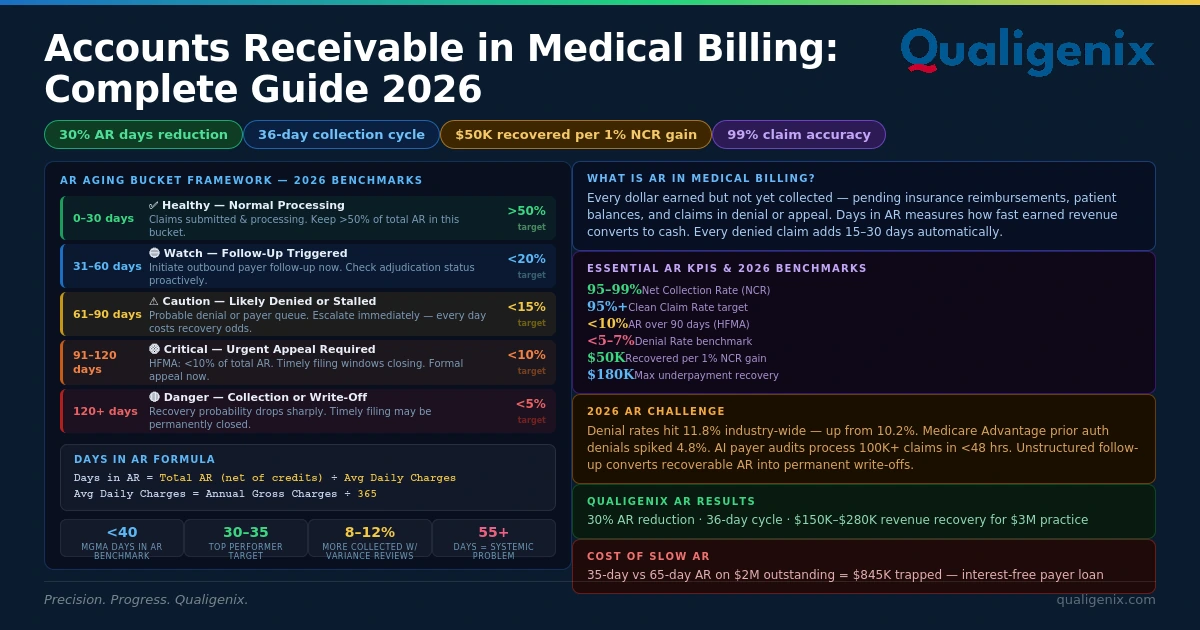
Accounts Receivable in Medical Billing: Complete Guide 2026
Accounts receivable (AR) in medical billing is every dollar your practice has earned but not yet collected —...