

The 7 most common claim denial reasons in 2026
The Qualigenix Editorial Team consists of certified billing and coding experts with over 40 years of experience across 38+ medical specialties. Our content is rigorously researched against CMS, AMA, and payer-specific guidelines to ensure total compliance and accuracy. We apply the same elite standards to our resources as we do our client work, consistently delivering high claim accuracy and significant reductions in AR days.


Written by the Qualigenix RCM Team
Healthcare revenue cycle and denial management specialists with hands-on experience across 275+ practices and 38+ specialties. About Qualigenix →
Last Updated: June 2026 | Updated to reflect payer policy changes and ICD-11 transition impacts affecting denial rates in 2026.
The 7 biggest claim denial reasons in 2026 are prior authorization failures, eligibility mismatches, coding errors, medical necessity rejections, timely filing misses, duplicate submissions, and missing or invalid modifiers. Most are preventable. Fixing them at the source is what separates practices with 3% denial rates from those sitting at 12%.
Claim denials cost U.S. healthcare practices an estimated $262 billion a year. And the frustrating part? About 86% of them are preventable. Yet most practices don’t have a clear picture of why their claims are getting denied — they just know revenue keeps slipping.
In 2026, payer rules are tighter, PA requirements have expanded into new procedure categories, and the ICD-11 transition is still causing coding headaches across specialties. The practices that are winning have denial rates under 5%. The ones struggling are often hitting 10–15%, and they’re appealing the same denial types month after month.
This guide breaks down the seven denial reasons showing up most in 2026, what’s driving each one, and what you can actually do to stop them.
The 7 most common claim denial reasons in 2026 are: (1) prior authorization failures, (2) eligibility and coverage mismatches, (3) medical coding errors, (4) medical necessity rejections, (5) timely filing limit violations, (6) duplicate claim submissions, and (7) missing or invalid modifiers. Together, these seven account for over 80% of all denied claims across U.S. practices.
Claim denial statistics that matter in 2026
Before we get into each denial type, here’s a data snapshot of where practices stand today. These numbers help you benchmark where your practice is and what’s at stake.
| Metric | Benchmark / Figure | Source |
|---|---|---|
| Average U.S. claim denial rate | 5–10% of submitted claims | CMS / CAQH Index |
| Revenue lost to denied/unresolved claims annually | $262 billion | CAQH Index 2025 |
| Preventable denials | 86% | MGMA 2025 |
| Denied claims never appealed | 65% | HFMA 2025 |
| Prior authorization — share of all denials | ~25% | AMA 2025 PA Survey |
| Coding error — share of all denials | ~18% | AAPC Benchmarking Report |
| Eligibility-related — share of all denials | ~15% | CAQH Index 2025 |
| Typical payer appeal window | 90–180 days | Payer contracts / CMS |
| Medicare Part B appeal window | 120 days | CMS.gov |
| Industry clean claim rate target | 95%+ | HFMA |
| Qualigenix first-pass acceptance rate | 95% | Qualigenix internal data |
| Qualigenix claim accuracy rate | 99% | Qualigenix internal data |
| Qualigenix average AR days reduction | 30% | Qualigenix internal data |
| Qualigenix average collection cycle | 36 days | Qualigenix internal data |
1. Prior authorization failures
Prior authorization denials are the top denial type in 2026, accounting for roughly 25% of all denied claims. A payer rejects the claim because the required PA wasn’t obtained before the service was delivered — or the PA was obtained but didn’t match the procedure, date, or facility listed on the claim.
In 2025, commercial payers expanded PA requirements to dozens of procedure categories that previously didn’t need them — including many outpatient imaging services, infusion therapies, and certain specialist visits. Many practices haven’t updated their PA checklists to keep up.
The fix isn’t complicated, but it requires discipline. You need a current list of PA requirements for your top five payers, updated quarterly. Assign someone to initiate requests at least five business days before the scheduled service, and track expiration dates. A PA that’s expired by the date of service is treated the same as no PA at all.
Quick rule: If a payer requires PA for a procedure, the PA must match the exact CPT code, patient, rendering provider, and service location listed on the claim. Any mismatch triggers a denial even if authorization was issued.
At Qualigenix, we manage PA workflows for practices across 38+ specialties. Our team tracks payer-specific requirements, handles submission, and follows up on pending authorizations before the appointment ever happens — so you’re not chasing approvals after the fact.
2. Eligibility and coverage mismatches
Eligibility denials happen when the patient’s insurance isn’t active on the date of service, the service isn’t covered under their plan, or the claim was submitted to the wrong payer. These account for about 15% of all denials, and they’re almost entirely preventable with a single workflow change.
The most common scenario: a patient’s employer changes insurance carriers at the start of the year. The patient shows up in January with a new card they haven’t seen yet, or staff uses the coverage on file from December. The claim goes to the old payer, gets denied, and now you’re chasing the correct payer weeks later.
Real-time eligibility verification solves this. Run a check at the point of scheduling, then again on the day of service. Confirm the plan is active, check for deductible status, verify any co-pay or co-insurance, and look for any service-specific coverage exclusions. This two-step check takes under two minutes and prevents a denial that can take hours to fix.
Don’t rely on the patient’s insurance card alone. Cards don’t always reflect current coverage. A real-time eligibility check through your clearinghouse gives you the live payer data.
3. Medical coding errors
Coding errors are behind roughly 18% of all claim denials, and in 2026, ICD-11 transition mistakes are adding a new layer of complexity. Wrong diagnosis codes, missing or incorrect procedure codes, and diagnosis-to-procedure mismatches are the most common culprits.
With ICD-11 now fully in effect for many payers, coders who learned ICD-10 need to understand the structural changes — not just code-to-code crosswalks. ICD-11 uses a different axis of classification for some conditions, and a direct map from an ICD-10 code doesn’t always land on the right ICD-11 code in terms of clinical meaning.
Quarterly coding audits are the standard fix. Pull a random sample of claims each quarter — ideally 20 to 30 per coder — and review for diagnosis code accuracy, procedure code selection, modifier use, and bundling compliance. Feed those findings back to your clinical documentation team. Most coding errors trace back to incomplete provider notes, not coder error alone.
ICD-11 warning: Some ICD-11 codes have different specificity requirements than their ICD-10 equivalents. A code that was acceptable at a higher level of specificity in ICD-10 may now require an additional extension code in ICD-11. Unspecified codes are drawing more scrutiny from payers in 2026.
4. Medical necessity rejections
A medical necessity denial means the payer’s system decided the service doesn’t meet its clinical criteria for coverage based on what you submitted. These denials are frustrating because the care was clearly warranted — but the claim didn’t communicate that well enough.
The most common cause is a diagnosis code that doesn’t support the procedure billed. If a patient comes in for an MRI of the knee and the primary diagnosis on the claim doesn’t align with the payer’s coverage criteria for that MRI, you’ll get a CO-50 denial. The service was medically necessary — the documentation just didn’t make that clear on the claim.
Fix this with front-end clinical documentation review. Your coders should be matching procedure codes to the most specific, supporting diagnosis codes available in the chart. For high-cost or high-volume procedures, consider building a payer-specific coverage criteria reference that your clinical team can check before services are ordered. Appeals for medical necessity denials require clinical records — pull them quickly and write a concise appeal letter that ties the diagnosis to the procedure using the payer’s own LCD or NCD language where applicable.
5. Timely filing limit violations
Timely filing denials are clean losses — there’s almost no way to recover them once the window closes. Each payer sets its own filing deadline, and they range from 90 days for some Medicaid plans to 365 days for Medicare. Missing that window means the claim can’t be paid, period.
These denials usually happen in one of three scenarios: a claim gets lost in a clearinghouse rejection and no one notices; a claim is held for documentation that never arrives; or a billing backlog builds up during staff turnover. Any one of these can quietly cost a practice thousands of dollars in unrecoverable revenue.
The prevention system is straightforward. Run a daily or weekly report of claims that haven’t received a response within 15 business days of submission. Investigate anything sitting unanswered. Build a payer-specific timely filing calendar so your team knows the hard deadlines for your top 10 payers. Flag claims older than 45 days as a standing escalation priority.
Medicare’s timely filing window is one calendar year from the date of service. Most commercial payers are 90 to 180 days. Some Medicaid programs are as short as 60 days. Know your payer calendar — missing it is a permanent write-off.
6. Duplicate claim submissions
A duplicate claim denial happens when a payer receives what looks like the same claim twice — same patient, same date of service, same procedure code, same provider. Payers auto-reject duplicates to prevent double-payment, and they don’t distinguish between an intentional resubmission and an accidental one.
The usual trigger: a biller resubmits a claim because they haven’t gotten a response, not realizing the original is still in the adjudication queue. Some clearinghouses will also resubmit claims automatically if they don’t receive a 277 acknowledgment, which can create duplicates without any human action.
Before resubmitting any claim, check the payer’s portal or call the provider line to confirm the original was received and is in process. If you genuinely need to correct and resubmit a claim, use a replacement bill type or void/resubmit process rather than submitting a clean copy. Your clearinghouse should be flagging duplicate submissions — if it isn’t, that’s a configuration issue worth fixing.
7. Missing or invalid modifiers
Modifier errors are a consistent source of claim denials, and they tend to cluster around a handful of codes that require modifiers in almost every case. Bilateral procedures missing the -50 modifier, assistant surgeon services without -80 or -82, and multiple procedure claims without -51 are the repeat offenders.
In 2026, payers are also scrutinizing the use of modifier -25 more closely. This modifier is used to bill a significant, separately identifiable E&M service on the same day as a procedure. Some payers now require additional documentation to substantiate the -25 before they’ll pay both the E&M and the procedure, and blanket application of the modifier without clear chart documentation is triggering more denials and post-payment audits.
Run a monthly modifier audit on your highest-volume CPT codes. Cross-reference your top 20 billed codes against payer modifier requirements and check that your billing team is applying them consistently. Modifier denials are usually fixable on appeal — but preventing them saves the rework entirely.
2026 denial types at a glance
| Denial type | Common denial code | Typical share of denials | Preventable? | Appealable? |
|---|---|---|---|---|
| Prior authorization failure | CO-15, CO-197 | ~25% | Yes | Limited |
| Eligibility / coverage mismatch | CO-27, CO-29 | ~15% | Yes | Sometimes |
| Coding error | CO-4, CO-11 | ~18% | Yes | Yes |
| Medical necessity rejection | CO-50, CO-167 | ~12% | Partially | Yes |
| Timely filing violation | CO-29 | ~10% | Yes | Rarely |
| Duplicate claim | CO-18 | ~6% | Yes | No |
| Missing / invalid modifier | CO-4, CO-9 | ~8% | Yes | Yes |
How Qualigenix helps practices cut denial rates
Across the 275+ practices we work with, we’ve seen denial rates drop to 3–5% within the first few months of bringing on structured denial management. That shift doesn’t happen because of one fix — it happens because we attack every denial reason simultaneously.
Our team runs a denial root-cause analysis in the first 30 days. We pull 90 days of claim data, group denials by code and payer, and identify the 3–5 denial types causing the most revenue loss. Then we build a prevention protocol specific to your payer mix and specialty.
- Real-time eligibility checks integrated into your scheduling workflow
- PA tracking for all high-risk CPT codes across your top payers
- Coding audits with feedback loops to clinical documentation
- 30-day appeal workflow with template letters by denial type
- Monthly denial trend reporting so nothing accumulates unnoticed
We serve 38+ specialties — from orthopedics and pain management to mental health and home health — so we know how denial patterns shift by specialty and payer. See our full medical billing and denial management services →
Denial prevention checklist for practice managers
- Run real-time eligibility verification at scheduling AND on the day of service
- Maintain a current PA requirement list for your top 5 payers, reviewed quarterly
- Initiate all PA requests at least 5 business days before the scheduled service
- Conduct quarterly coding audits covering your top 20 billed CPT codes
- Train clinical staff on ICD-11 specificity requirements, not just code crosswalks
- Run a weekly report of claims with no payer response after 15 business days
- Build and maintain a timely filing calendar for your top 10 payers
- Verify a claim’s original status before resubmitting — never assume it was lost
- Audit modifier use monthly for your highest-volume procedure codes
- Set an internal rule to appeal every denial within 30 days of receipt
What practice managers say about Qualigenix
“After partnering with Qualigenix, our denial rate dropped significantly, reimbursements became more consistent, and our billing process became much more efficient. Their team is knowledgeable, responsive, and truly understands the challenges of healthcare billing. Working with Qualigenix has allowed us to focus more on our patients and less on administrative headaches.”
Iveth Balanta
Practice Manager, Sweet Beginnings LLC · Midwifery
“Our practice struggled with mounting AR and delayed payments. Qualigenix stepped in with a clear strategy, consistent follow-ups, and accurate reporting. Within months, our outstanding balances decreased, and we finally had visibility and control over our revenue. Their AR services have been invaluable.”
Jennifer Hannor
CNP, Center for Pain Relief · Pain Management
Frequently asked questions
What is the most common reason for claim denials in 2026?
Prior authorization failures are the top denial type in 2026, making up roughly 25% of all denied claims. Payers have expanded PA requirements to new procedure categories, and practices that haven’t updated their PA checklists are seeing a spike in these denials.
How long do I have to appeal a denied claim?
Most commercial payers allow 90 to 180 days from the denial date. Medicare Part B allows 120 days. Always check your payer contract — the window varies and missing it removes your ability to appeal entirely.
What is a clean claim rate and what should it be?
A clean claim rate is the percentage of claims accepted and paid on first submission with no rework. The industry target is 95% or higher. Qualigenix maintains a 95% first-pass acceptance rate across its client practices.
Can denied claims be recovered after they’re written off?
Yes, many are. If the timely filing window hasn’t closed, written-off denials can often be corrected and resubmitted. A focused AR recovery audit frequently uncovers claims denied for fixable reasons — coding issues, eligibility errors, or missing modifiers — that are still within the appeal window.
What coding errors cause the most claim denials?
Wrong or overly vague diagnosis codes, missing modifiers, unbundled CPT codes, and ICD-11 mapping errors are the most common culprits. In 2026, ICD-11 specificity errors are a growing source of denials, particularly in practices still relying on ICD-10-to-ICD-11 crosswalks without clinical review.
How does duplicate claim submission cause denials?
Payers automatically reject claims that match a previously submitted claim for the same patient, date, and procedure. This usually happens when billing staff resubmit a claim before the original has been adjudicated. Always check the payer portal before resubmitting.
What does “not medically necessary” mean on a denial?
It means the payer’s system determined the service didn’t meet its clinical coverage criteria based on the diagnosis codes submitted. It’s often caused by a diagnosis code that doesn’t support the procedure billed, not by the care itself being unnecessary. Appeals require clinical documentation and a letter tying the diagnosis to the payer’s LCD or NCD criteria.
How can practices reduce claim denial rates in 2026?
The highest-impact steps are real-time eligibility verification, a proactive PA workflow, quarterly coding audits, and a structured 30-day appeal process. Practices that track denial patterns by code and payer — and fix root causes rather than just resubmitting — consistently achieve denial rates under 5%.
Related resources from Qualigenix
- Denial management services →
- Medical billing services →
- Revenue cycle management →
- Medical coding services →
- How to recover aging AR →
Tired of the same denial codes showing up every month?
Qualigenix builds denial prevention workflows specific to your payer mix and specialty — so you stop losing revenue to the same fixable mistakes. We work across 38+ specialties and onboard in as few as 6 days.
We deliver 99% claim accuracy, a 95% first-pass acceptance rate, an average 36-day collection cycle, and a 30% reduction in AR days.
What’s Next
Denial Management in 2026: The Top 10 Codes and the Appeal Playbook for Each
Denials cluster around a small set of codes, and each one has a different correct response. Some need a...
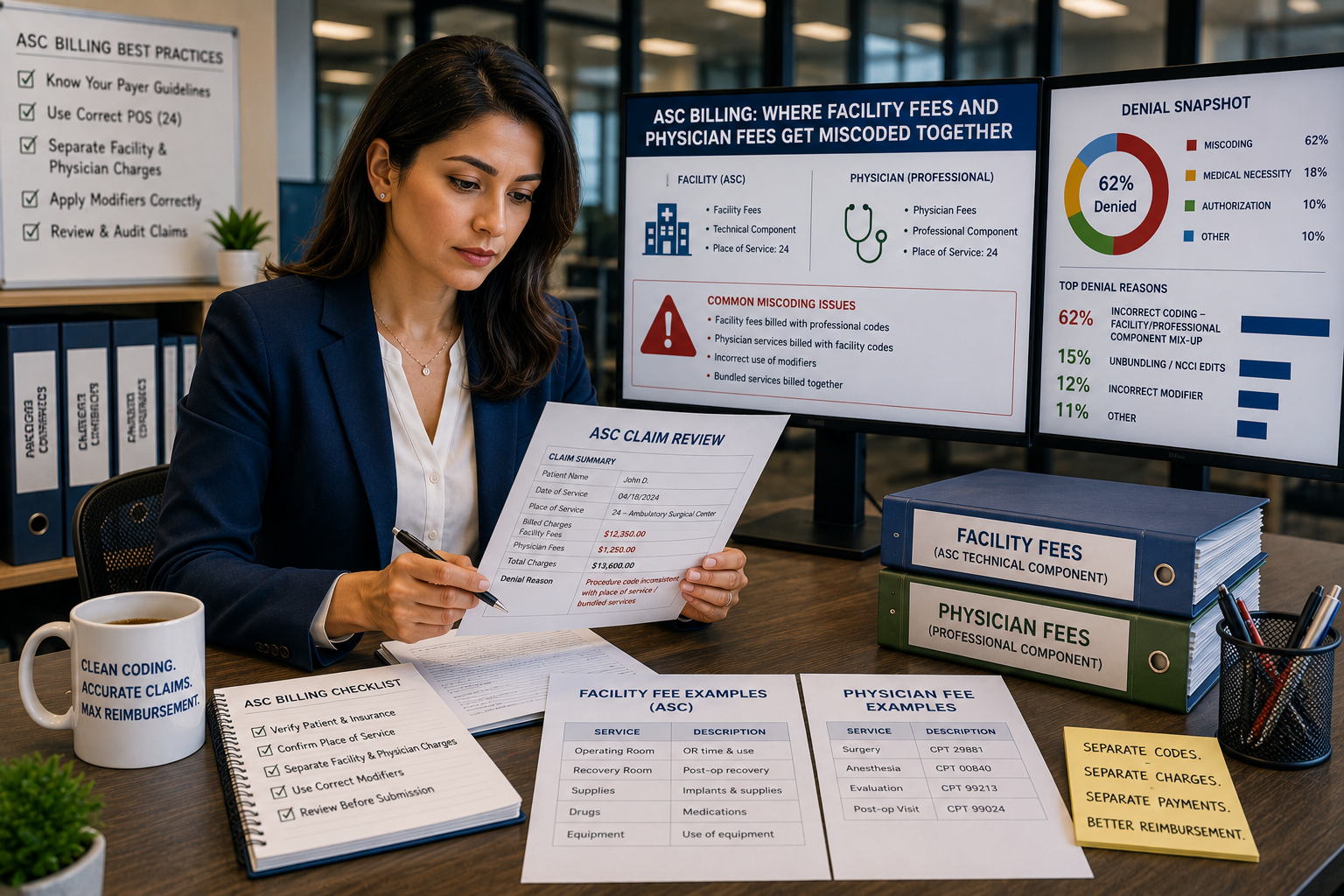
ASC Billing: Where Facility Fees and Physician Fees Get Miscoded Together
ASC facility and physician claims both go out on a CMS-1500 form with the same CPT code and place...
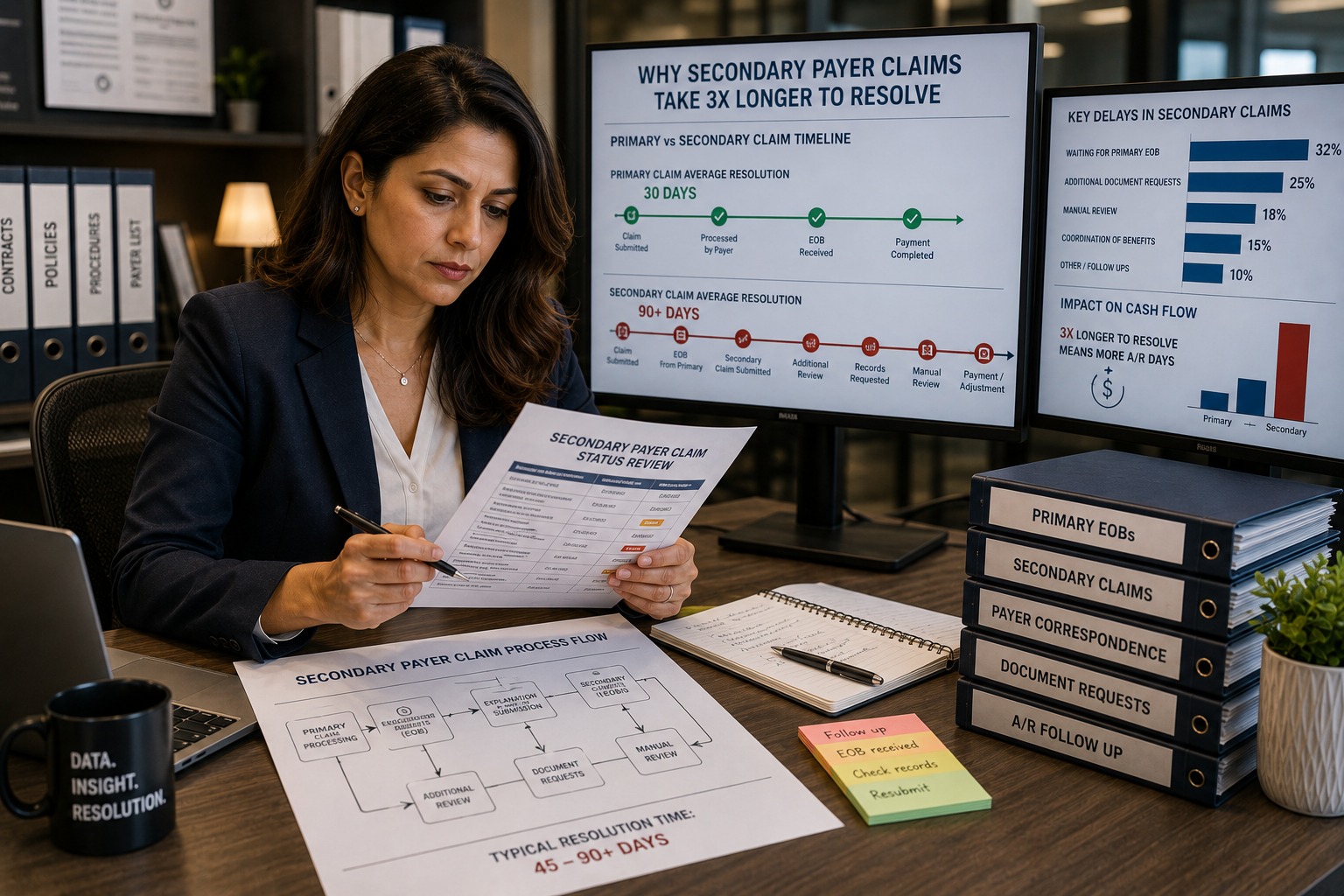
Coordination of benefits errors: why secondary payer claims take 3x longer to resolve
Secondary payer claims stall because coordination of benefits errors, wrong payer order, outdated COB records, and missing primary...