

Denial Management in 2026: The Top 10 Codes and the Appeal Playbook for Each
The Qualigenix Editorial Team consists of certified billing and coding experts with over 40 years of experience across 38+ medical specialties. Our content is rigorously researched against CMS, AMA, and payer-specific guidelines to ensure total compliance and accuracy. We apply the same elite standards to our resources as we do our client work, consistently delivering high claim accuracy and significant reductions in AR days.


Denials cluster around a small set of codes, and each one has a different correct response. Some need a corrected claim, some need an appeal, and some are valid write-offs. The costly mistake isn’t losing appeals. It’s never filing them: fewer than 1% of denied in-network Marketplace claims were appealed in 2024, while insurers overturned about a third of the appeals they did receive.
Denial work eats more staff hours than almost anything else in the revenue cycle, and most of those hours go to the same handful of codes. A practice that can’t name its top five denial codes by payer is guessing at where its money goes.
This guide covers the ten codes billing teams encounter most, what each one actually means, and the specific appeal move for each. Where a number appears, it comes from a named primary source. Where the industry repeats a statistic that no primary source supports, this guide says so.
One note on ranking before we start. No federal dataset publishes a ranked national list of denial codes by frequency. CMS collects denial reasons in broad categories, not CARC-level detail, and it doesn’t link those reasons to the services denied. The ten codes below are the ones that dominate day-to-day denial queues across payers and specialties, not a certified leaderboard.
Denial management is the process of finding out why a payer refused a claim, recovering the money through a corrected claim or an appeal, and fixing the upstream cause so the denial stops repeating. Every denial carries three layers: a group code showing who owes the money, a CARC showing why payment changed, and often a RARC giving the detail needed to act.
What the denial data actually shows in 2026
Reliable denial benchmarks are narrower than most vendor content admits. The best public dataset covers only plans sold on HealthCare.gov, and it excludes employer plans, Medicare, Medicaid, and state-run exchanges.
Within that scope, the picture is clear. KFF’s analysis of CMS Transparency in Coverage data found insurers denied 19% of in-network claims and 37% of out-of-network claims in 2024. Rates ranged from 3% to 36% depending on the insurer, and Texas alone spanned 12% to 36%. Your payer mix matters more than any national average.
| Metric | Figure | Source |
|---|---|---|
| In-network denial rate, HealthCare.gov plans, 2024 | 19% | KFF / CMS Transparency in Coverage |
| Out-of-network denial rate, same plans | 37% | KFF / CMS |
| Range across reporting insurers | 3% to 36% | KFF / CMS |
| Denials attributed to “other, unspecified” | 36% | KFF / CMS |
| Denials attributed to administrative reasons | 25% | KFF / CMS |
| Denials for excluded services | 13% | KFF / CMS |
| Denials for missing prior authorization or referral | 9% | KFF / CMS |
| Denials for medical necessity | 5% | KFF / CMS |
| Share of denied in-network claims appealed | Under 1% | KFF / CMS |
| Internal appeals upheld by insurer | 66% | KFF / CMS |
| Average denial rate, all NAIC-reporting plans, 2024 | 16% | NAIC Market Conduct Annual Statement |
| Medicare Advantage prior authorization denial rate, 2024 | ~8% | KFF analysis of federal data |
| Traditional Medicare prior authorization denial rate, 2024 | ~23% | KFF analysis of federal data |
| Medicaid managed care prior auth denial rate, 2019 | ~13% | HHS Office of Inspector General |
| MA prior auth denials that met Medicare coverage rules | 13% of sampled denials | HHS OIG, OEI-09-18-00260 (2022) |
| MA payment denials that met Medicare coverage and MAO billing rules | 18% of sampled denials | HHS OIG, OEI-09-18-00260 (2022) |
A note on the $262 billion figure: You’ll see a claim that US denials represent $262 billion a year with 86% avoidable. It traces to a Change Healthcare analysis that is widely repeated but not available as a verifiable primary publication. We don’t use it. Treat any vendor citing it without a working source link as repeating industry folklore.
Read the denial before you work it
Every line on an 835 remittance carries a group code, a CARC, and sometimes a RARC. The group code decides whether the balance is collectible at all. Skipping it is why teams appeal claims that were never appealable.
CO means contractual obligation. The provider absorbs it and can’t bill the patient. PR means patient responsibility, so it moves to patient billing rather than an appeal queue. OA covers other adjustments. PI covers reductions the payer applied without a contractual basis, which is often the most appealable category of all.
CARC definitions are maintained by X12 and are standardized across payers. How a payer applies them is not. Two plans can use the same code for different underlying problems, which is why the payer’s own provider manual beats any generic code list, including this one.
The 10 denial codes and the appeal move for each
Each entry below gives the meaning, the usual cause, and the specific response. Notice how many of these are not appeals at all. Sorting correctly at intake is where most of the recovery comes from.
1. CO-16 — Claim lacks information or has submission errors
The response is almost never an appeal. CO-16 is a pointer code: it tells you something is missing but not what. The paired RARC carries the actual instruction.
Usual cause: A missing modifier, absent NPI, incomplete patient demographics, or a required field left blank at charge entry.
Playbook: Pull the RARC first. Fix the identified field. Submit as a corrected claim, not an appeal, because the original claim was never adjudicated on its merits. Then check whether the same field fails repeatedly, since CO-16 volume is usually a charge-entry template problem rather than a biller problem.
2. CO-97 — Service is bundled into another paid service
Appeal this when the services were genuinely separate and distinct. The appeal lives or dies on modifier justification and documentation of separate encounters.
Usual cause: NCCI edit pairs, a missing modifier 25 on a same-day E/M with a procedure, or a missing modifier 59 on distinct procedural services.
Playbook: Confirm the edit pair actually applies and that a modifier is permitted for it. If the encounter documentation supports a significant, separately identifiable service, resubmit with the correct modifier and attach the note showing separate work. If the bundle is legitimate, write it off and stop billing the pair.
3. CO-197 — Precertification or authorization absent
Appeal on retro-authorization grounds where the payer’s policy allows it, or on emergency and urgent-care exception grounds. Missing prior authorization accounted for 9% of reported in-network denial reasons in 2024, per KFF analysis of CMS data.
Usual cause: Authorization never obtained, obtained for the wrong CPT, expired before the date of service, or obtained under a different rendering provider.
Playbook: Check whether an authorization exists under any variant before appealing, since a large share of these are clerical mismatches rather than true absences. If the service was emergent, appeal citing the prudent layperson standard. If the payer permits retroactive authorization, request it inside the stated window. This code is the strongest argument for front-end authorization tracking, because the cure is upstream.
4. CO-50 — Not deemed a medical necessity by the payer
This is a true clinical appeal and the highest-value category to fight. Only 5% of reported denial reasons were medical necessity in 2024, but these claims carry disproportionate dollar value.
Usual cause: Diagnosis code doesn’t support the procedure, the payer’s coverage policy sets criteria the note doesn’t document, or an LCD or NCD wasn’t met.
Playbook: Retrieve the payer’s specific medical policy or the applicable Medicare coverage determination and appeal against its stated criteria point by point. Attach only the documentation that proves each criterion. Add a physician letter of medical necessity where the clinical reasoning isn’t obvious from the chart. Generic appeals lose here; policy-anchored ones win.
5. CO-29 — Time limit for filing has expired
Appeal only with proof of timely original submission. Without a clearinghouse acknowledgment or payer acknowledgment showing the original date, this is unwinnable and unbillable to the patient.
Usual cause: Claim held in a work queue, denied once and never reworked, or a coordination-of-benefits delay that pushed secondary submission past the window.
Playbook: Produce the 277CA or clearinghouse acceptance report proving the claim reached the payer inside the window. For COB delays, appeal citing the primary payer’s remittance date as the start of the secondary filing clock. Where no proof exists, write it off and treat the volume as a workflow alarm, because CO-29 is the one denial that is pure preventable loss.
6. CO-18 — Duplicate claim or service
Appeal only when the services were genuinely distinct. Most CO-18 denials are correct, and the ones that aren’t involve legitimate repeat services on the same day.
Usual cause: A true resubmission, or two distinct same-day services that look identical to the payer’s duplicate logic.
Playbook: Verify whether the earlier claim was paid, denied, or is still pending, because chasing a duplicate on a pending claim wastes the effort. For genuinely repeated services, resubmit with the appropriate repeat-procedure modifier and documentation of the separate times or sites. Rising CO-18 volume usually means staff are resubmitting instead of checking claim status.
7. CO-45 — Charge exceeds fee schedule or contracted amount
Usually not a denial at all. CO-45 is the contractual write-off line on a paid claim. Appeal only when you have evidence the payer loaded the wrong rate.
Usual cause: Normal contractual adjustment, or a payer applying an outdated or incorrect fee schedule.
Playbook: Compare the allowed amount against your executed contract rate for that CPT and locality. If they match, post the adjustment. If they don’t, this becomes a payer contract dispute rather than a claim appeal, and it should be escalated to provider relations with a documented rate comparison across multiple claims. One underpaid claim is an error; a pattern is a contract loading problem worth real money.
8. CO-109 — Claim not covered by this payer or contractor
Rarely appealable. This is a routing problem, and the fix is submitting to the correct payer before the timely filing window closes there.
Usual cause: Patient enrolled in a Medicare Advantage plan while the claim went to traditional Medicare, wrong payer ID selected, or coverage terminated before the date of service.
Playbook: Re-verify eligibility for the actual date of service, not today. Identify the correct payer and submit there immediately, because the clock at the correct payer has been running the whole time. If the patient gave wrong coverage information at registration, the balance may be patient responsibility depending on your financial policy.
9. CO-96 — Non-covered charges
Check the RARC before deciding. CO-96 spans genuine plan exclusions, which aren’t appealable, and coverage determinations, which are. Excluded services accounted for 13% of reported in-network denial reasons in 2024.
Usual cause: The service is excluded from the plan’s benefits, or it is covered but the claim didn’t establish that it met coverage conditions.
Playbook: Read the accompanying RARC to separate exclusion from determination. For true exclusions, the balance shifts to the patient only if you have a valid advance notice on file, such as a signed ABN for Medicare. For coverage determinations, appeal against the plan’s benefit language. Front-desk benefit verification prevents most of this category.
10. PR-27 — Expenses incurred after coverage terminated
Not a payer appeal. The group code PR moves this to the patient, and the real work is confirming the termination date and finding whether other coverage was active.
Usual cause: Coverage lapsed, the patient changed employers, or the practice verified eligibility once at registration and never rechecked for a recurring series.
Playbook: Confirm the termination date directly with the payer, since retroactive terminations do get reversed. Search for replacement coverage effective on the date of service and rebill there if it exists. If not, move the balance to patient responsibility with clear documentation. For recurring visits, re-verify eligibility every month rather than once per episode.
The appeal deadlines that decide everything
For Original Medicare, a provider has 120 days from receipt of the initial determination to file a Level 1 redetermination. Receipt is presumed five calendar days after the notice date. Missing the deadline usually ends the claim regardless of merit.
Medicare’s fee-for-service process runs five levels, and each has its own clock. Commercial payers set their own windows by contract, and many are considerably shorter than Medicare’s. Calendar the deadline the day the denial posts, not the day someone gets to the work queue.
| Level | Who decides | Deadline to file | Decision timeframe |
|---|---|---|---|
| 1. Redetermination | Medicare Administrative Contractor | 120 days from receipt of initial determination | 60 days |
| 2. Reconsideration | Qualified Independent Contractor | 180 days from redetermination decision | 60 days |
| 3. ALJ hearing | Office of Medicare Hearings and Appeals | 60 days from reconsideration decision | Statutory target, backlogs vary |
| 4. Appeals Council review | Medicare Appeals Council | 60 days from ALJ decision | Statutory target, backlogs vary |
| 5. Judicial review | Federal district court | 60 days from Appeals Council decision | Court schedule |
Source: CMS Medicare Claims Processing Manual Chapter 29 and CMS appeals guidance. Levels 3 and 5 carry minimum amount-in-controversy thresholds that change annually; verify the current year’s figures with CMS before filing.
Why so few appeals get filed, and what that costs
Fewer than 1% of denied in-network Marketplace claims were appealed in 2024. Insurers upheld 66% of the appeals they received, which means roughly a third were overturned. The gap isn’t win rate. It’s filing rate.
Those KFF figures track consumer appeals rather than provider appeals, and the provider side isn’t reported under the same framework. Still, the shape of the problem is familiar to anyone running a billing office: appeals take time, the payoff per claim is uncertain, and the low-dollar denials get abandoned first.
That triage is rational per claim and expensive in aggregate. A denial that’s never worked is a 100% loss. A denial that’s worked and lost costs staff time only. The math favors filing far more often than most practices do, particularly when the appeal is templated by code rather than drafted from scratch each time.
There’s harder evidence for that on the Medicare Advantage side. HHS Office of Inspector General reviewed a stratified sample of denials issued by 15 of the largest Medicare Advantage organizations and found that 18% of denied payment requests actually met both Medicare coverage rules and the plan’s own billing rules. Most of those were caused by human error in manual claims review or by system processing errors, not by any genuine coverage dispute.
Read that figure carefully: nearly one in five denied payment requests in the OIG sample should have been paid on the original claim. That’s not a judgment call you have to win. It’s an error you have to point out. Any denial category where payer error is plausible deserves a second look before it becomes a write-off.
Fixing the source instead of the symptom
Recovery work is the visible half of denial management. Prevention is the half that changes the numbers.
Start by tagging every denial with code, payer, provider, CPT, and root cause. Within a quarter you’ll see that most of the volume traces to a small number of repeatable failures: a registration field nobody fills in, a specific payer’s authorization requirement that scheduling doesn’t know about, or a modifier rule one provider’s charges consistently miss.
Route each pattern to the department that creates it. CO-16 belongs to charge entry. CO-197 belongs to scheduling and pre-authorization. CO-29 belongs to whoever owns the work queue that let claims age out. CO-50 belongs to clinical documentation. Sending all of them to the billing team guarantees they keep recurring, because billing sits downstream of every one of these causes.
How Qualigenix handles denials
We work denials as a closed loop rather than a queue. Every denial gets coded to a root cause, appealed where the evidence supports it, and reported back to the function that generated it.
Our revenue cycle management team runs payer-specific appeal templates so a CO-50 for one carrier doesn’t get drafted with another carrier’s policy language. Our medical coding team audits the modifier and diagnosis patterns behind bundling and medical necessity denials. Our medical billing team owns the timely-filing calendar so CO-29 stops appearing at all.
We serve independent practices across more than 38 specialties from offices in Minneapolis and Austin.
Denial management checklist
- ☐ Every denial is coded to a root cause, not just a CARC
- ☐ Appeal deadlines are calendared the day the denial posts
- ☐ Denials are sorted into correct, appeal, or write off before any work begins
- ☐ Payer-specific appeal templates exist for your top five codes
- ☐ Appeals cite the payer’s own policy language, not general medical reasoning
- ☐ Timely filing proof is retrievable for every claim
- ☐ Eligibility is re-verified for recurring visit series, not once per episode
- ☐ Denial patterns are reported to scheduling, registration, coding, and clinical, not only billing
- ☐ Low-dollar denials have a defined threshold rule instead of being abandoned informally
- ☐ Denial rate is tracked by payer, since the national average hides a 3% to 36% spread
Frequently asked questions
What is denial management in medical billing?
Denial management is the process of finding out why a payer refused to pay a claim, correcting or appealing it, and fixing the upstream cause so the same denial stops recurring. It covers three jobs: root-cause analysis, recovery of the dollars at stake, and prevention.
What is the difference between a CARC and a RARC?
A CARC tells you why the payment amount changed. A RARC adds the specific detail you need to act. CARCs are categories; RARCs are instructions. A CO-16 on its own isn’t actionable, but its paired RARC tells you which field failed.
What does the group code on a denial mean?
The group code assigns financial responsibility. CO means the provider absorbs it. PR means it can be billed to the patient. OA covers other adjustments and PI covers payer-initiated reductions. Read it first, because it tells you whether the balance is collectible before you spend time appealing.
How long do I have to appeal a Medicare claim denial?
For Original Medicare, 120 days from receipt of the initial determination for a Level 1 redetermination, with receipt presumed five days after the notice date. Level 2 allows 180 days from the redetermination decision. Levels 3 through 5 each allow 60 days. Source: CMS.
What percentage of claims get denied?
Insurers on HealthCare.gov denied 19% of in-network and 37% of out-of-network claims in 2024, per KFF analysis of CMS data, with in-network rates ranging from 3% to 36% by insurer. Employer plans, Medicare, and Medicaid aren’t reported the same way, so no single national figure covers all payers.
Are appeals actually worth filing?
The data points to underuse rather than futility. Fewer than 1% of denied in-network Marketplace claims were appealed in 2024, and insurers upheld 66% of those filed, leaving about a third overturned. HHS OIG separately found 18% of denied Medicare Advantage payment requests met coverage and billing rules already. A denial nobody appeals is written off in full.
Which denial codes should never be appealed?
Codes reflecting a correct contractual adjustment. CO-45 is usually a valid write-off unless the payer loaded the wrong rate. Genuine duplicates under CO-18 aren’t appealable either. Save appeal capacity for denials caused by documentation gaps or payer error.
What is the most common reason claims are denied?
Among reasons HealthCare.gov plans reported to CMS for 2024, unspecified “other” led at 36%, then administrative reasons at 25%, excluded services at 13%, missing prior authorization at 9%, and medical necessity at 5%. Administrative causes are the largest identifiable group.
Related resources
- Revenue cycle management services
- Medical billing services
- Medical coding and audit services
- CMS: Medicare fee-for-service appeals
- KFF: Claims denials and appeals in ACA Marketplace plans, 2024
Find out what your denials are actually costing you
We’ll review your denial mix by code and payer and show you which categories are recoverable. No obligation.
What’s Next

ASC Billing: Where Facility Fees and Physician Fees Get Miscoded Together
ASC facility and physician claims both go out on a CMS-1500 form with the same CPT code and place...
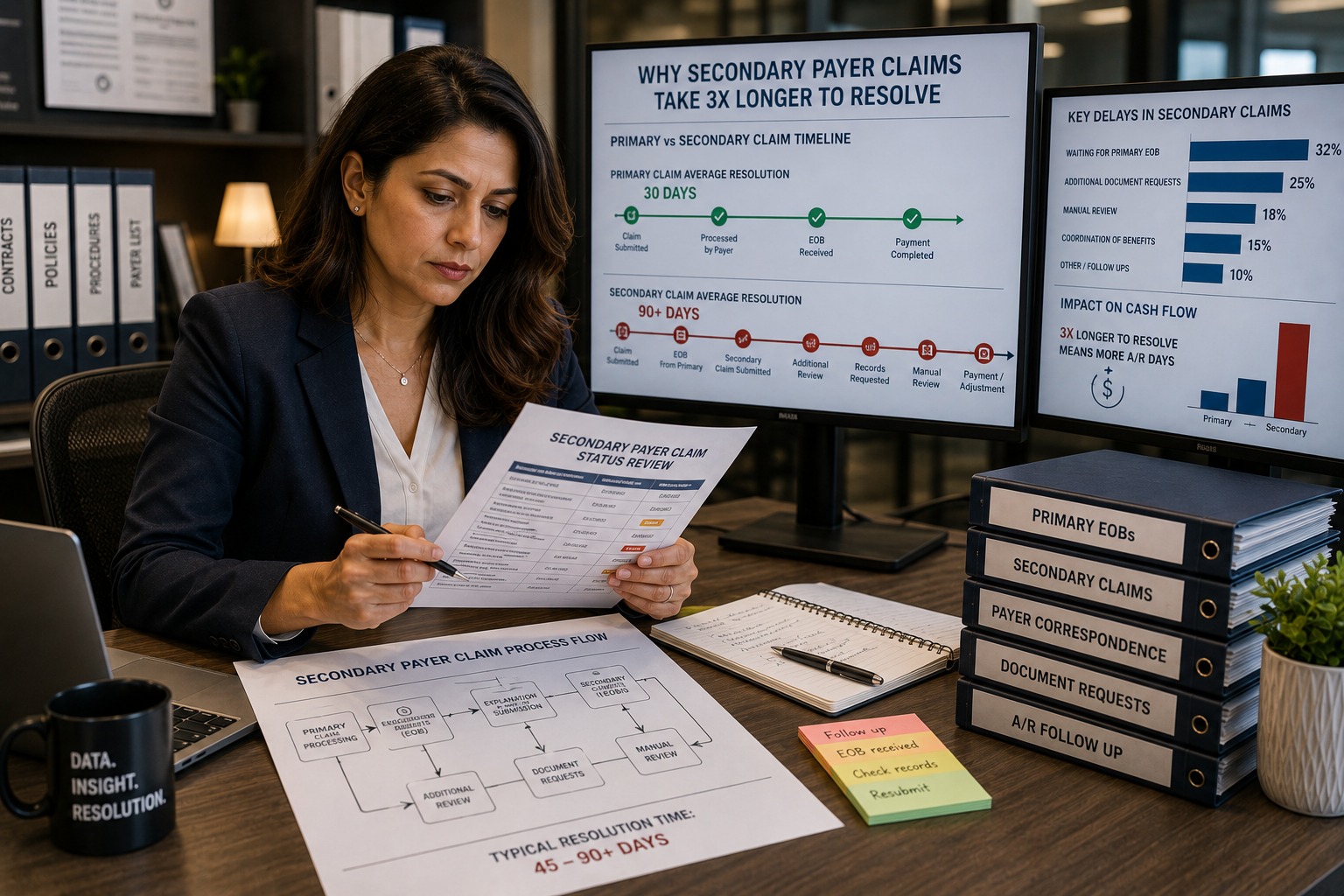
Coordination of benefits errors: why secondary payer claims take 3x longer to resolve
Secondary payer claims stall because coordination of benefits errors, wrong payer order, outdated COB records, and missing primary...
The Real Cost of Claim Denials: A 2026 Benchmark Guide for Independent Practices
The cost of claim denials isn’t the denied dollar amount. It’s the rework labor plus the revenue you never...