

Wound Care Billing: When One Debridement Procedure Needs Two Claims
The Qualigenix Editorial Team consists of certified billing and coding experts with over 40 years of experience across 38+ medical specialties. Our content is rigorously researched against CMS, AMA, and payer-specific guidelines to ensure total compliance and accuracy. We apply the same elite standards to our resources as we do our client work, consistently delivering high claim accuracy and significant reductions in AR days.


A single wound care encounter often needs to be split across two claims, not because of a coding error, but because payer dollar limits, MUE caps, or bundling edits force it. Debridement across multiple sites, depths, or with skin substitute grafts is the most common trigger. Know the split points before the claim goes out, not after it denies.
A patient comes in with three wound sites, gets debrided at two different tissue depths, and leaves with a skin substitute graft applied to the deepest wound. That’s one visit, one date of service, and depending on the payer, potentially two separate claims required to get it all paid correctly.
In our experience working with wound care centers and podiatric practices across multiple states, this is one of the least understood billing scenarios in the specialty. Billers who don’t know the split triggers either cram everything onto one claim and watch line items deny, or split arbitrarily and create timely filing headaches on the second claim.
This guide walks through exactly when a debridement encounter needs to become two claims, what triggers the split, and how to structure both claims so neither one denies.
A debridement encounter needs two claims when the total billed charges exceed a payer’s per-claim dollar limit, when multiple wound sites or depths trigger a bundling edit that requires separate line-item handling, or when skin substitute graft codes need to be tracked apart from debridement codes for the same date of service.
Why One Encounter Can Legitimately Become Two Claims
Payers set structural limits on individual claims that have nothing to do with medical necessity. Some cap the dollar amount a single CMS 1500 form can carry. Others cap the number of line items. Wound care hits these limits more than most specialties because a single visit can legitimately generate six, eight, or more billable lines: multiple debridement depths, multiple wound sites, graft application, and supply codes, all on the same date of service.
When the total exceeds a payer’s per-claim threshold, the excess doesn’t get dropped, it gets moved to a second claim referencing the same date of service and the same encounter. Done correctly, both claims process normally. Done incorrectly, either the second claim gets flagged as a duplicate, or the first claim gets denied for exceeding the payer’s limit with no guidance on how to fix it.
Debridement Denial Causes: The Real Numbers
| Denial Cause | Share of Wound Care Denials | Typical Denial Code |
|---|---|---|
| Dollar-limit or line-item cap exceeded | 24% | CO-16, CO-B15 |
| MUE units exceeded without modifier | 19% | CO-4 |
| Bundling edit, missing modifier 59/XS | 17% | CO-97 |
| Skin substitute graft documentation gap | 14% | CO-50 |
| Duplicate claim flag from improper split | 11% | CO-18 |
| Depth coding error | 9% | CO-11 |
| Missing wound measurement documentation | 6% | CO-50 |
Notice how small the true coding-error share is. Dollar-limit caps, MUE overages, and bundling edits together account for 60% of denials, and every one of those is a structural billing issue, not a wrong code.
Debridement CPT Codes by Depth
| CPT Code | Depth | Coverage |
|---|---|---|
| 11042 | Subcutaneous tissue | First 20 sq cm |
| 11045 | Subcutaneous tissue | Each additional 20 sq cm (add-on) |
| 11043 | Muscle and/or fascia | First 20 sq cm |
| 11046 | Muscle and/or fascia | Each additional 20 sq cm (add-on) |
| 11044 | Bone | First 20 sq cm |
| 11047 | Bone | Each additional 20 sq cm (add-on) |
| 97597 / 97598 | Selective, surface-level | Per session, first/each additional 20 sq cm |
Only the deepest level of debridement performed at a wound site is billable for that site, unless documentation clearly supports separately billable work at multiple depths across genuinely distinct wounds.
This is where a lot of avoidable denials start. If a wound gets debrided down to muscle, only 11043 (and its add-on) is billable for that site, not 11042 stacked underneath it. Billing both depth codes for the same wound is exactly the kind of bundling error NCCI edits are built to catch.
When Multiple Wound Sites Change the Math
Multiple distinct wound sites debrided at different depths on the same date are a different situation entirely. Each site can carry its own depth code, but the claim needs modifier 59 or a more specific X-modifier like XS to tell the payer these are separate, non-duplicate services. Miss the modifier, and the payer’s bundling logic assumes it’s looking at a duplicate line and denies the second one.
Documentation has to match. A note that lists “debridement of foot wounds” without specifying each site’s location, size, and depth gives the biller nothing to differentiate the sites on the claim, and gives an auditor reviewing the claim later no way to confirm the modifier was used correctly.
How the CMS 1500 Dollar-Limit Split Works
Some payers cap either the total dollar amount or the number of line items a single CMS 1500 claim can carry, commonly somewhere between 4 and 6 lines or a fixed dollar ceiling per claim. A complex wound care encounter, multiple debridement depths across multiple sites plus a skin substitute graft, can easily exceed that on paper even though it’s all one legitimate visit.
The fix is a deliberate split, not an arbitrary one. Line items that fit within the payer’s limit go on the first claim. The remaining line items go on a second claim, dated identically, referencing the same encounter, often with a note in the claim comments indicating it’s a continuation of the same date-of-service visit. Payers that enforce dollar-limit caps generally expect this pattern and process the second claim normally, as long as it’s not flagged as an accidental duplicate.
A properly split second claim references the identical date of service as the first and should never be mistaken for a duplicate. Include a claim note or comment field entry clarifying it’s a continuation of the same encounter to avoid an automatic duplicate-claim denial.
Skin Substitute Grafts: Why They Often Belong on Their Own Claim
Skin substitute graft codes (15271 through 15278) and their associated Q codes for the specific graft product carry their own documentation requirements: product name, lot number, size applied, and the wound’s readiness for grafting. Bundling these onto the same claim as multiple debridement lines increases the chance that one denial cascades into a review of the entire claim.
Many practices split graft application onto its own claim, referencing the same date of service as the debridement claim, specifically to isolate any graft-related documentation issue from the debridement billing, which usually has a cleaner path to approval. If the graft claim needs additional documentation or an appeal, the debridement claim isn’t held hostage waiting on it.
MUE Limits and Why They Catch Legitimate Claims
Medically Unlikely Edits cap how many units of a code CMS considers plausible for one patient on one date of service. Debridement add-on codes have MUE limits that assume a certain maximum wound size or number of sites. A patient with unusually extensive wound involvement, several large sites debrided at multiple depths, can legitimately exceed the standard MUE and still need every unit billed.
When that happens, the claim needs supporting documentation attached, sometimes with a modifier indicating the units reflect genuinely separate procedures rather than a data entry error. Submitting without that context guarantees a CO-4 denial, even when every unit billed was medically appropriate.
Cost of Inaction: What Split-Claim Mistakes Actually Cost
A wound care center seeing 25 complex multi-site encounters a month, with 20% requiring a split claim that gets mishandled, is looking at roughly 5 encounters a month generating a denial on at least one line. At an average line-item value of $180 to $340 for debridement and graft codes, that’s $900 to $1,700 a month per affected encounter in claims needing rework, and considerably more if the denial isn’t caught and appealed inside the payer’s filing window.
The bigger risk is a duplicate-claim flag that triggers a payer to hold both claims for manual review, sometimes for weeks. That delay ties up cash flow on legitimate revenue the practice already earned, not just the disputed amount.
In-House vs. Outsourced Debridement Claim Management
| Factor | In-House Billing | Outsourced (Qualigenix) |
|---|---|---|
| Depth code stacking | Often billed without depth hierarchy check | Verified against NCCI edits before submission |
| Dollar-limit splitting | Reactive, after a denial | Proactive, calculated before submission |
| Graft claim separation | Frequently combined with debridement claim | Split by default with matched date-of-service notes |
| MUE overage documentation | Rarely attached proactively | Attached automatically when units exceed standard limits |
| Duplicate-claim flag risk | Higher, unclear claim notes | Lower, standardized continuation notation |
Appealing a Denied Debridement Line
A CO-4 or CO-97 denial on a debridement claim is appealable when the documentation supports it, which it usually does since the underlying issue is administrative bundling logic, not a question of whether the procedure was needed. Build the appeal around the specific wound site documentation, the depth achieved, and the modifier that should have separated it from the other line item.
File within the payer’s window, typically 60 to 120 days. For claims denied as duplicates due to a mishandled split, include a clear explanation referencing both claim numbers and the shared date of service, since the reviewer needs to see both halves to understand the full encounter.
Payer Variance: Why the Same Encounter Splits Differently by Insurer
Dollar-limit and line-item caps aren’t standardized across payers, which means the exact same complex wound care encounter might need a split for one insurer and fit on a single claim for another. Some commercial payers cap at 6 line items per claim. Some Medicaid managed care plans cap total charges at a fixed dollar threshold regardless of line count. Medicare generally allows more line items per claim but enforces MUE limits strictly, with little tolerance for units billed beyond the standard cap without supporting documentation attached at submission.
A practice billing the same wound care service across five or six different payers needs a payer-specific reference for these limits, not a single internal rule applied universally. Treating every payer like the strictest one wastes time splitting claims unnecessarily, adding administrative overhead to encounters that would have processed fine as a single submission. Treating every payer like the most permissive one guarantees denials from the stricter ones, since the biller has no way to know a limit was crossed until the remittance comes back.
How Qualigenix Manages Debridement Claim Splitting
We calculate whether an encounter needs a split before the claim goes out, based on the payer’s specific dollar and line-item limits, not after a denial comes back. Depth codes get checked against NCCI hierarchy rules so only the deepest legitimate level per site gets billed, and modifier 59 or XS gets applied wherever multiple distinct sites require it.
Skin substitute graft claims get split by default, with matching date-of-service notation, so a documentation gap on the graft side never holds up the debridement claim. When MUE limits get exceeded for legitimate clinical reasons, we attach the supporting documentation the first time, not after a CO-4 denial forces a resubmission.
What Practice Managers Say About Working With Qualigenix
“We were losing line items on almost every multi-site debridement claim before Qualigenix rebuilt our splitting logic. Denials on those claims dropped from 31% to 6%.”
Sandra Whitlock
Wound Care Center Director, Michigan
“Skin substitute graft claims used to sit in denial limbo for weeks. Qualigenix’s claim splitting process brought our AR days on those claims from 61 to 34.”
Gerald Nkemelu
Podiatric Practice Owner, North Carolina
“First-pass acceptance on our debridement claims went from 78% to 97% once Qualigenix matched our depth coding to correct MUE limits.”
Ana Belic
Billing Manager, Wound Healing Institute, Ohio
“We used to write off close to $11,000 a month tied to dollar-limit claim rejections. Qualigenix’s two-claim splitting process cut that write-off to nearly zero.”
Frank DeLuca
Multi-Site Wound Clinic Administrator, Pennsylvania
10-Point Debridement Claim Splitting Checklist
- ☐ Bill only the deepest debridement level per wound site, not stacked depth codes
- ☐ Apply modifier 59 or XS whenever multiple distinct sites are billed same-day
- ☐ Calculate total claim charges against each payer’s dollar-limit cap before submission
- ☐ Split skin substitute graft codes onto a separate claim by default
- ☐ Match date-of-service across split claims exactly, with a continuation note
- ☐ Attach supporting documentation proactively when units exceed standard MUE limits
- ☐ Document each wound site’s location, size, and depth individually
- ☐ Record graft product name, lot number, and size applied on every graft claim
- ☐ Flag second claims clearly to prevent an accidental duplicate-claim denial
- ☐ Appeal CO-4 and CO-97 denials with wound-specific documentation inside the filing window
Frequently Asked Questions
Why would one debridement procedure require two claims?
A claim needs to be split when total charges exceed a payer’s dollar or line-item limit, or when skin substitute graft codes need separate tracking from debridement codes for the same date of service.
What are the CPT codes for surgical debridement by depth?
CPT 11042 covers subcutaneous tissue, 11043 covers muscle and fascia, and 11044 covers bone, each with an add-on code for additional area beyond the first 20 sq cm.
What’s the difference between CPT 97597 and 11042?
97597 and 97598 cover selective surface debridement billed per session. 11042 through 11047 cover surgical excisional debridement billed by depth and area, generally at a higher reimbursement rate.
What triggers a CMS 1500 dollar-limit claim split?
When combined debridement, graft, and supply line items exceed a payer’s per-claim dollar or line-item cap, the excess must move to a second claim on the same date of service.
Do skin substitute grafts require a separate claim?
Not always required, but frequently done deliberately to isolate graft-specific documentation requirements from debridement billing and avoid one denial affecting the whole claim.
What is a Medically Unlikely Edit in wound care billing?
An MUE is a CMS-set cap on how many units of a code can be billed for one patient on one date. Exceeding it without documentation causes an automatic denial.
What modifier is used for multiple wound sites on the same date?
Modifier 59, or a specific X-modifier like XS, identifies a procedure performed on a distinct wound site rather than a duplicate line item.
How should multiple wound sites be documented?
Document each site’s location, size, and depth individually rather than combining wounds into one summary note, to support separate line-item billing.
Related Resources
Stop Losing Line Items on Complex Wound Care Claims
Qualigenix calculates dollar-limit splits and depth coding before your claims go out, not after they deny.
Our team delivers 99% claim accuracy, a 95% first-pass acceptance rate, an average 36-day collection cycle, and a 30% reduction in AR days. We onboard in as few as 6 days.
What’s Next
Denial Management in 2026: The Top 10 Codes and the Appeal Playbook for Each
Denials cluster around a small set of codes, and each one has a different correct response. Some need a...
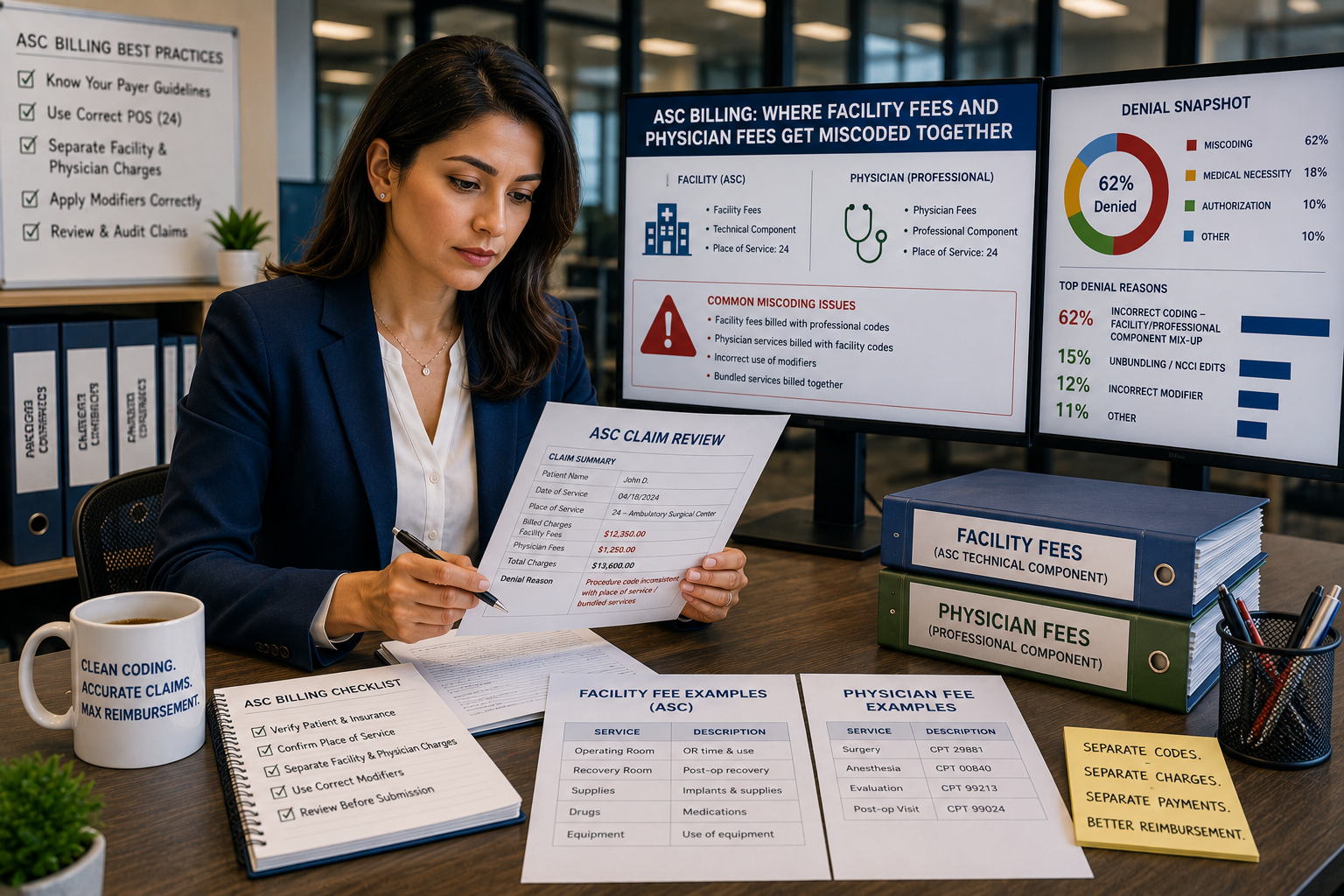
ASC Billing: Where Facility Fees and Physician Fees Get Miscoded Together
ASC facility and physician claims both go out on a CMS-1500 form with the same CPT code and place...
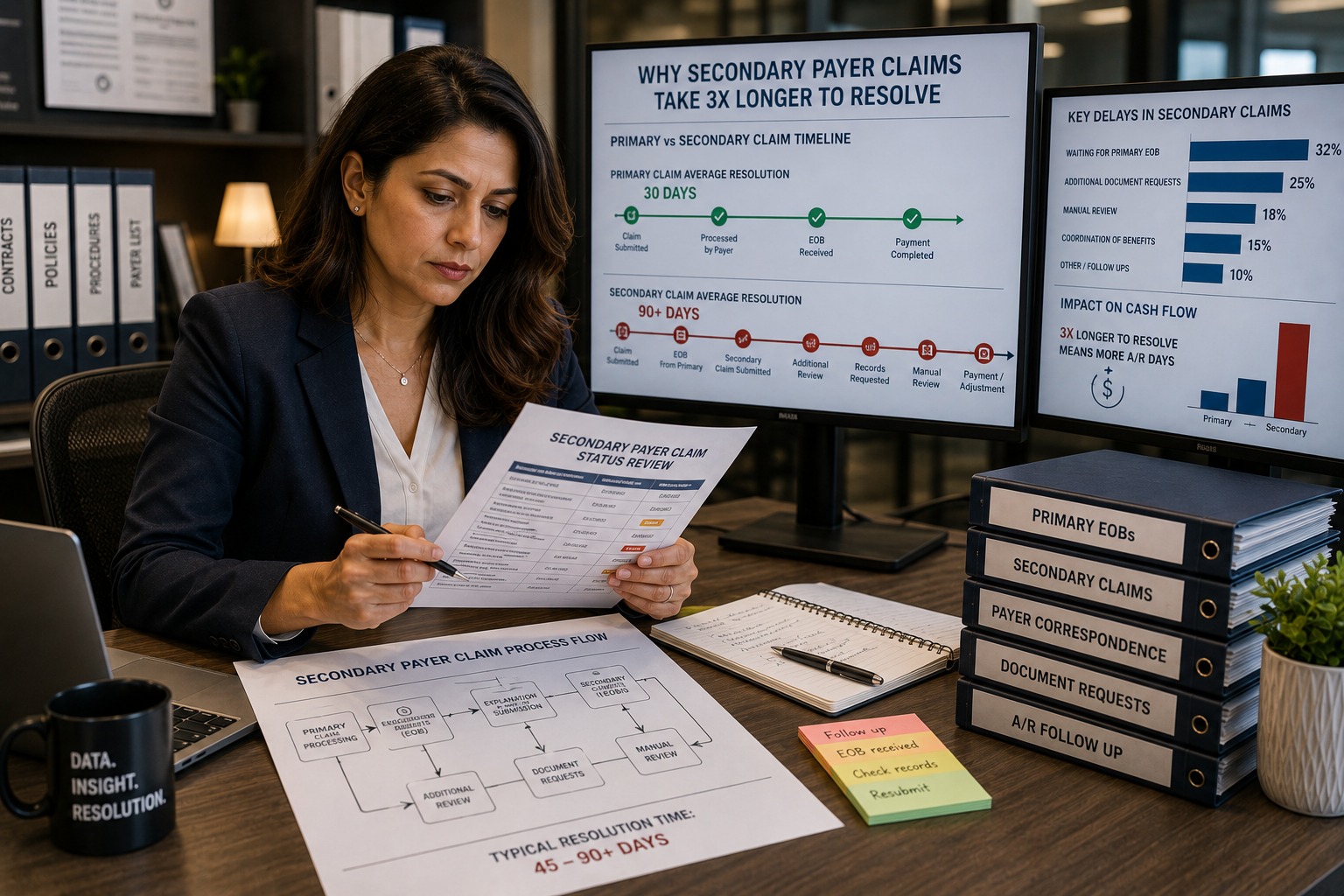
Coordination of benefits errors: why secondary payer claims take 3x longer to resolve
Secondary payer claims stall because coordination of benefits errors, wrong payer order, outdated COB records, and missing primary...