
Effective Strategies for Charge Entry to Maximize Revenue
The Qualigenix Editorial Team comprises certified medical billing professionals, CPC-credentialed coders, prior authorization specialists, and revenue cycle consultants with more than 40 years of combined hands-on experience serving solo physicians, group practices, hospitals, and ASCs across 38+ specialties in the United States. Every guide, article, and resource published on the Qualigenix blog is researched against current CMS guidelines, Federal Register notices, AMA policy updates, and payer-specific billing rules — and reviewed for compliance accuracy before publication. Our content reflects the same standards we apply to our client work: 99% claim accuracy, 95% first-pass acceptance, and a 30% average reduction in AR days.


Most practices focus on coding or collections, but charge entry in medical billing is where revenue strength is truly built. Miss a charge, apply the wrong modifier, or post late, and you invite denials, revenue leakage, and compliance risk. U.S. healthcare loses billions each year to charge capture errors and delays. The money that could have been collected with accurate posting. And when you have a team that validates clinical documentation, you can ensure modifier usage accuracy and shorten charge lag time. Suddenly, first-pass claims rise, audits are easier, and your bottom line gets healthier. This guide breaks down proven medical charge posting workflows and accuracy tactics that boost cash flow and strengthen compliance from the ground up.
What is the Role of Charge Entry in the Revenue Cycle?
Charge entry in medical billing is where you turn documented services, procedures, and supplies into billing codes, modifiers, and charges. At this point, you also confirm the date of service, number of units, place of service, and provider details before submission. Accurate charge entry ensures that every service you deliver gets billed and paid. This improves medical billing accuracy and keeps your revenue cycle compliant.
Connection to Downstream Processes
Any mistake you make during charge entry has consequences later. A wrong code or missing modifier can cause claim rejections, delayed payments, or higher denial rates. Poor charge capture accuracy can disrupt the claim submission process and extend your accounts receivable days. By keeping this step clean, you reduce duplicate billing errors, improve compliance, and shorten the time it takes to collect payments.
Metrics Affected by Charge Entry
Your charge entry process influences key revenue metrics. Charge lag time is the delay between delivering a service and posting the charge. It determines how quickly you receive payment. Clean claim rate depends on how accurately you capture charges and use modifiers. Missed charges cause revenue leakage, and a high denial rate often traces back to charge entry errors. So, track these metrics to identify problems early and improve financial outcomes.
Common Errors & Revenue Leakages in Charge Entry
Even small mistakes during charge entry in medical billing can drain your revenue and create compliance risks. Missing services, incorrect modifiers, mismatched documentation, and unreconciled charges all contribute to denials and payment delays. Here are the common errors and revenue leakages you should know to tighten your process and protect your income:
Missing or Under-captured Services
You lose revenue every time a service you perform is not entered into the system. This usually happens when documentation is incomplete or when small procedures, supplies, or ancillary services are overlooked. Careful review of clinical notes helps you capture every billable service.
Incorrect Modifier or Duplicate Charges
Wrong modifiers confuse payers and lead to denials or reduced payments. Duplicate charges, often caused by manual entry, can trigger payer rejections or audits. Reviewing claims before submission helps you avoid these errors and secure proper reimbursement.
Data Entry Mistakes (Units, Dates, Place of Service)
Simple errors, such as the wrong number of units, incorrect service dates, or inaccurate locations, can result in claim denials or lower payments. Using validation tools and double-checking entries helps you catch these mistakes before they reach the payer.
Non-aligned Documentation & Coding
Your charges must match what is documented in the patient’s record. Any mismatch causes clinical documentation integrity issues, increases payer scrutiny, and puts compliance at risk. Cross-checking charges with documentation keeps your billing accurate and audit-ready.
Failure to Reconcile Charges with Clinical Records
If you do not reconcile charges with clinical records, services can go unbilled. This gap leads to missed revenue and weakens revenue leakage prevention efforts. Regular reconciliation ensures that every service you provide is captured, billed, and paid.
Best Practices & Strategies for Accurate, Efficient Charge Entry

Your charge entry in the medical billing process is the backbone of your revenue cycle. If this step isn’t airtight, even perfect coding and aggressive collections can’t save you from lost revenue. A strong charge entry workflow helps you capture every dollar you’ve earned, shorten charge lag time, reduce denials, and keep compliance risks low. Here’s how you can tighten it at every level:
Standardize Charge Entry Workflows
Start by building a clear, repeatable process. Each charge should move through the same steps:
The provider documents the service → a reviewer checks for completeness → the charge is entered → a final audit confirms accuracy.
Standardizing this flow keeps everyone on the same page and reduces mistakes that lead to revenue leakage or denials.
Real-Time Entry vs Batch Entry
If you want faster cash flow, real-time entry is your friend. Posting charges soon after services are delivered cuts down on delays and keeps claims moving. Batch entry can work for high-volume practices, but only if you have tight checks to prevent missed services or posting errors. The key is matching your method to your workflow without letting charge capture accuracy slip.
Use Audit & Validation Rules
Technology can be a second set of eyes. Set up automated checks that flag missing modifiers, mismatched codes, duplicate charges, or outliers before a claim ever leaves your system. These built-in safeguards help you avoid rejections, improve medical billing accuracy, and keep you compliant without adding manual work.
Dedicated Charge Entry Teams
If possible, assign charge entry to a focused team instead of splitting it among busy billers. Specialists who handle this step every day spot problems faster, apply payer rules correctly, and build consistency into your process. That attention to detail directly improves your clean claim rate and reduces costly errors.
Ongoing Training & Policy Updates
Rules change. Code update. Payer policies evolve. Your charge entry team has to keep pace. Regular training sessions and quick policy refreshers help your staff stay sharp and avoid errors that come from outdated knowledge. Even a short quarterly update can make a noticeable difference in accuracy.
Reconciliation & Daily Charge Audits
Don’t wait until month-end to catch errors. Compare entered charges with your clinical logs every day. Daily reconciliation closes gaps quickly and ensures every service you provide gets billed. Over time, this habit dramatically reduces revenue leakage and builds a more reliable revenue cycle.
Leverage Technology & Automation
Smart charge entry software can suggest the right codes, flag inconsistencies, and integrate directly with your EHR. Automation reduces manual data entry, shortens charge lag time, and prevents errors before they snowball into denials. It doesn’t replace your team. It makes them faster and more precise.
Monitor Key Metrics & Feedback Loops
You can’t fix what you don’t measure. Keep an eye on charge lag time, missed charge rate, and rework volume. Use that data to pinpoint weak spots and make targeted improvements. Setting up feedback loops between billing and clinical staff will prevent repeat mistakes and keep your process evolving.
Example Workflow: Medical Charge Posting Workflow
A strong medical charge posting workflow is all about accuracy, speed, and accountability at every step. Here’s how an effective process should look from start to finish:
Step 1: Documentation & Clinical Capture
Everything starts with accurate clinical documentation. If services, procedures, or supplies aren’t properly recorded, you can’t bill for them. Make sure providers capture all billable details in the patient’s record.
Step 2: Review & Validation
Before posting, review the documentation for completeness and accuracy. This is your chance to confirm coding, check modifiers, and ensure everything matches payer requirements.
Step 3: Charge Entry into Billing System
Enter the charges into your billing software, verifying key details like units, service dates, and provider information. Precision here prevents downstream errors that could lead to denials.
Step 4: Automated Validations & Rules Checks
Run automated checks to catch missing modifiers, mismatched codes, or duplicate charges. These validations reduce duplicate billing errors and help ensure compliance before submission.
Step 5: Daily Charge Auditing & Reconciliation
Compare charges against clinical logs to confirm nothing was missed. Daily reconciliation closes revenue gaps and strengthens revenue leakage prevention efforts.
Step 6: Submission of Claims & Charge Aging Monitoring
Once charges pass all checks, submit the claims and monitor their progress. Keep a close watch on charge aging reports to catch delays early and ensure you’re collecting revenue as quickly as possible.
How Qualigenix Implements Effective Charge Entry Practices

When you want to strengthen charge entry without overloading your team, Qualigenix steps in as an extension of your RCM operations. We combine deep industry expertise with advanced automation to build a process that is fast, accurate, and compliant.
Why Qualigenix Is Ideal
Our team brings decades of revenue cycle experience and pairs it with technology that eliminates errors before they cost you money. You get human expertise supported by intelligent automation.
What You Receive
We design standardized workflows tailored to your practice, set up powerful validation rule engines, train your staff, and build reconciliation protocols. You also gain real-time performance dashboards that track metrics like charge lag time and missed charge rates.
How We Drive Impact
Our approach reduces posting delays, cuts denial rates, and captures revenue you’re currently losing. Practices see measurable ROI through faster payments, cleaner claims, and stronger financial performance.
Unlock Hidden Revenue Through Smarter Charge Entry!
When you build structured workflows, apply validation checks, train teams consistently, and reconcile charges daily, you capture every service you provide. Automation and smart technology further reduce errors and shorten payment cycles. Qualigenix helps you put all these pieces together into a system that works without gaps. With the right partner, you recover missed revenue, cut denials, and improve cash flow. Connect with Qualigenix today to turn charge entry in medical billing into a powerful driver of growth and financial strength for your practice.
FAQs
1. What is charge lag time?
Charge lag time is the gap between when a service is delivered and when its charge is entered into the billing system. Reducing this delay improves cash flow, shortens payment cycles, and increases revenue predictability.
2. How much revenue is lost due to charge errors?
Practices can lose 1 percent to 2 percent or more of annual revenue from missed or incorrect charges. These errors often go unnoticed but accumulate over time. Strong workflows and regular audits help recover that lost revenue.
3. Should charge entry be done in real time or as a daily batch?
Real time charge entry supports faster posting and smoother revenue flow. Daily batch entry can work for high volume environments if strict controls prevent delays, missed charges, and posting errors that reduce cash flow.
4. How often should charge entry audits occur?
High volume organizations should audit charge entry daily or near daily. Smaller practices can audit weekly. Frequent audits catch errors early, prevent revenue leakage, and support compliance.
5. What automation features matter most for charge entry?
Prioritize tools that suggest accurate codes, detect anomalies, and integrate smoothly with the EHR. Validation rules that flag missing modifiers or mismatched data improve accuracy, reduce denials, and make charge entry more reliable.
What’s Next
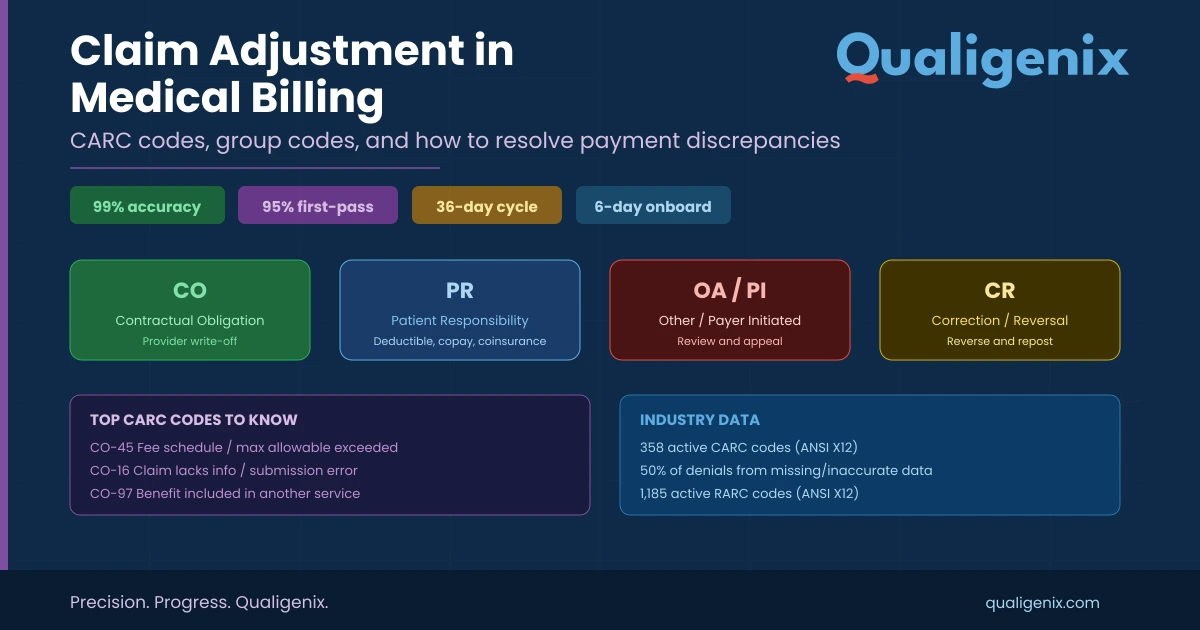
Claim Adjustment in Medical Billing: CARC Codes, Group Codes, and How to Resolve Payment Discrepancies
A claim adjustment occurs when a payer changes the reimbursement amount from what was originally billed. Every adjustment is...
Medical Necessity Documentation Mistakes to Avoid
A claim can look perfect in your billing system, then fall apart the moment a payer asks for records....
Denial Management in Medical Billing: 7 Common Causes
A patient visits your clinic, receives care, and leaves reassured. The service is documented, the claim is submitted, and...