

Radiology Billing: Getting the Professional/Technical Split Right Across Multi-Site Groups
The Qualigenix Editorial Team consists of certified billing and coding experts with over 40 years of experience across 38+ medical specialties. Our content is rigorously researched against CMS, AMA, and payer-specific guidelines to ensure total compliance and accuracy. We apply the same elite standards to our resources as we do our client work, consistently delivering high claim accuracy and significant reductions in AR days.


Radiology reimbursement splits into a technical component, the imaging itself, and a professional component, the radiologist’s read. Multi-site groups deny claims constantly not because the interpretation was wrong, but because the modifier and place of service don’t match which site actually did which part of the work.
A patient gets an MRI at one imaging center. A radiologist at a completely different location, sometimes a different state, reads it and writes the report. Two entities did two distinct parts of the same service, and the claim needs to reflect that split correctly or it denies, no matter how accurate the read was.
In our experience working with multi-site radiology groups and teleradiology operations, this is one of the most consistent sources of denials in the specialty, and one of the least understood. It’s not a coding accuracy problem. It’s a mapping problem: matching the right modifier and place of service to the entity that actually performed each part of the service.
This guide breaks down exactly how the professional and technical split works, where multi-site groups get it wrong, and how to fix the mapping before claims go out.
The professional/technical split works correctly when modifier TC is billed by the site that performed the imaging, modifier 26 is billed by the radiologist who interpreted it, and the place of service reflects where the imaging actually happened, not where the radiologist is located.
Professional vs. Technical Component: The Basic Split
| Component | Modifier | Who Bills It | Covers |
|---|---|---|---|
| Technical | TC | Imaging facility/equipment owner | Equipment, staff, facility overhead |
| Professional | 26 | Interpreting radiologist | Image interpretation, report generation |
| Global | None | Single entity owning both | Full service, imaging and interpretation combined |
The rule is simple in theory: bill global when one entity does both, split when two different entities each did one part. In a single-site independent practice, this rarely causes problems. In a multi-site group where imaging happens at Location A and reading happens at Location B, or is outsourced to a teleradiology group entirely, getting this wrong is easy and common.
Why Multi-Site Structure Creates More Denial Risk
Multi-site groups deny more split-billing claims because the billing system defaults often assume a single-site model, where the same entity performed both components, unless someone actively maps each encounter to its actual site structure.
A billing team pulling claims from a centralized system, without site-specific logic, tends to default to global billing because that’s the simplest path. If Location A did the imaging and a radiologist group at Location B did the read, but the claim went out global under Location A’s NPI, the payer sees a claim for professional work Location A didn’t actually perform, and it denies or gets flagged for review.
The reverse problem happens just as often: a group correctly splits the claim, but bills the wrong place of service code, listing the radiologist’s home office instead of the imaging facility where the scan actually took place. Payers use place of service to validate the technical component specifically, so a mismatch here denies the TC claim even when the split itself was structured correctly.
Radiology Split-Billing Denial Causes
| Denial Cause | Share of Split-Billing Denials | Typical Denial Code |
|---|---|---|
| Global billed when split was required | 29% | CO-B15 |
| Place of service mismatch | 23% | CO-58 |
| Radiologist not credentialed at facility state | 19% | CO-8 |
| Modifier 26/TC missing or reversed | 17% | CO-4 |
| Duplicate billing of global and split components | 8% | CO-18 |
| Teleradiology state licensure gap | 4% | CO-B7 |
More than half of these denials trace to the same root cause: the billing system treated a multi-entity encounter as a single-entity one.
Teleradiology Adds State Licensure to the Equation
When a radiologist reads images from a different state than where the patient was scanned, licensure and payer credentialing both need to match the patient’s state, not the radiologist’s home base. A radiologist licensed and credentialed in California reading a scan performed in Texas needs Texas licensure and Texas payer enrollment before that claim will pay, regardless of how the imaging facility is billed.
This gets more complicated with multi-state groups running a centralized teleradiology reading pool. Each radiologist in that pool needs an active license and payer credentialing status specific to every state where imaging sites send them scans, tracked individually, not assumed from a single home-state credential.
Teleradiology claims deny for licensure reasons when the reading radiologist isn’t credentialed and licensed in the state where the patient physically received the imaging, even if the read itself was clinically accurate.
Mapping Site Roles Correctly: A Practical Framework
Every imaging encounter in a multi-site group needs three data points confirmed before billing: which site performed the technical capture, which entity or radiologist performed the interpretation, and whether both belong to the same billing entity or need a split. Building this as a lookup table, tied to each imaging location and its typical reading assignment, prevents billers from defaulting to global out of convenience.
For groups with consistent site-to-reader pairings, this mapping can largely run on autopilot. For groups using rotating teleradiology pools or overflow reading arrangements, the mapping needs to happen per encounter, since the reading radiologist can change scan to scan.
Modality Differences That Complicate the Split
Not every imaging modality carries the same split-billing risk. Plain film X-ray, performed and often read at the same site by an on-staff radiologist, rarely needs a split at all. MRI and CT are where the split most often applies, since these studies are more likely to be sent to a specialized reading group or a subspecialist radiologist not physically present at the imaging site.
Nuclear medicine and PET studies add another layer, since these often involve both a technologist administering a radiopharmaceutical at the imaging site and a separate physician supervising and interpreting, sometimes with a distinct supervision component billed apart from the interpretation itself. Groups running multiple modalities need split-billing logic that accounts for modality-specific supervision and interpretation structures, not a single blanket rule applied to every study type.
Reading Pools and the Retroactive Assignment Problem
Groups using a centralized or overflow teleradiology reading pool face a specific timing issue: the radiologist assigned to a given study isn’t always known until after the imaging is complete and the study gets routed for reading. If the billing system generates a claim before that assignment is finalized and confirmed against the radiologist’s credentialing status, it risks billing the wrong provider entirely, or missing a licensure gap that only becomes visible once the actual reader is known.
The fix is a hold-and-confirm step: claims for studies read through a rotating pool shouldn’t go out until the system confirms which radiologist actually performed the read and verifies that radiologist’s current credentialing status for the state where the study originated. This adds a short delay to claim submission but prevents a much longer delay caused by a denial and resubmission cycle.
Cost of Inaction: What Split-Billing Errors Actually Cost
A multi-site radiology group reading 800 studies a month, with even 10% hitting a split-billing error, is looking at 80 claims a month needing rework. At an average combined professional and technical reimbursement of $220 to $450 per study depending on modality, that’s $17,600 to $36,000 a month in claims delayed or denied, much of it recoverable only through a manual appeal process that ties up billing staff for weeks.
Licensure-related denials carry an added risk: they can’t always be fixed retroactively. If a radiologist wasn’t actually credentialed in the state at the time of service, no amount of documentation resubmission changes that fact, and the claim may be permanently unrecoverable.
In-House vs. Outsourced Multi-Site Radiology Billing
| Factor | In-House Billing | Outsourced (Qualigenix) |
|---|---|---|
| Site-to-reader mapping | Often manual, inconsistent across sites | Structured lookup table per encounter |
| Place of service accuracy | Frequently defaults to billing office address | Verified against actual imaging location |
| Multi-state credentialing tracking | Reactive, discovered at denial | Tracked proactively per radiologist per state |
| Global vs. split default | Defaults to global for simplicity | Determined per encounter based on actual site roles |
| Denial appeal turnaround | Weeks, often deprioritized | Filed within days of denial receipt |
Reading Group Contracts and Who Bills What
A less obvious source of split-billing confusion is the contract between an imaging site and its outside reading group. Some arrangements have the reading group bill the professional component directly to the payer under its own NPI. Others have the reading group bill the imaging site instead, and the site bills the payer as a global claim with an internal cost allocation to the reading group. Both are legitimate business structures, but they require completely different billing setups.
A billing team unaware of which contract structure applies to a given reading relationship will default to whichever pattern they’re used to, which causes denials whenever a site switches reading groups or renegotiates its contract terms without updating the billing configuration to match. Every reading group relationship needs its billing structure documented and reviewed whenever the contract changes.
Appealing a Professional/Technical Split Denial
A CO-B15 or CO-4 denial on a split-billing claim is appealable when the underlying service was performed correctly and the error was administrative. Build the appeal around documentation showing which entity actually performed each component: the imaging facility’s equipment log or technical report, and the radiologist’s signed interpretation with their credentialing status for that state attached.
For place of service errors, resubmit with the corrected code rather than filing a formal appeal, since most payers treat this as a correctable claim error rather than a disputed medical necessity issue. File within the payer’s timely filing window, and track which sites generate repeat place-of-service errors so the root cause gets fixed in the billing workflow, not just on each individual claim.
How Qualigenix Manages Multi-Site Radiology Billing
We build a site-to-reader mapping for every imaging location in a group, confirming which entity performs the technical component and which radiologist or teleradiology group performs the read for each site. That mapping drives the modifier selection automatically, instead of defaulting to global billing out of convenience.
For teleradiology groups, we track state licensure and payer credentialing status per radiologist per state, flagging any gap before a claim goes out rather than after a denial reveals it. Place of service gets verified against the actual imaging location on every claim, not the billing office default.
What Practice Managers Say About Working With Qualigenix
“Split-billing denials across our four imaging centers dropped from 26% to 5% once Qualigenix mapped every site’s role to the correct modifier.”
William Chu
Radiology Group CFO, Illinois
“We were denied constantly for licensure mismatches on out-of-state reads. Qualigenix’s credentialing tracking brought our first-pass rate from 79% to 96%.”
Renata Volkov
Teleradiology Operations Manager, Colorado
“Our AR days on split-component claims fell from 55 to 31 after Qualigenix fixed our place of service coding across all five sites.”
Howard Lin
Imaging Center Billing Director, Texas
“We were writing off nearly $16,000 a month in global-versus-split billing errors before Qualigenix rebuilt our site-mapping process.”
Sophie Duarte
Multi-Site Radiology Administrator, Florida
10-Point Professional/Technical Split Checklist
- ☐ Map every imaging site to its typical reading entity before billing begins
- ☐ Confirm whether each encounter needs global or split billing individually
- ☐ Apply modifier TC only for the entity that performed the technical capture
- ☐ Apply modifier 26 only for the radiologist who performed the interpretation
- ☐ Set place of service to the imaging location, not the radiologist’s office
- ☐ Track radiologist licensure and credentialing status per state served
- ☐ Verify teleradiology reads match the patient’s state of service before submission
- ☐ Audit rotating reading pool assignments for credentialing gaps quarterly
- ☐ Flag and correct place of service errors as claim corrections, not appeals
- ☐ Review split-billing denial patterns by site monthly to catch systemic errors
Frequently Asked Questions
What is the difference between the professional and technical component?
The technical component covers equipment and facility, billed with modifier TC. The professional component covers the radiologist’s interpretation, billed with modifier 26.
When should modifier 26 be used instead of TC?
Modifier 26 applies when the radiologist interprets an image but doesn’t own the equipment or facility. Modifier TC applies to the site that owns the equipment.
Why do multi-site groups see more split-billing denials?
Billing systems often default to global billing, assuming one entity performed both components, unless each encounter is actively mapped to its real site structure.
What is the denial code for an incorrect split?
CO-B15 or CO-4 typically indicates a modifier mismatch with what the payer’s records show for that provider or facility’s role.
Does the radiologist need to be credentialed at the imaging facility’s state?
Yes, for most payers the interpreting radiologist needs active licensure and payer enrollment in the state where the patient received the imaging.
Do teleradiology claims follow the same split rules?
Yes, with an added requirement: the reading radiologist’s license and credentialing must match the patient’s state, not the radiologist’s home state.
How does place of service affect the split?
Place of service must reflect where the imaging was performed, not the radiologist’s location. A mismatch here is a frequent, avoidable denial cause.
Building a Standard Onboarding Checklist for New Sites
Every time a multi-site group adds a new imaging location or brings on a new reading group, that’s a new node in the site-to-reader mapping that needs to be built correctly from day one, not discovered through a wave of denials in the first month of operation. A standard onboarding checklist for new sites should confirm the reading arrangement, the billing structure agreed to in the contract, place of service designation, and every reading radiologist’s licensure status for that specific state before the site goes live.
Groups that treat this as a one-time setup task rather than an ongoing maintenance process tend to accumulate mapping errors as radiologists rotate, sites open and close, and reading arrangements shift. A quarterly review of the full site-to-reader map, cross-checked against current credentialing records, catches drift before it becomes a denial pattern rather than after a batch of claims has already gone out wrong and needs correcting one by one.
Related Resources
Stop Losing Revenue to Split-Billing Mismatches
Qualigenix maps every site’s role and every radiologist’s credentialing status before claims go out, not after they deny.
Our team delivers 99% claim accuracy, a 95% first-pass acceptance rate, an average 36-day collection cycle, and a 30% reduction in AR days. We onboard in as few as 6 days.
What’s Next
Denial Management in 2026: The Top 10 Codes and the Appeal Playbook for Each
Denials cluster around a small set of codes, and each one has a different correct response. Some need a...
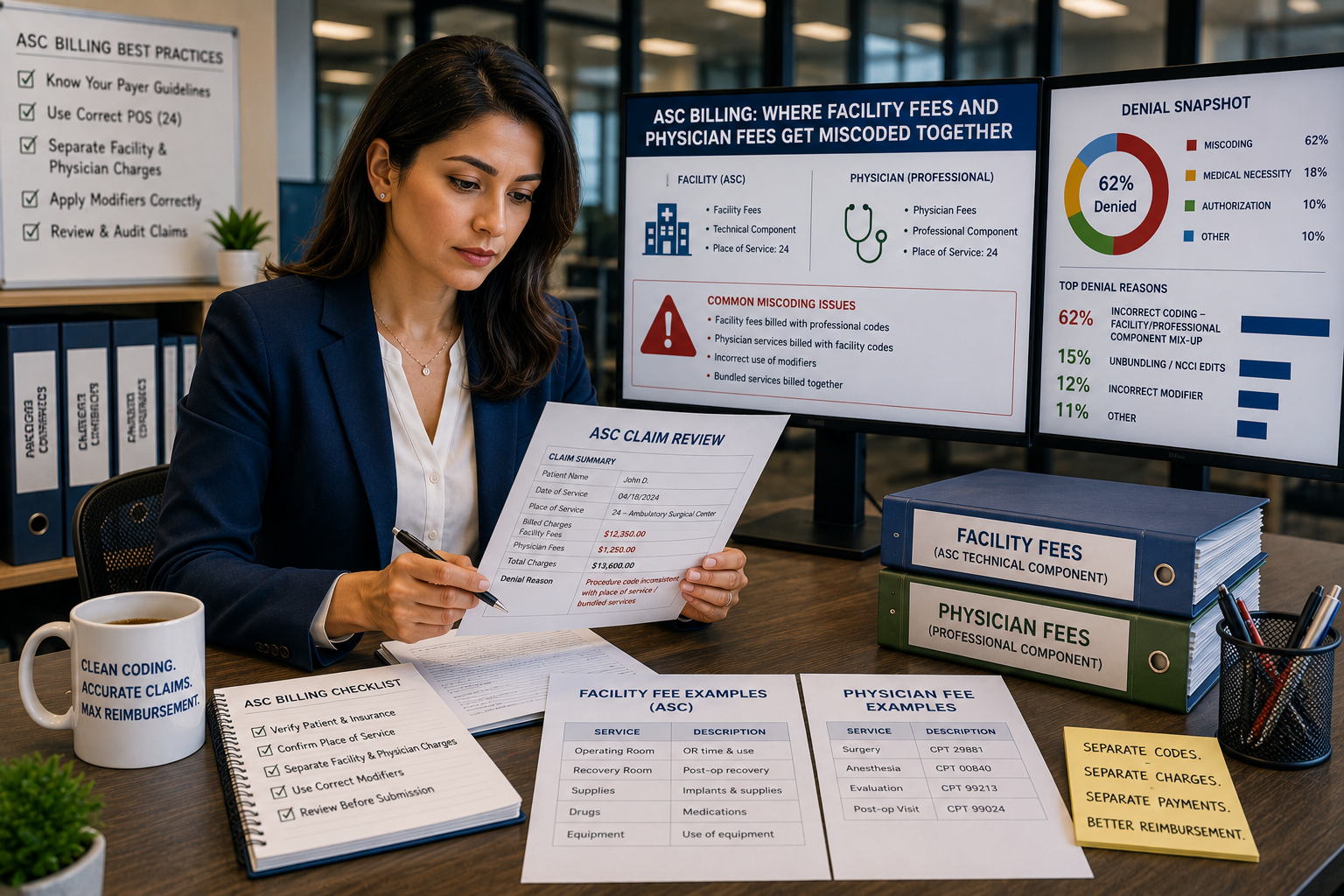
ASC Billing: Where Facility Fees and Physician Fees Get Miscoded Together
ASC facility and physician claims both go out on a CMS-1500 form with the same CPT code and place...
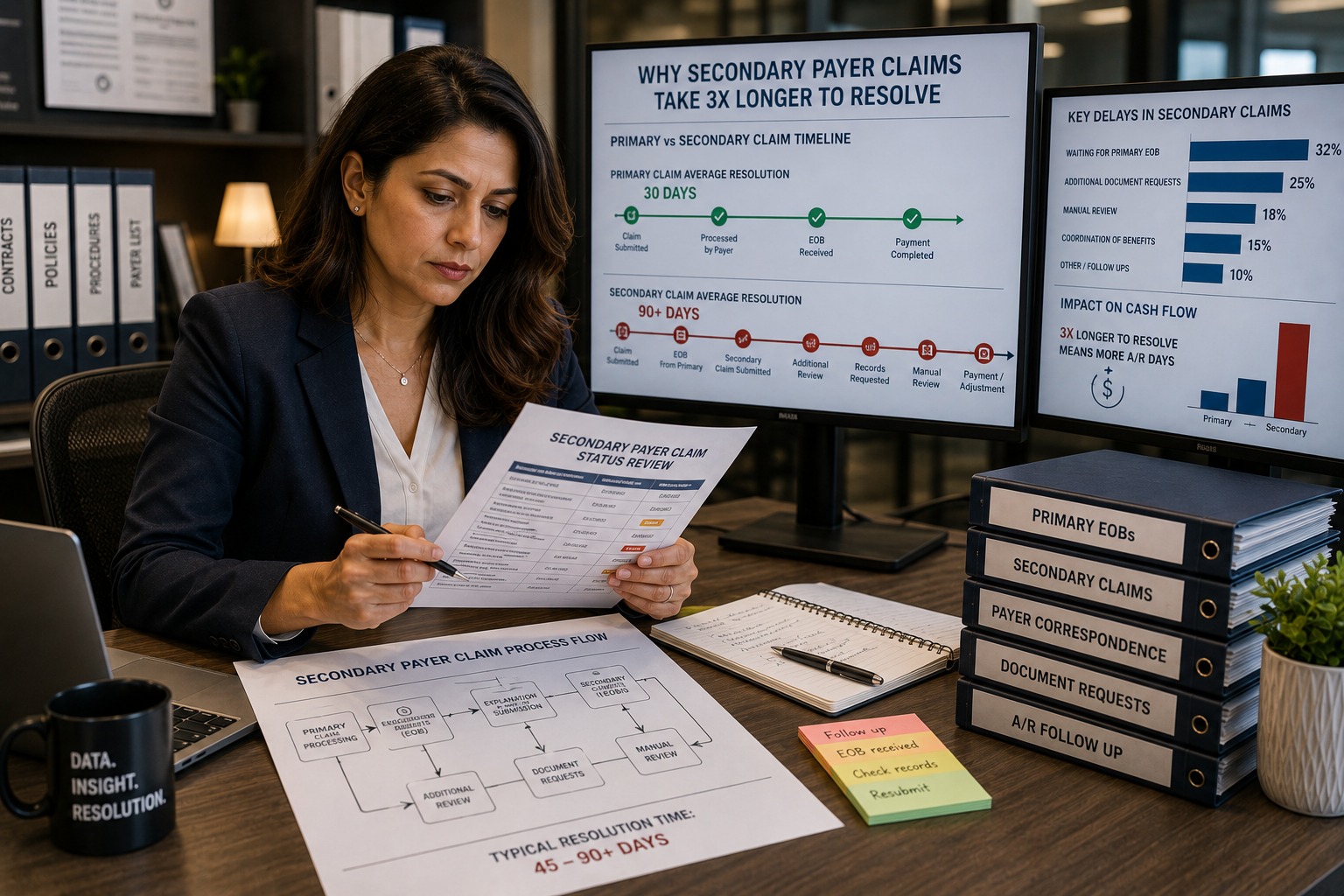
Coordination of benefits errors: why secondary payer claims take 3x longer to resolve
Secondary payer claims stall because coordination of benefits errors, wrong payer order, outdated COB records, and missing primary...