

Behavioral health billing: why session caps and auth renewals break more claims than coding errors
The Qualigenix Editorial Team consists of certified billing and coding experts with over 40 years of experience across 38+ medical specialties. Our content is rigorously researched against CMS, AMA, and payer-specific guidelines to ensure total compliance and accuracy. We apply the same elite standards to our resources as we do our client work, consistently delivering high claim accuracy and significant reductions in AR days.


Session caps and late authorization renewals deny more behavioral health claims than CPT or modifier mistakes. Once a patient hits an authorized session count, or an authorization expires, every claim behind it denies automatically. Coding review can’t fix that. Tracking session usage and renewal dates against the schedule, in real time, is what actually stops these denials.
A clean CPT code doesn’t save a claim if the authorization behind it already expired. That’s the part practice managers miss when they treat coding accuracy as the fix for behavioral health denials.
Most unpaid behavioral health claims never had a coding problem. The real trigger is a session count that ran out or a renewal that landed a day late. Here’s why those two failure points cost more than any CPT error, and what to track instead.
Session cap and authorization renewal denials outnumber coding-error denials in behavioral health billing because they trigger automatically once a session count or expiration date passes, no matter how the claim is coded. Fixing the CPT code after the fact doesn’t reverse a denial caused by a missing or expired authorization.
Prior authorization, by the numbers
| Metric | Figure | Source |
|---|---|---|
| Prior authorization requests per physician, per week | 39 | AMA physician survey |
| Staff hours per week spent on prior authorization follow-up | 13 | AMA physician survey |
| Practices with staff working exclusively on prior authorization | 40% | AMA physician survey |
| Prior authorization denials that get appealed | 11.7% | AMA physician survey |
| Appealed denials overturned in full or in part | 81.7% | AMA physician survey |
| US health care administrative spend tied to prior authorization | $35 billion | Peer-reviewed PA burden research |
| Insured adults needing specialized care who were denied after prior authorization | 27% | KFF Health Tracking Poll |
| Insured adults who experienced a prior authorization delay or denial | 36% | KFF Health Tracking Poll |
| Medicaid enrollees reporting a prior authorization problem in the past year | 22% | KFF survey analysis |
| Medicare enrollees reporting a prior authorization problem | 11% | KFF survey analysis |
| Patients reporting a negative impact on care access after a PA problem, highest among psychiatry, behavioral health, and substance use treatment | 42% | Peer-reviewed PA burden research |
| Qualigenix behavioral health book-of-business first-pass acceptance rate | 95% | Qualigenix internal data |
| Qualigenix claim accuracy rate | 99% | Qualigenix internal data |
| Average reduction in AR days after Qualigenix onboarding | 30% | Qualigenix internal data |
Coding errors get the blame. Session caps and auth gaps do the damage
When a behavioral health claim comes back unpaid, the first move is usually a coding review. Check the CPT code, check the modifier, check the diagnosis pointer. That instinct makes sense for surgical or diagnostic billing, where code selection drives most denials.
Behavioral health runs differently. Nationally, physician practices report burning close to 13 staff hours a week just on authorization follow-up, and 40% of practices now dedicate a staff member to authorization work full time, according to AMA physician survey data. That volume alone tells you where the risk sits: not in the code, but in whether an authorization is still active when the code gets billed.
Research on prior authorization burden backs this up for behavioral health specifically. Among the treatment categories studied, psychiatry, behavioral health, and substance use care showed the steepest drop in patients’ ability to get treatment after an authorization problem, at 42%, roughly triple the rate seen in specialties like plastic surgery. A coding mistake rarely stops care outright. A lapsed authorization does.
How session caps quietly stop payment before a coder ever touches the claim
Payers set a fixed number of sessions per authorization period for outpatient psychotherapy and psychiatric visits. That number depends on the plan, the diagnosis, and sometimes the state’s Medicaid managed care rules, and it commonly falls somewhere between 8 and 24 sessions before a new review is required.
Once a patient uses every authorized visit, the next claim denies as exceeding authorized units. It doesn’t matter if the therapist billed 90837 correctly, used the right place of service, or attached the right diagnosis code. The payer’s system checks the session count before it checks anything else.
Practices that track sessions on a spreadsheet, or not at all, usually find out the count ran out when the remittance advice shows up weeks later. By then, the patient has already been seen several more times without coverage, and every one of those visits is now a write-off risk instead of a billing fix.
Why an authorization renewal one day late costs more than a wrong modifier
Authorizations expire on a set date, separate from the session count. A patient might have five sessions left on paper and still get denied, because the authorization period itself closed before the renewal was submitted.
This is where session cap denials and coding denials split apart in how hard they are to fix. A coding error gets corrected and resubmitted, often within days. An authorization gap usually requires a brand-new continuation of care request, a fresh clinical review, and payer turnaround time that can run one to three weeks. Some payers won’t grant a retro-authorization at all for behavioral health services once the date has passed, which turns the gap into a permanent loss instead of a delay.
Timely filing limits don’t pause for any of this. A practice that waits to sort out an authorization dispute before appealing can miss the filing window entirely, turning one preventable gap into two.
Does the timely filing clock still run during an authorization dispute? Yes. Most payers give a fixed window from the date of service, regardless of whether the delay was caused by a lapsed authorization. Appeals and renewal requests need to move in parallel, not one after the other.
The dollar difference between the three denial types
Not every denial costs the same amount of staff time or the same odds of recovery. Here’s how the three most common behavioral health denial types compare once a claim actually lands on a payer’s desk.
| Denial type | Standard fix | Typical resolution time | Fixable by resubmission alone |
|---|---|---|---|
| Coding or modifier error | Correct and resubmit claim | 3–10 days | Yes |
| Session cap exceeded | New authorization or continuation of care review | 10–21 days | No |
| Authorization expired before renewal | Retro-authorization request (often denied) or formal appeal | 14–30+ days | No |
What changes when authorization tracking runs ahead of the schedule
The fix isn’t more coding review. It’s moving the authorization check to the front of the workflow instead of the back. A session counter tied to the scheduling system flags an account at 75% of its authorized visits, not at zero. A renewal request goes out 10 to 14 business days before the expiration date, adjusted for how slow each specific payer runs.
That lead time matters because payer response speed isn’t consistent. Some plans turn a renewal around in 48 hours. Others take two weeks, and a practice that submits at the same fixed interval for every payer will keep hitting gaps with the slow ones.
Can a patient still be seen while an authorization renewal is pending? It depends on the payer and the plan’s continuity of care rules. Some allow a short bridge period; many do not, and any session billed during a true gap carries denial risk until the new authorization is confirmed in writing.
Where Qualigenix fits into behavioral health authorization management
Qualigenix runs behavioral health billing for practices across therapy, psychiatry, and substance use treatment, and authorization tracking is built into the workflow rather than added after a denial shows up. Our prior authorization management team logs session counts and expiration dates at intake, flags accounts before they hit either limit, and works renewal requests against each payer’s actual turnaround time.
When a denial does happen, our denial management team separates authorization-driven denials from coding-driven ones in reporting, so a practice can see exactly where revenue is actually at risk instead of guessing.
Do Medicaid managed care plans require more frequent authorization reviews for behavioral health? Generally yes. Medicaid MCOs often set shorter authorization windows and more frequent medical necessity reviews than commercial plans, which raises the number of renewal deadlines a practice has to track in a given year.
What practice managers say about working with Qualigenix
“Our session cap denials dropped from around 14% of behavioral health claims to under 4% once Qualigenix started tracking visit counts against our schedule instead of waiting for the remittance to tell us.”
Renee Ashford
Practice Manager, Outpatient Psychotherapy Group, Ohio
“We used to submit renewals when the authorization ran out. Now they go out ten business days early, and our authorization-gap denials fell by 60% in the first two quarters.”
Marcus Delaney
Billing Director, Psychiatric Associates, Texas
“Days in AR for our behavioral health division went from 61 to 39 after Qualigenix separated our authorization denials from coding denials in reporting. We could finally see where the real problem was.”
Priya Nair
Revenue Cycle Manager, Substance Use Treatment Center, California
“First-pass acceptance on our therapy claims went from 82% to 96% within four months. Most of the gain came from authorization renewals going out on time, not from coding fixes.”
Daniel Okafor
Clinical Operations Lead, Family Counseling Practice, Georgia
10-point behavioral health authorization checklist
- Log the exact authorized session count and expiration date for every patient at intake
- Flag accounts at 75% of authorized sessions used, not at 100%
- Set a renewal reminder 10 to 14 business days before each authorization expires
- Adjust renewal lead time by payer, based on each plan’s actual turnaround speed
- Confirm the new authorization number in writing before billing the next session
- Separate authorization-driven denials from coding-driven denials in weekly reports
- Track timely filing deadlines independently of authorization disputes
- Check state-specific Medicaid managed care rules for behavioral health authorization limits
- Review continuity of care rules for each payer before scheduling during a pending renewal
- Audit denial reason codes monthly to confirm which failure point is driving lost revenue
Frequently asked questions
What is the difference between a session cap denial and a coding error denial?
A coding error denial happens because a CPT code, modifier, or diagnosis pointer was entered wrong on an otherwise valid claim. A session cap denial happens because the patient already used every visit the payer authorized, no matter how the claim was coded.
How many therapy sessions do insurers typically authorize before requiring a new prior authorization?
It varies by payer, plan, and diagnosis, with initial authorization blocks commonly falling between 8 and 24 sessions. A practice billing multiple payers needs to track each authorization limit separately.
Can a behavioral health claim be resubmitted after a session cap denial?
Not by resubmitting the same claim. The practice needs a new authorization or a continuation of care review approved first, then a rebill once that authorization is on file.
How far in advance should a practice request an authorization renewal?
Most teams aim for 10 to 14 business days before expiration, or once a patient hits 75% of authorized sessions, whichever comes first. The exact lead time should match the slowest payer in the mix.
Do Medicaid and commercial payers handle behavioral health session caps differently?
Yes. Medicaid managed care plans often require more frequent medical necessity reviews and shorter authorization windows than commercial plans, and some states apply parity rules that affect how caps are structured.
What CPT codes are most affected by session limits in behavioral health billing?
Psychotherapy codes 90834, 90837, and 90847, along with the psychiatric diagnostic evaluation code 90791, are tied to session caps most often. Group therapy and intensive outpatient codes carry separate authorization limits.
Is coding accuracy still important if session caps cause most denials?
Yes, for clean claim rates and audit protection. The point isn’t that coding doesn’t matter, it’s that coding review alone won’t stop the largest share of behavioral health denials, since those come from authorization status.
How does Qualigenix track authorization windows to prevent session cap denials?
Qualigenix maps each patient’s authorized session count and expiration date against the practice’s schedule, flags accounts approaching either limit, and submits renewal requests ahead of each payer’s stated turnaround time.
Related resources
- Behavioral health billing services
- Prior authorization management
- Denial management and appeals
- Provider credentialing services
- CMS.gov — federal prior authorization requirements
Stop losing behavioral health revenue to authorization gaps
Qualigenix tracks session counts and renewal deadlines before they become denials, not after.
Our team delivers 99% claim accuracy, a 95% first-pass acceptance rate, an average 36-day collection cycle, and a 30% reduction in AR days. We onboard in as few as 6 days.
Precision. Progress. Qualigenix.
What’s Next
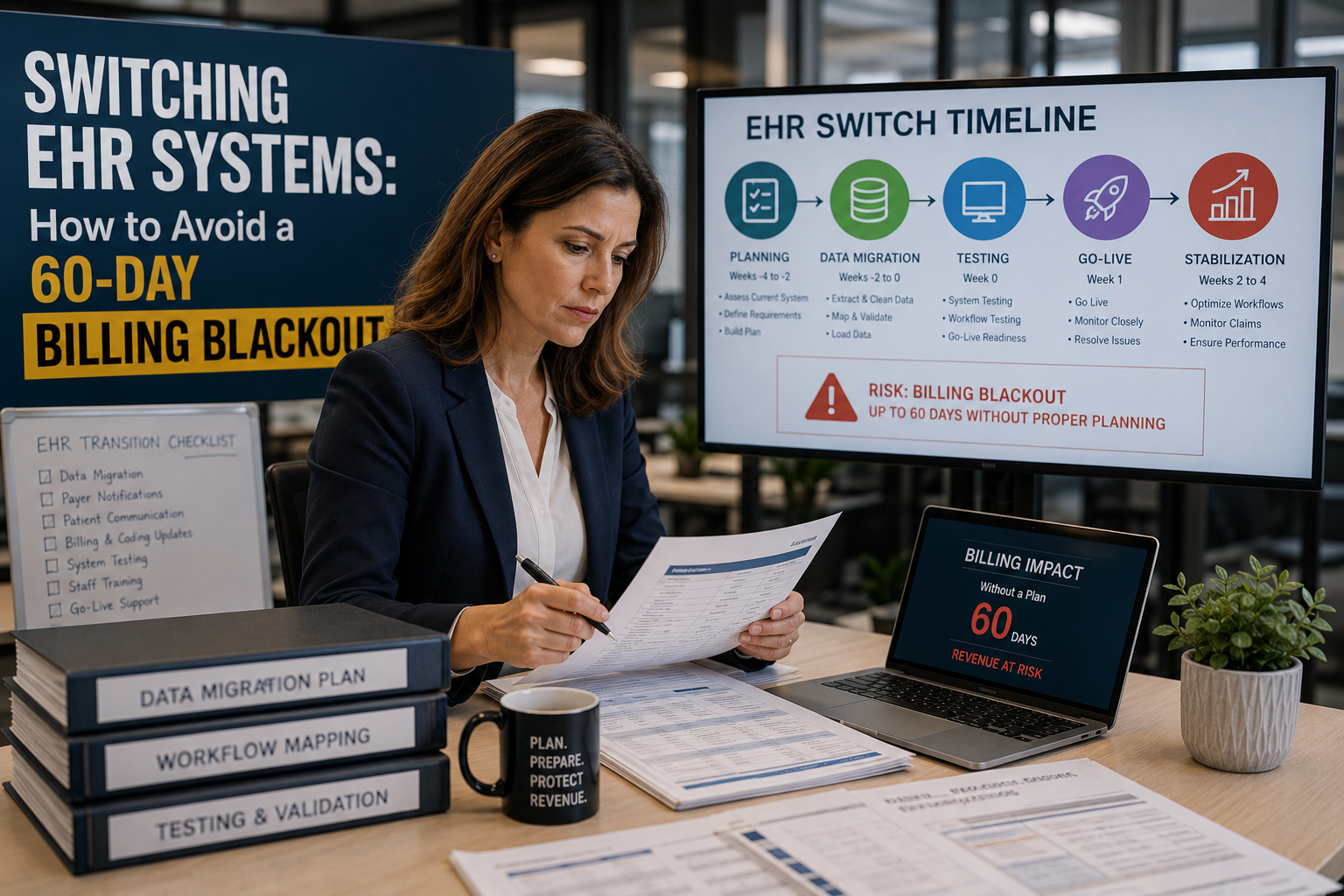
Switching EHR Systems: How to Avoid a 60-Day Billing Blackout
An EHR switch does not have to cost you two months of cash flow. The blackout comes from three...

Running billing across multiple DSO locations: centralize or keep it site-by-site?
Full centralization wins on cost and denial rate once a DSO passes about 10 to 12 locations. Below...

Home Health Billing Under PDGM: Where 30-Day Periods Quietly Cost You Revenue
PDGM pays home health agencies by the 30-day period, and every period gets scored independently on admission source,...