

Medical Insurance Verification Services: How the Right Vendor Cuts Eligibility Denials
The Qualigenix Editorial Team consists of certified billing and coding experts with over 40 years of experience across 38+ medical specialties. Our content is rigorously researched against CMS, AMA, and payer-specific guidelines to ensure total compliance and accuracy. We apply the same elite standards to our resources as we do our client work, consistently delivering high claim accuracy and significant reductions in AR days.

Eligibility errors are the number one cause of preventable claim denials. The Optum 2024 Denials Index puts provider eligibility issues at 24 percent of all denials by volume. The right verification vendor checks coverage early, catches plan changes, and flags authorization needs before the claim goes out. Qualigenix clients hold a 95 percent first-pass acceptance rate and cut AR days by 30 percent.
A denied claim is not free to fix. Your staff pulls the record, calls the payer, corrects the data, and resubmits. That cycle costs money and delays cash you already earned. Most of it starts at one weak point: insurance verification.
When coverage is wrong at intake, the claim fails on submission. And these failures are not rare. Denial rates keep climbing, and eligibility sits at the top of the list of causes. This is the one denial category you can remove almost entirely before a claim is ever created.
The question is not whether to verify. It’s whether your current process, or your current vendor, is doing it well enough to protect your revenue.
Medical insurance verification services confirm a patient’s active coverage, benefits, copays, deductibles, and authorization requirements before care is delivered. Done well, they stop the front-end errors that cause roughly a quarter of all claim denials, so more claims get paid on the first pass.
Why eligibility errors drive so many denials
Denials are getting worse, not better. In 2025, 41 percent of providers reported denial rates of 10 percent or higher, up from 30 percent in 2022, according to Experian Health’s State of Claims survey. Half of those providers named missing or inaccurate data as the top driver.
Eligibility is where that bad data enters. The Optum 2024 Denials Index found provider eligibility issues were the single largest denial category by volume at 24 percent, ahead of authorization and pre-certification problems at 16 percent. A wrong subscriber ID, a lapsed plan, a missed secondary payer: each one turns into a rejected claim.
Here’s the part practice managers know but payers rarely say out loud. Most of these denials are recoverable, but recovery is expensive. MGMA data shows up to 15 percent of claims get denied or delayed, and about two-thirds are recoverable if you have the systems to chase them. Preventing the denial costs far less than winning it back.
Denial and verification benchmarks worth knowing
| Metric | Value | Source |
|---|---|---|
| Average initial claim denial rate (2024) | 11.8% | MGMA |
| Providers with denial rates of 10%+ (2025) | 41% | Experian Health, State of Claims 2025 |
| Same figure in 2022 | 30% | Experian Health |
| Largest denial category by volume | Provider eligibility, 24% | Optum 2024 Denials Index |
| Second largest denial category | Authorization / pre-cert, 16% | Optum 2024 Denials Index |
| Providers naming bad data as top denial driver | 50% | Experian Health, 2025 |
| Providers saying claim errors are rising | 54% | Experian Health, 2025 |
| Providers saying clean claims are harder now | 68% | Experian Health, 2025 |
| Share of claims denied or delayed | Up to 15% | MGMA 2024 |
| Denials that are recoverable | ~two-thirds | MGMA 2024 |
| Commercial denial rate, initial vs final | 21% to 3% | Experian Health via Enjoin, 2025 |
| Hospital net revenue leakage (2025) | $48.4 billion | Experian Health / Enjoin |
| Qualigenix first-pass acceptance rate | 95% | Qualigenix |
| Qualigenix reduction in AR days | 30% | Qualigenix |
What the wrong verification setup costs you
A weak verification process rarely looks like a crisis. It looks like a busy front desk running one eligibility check at intake and moving on. That single check misses the coverage that lapsed since scheduling, the plan that reset at year end, and the secondary payer nobody asked about.
Then the denials arrive. Your billers rework claims that should have gone out clean. Cash slows down. AR days climb. Staff burn hours on payer calls instead of new revenue. And because 68 percent of providers now say clean claims are harder to submit than a year ago, the pressure only grows as payer rules tighten.
The wrong vendor can be worse than no vendor. Some run a bare active-or-inactive check and call it done. That tells you the patient has coverage. It does not tell you the copay, the deductible status, or whether the service needs prior authorization. Those gaps become denials you pay for later.
What the right verification vendor actually does
Strong verification is not one check. It’s a workflow. The vendor that protects your revenue runs the process below on every patient, every time.
Real-time payer connections
The vendor connects directly to payers and returns coverage status in seconds, not the next business day. Speed matters because coverage changes constantly and a stale check is a denial waiting to happen.
Full benefit detail, not just active or inactive
You get the copay, deductible, coinsurance, plan type, and coverage limits. That detail lets you collect the right patient balance up front and bill the claim correctly the first time.
Authorization flags at the eligibility step
When a scheduled service needs prior authorization, the vendor flags it during verification. Your team starts the authorization early instead of learning about it from a denial weeks later.
A second check before the visit
Coverage that was active at scheduling can lapse before the appointment. A good vendor re-verifies within 24 to 48 hours of the visit so nothing slips through.
In-house verification vs an outsourced vendor
| Factor | In-house front desk | Dedicated verification vendor |
|---|---|---|
| Timing of checks | Often one check at intake | At scheduling plus a pre-visit recheck |
| Payer rule coverage | Limited to what staff remember | Plan-specific rules across all payers |
| Staffing risk | Breaks down during turnover and busy days | Consistent regardless of your staffing |
| Authorization flagging | Usually caught after denial | Flagged during the eligibility check |
| Reporting | Hard to audit | First-pass and denial rates you can track |
Does outsourcing verification mean losing control? No. You keep visibility through reporting, and you set the first-pass acceptance target the vendor has to hit. You trade the manual work, not the oversight.
How Qualigenix handles insurance verification
At Qualigenix, verification is the first line of defense in the revenue cycle, not an afterthought at the front desk. We check coverage at scheduling, pull full benefit detail, flag authorization needs, and re-verify before the visit. Every step feeds a clean claim.
The results show up where they matter. Our clients hold a 99 percent claim accuracy rate and a 95 percent first-pass acceptance rate, and they cut AR days by 30 percent. We serve 38-plus specialties, so the payer rules for your practice type are already mapped. And we onboard in as few as 6 days.
Verification works best when it connects to the rest of the cycle. Pair it with our denial management and full revenue cycle management services, and the front-end fix protects everything downstream. See how it fits into your medical billing workflow.
How fast do results show up? Most practices see their first-pass acceptance rate climb within the first billing cycle after verification moves to a structured workflow, because the errors that caused rejections stop entering the system.
What practice managers say about working with Qualigenix
“Our eligibility denials dropped from 19 percent of front-end rejections to under 5 percent in the first quarter. Qualigenix caught plan changes our front desk kept missing.”
Danielle Reyes
Practice Manager, Cardiology Group, Texas
“First-pass acceptance went from 82 percent to 96 percent after they took over verification. We stopped reworking the same eligibility errors every week.”
Marcus Hled
Billing Director, Orthopedics Practice, Ohio
“They flag prior authorization needs during the eligibility check now, so we start early. Our authorization-related denials fell by about 40 percent.”
Priya Anand
Revenue Cycle Lead, Multi-specialty Clinic, California
“AR days came down from 51 to 34 within four months. Cleaner verification at the front end was the biggest reason our cash flow steadied.”
Tom Becker
Office Administrator, Family Practice, Florida
Checklist: what to look for in a verification vendor
Use this before you sign with any medical insurance verification services provider.
- ☐ Real-time payer connections, not next-day batch checks
- ☐ Coverage for every specialty and payer you bill
- ☐ Full benefit detail: copay, deductible, coinsurance, plan type
- ☐ Prior authorization flagged during the eligibility check
- ☐ Coordination of benefits captured for secondary payers
- ☐ A pre-visit recheck, not just one check at scheduling
- ☐ A stated first-pass acceptance target you can hold them to
- ☐ Reporting you can audit on demand
- ☐ Clear turnaround times in writing
- ☐ Fast onboarding measured in days, not months
Frequently asked questions
What are medical insurance verification services?
They confirm a patient’s active coverage, plan benefits, copays, deductibles, and any prior authorization requirements before care is delivered. The check runs against the payer so the claim goes out with correct data the first time.
How do eligibility errors cause claim denials?
When coverage, plan details, or authorization needs are wrong at intake, the payer rejects the claim on submission. The Optum 2024 Denials Index put provider eligibility issues at 24 percent of denials by volume, the largest single category. Nearly all of it is preventable at the front end.
Is it better to verify in-house or outsource it?
Outsource when your volume is high, staff turns over often, or you serve many payers. A dedicated vendor runs checks earlier, catches plan-specific rules, and holds a clean claim rate through busy periods that a front desk cannot.
When should insurance verification happen?
Verify at scheduling, then re-check within 24 to 48 hours of the visit. Coverage changes mid-month and benefits reset at year end. One check at intake is not enough for recurring patients or scheduled procedures.
Does verification cover prior authorization?
They are separate steps, but a good vendor flags when a service needs authorization during the eligibility check. That flag lets your team start early instead of finding out after the claim is denied.
How fast can Qualigenix take over verification?
Qualigenix onboards new clients in as few as 6 days. That includes payer setup, workflow mapping, and a first-pass acceptance target your team can track from week one.
Related resources
- Denial management services
- Revenue cycle management
- Medical billing services
- Centers for Medicare & Medicaid Services (CMS)
Stop paying for denials you could prevent
Move verification to a workflow built to catch errors before the claim goes out. Keep the cash you already earned.
Our team delivers 99% claim accuracy, a 95% first-pass acceptance rate, an average 36-day collection cycle, and a 30% reduction in AR days. We onboard in as few as 6 days.
Precision. Progress. Qualigenix.
What’s Next
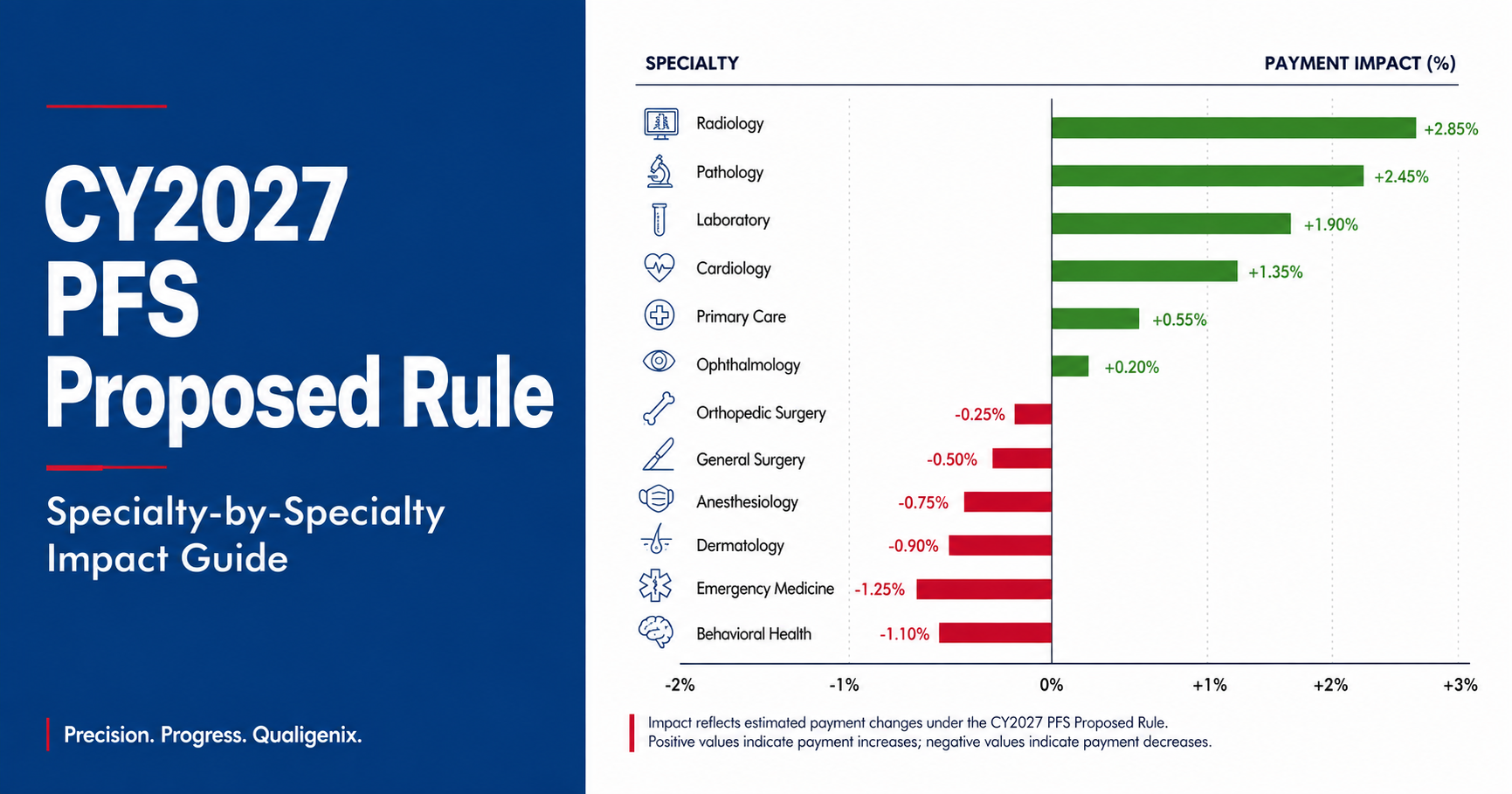
CY2027 Medicare PFS Proposed Rule: Specialty-by-Specialty Impact Guide
The CY2027 PFS proposed rule cuts the conversion factor to $32.84 for non-APM clinicians, but the real story...
Real-time eligibility returned active and the claim still denied: the five reasons why
An “active” eligibility result only proves the policy is in force. It never proves the service is covered, that...
Prior authorization turnaround requirements under the CMS interoperability rule: what changed for practices
The CMS interoperability rule (CMS-0057-F) forces impacted payers to decide standard prior authorizations in 7 calendar days and...