

CY2027 Medicare PFS Proposed Rule: Specialty-by-Specialty Impact Guide
The Qualigenix Editorial Team consists of certified billing and coding experts with over 40 years of experience across 38+ medical specialties. Our content is rigorously researched against CMS, AMA, and payer-specific guidelines to ensure total compliance and accuracy. We apply the same elite standards to our resources as we do our client work, consistently delivering high claim accuracy and significant reductions in AR days.

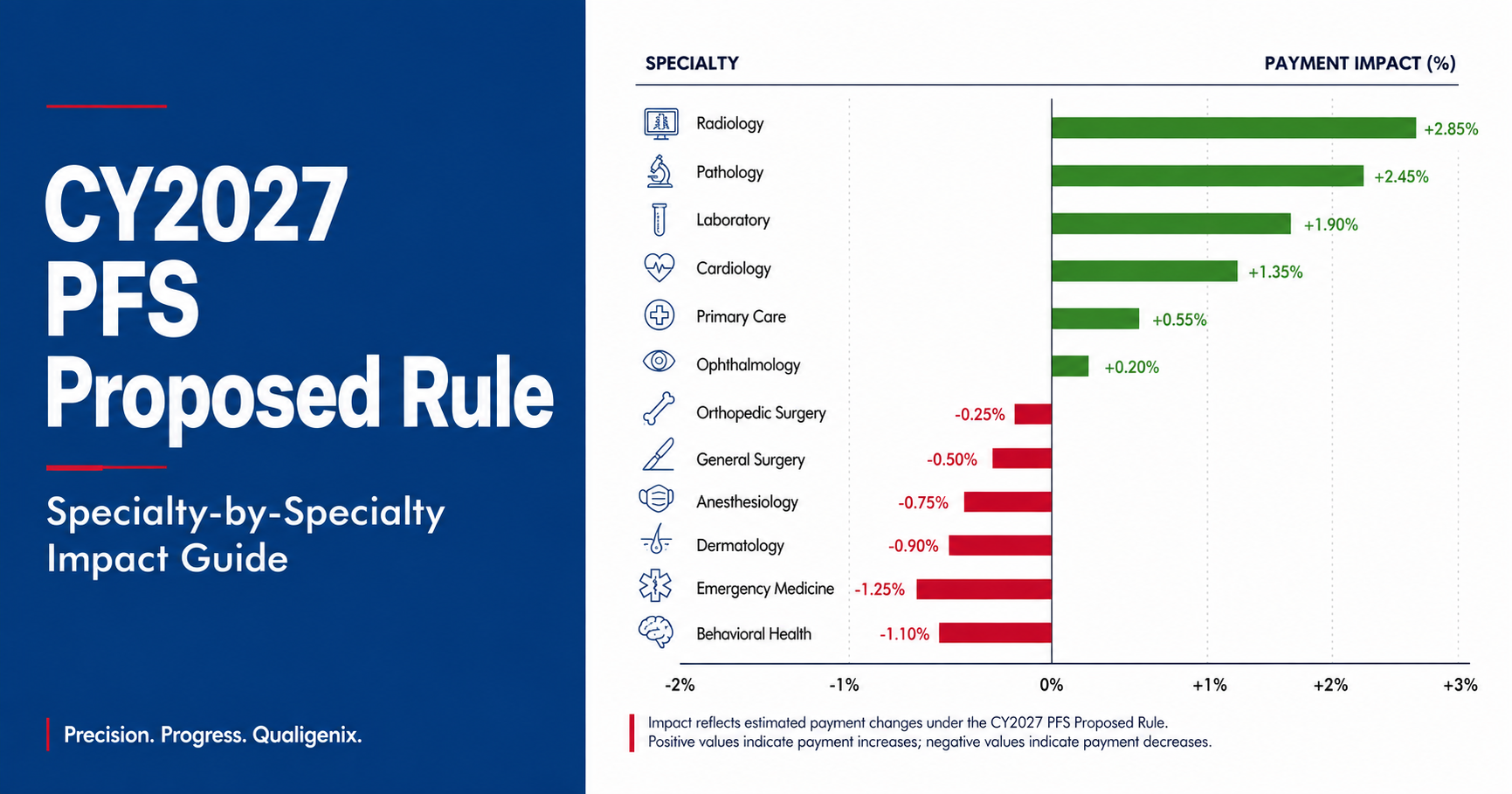
The CY2027 PFS proposed rule cuts the conversion factor to $32.84 for non-APM clinicians, but the real story is specialty-level. Radiology sees an estimated gain, emergency medicine an estimated cut, and a new same-day payment reduction changes how surgical claims pay. Comments close September 14, 2026. Model your own specialty before then.
Every year, CMS proposes changes to the Medicare Physician Fee Schedule. Most years, practices read the headline conversion factor and move on. That’s a mistake in 2027.
The CY2027 proposed rule doesn’t hit every specialty the same way. A radiology group and an emergency department are reading the same document and facing opposite revenue outcomes. The averaged number tells you almost nothing about your own practice.
This guide breaks the proposed rule down by specialty, using CMS’s own impact figures where they’re published. It flags the changes that move money, separates them from the ones that don’t, and tells you what to check before the comment window closes on September 14.
The CY2027 PFS proposed rule sets the conversion factor at $33.17 for qualifying APM participants and $32.84 for non-qualifying participants. Beyond that headline, specialty impacts range from roughly +3% for interventional radiology to about −1.25% for emergency medicine, driven by RVU reallocation and a new same-day payment reduction. Comments are due September 14, 2026.
Key CY2027 PFS figures at a glance
| Item | Proposed CY2027 Figure | Source |
|---|---|---|
| Conversion factor — qualifying APM | $33.1693 (−1.19%) | CMS / Holland & Knight |
| Conversion factor — non-qualifying APM | $32.8409 (−1.68%) | CMS / Holland & Knight |
| Anesthesia CF — non-qualifying | $20.2143 | Holland & Knight |
| Diagnostic radiology / nuclear medicine | ~ +2% estimated | CMS impact tables / Ventra |
| Interventional radiology / radiation oncology | ~ +3% estimated | CMS impact tables / Ventra |
| Emergency medicine (non-APM) | ~ −1.25% estimated | CMS impact tables / Ventra |
| Facility site-of-service | ~ −7% (facility) | CMS / AMA summary |
| Non-facility (office) site-of-service | ~ +4% (non-facility) | CMS / AMA summary |
| Same-day E/M + global procedure | Highest service 100%, others 50% | CMS / ASCRS / ACC |
| G2211 add-on | Becomes modifier, +16% base E/M (32% for certain ACOs) | CMS fact sheet |
| Comment deadline | September 14, 2026 | CMS / Federal Register |
| Rule identifier | CMS-1848-P | CMS |
A note on these figures: Every number here is proposed, not final, and several CMS specialty estimates are still marked “under review.” Treat these as planning figures, and confirm your own specialty against the CMS-1848-P impact tables before you act.
The conversion factor: what actually changed
The proposed conversion factor drops to $33.17 for qualifying APM participants and $32.84 for everyone else. That gap between the two numbers matters more than practices expect.
Which factor applies to your providers depends on their APM participation status. That status lives in your enrollment and credentialing data, not in your coding. If a provider’s status is wrong on file, you’re modeling revenue against the wrong number from the start.
The cut itself reflects the loss of the temporary 2.5% increase that applied in 2026. It isn’t a surprise, and it isn’t the biggest line in the rule for most specialties. The RVU reallocation underneath it usually matters more, because that’s what moves money between specialties.
The same-day payment reduction: read this carefully
This is the change most likely to be misread, and the one most likely to cost surgical practices money if they get it wrong.
CMS proposes that when a separately identifiable E/M is furnished the same day as a procedure with a 0-, 10-, or 90-day global period, by the same physician or group, the highest-valued service is paid at 100% and every other service on that claim is paid at 50%.
The reduction hits the lesser-valued service, not the E/M by default. On most surgical days the procedure is worth more, so the E/M usually takes the cut. But the mechanism cuts whichever service is lower, and that changes how you apply modifiers 25 and 57.
Get this backward and you either leave money on the table or invite a denial. The practices modeling their own same-day claims now will know exactly which encounters need restructuring before any of this is final.
Which specialties gain, and which face cuts
Here’s where the averaged number falls apart. CMS’s own impact modeling shows a real spread.
Radiology comes out ahead in the estimates. Diagnostic radiology and nuclear medicine see a combined impact near +2%, and interventional radiology and radiation oncology near +3%. Behavioral health continues a multi-year increase in the valuation of timed psychotherapy services, with smoking cessation and SBIRT services folded into that transition for 2027.
Emergency medicine sits on the other side, with an estimated net reduction near 1.25% for non-APM participants. The bigger driver for many hospital-based groups is the site-of-service split: facility services see an estimated −7% while non-facility services see about +4%. If your specialty lives in the hospital, that shift can outweigh the headline conversion factor entirely.
Practice expense methodology and G2211
Two structural changes sit underneath the specialty numbers. Both are worth understanding even though neither shows up as a single headline figure.
First, CMS proposes to keep phasing out the older practice expense methodology that leaned on specialty-specific, per-hour survey data. The agency wants a more auditable system that reduces volatility. Procedural specialties and cognitive specialties feel this differently, which is part of why the specialty spread exists.
Second, G2211 changes form. The visit complexity add-on is proposed to become a modifier that raises the base E/M payment by 16%, or 32% for clinicians in certain accountable care arrangements. If you bill G2211 today, confirm the new mechanism before you model 2027, because the way it attaches to the claim is changing.
How Qualigenix models this for your specialty
We don’t read the rule for the industry. We read it for your specialty, your codes, and your payer mix.
That means taking the proposed conversion factor, the same-day reduction, the G2211 change, and the practice expense shift, then mapping each one to the specific codes and modifiers your practice actually bills. The output isn’t a summary of the rule. It’s a number your practice manager can plan a quarter around.
Our medical billing and medical coding teams work across 38+ specialties, so the modeling reflects how your specialty is actually paid, not an average. And because accurate credentialing data determines which conversion factor applies to each provider, we check that status before the numbers ever get built.
What practice managers say about working with Qualigenix
“Qualigenix modeled the CY2027 proposed rule against our exact code mix and showed us the same-day reduction would hit two of our surgeons. We restructured before it cost us anything.”
Rachel Owens
Practice Manager, Surgical Group, Texas
“They caught that half our providers were coded to the wrong APM status, which meant we were modeling the wrong conversion factor entirely. That fix alone changed our 2027 projection.”
David Kim
Administrator, Multi-Specialty Practice, Illinois
“Our radiology group saw the estimated +2% and assumed we were fine. Qualigenix showed us the site-of-service split mattered more than the headline number. Our denial rate stayed under 10% through the transition.”
Maria Delgado
Billing Director, Radiology Group, Florida
“First-pass acceptance stayed at 95% even while we changed how we billed same-day visits. That is the part I did not expect to go smoothly, and it did.”
James Whitfield
Practice Owner, Orthopedics, Ohio
Your CY2027 readiness checklist
- ☐ Find your specialty in the CMS-1848-P impact tables, not the headline CF
- ☐ Confirm each provider’s APM/QP status so you model the right conversion factor
- ☐ Pull your same-day E/M + global-procedure claims and check which service is highest-valued
- ☐ Review modifier 25 and 57 usage against the proposed same-day reduction
- ☐ Confirm how G2211 attaches to your E/M claims under the modifier proposal
- ☐ Check your facility vs non-facility service mix against the site-of-service split
- ☐ Model behavioral health timed-service changes if you bill psychotherapy or SBIRT
- ☐ Separate binding payment proposals from RFIs before you plan
- ☐ Draft comments on the provisions that affect your specialty
- ☐ Submit comments before September 14, 2026
Frequently asked questions
When is the comment deadline for the CY2027 PFS proposed rule?
The public comment deadline is September 14, 2026. CMS released the proposed rule (CMS-1848-P) on July 14, 2026. Every provision can still change before the final rule, so the comment window is your chance to weigh in.
What is the proposed CY2027 conversion factor?
CMS proposes $33.1693 for qualifying APM participants (a 1.19% cut) and $32.8409 for non-qualifying participants (a 1.68% cut). The drop reflects the expiration of the temporary 2.5% statutory increase from 2026.
Does the same-day reduction always cut the E/M?
No. The highest-valued service is paid at 100% and every other service at 50%. On most surgical days the procedure is higher-valued, so the E/M is usually reduced, but the rule cuts whichever service is lesser, not the E/M automatically.
Which specialties gain under the proposed rule?
Diagnostic radiology and nuclear medicine see an estimated +2%, and interventional radiology and radiation oncology near +3%. Behavioral health continues an upward valuation for timed services. Office-based (non-facility) services see an estimated +4% site-of-service shift.
Which specialties face cuts?
Emergency medicine faces an estimated 1.25% cut for non-APM participants, and facility-based services an estimated 7% site-of-service reduction. Several hospital-based specialty figures, including anesthesiology and hospital medicine, are still under CMS review.
Do APM participants face a smaller cut?
Yes. Qualifying APM participants use the higher conversion factor ($33.17 vs $32.84) and generally see a smaller reduction. That’s why confirming each provider’s APM status before modeling is essential.
Related resources
Sources: CMS CY2027 PFS Proposed Rule fact sheet (CMS-1848-P); CMS QPP fact sheet; Holland & Knight; Ventra Health; AMA summary analysis; America’s Essential Hospitals. All figures are proposed and subject to change in the final rule. This content was researched and drafted with AI assistance and reviewed for accuracy against primary CMS and specialty-society sources.
Model the CY2027 rule for your specialty before September 14
Don’t plan off the averaged number. We map every proposed change to the codes your practice actually bills, so you know your real 2027 exposure.
Our team delivers 99% claim accuracy, a 95% first-pass acceptance rate, an average 36-day collection cycle, and a 30% reduction in AR days. We onboard in as few as 6 days.
Precision. Progress. Qualigenix.
What’s Next

Real-time eligibility returned active and the claim still denied: the five reasons why
An “active” eligibility result only proves the policy is in force. It never proves the service is covered, that...
Prior authorization turnaround requirements under the CMS interoperability rule: what changed for practices
The CMS interoperability rule (CMS-0057-F) forces impacted payers to decide standard prior authorizations in 7 calendar days and...

Appeal or Write Off? A Decision Framework for Denied Claims Over $500
Don’t let the dollar amount make the call by itself. Sort the denial by reason code, run the...