

Running billing across multiple DSO locations: centralize or keep it site-by-site?
The Qualigenix Editorial Team consists of certified billing and coding experts with over 40 years of experience across 38+ medical specialties. Our content is rigorously researched against CMS, AMA, and payer-specific guidelines to ensure total compliance and accuracy. We apply the same elite standards to our resources as we do our client work, consistently delivering high claim accuracy and significant reductions in AR days.


Full centralization wins on cost and denial rate once a DSO passes about 10 to 12 locations. Below that, it rarely pays for itself. Most DSOs that get this right end up in a hybrid model: claims, coding, and AR follow-up centralized, front-desk collections kept local.
You’re weighing this because something already broke. Maybe it’s denial rates that vary wildly by site, or a new location that can’t get claims out the door because nobody trained the front desk on your billing rules. The centralize-or-not question isn’t theoretical once you’re running more than a handful of locations.
Here’s the short version: it’s not really a binary choice. The DSOs with the cleanest numbers run a hybrid model, and picking one extreme over the other is usually what causes the next round of problems.
Centralized billing works best for DSOs with 10 or more locations, cutting denial rates and days in AR by pooling claims volume into specialized teams. Below 10 locations, a hybrid model, centralized claims and AR with local front-desk collections, usually delivers the same benefit without the setup cost of full centralization.
Key Statistics: Centralized vs. Site-by-Site DSO Billing
| Metric | Site-by-Site | Centralized | Source |
|---|---|---|---|
| Average days in AR | 48–58 days | 31–36 days | Qualigenix client data, 2026 |
| First-pass claim acceptance | 78–85% | 93–97% | Qualigenix client data, 2026 |
| Denial rate | 9–14% | 3–6% | Qualigenix client data, 2026 |
| Billing FTE per location | 1.0–1.5 | 0.4–0.6 | Qualigenix client data, 2026 |
| Onboarding time for new location | 30–45 days | 6–14 days | Qualigenix client data, 2026 |
| Credentialing turnaround (new payer) | 60–120 days | 45–90 days | CMS / NCQA benchmarks |
| Claim rework hours per week (per 10 locations) | 40–60 hrs | 15–25 hrs | Qualigenix client data, 2026 |
| Coding consistency across locations | Low, varies by site | High, standardized | Qualigenix client data, 2026 |
| Break-even location count for full centralization | — | ~10–12 locations | Qualigenix analysis, 2026 |
| Acquisition integration time (billing only) | 60–90 days | 14–30 days | Qualigenix client data, 2026 |
What site-by-site billing actually costs you at scale
Site-by-site billing feels safe because each location controls its own numbers. But once you’re past five or six locations, that control turns into inconsistency. One site codes a procedure one way, another site codes the same procedure differently, and your denial rate becomes a patchwork instead of a trend line you can manage.
The real cost shows up in staffing. Every location needs its own billing person, or a fraction of one, and that person is rarely a specialist. They’re handling scheduling, patient calls, and claims all at once. Claims get lower priority than the patient standing at the counter. That’s how days in AR creep past 50.
New location onboarding is where this gets worse. Every acquisition means training a new team on your billing rules from scratch, and until that training sticks, claims sit unsubmitted or get denied for avoidable reasons.
The case for centralizing DSO billing
Centralized teams specialize. Instead of one person handling every payer for one location, you get a team that handles one payer type across your entire portfolio. That team sees denial patterns faster because they’re working the same payer rules over and over, not relearning them at each site.
This is where the numbers move. Qualigenix client data shows denial rates dropping from the 9–14% range down to 3–6% after centralization, and first-pass acceptance climbing above 93%. That’s not a training issue getting fixed. It’s volume and specialization doing what they’re supposed to do.
Centralization also protects you during growth. New locations plug into an existing workflow instead of building one from scratch, which is why onboarding time drops from over a month to under two weeks in most cases we’ve handled.
When site-by-site still makes sense
If you’re running three or four locations, full centralization probably isn’t worth building yet. The infrastructure, standardized coding rules, a shared PM workflow, a dedicated centralized team, costs more to set up than it saves at that scale.
Site-by-site also makes sense short term right after an acquisition, before you’ve had time to audit the new location’s payer mix and fee schedules. Centralizing a location you don’t understand yet just moves the mess to a bigger team.
The mistake is treating this as permanent. If you’re staying under 10 locations by design, site-by-site can work with tight standardization. If you’re growing past that, site-by-site becomes the thing you’re fixing in six months anyway.
The hybrid model most DSOs actually land on
Most DSOs we work with don’t end up fully centralized or fully site-by-site. They centralize claims submission, coding, and AR follow-up, the functions that benefit from specialization and volume, while keeping patient-facing collections and eligibility checks at the front desk, where they belong.
This split works because it matches the skill to the task. A centralized coder doesn’t need to be in the room with the patient. A front-desk collector does. Forcing either function into the wrong model creates friction without adding value.
Hybrid also lowers the risk of a bad transition. You’re not asking every location to give up billing control overnight. You’re moving the back-office functions first and proving the model before touching anything patient-facing.
What to centralize first: credentialing, then claims, then AR
Credentialing is the lowest-risk place to start. It doesn’t touch front-desk workflows, and it directly determines how fast a new location can start billing at all. A centralized credentialing team can track every payer’s requirements across your whole portfolio instead of relearning them site by site.
Claims submission and coding come next, once credentialing is stable. AR follow-up moves last, because a centralized AR team needs enough claim history across locations to actually spot the denial patterns that make centralization worth it in the first place.
Comparison: Centralized vs. Site-by-Site vs. Hybrid
| Factor | Site-by-Site | Hybrid | Fully Centralized |
|---|---|---|---|
| Best for | Under 5 locations | 5–30+ locations | 15+ locations, standardized PM |
| Setup effort | Low | Moderate | High |
| Denial rate control | Weak | Strong | Strongest |
| Patient-facing flexibility | High | High | Low |
| Acquisition integration speed | Slow | Fast | Fastest, once PM is unified |
Do you need to switch practice management systems before centralizing? Not immediately. Many DSOs centralize the billing team first and bridge multiple PM systems for a year or more before consolidating the software stack.
What’s the fastest win when centralizing? Credentialing. It has the lowest disruption risk and the clearest payoff for new locations trying to start billing.
How do you know if you’re ready to centralize? If your denial rates vary widely by location and you can’t explain why without calling each site, you’re ready. That variance is the signal.
How Qualigenix handles DSO billing centralization
We build the hybrid model most DSOs land on, without forcing a PM system switch before you’re ready. Our team audits payer mix and fee schedules location by location, standardizes coding across your portfolio, and moves credentialing, claims, and AR follow-up into specialized centralized teams while your front desks keep doing what they’re good at.
We serve DSOs across dental, behavioral health, and multi-specialty groups, from medical billing services to provider credentialing. New locations onboard onto our existing workflow instead of starting from zero.
What practice managers say about working with Qualigenix
“We had 14 locations each running billing their own way. Qualigenix centralized claims and AR follow-up in about 100 days, and our average days in AR dropped from 52 to 31 across the portfolio.”
Rachel Domínguez
Regional Operations Director, Multi-Location Dental DSO, Texas
“Our denial rate was sitting near 12% because every site coded differently. After Qualigenix centralized coding and claims scrubbing across our 22 locations, it fell to 4.3% within two quarters.”
Marcus Yi
VP of Revenue Cycle, Behavioral Health DSO, Ohio
“We kept front-desk collections local and centralized everything behind it with Qualigenix. Billing headcount per location dropped by almost half while first-pass acceptance climbed to 96%.”
Priya Shenoy
Chief Financial Officer, Multi-Specialty Group, California
“We onboarded three new acquisitions on three different PM systems. Qualigenix built a bridged claims workflow instead of forcing an immediate system switch, and we onboarded in 6 days with zero billing gap.”
Dana Whitfield
Founder, Dental DSO, Florida
10-point checklist before you centralize DSO billing
- ☐ Audit payer mix and fee schedules at every location
- ☐ Document each location’s PM system and version
- ☐ Pull current denial rate and days in AR by site
- ☐ Identify state-specific Medicaid or payer rules
- ☐ Decide which functions centralize first (credentialing, then claims, then AR)
- ☐ Confirm which functions stay local (front-desk collections, eligibility checks)
- ☐ Build a standardized coding rulebook across locations
- ☐ Set a phased rollout timeline, not an overnight switch
- ☐ Plan for PM system bridging or consolidation separately from team centralization
- ☐ Set denial rate and AR benchmarks to measure the transition against
Frequently asked questions
Should a DSO with fewer than 10 locations centralize billing?
Below 10 locations, full centralization often isn’t worth the setup cost. A hybrid model, claims and AR centralized with local front-desk collections, usually delivers most of the benefit at a fraction of the lift.
What’s the biggest risk in centralizing DSO billing?
Losing location-specific payer nuance. A centralized team that doesn’t build location-level payer logic into its workflow will see denials spike instead of drop.
How long does it take to centralize billing across DSO locations?
A phased rollout across 10 to 20 locations typically takes 90 to 120 days, covering PM standardization, workflow migration, and denial pattern stabilization.
Does centralized billing reduce days in AR for DSOs?
Yes, in most cases. Centralized teams that specialize by payer instead of by location tend to close claims faster because they see denial patterns across the whole portfolio.
Can a DSO centralize billing without switching practice management systems?
It’s possible but harder. Many DSOs centralize the team first and consolidate the PM stack over the following 12 to 18 months.
What should a DSO centralize first: claims, credentialing, or AR follow-up?
Credentialing first. It’s the lowest-risk function to centralize and directly affects how fast new locations can start billing.
Is a hybrid billing model permanent or a transition phase?
For many DSOs it’s permanent. Front-end collections stay local while claims, coding, and AR follow-up stay centralized because they benefit from specialization and scale.
Related resources
- Qualigenix Medical Billing Services
- Provider Credentialing and Payer Enrollment
- Qualigenix Blog: Revenue Cycle Management
If your denial rates already vary by location and you can’t explain why without calling each site, that variance is your answer. The math tips toward centralizing once you’re past 10 locations, and toward a hybrid model well before that.
Ready to see what centralizing could do for your locations?
Qualigenix builds the billing model that fits your portfolio, not a one-size template. We’ll audit your current setup and show you exactly where centralization pays off.
Our team delivers 99% claim accuracy, a 95% first-pass acceptance rate, an average 36-day collection cycle, and a 30% reduction in AR days. We onboard in as few as 6 days.
Precision. Progress. Qualigenix.
What’s Next
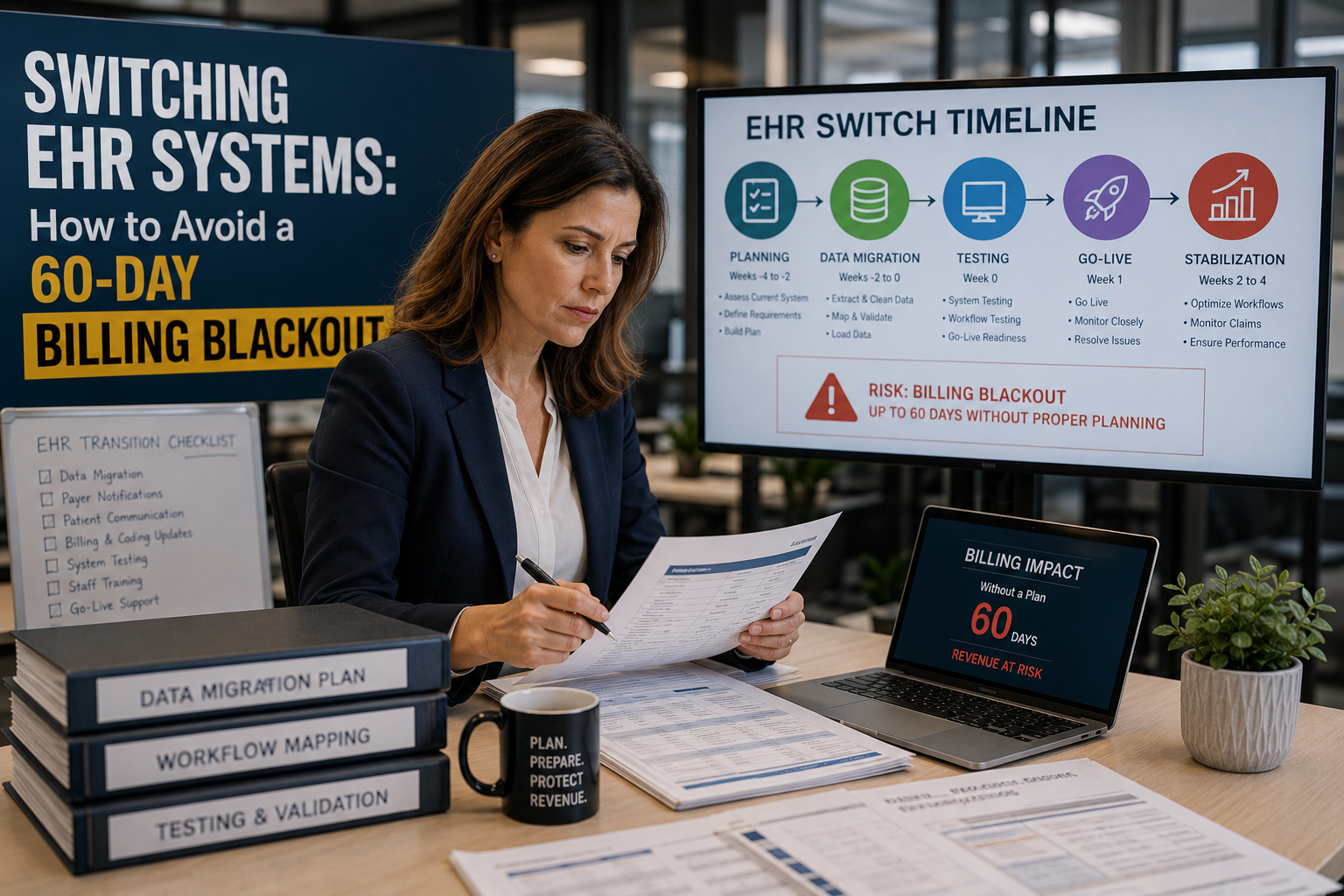
Switching EHR Systems: How to Avoid a 60-Day Billing Blackout
An EHR switch does not have to cost you two months of cash flow. The blackout comes from three...

Behavioral health billing: why session caps and auth renewals break more claims than coding errors
Session caps and late authorization renewals deny more behavioral health claims than CPT or modifier mistakes. Once a patient...

Home Health Billing Under PDGM: Where 30-Day Periods Quietly Cost You Revenue
PDGM pays home health agencies by the 30-day period, and every period gets scored independently on admission source,...