

Medical Coding Errors That Cost Practices the Most (And How to Catch Them Before They Submit)
The Qualigenix Editorial Team consists of certified billing and coding experts with over 40 years of experience across 38+ medical specialties. Our content is rigorously researched against CMS, AMA, and payer-specific guidelines to ensure total compliance and accuracy. We apply the same elite standards to our resources as we do our client work, consistently delivering high claim accuracy and significant reductions in AR days.


Medical Coding Errors That Cost Practices the Most (And How to Catch Them Before They Submit)
Written by the Qualigenix RCM Team
Certified coding and revenue cycle specialists with hands-on experience across 275+ practices and 38+ medical specialties. About Qualigenix →
Last Updated: June 2026 | Reflects current OIG Work Plan priorities and 2026 AMA CPT guidelines
TL;DR: Key Takeaway: Coding errors cause 30-40% of all claim denials and can cost a practice up to $100,000 per year in uncollected revenue. The eight most damaging errors are: wrong E&M level, unspecified ICD-10 codes, missing modifiers, unbundling, upcoding, duplicate billing, wrong place-of-service codes, and using outdated codes. A structured pre-submission review catches most of these before they reach a payer. Qualigenix maintains 99% claim accuracy with this review built into every claim workflow.
Most coding errors don’t announce themselves with a denial. The worst ones go through quietly. A 99213 where the documentation supports a 99214. An unspecified ICD-10 code that just barely clears the payer’s medical necessity edit. A missing -25 modifier that gets paid anyway because the payer’s system didn’t catch it that day. These aren’t failures the denial report surfaces. They’re revenue that left your practice permanently and compliance exposure you don’t know you’re carrying.
The errors that do cause denials are easier to track but harder to fix if you don’t know the root cause. A claim that denies for “medical necessity” often isn’t a documentation problem at all. It’s a specificity problem in the ICD-10 code. A claim that denies for “duplicate billing” is usually a resubmission error from a workflow gap. A claim that denies for “incorrect code combination” is an NCCI bundling violation that a pre-submission check would have caught in seconds.
This post breaks down the eight coding errors that cost practices the most money, explains exactly why each one happens, and gives you a pre-submission checklist to stop them before they become denials, audits, or worse.
The most costly medical coding errors are wrong E&M level assignment, unspecified ICD-10 diagnosis codes, missing or incorrect modifiers, CPT unbundling, upcoding, duplicate billing, incorrect place-of-service codes, and using prior-year codes after a January 1 update. These eight errors account for the majority of coding-related claim denials and the bulk of OIG audit findings in physician practices. A pre-submission coding review catches most of them before a claim is transmitted.
Medical Coding Error Impact: 2026 Benchmarks
| Coding Error | Type of Impact | Financial / Compliance Risk |
|---|---|---|
| Wrong E&M level | Revenue loss (under) / audit risk (over) | Up to $100K/year undercollected |
| Unspecified ICD-10 code | Medical necessity denial | 30-40% of all coding denials |
| Missing modifier | Denial or wrong-rate payment | Top 5 denial reason across all specialties |
| Unbundling (NCCI violation) | Denial + compliance audit risk | OIG Work Plan flagged item |
| Upcoding | False Claims Act violation | Up to $27,000 penalty per claim |
| Duplicate billing | Automatic denial + audit trigger | Compliance risk if pattern is consistent |
| Wrong place-of-service code | Denial or incorrect rate paid | Telehealth POS errors rising in 2026 |
| Using outdated codes (prior year) | Automatic rejection at clearinghouse | All claims on old codes fail validation |
| Industry coding audit error rate | Baseline for undetected errors | 7-10% in random sample audits |
| OIG audit recovery (2025) | National coding enforcement | $3.2 billion recovered from improper claims |
| Qualigenix claim accuracy | Post-review benchmark | 99% with pre-submission review |
| Qualigenix first-pass rate | Payer acceptance benchmark | 95% vs. 75-85% industry average |
Error 1: Wrong E&M Level Assignment
E&M coding errors are the most expensive mistakes in most physician practices, and they usually go in one direction: down. Providers and coders default to lower-complexity codes because they’re worried about audits. The result is thousands of dollars in legitimate revenue collected at the wrong rate every single month.
Here’s the math. A 99214 reimburses roughly $150-$180 more than a 99213 under most commercial contracts. If a busy internist sees 30 patients a day and correctly documents 10 of them at the 99214 level, but the coder assigns 99213 out of caution, that’s $1,500 in daily undercollection. Over 250 working days, it’s $375,000 in revenue the practice earned but never collected.
The 2021 AMA E&M overhaul changed how complexity is determined for office and outpatient coding. The old system counted history elements, review of systems bullets, and exam findings. The new system keys off medical decision-making (MDM) complexity or total provider time. A coder still applying the old bullet-counting method is not just using an outdated approach. They’re making errors. MDM at moderate complexity (which supports 99214) includes things like prescription drug management, review of external records, or assessment of a new or worsening condition. These are documented every day in primary care, cardiology, and most other outpatient specialties. Coders who don’t recognize them assign 99213 by default.
Upcoding is the other E&M error. It’s less common but carries far more risk. Billing 99215 for every visit regardless of documentation is a pattern the OIG specifically flags in its Work Plan. A practice where 40% of office visits are billed at the highest complexity level when the specialty peer group average is 15% will attract a targeted review. The False Claims Act penalty per claim is up to $27,000.
Pre-submission check for E&M errors: Compare the billed code level against the documented MDM category or total provider time. For 99214, you need moderate MDM. For 99215, you need high MDM. If the note doesn’t document prescription management, review of external data, or assessment of an independent problem, the note doesn’t support 99214. Recode to 99213 and flag the documentation gap for the provider.
Error 2: Unspecified ICD-10 Diagnosis Codes
ICD-10-CM has over 70,000 diagnosis codes. Many of them are “unspecified” versions of more specific conditions. When a coder selects M54.50 (low back pain, unspecified) instead of M54.51 (vertebrogenic low back pain) or M54.59 (other low back pain), they’re choosing a code that many payers will reject on medical necessity grounds when paired with specific procedure codes.
Payers run automated medical necessity edits called Local Coverage Determinations (LCDs) and National Coverage Determinations (NCDs). These edits map procedure codes to approved diagnosis codes. An unspecified diagnosis code often fails the edit, even when a more specific code for the same condition would have passed. The claim gets denied for “services not medically necessary” before a human reviewer ever looks at it.
The fix sounds simple: always code to the highest specificity the documentation supports. In practice, it requires coders to read the clinical note carefully and not default to a familiar unspecified code because it’s faster. For high-volume practices with tight turnaround requirements, specificity shortcuts happen constantly. A coder processing 150 claims a day will use shortcut codes. A coder reviewing 40 claims a day with a pre-submission check will use the right ones.
The second ICD-10 error is sequencing. Many multi-code claims require the codes to appear in a specific order, with the primary diagnosis listed first. If the code for the principal reason for the visit is listed second or third, some payers read the claim as a different encounter type and apply different coverage rules. Sequencing errors are almost always a training gap, not a documentation gap.
Warning: If your practice is seeing a high volume of medical necessity denials, check whether unspecified ICD-10 codes are the root cause before assuming the issue is documentation. Pull a sample of denied claims and look at the diagnosis code. If you see codes ending in “9” or “unspecified” on claims where the note clearly documents a specific condition, the problem is coder specificity, not clinical documentation.
Error 3: Missing or Incorrect Modifiers
Modifiers are two-digit codes appended to CPT codes that change how the payer processes a claim. They’re not optional decoration. Missing the right modifier means a claim gets denied. Using the wrong modifier means a claim gets paid at the wrong rate. Either way, the practice loses.
The most frequently missed modifiers span every specialty. Modifier -25 is required when a significant, separately identifiable evaluation and management service is performed on the same day as a procedure. Without it, the E&M gets bundled into the procedure payment and the separate office visit revenue disappears. Modifier -59 is required for distinct procedural services when two codes that are normally bundled are legitimately billed separately because they were performed at different anatomical sites or during separate sessions.
For surgical and procedural specialties, modifiers -LT and -RT indicate left and right side, which matters for bilateral reimbursement on procedures where the fee schedule pays differently by side. For imaging and interpretation services, the -26 modifier (professional component) and -TC modifier (technical component) split the code between the interpreting physician and the facility. Getting these backwards means the wrong entity gets paid and the correct one gets denied.
Telehealth expanded the modifier landscape significantly after 2020. Modifier -95 is used for synchronous telehealth services when the patient is at an originating site. Modifier -GT is still used by some payers for Medicare telehealth. Practices that shifted to telehealth during the public health emergency and never updated their modifier protocols are still submitting claims with wrong or missing telehealth modifiers in 2026.
The fastest way to identify modifier errors is to pull a 90-day denial report filtered by denial reason “modifier missing” or “modifier incompatible.” If the same CPT code appears repeatedly on that list, you have a systematic modifier gap, not a one-off error. Fix the coding rule, not just the individual claims.
Error 4: Unbundling and NCCI Violations
Unbundling is billing for multiple CPT codes that represent components of a single procedure when CMS has defined a single comprehensive code that covers all of those components together. It’s one of the most common compliance violations in surgical specialties, and it’s detected automatically by National Correct Coding Initiative (NCCI) edits that payers run on every claim.
The NCCI edits table, maintained by CMS, defines “column 1/column 2” code pairs where billing both codes without a valid modifier exception is prohibited. If a coder submits both codes, the payer’s system identifies the bundled pair and denies the column 2 code. If this happens in volume, it’s flagged as a pattern of unbundling and triggers a post-payment audit.
Unbundling isn’t always intentional. In orthopedics, surgical coding is complex enough that a coder working from an operative report may legitimately not know which components are included in the primary procedure code and which are separately billable. In gastroenterology, colonoscopy add-on codes are frequently billed incorrectly because the coder doesn’t know whether the primary colonoscopy code already includes certain diagnostic services. The error looks identical to intentional unbundling on a payer’s audit screen.
The opposite error is also costly: failing to bill separately for services that are legitimately unbundled. If a surgeon performs two procedures at different anatomical sites during the same session, and both are billable separately with a -59 modifier, not billing the second procedure is leaving money on the table. Coders unfamiliar with NCCI modifier exceptions often default to bundling to avoid the denial risk, which means the practice under-collects on procedures it legitimately performed.
Error 5: Upcoding and the OIG Audit Pattern
Upcoding is billing for a more complex, more expensive service than what was documented and performed. It’s not a clerical mistake. When it happens in volume, it’s treated as fraudulent billing under the False Claims Act, which carries civil monetary penalties of up to $27,000 per claim and potential exclusion from Medicare and Medicaid.
Upcoding shows up in two common patterns. The first is E&M upcoding, where a provider or coder consistently assigns 99214 or 99215 to visits where the documentation doesn’t support that level. The second is procedure upcoding, where a simpler procedure is billed under a code for a more complex version. In orthopedics, billing a total knee replacement code when the procedure was a partial resurfacing is upcoding. In dermatology, billing an excision as a Mohs procedure when Mohs wasn’t performed is upcoding.
The OIG detects upcoding statistically. They compare a practice’s billing pattern against the specialty peer group average. A primary care physician who bills 99215 at a rate far above the specialty mean for their geographic area will appear on an anomaly report. The OIG doesn’t need to find intentional fraud to recover money. A pattern of overpayment, regardless of intent, creates a repayment obligation.
Practices should run their own E&M distribution analysis at least quarterly: what percentage of office visits are billed at each code level, compared to the specialty national average from CMS data. If the distribution is significantly skewed toward the higher levels without a clear clinical explanation, that’s a signal to audit the documentation and recalibrate coder training before a payer does it for you.
Error 6: Duplicate Billing
Duplicate billing happens when the same service is submitted to the same payer more than once for the same patient on the same date of service. The denial is automatic and fast. What makes it a problem beyond a single rejected claim is what happens next.
Most duplicate billing occurs during the denial rework process. A claim denies for an unrelated reason. The billing team corrects it and resubmits. But the original claim was already processed and paid on a second pass through the clearinghouse, and now two claims for the same service exist in the payer’s system. When the payer runs a post-payment audit and finds both paid, they issue a refund demand for the overpayment. If this pattern recurs across multiple dates of service, it becomes a compliance issue.
The other common source of duplicate billing is system-to-paper overlap. A claim is submitted electronically through the clearinghouse. Someone in the billing department also prints and mails a paper claim for the same service, not knowing the electronic version went through. Both versions process independently if the payer’s duplicate detection doesn’t catch them on the same day. This is particularly common in practices that recently transitioned between billing systems or that handle claim resubmissions manually.
Prevention is a workflow problem, not a coding problem. Every resubmission should be logged against the original claim before it’s sent. Every clearinghouse acknowledgment should be reconciled before a paper backup is generated. If your billing system doesn’t show original claim status before allowing a resubmission, that’s a system configuration problem that needs to be fixed at the process level.
Error 7: Wrong Place-of-Service Codes
Place-of-service (POS) codes tell the payer where a service was delivered. They matter more than most practices realize because payer fee schedules often pay different rates for the same procedure depending on the care setting. A 99214 billed with POS 11 (physician office) reimburses at a different rate than the same code billed with POS 22 (on-campus outpatient hospital). For some payers, the difference is 30-40%.
Telehealth has added complexity to POS coding that many practices still haven’t fully worked through. During the COVID-19 public health emergency, CMS allowed providers to use POS 11 for telehealth services billed at the in-person rate. When the PHE ended, requirements changed. CMS now uses POS 02 for audio-video telehealth and POS 10 for audio-only telehealth. Practices still billing telehealth with POS 11 after the rule change are submitting incorrect claims, many of which are being processed at wrong rates rather than denied outright.
Federally Qualified Health Centers (FQHCs) and Rural Health Clinics (RHCs) have their own POS codes and billing rules that are distinct from standard physician billing. A provider who delivers services in one of these settings but whose billing team uses standard POS codes is generating systematic errors on every claim from that setting.
Error 8: Using Outdated Codes After January 1
The AMA releases CPT code updates every January 1. CMS updates ICD-10-CM codes in April and October. Any claim submitted with a code that was deleted or revised in the current update cycle is automatically rejected at the clearinghouse before it ever reaches the payer. The claim fails validation because the code doesn’t exist in the current active code set.
This sounds like a problem that should be easy to avoid. It isn’t. Practices using EHR systems with auto-populated CPT codes rely on their vendor to push code updates on schedule. If the vendor delays the update, or if the practice has custom code mappings that override the system defaults, old codes stay active in the workflow past their deletion date. Claims go out, fail at the clearinghouse, return as rejections, and sit in a queue until someone manually corrects them.
The 2026 CPT update included over 300 code changes, with significant additions in digital health monitoring, genetic testing, and minimally invasive surgical procedures. Specialties that added new service lines in those areas are most likely to be affected if their billing system wasn’t updated before January 1. Practices in these specialties should verify with their billing partner that current-year codes are active and that no claims submitted after January 1 are using prior-year codes.
Warning: If your clearinghouse rejection rate spiked in January or April of any year, outdated codes are the most likely cause. Pull the rejection report and filter by “invalid code” or “code not found.” If multiple claims are rejected for the same CPT or ICD-10 code, the code was either deleted or revised in the most recent update cycle. Update the code in your system and resubmit.
How Qualigenix Prevents These Errors Before They Submit
The only reliable way to prevent coding errors from reaching a payer is to catch them before the claim is transmitted. At Qualigenix, every claim goes through a pre-submission compliance review as part of the standard coding workflow. This isn’t a spot check. It’s a systematic review of every claim against a checklist that covers the eight error types described above.
Our specialty-dedicated coding teams know the NCCI edits for their specialty’s procedure codes, the ICD-10 codes that fail medical necessity edits for their specialty’s most common procedures, and the modifier requirements for their payer mix. This knowledge doesn’t come from a general training course. It comes from coding thousands of claims in one specialty, seeing the denial patterns, and building institutional knowledge about what payers in specific states and networks will and won’t accept.
New clients go through a complimentary coding audit during onboarding. We pull a sample of 50-100 recent claims, review code selection against documentation, and report findings by error type. Most audits reveal a mix of undercoding (revenue loss), modifier gaps (denial risk), and occasionally specificity issues in ICD-10 selection. The audit findings drive the first 30 days of billing improvement, and most clients see measurable denial rate reduction within the first 60 days.
Our performance benchmarks tell the story: 99% claim accuracy, 95% first-pass acceptance rate, 36-day average collection cycle, and a 30% reduction in AR days. Those numbers are the direct result of catching coding errors before they leave the building. Learn more about our medical coding services, denial management, and full billing services.
Pre-Submission Coding Checklist: 10 Checks Before Every Claim
- ICD-10 diagnosis code is the most specific code the documentation supports, not an unspecified default
- Diagnosis code is sequenced correctly, with the primary reason for the visit listed first
- E&M code level matches the documented MDM complexity or total provider time under 2021 AMA guidelines
- All required modifiers are applied, including -25 for same-day E&M and procedure, -59 for distinct services
- CPT code pair checked against NCCI edits to confirm no bundling violation exists
- Place-of-service code matches the actual care delivery setting, including POS 02 or 10 for telehealth
- All CPT and ICD-10 codes are from the current code year and are not deleted or revised codes
- Original claim status confirmed before any resubmission to prevent duplicate billing
- Diagnosis code supports the procedure billed under the payer’s LCD or NCD for this specialty
- E&M distribution for this provider reviewed monthly against specialty peer group averages to flag outliers
What Practice Managers Say About Qualigenix
“After partnering with Qualigenix, we saw an immediate improvement. Their team conducted a detailed review of our billing workflow, corrected recurring coding and claim submission issues, and established a proactive denial management process. The reduction in denials and improvement in collections have had a significant impact on our practice’s financial health.”
Melyssa Lopez
Practice Manager, Sweet Beginnings LLC · Midwifery
“Our practice struggled with mounting AR and delayed payments. Qualigenix stepped in with a clear strategy, consistent follow-ups, and accurate reporting. Within months, our outstanding balances decreased, and we finally had visibility and control over our revenue. Their AR services have been invaluable.”
Jennifer Hannor
CNP, Center for Pain Relief · Pain Management
Frequently Asked Questions
What are the most common medical coding errors?
The most common errors are wrong E&M level, unspecified ICD-10 diagnosis codes, missing or incorrect modifiers, CPT unbundling, upcoding, duplicate billing, wrong place-of-service codes, and using prior-year codes after a January 1 update. These eight error types account for the majority of coding-related claim denials.
How much revenue do coding errors cost a practice?
Undercoding by one E&M level on 8 patients per day can cost $50,000 to $100,000 per year in uncollected revenue. Coding errors also contribute to 30-40% of all claim denials, each of which delays payment and requires rework time. Overcoding creates repayment liability and OIG audit exposure on top of the immediate denial impact.
What is the difference between upcoding and undercoding?
Upcoding bills for a higher-complexity service than documented and is a False Claims Act violation with penalties up to $27,000 per claim. Undercoding bills for a lower-complexity service than documentation supports and results in lost revenue without compliance risk. Both are costly, in different ways.
Why do unspecified ICD-10 codes cause medical necessity denials?
Payers use Local Coverage Determinations and National Coverage Determinations to match diagnosis codes to procedures. Unspecified codes often fail these medical necessity edits automatically. Selecting the most specific ICD-10 code the documentation supports eliminates most of these denials without any other change to the claim.
What is unbundling in medical coding?
Unbundling bills multiple CPT codes for components of a procedure that should be covered by a single comprehensive code. CMS NCCI edits detect it automatically. When a bundled code pair is submitted without a valid modifier exception, the column 2 code is denied. Consistent unbundling is an OIG audit trigger regardless of intent.
What modifiers are most commonly missing on claims?
The most commonly missing modifiers are -25 (separate E&M on a procedure day), -59 (distinct procedural service), -LT/-RT (bilateral procedures), -26/-TC (professional and technical components), and -95 (synchronous telehealth). Each missing modifier results in a denial or incorrect payment rate.
How does duplicate billing happen?
Duplicate billing most often occurs when a denied claim is resubmitted without verifying the original claim status, or when a paper claim is mailed after an electronic claim was already submitted and paid. Both result in two paid claims for the same service, which becomes a refund liability when the payer detects it in a post-payment audit.
Which place-of-service codes are most often wrong in 2026?
Telehealth POS codes are the most frequently wrong in 2026. Many practices still use POS 11 (office) for telehealth services after the public health emergency rules changed. CMS now uses POS 02 for audio-video telehealth and POS 10 for audio-only. Using POS 11 for telehealth after the PHE ended results in claims paid at incorrect rates or denied outright by some payers.
What coding errors trigger OIG audits?
The OIG Work Plan consistently flags E&M upcoding at the highest complexity levels, improper modifier use, and billing for services not supported by documentation. The detection method is statistical: if a practice’s code distribution is significantly above the specialty peer group average, it appears on an anomaly report regardless of whether errors were intentional.
What is a pre-submission coding review?
A pre-submission coding review checks every claim for the most common error types before transmission to the payer. It verifies diagnosis specificity, E&M level, modifiers, NCCI compliance, POS codes, and code year validity. At Qualigenix, this review is built into the standard workflow on every claim, which is why we maintain a 95% first-pass acceptance rate.
How often should a practice audit its coding?
At minimum, annually. Also after any payer contract change, when denial rates increase by 5% or more, and when new coders or service lines are added. Qualigenix performs quarterly internal audits across all client accounts and includes a complimentary audit for every new client during onboarding.
How does Qualigenix prevent coding errors?
Qualigenix uses specialty-dedicated coding teams, pre-submission compliance review on every claim, quarterly internal audits, and current-year code implementation from January 1. All coders hold active CPC or CCS certifications. New clients receive a complimentary coding audit at onboarding. Average onboarding is 6 days.
Related Resources from Qualigenix
- Medical Coding Services
- Denial Management Services
- Medical Billing Services
- Revenue Cycle Management
- Book a Free Coding Audit
- OIG Work Plan 2026
Find Out What Coding Errors Are Costing Your Practice
Most practices don’t know their coding error rate until a payer finds it first. Qualigenix includes a complimentary coding audit with every new client onboarding, with findings reported by error type and estimated revenue impact.
We deliver 99% claim accuracy, a 95% first-pass acceptance rate, an average 36-day collection cycle, and a 30% reduction in AR days. Onboarding takes as few as 6 days.
Precision. Progress. Qualigenix.
What’s Next
Prior authorization turnaround requirements under the CMS interoperability rule: what changed for practices
The CMS interoperability rule (CMS-0057-F) forces impacted payers to decide standard prior authorizations in 7 calendar days and...

Appeal or Write Off? A Decision Framework for Denied Claims Over $500
Don’t let the dollar amount make the call by itself. Sort the denial by reason code, run the...
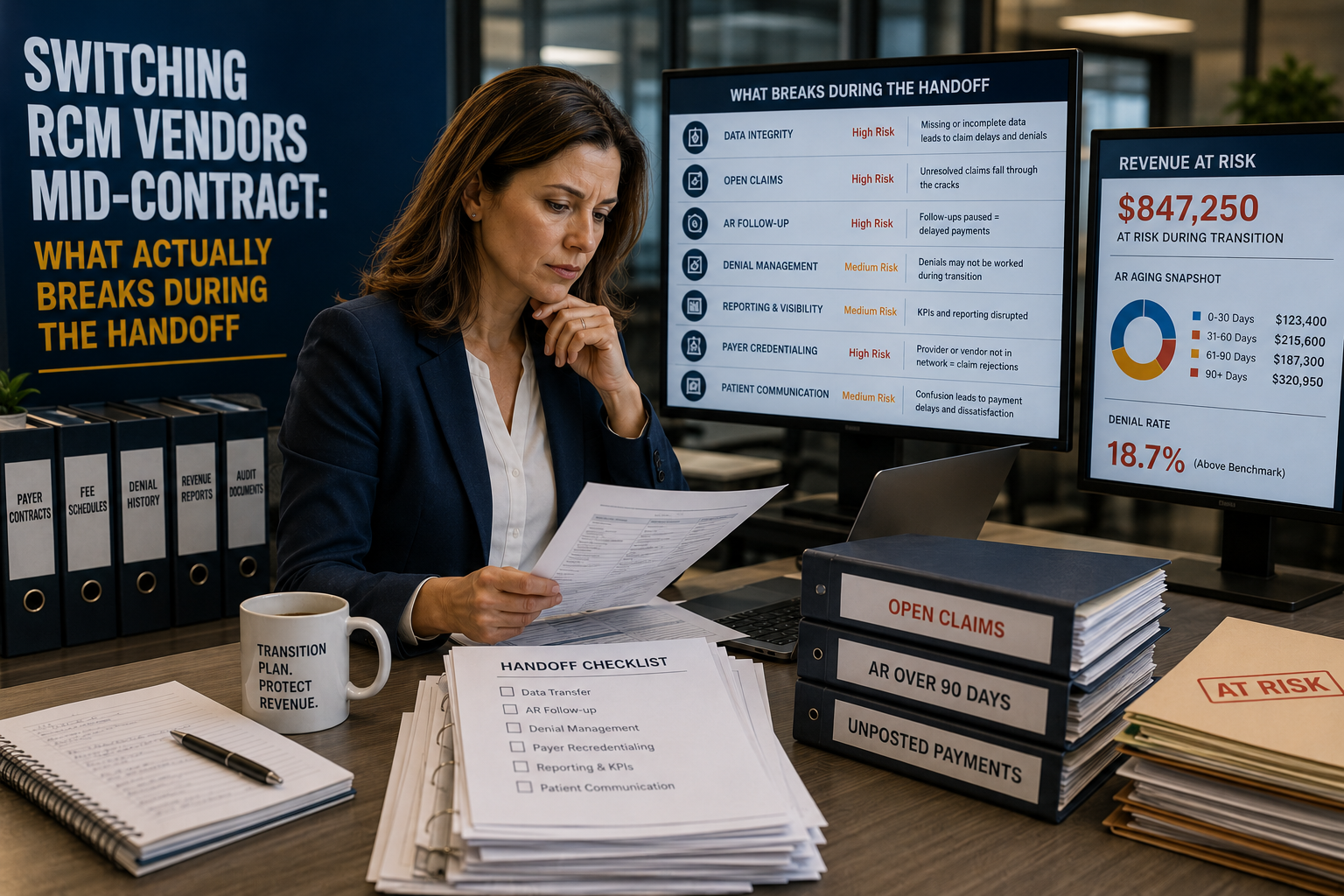
Switching RCM Vendors Mid-Contract: What Actually Breaks During the Handoff
Switching RCM vendors before a contract ends feels like the fast fix for a billing team that’s underperforming....