
Why Onshore Medical Billing in the USA Improves Compliance, Control & Cash
The Qualigenix Editorial Team comprises certified medical billing professionals, CPC-credentialed coders, prior authorization specialists, and revenue cycle consultants with more than 40 years of combined hands-on experience serving solo physicians, group practices, hospitals, and ASCs across 38+ specialties in the United States. Every guide, article, and resource published on the Qualigenix blog is researched against current CMS guidelines, Federal Register notices, AMA policy updates, and payer-specific billing rules — and reviewed for compliance accuracy before publication. Our content reflects the same standards we apply to our client work: 99% claim accuracy, 95% first-pass acceptance, and a 30% average reduction in AR days.

You have probably wondered why so many providers insist on US medical billing companies even when offshore options are cheaper. The truth: when billing stays domestic, you gain stronger compliance, more control, and healthier cash flow. The US-based medical billing outsourcing market is already valued at USD 6.28 billion (2024) and projected to grow at a 12 % CAGR.
Imagine a multi-state clinic using an onshore medical billing services partner. Their billing team shares your time zone, they’re bound by U.S. law, your data never leaves U.S. soil, and audits or disputes are easier to resolve. Instead of chasing denials, you start improving first-pass yield, reducing AR days, and keeping compliance risks low. In this post, you’ll see how trusting a domestic medical billing partner gives you the strategic edge many practices overlook.
Enhanced Regulatory Compliance & Data Security
When you work with US medical billing companies, you take a step towards building a safety net for your data and compliance responsibilities. Since your billing partner operates under the same legal framework as your practice, the risks of missteps drop dramatically.
HIPAA, SOC-2, and State Laws Alignment
Onshore medical billing services must follow the same HIPAA, SOC-2, and state-specific privacy laws you do. That means every workflow, such as patient data handling or claim submission, is designed with U.S. regulations in mind. You don’t need to worry about gaps created by foreign data practices or cross-border transfers, because everyone is accountable to the same legal standards.
Data Residency & Storage Controls
Keeping protected health information (PHI) within U.S. borders reduces exposure to international data-sharing laws like GDPR, which can complicate compliance. With a domestic RCM partner, your data is stored on U.S.-based servers with strong encryption, restricted access, and disaster recovery protocols. That also means faster responses to audits, breach notifications, or compliance reviews — no waiting for overseas teams or navigating foreign jurisdictions.
Audit Trails and Vendor Accountability
Auditing a domestic billing partner is far simpler than dealing with one overseas. Contracts are governed by U.S. law, service-level expectations are clearer, and corrective action is easier to enforce. In addition, transparency and audit trails are stronger. You’ll have detailed logs of who accessed data, when claims were processed, and how errors were resolved.
Seamless Credentialing and Prior Authorization Support
Many onshore partners also extend support beyond billing. They help you with credentialing, payer enrollment, and prior authorization workflows. As they operate in the same regulatory and payer environment, they can track changes to payer policies in real time and respond quickly when new compliance rules are introduced.
Better Control, Oversight & Communication
Beyond compliance, onshore billing brings you closer to your revenue operations. Visibility improves, communication is smoother, and issues get resolved before they turn into payment delays.
Time-Zone and Cultural Synchrony
With an onshore partner, your billing team works in the same time zone or close to it. That means issues are handled as they arise, not hours later. For example, if a claim is rejected at 10 a.m., you can discuss and correct it before the day ends. Shared language and cultural context also improve clarity during training, meetings, and audits.
Closer Relationship with Payers & Providers
Domestic billing partners already understand payer-specific rules and state compliance changes. They know how regional Medicare carriers operate and can escalate issues through established local channels. This familiarity shortens response times and often speeds up reimbursement because claims are coded and submitted in line with payer expectations from the start.
Consistency in Quality & Documentation
Managing quality standards becomes easier when your billing partner is nearby. Onshore teams receive regular updates on ICD-10 and CPT changes, undergo training that matches U.S. standards, and adapt documentation practices to meet payer and regulatory requirements. This leads to higher first-pass yield and fewer denials caused by outdated coding or incomplete documentation.
Transparent Communication & Real-Time Collaboration
One more benefit is how communication improves. With a domestic RCM partner, you can schedule real-time check-ins, review denial reports together, and resolve claim disputes within hours. Regular meetings keep oversight strong and ensure both teams stay aligned on billing targets and compliance updates. That level of coordination is difficult to achieve across distant time zones and legal jurisdictions.
Financial Advantages: Cash Flow, First-Pass Yields & AR Days

Partnering with US medical billing companies is not only about compliance. It directly impacts how quickly and reliably you get paid. A domestic team’s knowledge of payer rules, real-time coordination, and faster response times improves every financial metric that matters to your practice.
First-Pass Clean Claim Improvement
When claims are submitted correctly the first time, you avoid delays and costly rework. Onshore teams understand payer-specific rules and state-level policies better because they work with them daily. For example, they know when Medicare requires a modifier for a particular diagnostic test or when a state Medicaid program changes prior authorization rules. This familiarity often pushes first-pass clean claim rates above 95%, compared to the industry average of around 85%, giving you faster reimbursements and steadier cash flow.
Reduced Days in Accounts Receivable
Time-zone alignment means your billing team can act the same day an issue occurs. If a payer requests additional documentation, they can respond within hours, not days. That responsiveness helps you collect payments faster and reduce AR days, which typically fall by 20–30% after switching to an onshore billing partner. Faster payment cycles improve predictability and free up revenue you can reinvest in patient care or growth.
Lower Risk of Penalties & Write-Offs
Mistakes in coding or failure to follow payer policies can lead to claim denials, financial penalties, or revenue write-offs. Because domestic billing teams stay current with HIPAA, SOC-2, and payer-specific updates, they help you avoid these risks. It’s far less expensive to invest in accurate billing upfront than to lose revenue to audits or compliance violations later.
Key Features to Seek in a Domestic Medical Billing Partner
If you decide to work with an onshore medical billing services provider, choosing the right one is just as important as the decision itself. Here’s what you should look for to make sure you’re getting real results:
Credentialing & Prior Auth Expertise
Accurate credentialing and fast prior authorization directly affect revenue, especially for high-complexity specialties like cardiology, orthopedics, or oncology. A strong domestic RCM partner ensures providers are properly enrolled with payers and that prior approvals are secured before services are rendered. That means fewer delays, faster payments, and fewer denials.
Transparent Reporting & Audits
Visibility is essential if you want control. Choose a domestic RCM partner that offers real-time dashboards, clean claim metrics, and denial analytics you can access anytime. These tools help you track trends, spot revenue leaks, and make informed decisions to improve billing outcomes.
Skilled U.S. Billing / Coding Teams
Certified billers and coders based in the U.S. are trained to follow ICD-10, CPT, and payer-specific rules. They’re also better equipped to handle state-level compliance requirements. Their expertise reduces errors, improves documentation quality, and helps you maintain a first-pass yield consistently above 95%, which keeps your revenue cycle moving smoothly.
How Qualigenix Proves Onshore Billing Is the Best Choice

Why Qualigenix Leads
Qualigenix is built for the realities of U.S. healthcare. Our solutions include a full compliance stack, strict HIPAA and SOC-2 standards, and secure U.S.-based data storage. As our teams understand federal and state laws inside out, we help you stay compliant while minimizing regulatory risk.
What You Receive
With Qualigenix, you see measurable results: reduced denial rates, first-pass yields above 95%, and shorter AR days. Our robust vendor oversight and detailed audit trails give you complete visibility into every step of your revenue cycle, so nothing is left to guesswork.
How We Deliver Value
Our onshore teams integrate seamlessly with your workflows, providing real-time dashboards, transparent pricing, and proactive communication. We prioritize compliance and accuracy while aligning billing operations with payer rules and regulatory changes, ensuring your revenue cycle stays efficient and audit-ready.
Transform Your Revenue with the Right Onshore Partner!
Onshore medical billing can be the smartest business decision. US medical billing companies bring local regulatory alignment, stronger oversight, and faster revenue cycles. If compliance, control, and cash flow matter to your practice, partnering with a trusted onshore team can change how your revenue cycle performs.
Qualigenix was built to deliver that transformation. With automation, transparency, and measurable results baked into our services, we help you strengthen compliance, accelerate payments, and stay audit-ready from day one. Connect with Qualigenix today to see how our onshore RCM solutions can elevate your billing performance and put your revenue cycle on a stronger, more predictable path.
FAQs
1. What makes onshore billing more compliant than offshore?
Onshore billing teams operate under the same federal and state regulations as your practice. Patient data remains within U.S. borders, which removes cross border jurisdiction risks and simplifies compliance. Onshore teams also respond faster to regulatory updates and payer rule changes.
2. Is onshore billing significantly more expensive?
Yes, onshore billing has higher labor costs than offshore models. Many practices recover this cost through fewer denials, faster reimbursements, and lower compliance risk, which improves long term cash flow and financial stability.
3. How much can AR days improve with onshore billing?
Practices often see a 10 percent to 20 percent improvement in AR days after moving to an onshore billing partner. Faster claim corrections, direct communication, and stronger payer follow up help shorten payment cycles.
4. What kinds of practices benefit most from onshore billing?
Large practices, multi specialty groups, and organizations managing complex authorizations or strict payer rules benefit the most. Onshore billing also suits compliance sensitive practices that must meet state specific requirements and need closer operational oversight.
5. What security standards should I demand from an onshore billing partner?
Required standards include HIPAA compliance, SOC 2 certification, and PCI DSS if payment processing is involved. Partners should also provide clear breach notification procedures, strong encryption, and secure U.S. based data storage for PHI.
What’s Next
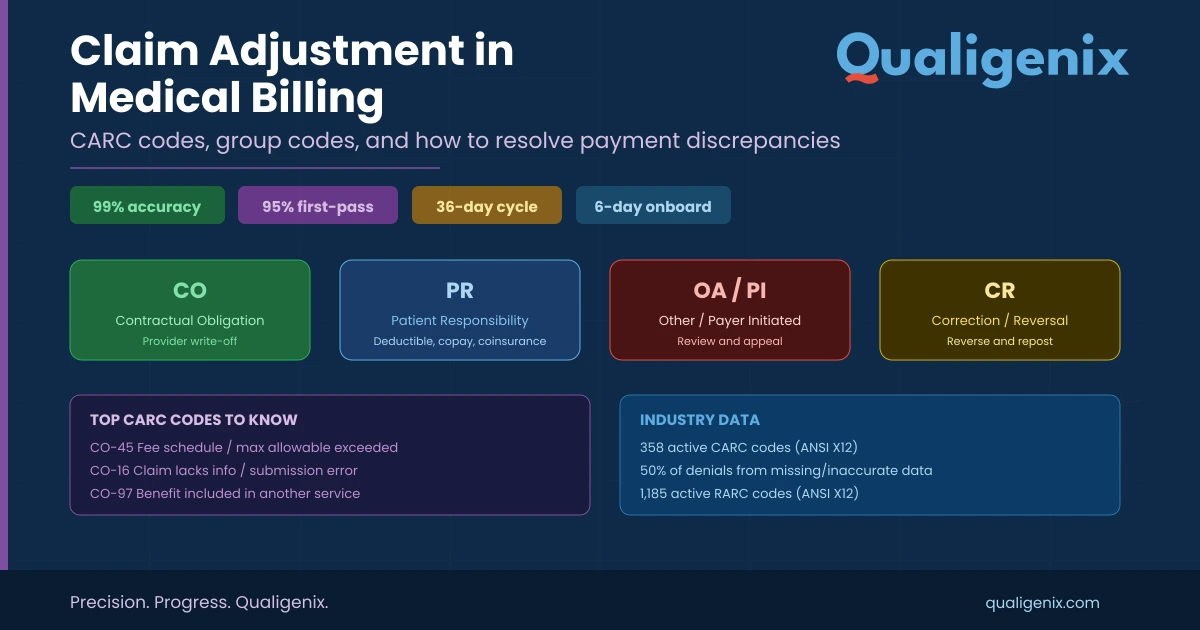
Claim Adjustment in Medical Billing: CARC Codes, Group Codes, and How to Resolve Payment Discrepancies
A claim adjustment occurs when a payer changes the reimbursement amount from what was originally billed. Every adjustment is...
Medical Necessity Documentation Mistakes to Avoid
A claim can look perfect in your billing system, then fall apart the moment a payer asks for records....
Denial Management in Medical Billing: 7 Common Causes
A patient visits your clinic, receives care, and leaves reassured. The service is documented, the claim is submitted, and...